Requirements
This assignment focuses on defining how the final project will be shared, protected, improved and potentially developed after Fab Academy. It also requires tracking the current state of the final project and reflecting on what has been completed, what remains, and what was learned during the development process.
Invention, Intellectual Property and Income
- Create a dissemination plan for the final project
- Define how the project will be shared with others
- Consider intellectual property and licensing options
- Identify future opportunities for development
- Describe how future possibilities can become probabilities
Project Development
- Track the progress of the final project
- Identify completed and remaining tasks
- Document what is working and what needs improvement
- Define questions that still need to be resolved
- Plan future development steps
- Summarize lessons learned during the project
Project Status
At this stage, the GameLab Controller has reached a complete functional prototype state. The main mechanical, electronic, programming and system integration tasks have been completed, while future work focuses on refinement, dissemination, educational use and possible future development.
Educational purpose and final project vision defined.
Controller enclosure and internal layout completed.
Main PCB and secondary PCB designed and fabricated.
ESP32-S3 firmware and interface functions implemented.
Electronics, enclosure and user interface successfully integrated and validated. Battery-powered operation is not yet implemented.
Dissemination strategy, intellectual property approach and future opportunities documented.
Final Project Overview
🚀 Related Final Project
This assignment documents a specific stage of the development of the GameLab Controller. For complete documentation, fabrication files, programming details and final results, visit the Final Project page.
View Final Project DocumentationThe GameLab Controller is a portable embedded systems educational platform designed to simplify the learning process for students and makers. The project integrates the most commonly used inputs, outputs and sensors into a single handheld device, eliminating many of the challenges associated with breadboarding, wiring mistakes and component acquisition.
Built around an ESP32-S3 microcontroller, the platform combines a TFT display, joystick, push buttons, LEDs, motion sensing and expansion ports within a compact battery-powered enclosure. This allows learners to experiment with embedded programming concepts immediately without spending significant time assembling external hardware.
The project was developed as a practical demonstration of how the different disciplines explored during Fab Academy can be integrated into a complete product. Mechanical design, electronics production, embedded programming, additive manufacturing and system integration were combined to create a functional educational device.
Beyond serving as a final project, the GameLab Controller aims to become a reusable learning platform capable of supporting future educational activities, workshops and experimentation in embedded systems.
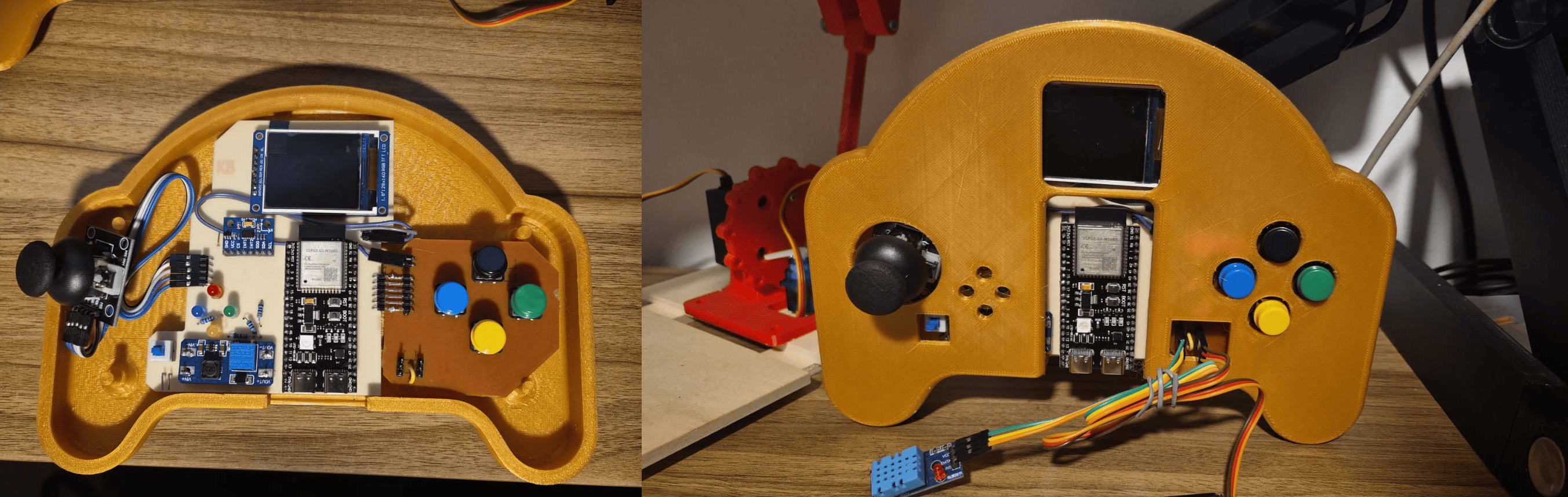
Final integrated GameLab Controller prototype combining embedded programming, electronics, sensing, visualization and hardware expansion capabilities.
Key Features
Embedded Learning Platform
Designed to reduce barriers when learning embedded systems and microcontroller programming.
Integrated Peripherals
TFT display, joystick, buttons, LEDs, IMU sensor and GPIO expansion ports integrated into a single device.
Portable Operation
Battery-powered architecture allows experimentation without requiring a permanent connection to a computer.
Technologies Integrated
CAD Design
Electronics Design
Digital Fabrication
Embedded Programming
Dissemination Plan
The primary objective of the GameLab Controller is to make embedded systems education more accessible to beginners. Therefore, the dissemination strategy focuses on sharing the project openly with students, educators and makers who may benefit from a portable and integrated learning platform.
Rather than limiting access to the project, the intention is to encourage replication, experimentation and educational use. All project documentation, design files and development resources will be publicly available to support learning and community-driven improvement.
Target Audience
High School Students
Students beginning their journey in electronics, robotics and programming.
Technical Education
Learners enrolled in vocational and technical training programs.
University Students
Engineering students taking introductory courses in embedded systems.
Educators & Makers
Teachers and makers interested in replicating and extending the platform.
Dissemination Channels
The project will be shared through multiple channels to maximize its educational impact and accessibility.
Fab Academy Documentation
Complete project documentation hosted on the Fab Academy website, including design decisions, fabrication methods and development process.
Personal Website
The project will be published through a personal educational website where students can access resources and updates.
University Courses
The platform will be used as a teaching tool with engineering students during introductory embedded systems activities.
Workshops and Conferences
Demonstrations and presentations in robotics courses, university events and educational technology conferences.
Open Access Resources
All project resources will be available through the Fab Academy documentation page, which will provide access to a public repository containing downloadable project files.
- Source code and firmware
- EasyEDA project files
- PCB fabrication files
- SolidWorks design files
- STEP and STL models
- Bill of Materials (BOM)
- Documentation and educational resources
Community Development Vision
Beyond sharing the hardware itself, the long-term goal is to encourage the creation of educational content around the platform. Similar to the way Arduino became successful through community participation, the GameLab Controller aims to support collaborative learning experiences.
Educators and students are encouraged to develop laboratory guides, programming challenges, classroom activities and new educational modules that expand the capabilities of the platform.
Success will not be measured only by the number of devices built, but by the creation of a community that actively uses, improves and shares new learning experiences based on the GameLab Controller.
Intellectual Property Strategy
The GameLab Controller was conceived as an educational platform intended to support learning, experimentation and collaboration. For this reason, the intellectual property strategy focuses on openness, accessibility and community-driven development rather than restrictive ownership.
The project will be shared publicly through the Fab Academy documentation platform and associated repositories, allowing students, educators and makers to study, replicate and improve the design. The objective is to maximize educational impact by reducing barriers to access and encouraging knowledge sharing.
Open Educational Philosophy
Inspired by successful educational platforms such as Arduino, the GameLab Controller is intended to serve as an open learning resource. Users are encouraged to build their own versions, adapt the design to their needs and develop new educational activities based on the platform.
Attribution to the original author is expected whenever the project or its derivatives are reused. This ensures recognition of the original work while maintaining an environment of collaboration and continuous improvement.
Resources Available to the Community
Software
Firmware, source code and programming examples will be openly available for study and modification.
Hardware
Schematics, PCB files and fabrication resources will be provided to allow complete replication of the platform.
Documentation
Design files, assembly instructions and educational materials will be publicly accessible.
Collaborative Development
Future improvements developed by students, educators or makers are strongly encouraged. New PCB revisions, enclosure modifications, educational exercises and expansion modules can contribute to the growth of the platform and increase its usefulness in different learning environments.
By sharing improvements back with the community, contributors can help create a continuously evolving ecosystem of educational resources around the GameLab Controller.
Licensing Approach
The project follows an open-source and open-hardware philosophy. Software, hardware designs and documentation are intended to be shared under licenses that allow reuse, modification and redistribution while preserving attribution to the original author.
This strategy aligns with the educational goals of the project and supports the creation of a broader community of learners, educators and makers who can benefit from and contribute to the continued development of the platform.
Future Opportunities
While the current version of the GameLab Controller successfully achieves its educational objectives, the project has the potential to evolve beyond a single prototype and become part of a broader educational ecosystem. Future development will focus not only on technical improvements, but also on expanding its impact within schools, universities, Fab Labs and maker communities.
The long-term vision is to transform the GameLab Controller into a platform that promotes hands-on learning, digital fabrication and embedded systems education through collaborative projects and community participation.
Educational Deployment
One of the most promising opportunities is the introduction of the platform into educational environments. The GameLab Controller was specifically designed for students in the early stages of learning electronics, programming and robotics, making it suitable for high schools, technical education programs and introductory engineering courses.
Future collaborations could involve educational institutions interested in implementing project-based learning activities where students build, program and modify their own controllers while learning embedded systems concepts.
Collaboration with Fab Labs and Universities
Colombia already has an active network of digital fabrication laboratories, innovation centers and university makerspaces that could serve as replication hubs for the project. These spaces provide access to digital fabrication equipment, technical expertise and communities interested in technology and education.
Potential collaborations with universities, Fab Labs and innovation centers could enable local manufacturing of the GameLab Controller, allowing students to experience the complete engineering process, from CAD design and PCB fabrication to assembly and programming.
Community Development
Beyond the hardware itself, the most valuable future opportunity is the creation of a learning community around the platform. Similar to the way Arduino grew through user contributions, educational examples and shared projects, the GameLab Controller can evolve through collective participation.
Students, educators and makers could contribute laboratory guides, programming challenges, robotics exercises, classroom activities and new hardware expansion modules. This collaborative approach would continuously increase the educational value of the platform.
Turning Possibilities into Probabilities
To transform these opportunities into realistic outcomes, several actions are planned:
- Publish complete documentation and fabrication files.
- Create downloadable educational resources and laboratory activities.
- Use the platform in introductory robotics and embedded systems courses.
- Present the project in academic events and university conferences.
- Promote collaboration with Fab Labs and digital fabrication communities.
- Encourage students to develop and share new applications.
- Build a repository of educational examples and programming challenges.
Success will be achieved when the GameLab Controller evolves from a final project into a reusable educational platform adopted by students, educators and makers who continue expanding its capabilities and sharing new learning experiences with the community.
Development Progress
The GameLab Controller has successfully progressed from an initial concept into a fully functional educational platform. The core objectives of the project have been achieved, including the design, fabrication, programming and integration of all major subsystems. At the time of this documentation, the project operates as a complete prototype and serves as a demonstration of the skills acquired throughout Fab Academy.
While the first version is complete, the project remains open to future educational, technical and community-driven improvements. The following sections summarize the current state of development and the next steps envisioned for the platform.
Completed Tasks
Ongoing Activities
Development of educational activities and practical exercises.
Creation of beginner-friendly embedded programming challenges.
Future Development
Redesign the electronics into a single PCB using smaller components and eliminating dependence on commercial modules.
Expand interaction capabilities through touch buttons and additional user feedback mechanisms.
Develop the second phase of the project by integrating the controller with a robotic vehicle, as originally envisioned.
Integration into robotics and embedded systems courses.
Sharing the project with educators, students and makers.
Development Outlook
Although the GameLab Controller has reached its primary objectives, its greatest potential lies in future educational adoption and continued improvement. The current version establishes a solid foundation that can evolve into a broader learning ecosystem, incorporating new hardware revisions, educational content and robotics applications.
What's Working and What's Not
The GameLab Controller successfully achieved most of its functional and educational objectives. Mechanical integration, electronics fabrication and embedded programming were completed, resulting in a fully operational prototype capable of demonstrating multiple embedded systems concepts.
However, as with most engineering projects, some aspects performed better than others and several opportunities for improvement were identified during development and testing.
What's Working
The enclosure successfully accommodates all electronic components and provides a comfortable handheld form factor.
The microcontroller operates reliably and integrates all system peripherals.
Graphics, menus and visual feedback are displayed correctly.
Buttons, joystick and IMU sensor operate correctly and provide reliable interaction.
External devices can be connected, allowing future educational activities and hardware extensions.
The dual-PCB architecture, wiring and enclosure assembly work together as a complete system.
What Needs Improvement
During final testing, a short-circuit issue was identified between the battery power section and the ESP32-S3 system. As a result, the battery-powered operation was not fully validated and requires further investigation in a future hardware revision.
The current design relies on multiple modules and two separate PCBs. A future revision could integrate all electronics into a more compact single-board solution.
Several functions currently depend on commercial modules. Future versions should replace these modules with fully custom hardware.
Additional interaction methods such as capacitive touch controls and programmable educational modules could further enhance the platform.
Current Assessment
Despite the battery integration issue, the GameLab Controller successfully demonstrates the core objectives of the project: integrating electronics, embedded programming, sensing, visualization and educational interaction into a single platform. The identified improvements provide a clear roadmap for future development and refinement.
Open Questions
Although the GameLab Controller successfully demonstrates its core functionality, the development process revealed several questions that remain open for future investigation. Addressing these questions will help improve the platform, increase its educational value and guide future hardware revisions.
Battery Integration
What is the root cause of the short-circuit condition observed during battery integration, and how can the power architecture be redesigned to achieve reliable portable operation?
Single PCB Architecture
Can all system electronics be consolidated into a single compact PCB while maintaining ease of fabrication and assembly?
Custom Electronics
How many commercial modules can be replaced by custom-designed circuits in future revisions of the platform?
Advanced User Interface
Would touch controls, additional sensors or new interaction methods improve the educational experience without increasing complexity?
Educational Validation
How effective is the platform in reducing learning barriers when used by students with little or no prior experience in embedded systems?
Second Project Phase
How should the planned robotic vehicle be designed to complement the controller and create a complete educational robotics ecosystem?
Why These Questions Matter
These questions represent opportunities rather than limitations. The current version of the GameLab Controller already fulfills its primary objectives, but answering these questions would allow the platform to evolve into a more robust, scalable and educationally valuable system.
Future development efforts will focus on investigating these topics and transforming the lessons learned from the first prototype into improvements for future versions.
Roadmap
The first version of the GameLab Controller successfully demonstrates the feasibility of a portable embedded systems educational platform. However, the project was always envisioned as the first step toward a larger educational ecosystem. Future development will focus on improving the hardware, expanding educational content and creating complementary learning tools.
Short-Term Goals
Educational Content
Develop laboratory guides, programming exercises and classroom activities specifically designed for beginner students.
Classroom Validation
Introduce the platform into robotics and embedded systems courses and gather feedback from students and instructors.
Community Building
Share the project through workshops, university events and maker communities.
Medium-Term Goals
Hardware Revision
Consolidate the electronics into a single PCB using smaller components and fully custom circuit designs.
Improved User Interface
Explore touch controls, additional sensors and new interaction mechanisms to enhance the educational experience.
Long-Term Vision
The original concept behind the GameLab Controller included a second phase involving a mobile robotic platform. In this vision, the controller becomes the central interface for programming, controlling and interacting with a robotic vehicle, creating a complete educational robotics ecosystem.
Combined with classroom activities, community participation and digital fabrication workshops, this ecosystem could support a progressive learning pathway from basic programming concepts to robotics, sensing and autonomous systems.
Ultimately, the goal is to establish the GameLab Controller as an open, accessible and continuously evolving educational platform capable of supporting future generations of students interested in engineering, robotics and embedded systems.
Lessons Learned
The development of the GameLab Controller provided valuable lessons that extend beyond electronics or programming. The project demonstrated the importance of systems thinking and the need to consider mechanical, electrical and software design as interconnected parts of a single product.
Planning Matters
Investing time in defining requirements, architecture and component placement significantly reduced integration problems later in the project.
Mechanical and Electronics Design Are Connected
PCB dimensions, battery placement and enclosure geometry influenced each other continuously throughout development.
Iteration Is Essential
Several design decisions evolved during fabrication and testing. Building prototypes and validating assumptions proved critical to the final outcome.
Integration Is the Greatest Challenge
Individual subsystems can function correctly on their own, but integrating power, electronics, firmware and mechanics into a single product requires careful validation.
Personal Reflection
One of the most important lessons learned during Fab Academy was that successful projects are not built by mastering a single skill, but by combining multiple disciplines into a coherent system. The GameLab Controller required CAD design, PCB development, digital fabrication, embedded programming and documentation to work together toward a common goal.
The project also reinforced the educational value of making. Designing, fabricating, assembling and debugging a complete system provided a deeper understanding of engineering principles than could be obtained through theory alone.
Beyond the technical achievements, the most meaningful outcome is the possibility that the GameLab Controller may help future students discover electronics, programming and robotics through a more accessible and engaging learning experience.