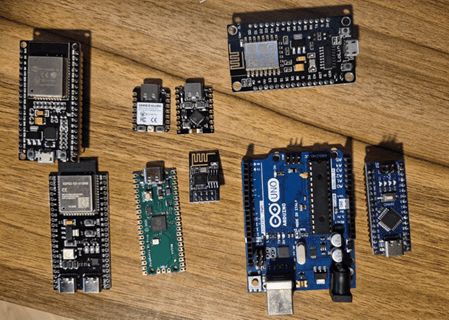
For this group assignment, we analyzed and compared multiple embedded platforms available in our lab. The objective was to understand how architecture influences toolchain selection, programming workflow, system capability, and overall development complexity.
Platforms Evaluated
- Arduino UNO and Nano (ATmega328P – AVR)
- ESP8266 (ESP-01 and ESP-MOD)
- ESP32 family (WROOM, S3, C3 Mini)
- Seeed Studio XIAO ESP32-C3
- Raspberry Pi Pico V1 (RP2040)
Comparison Criteria
- Architecture
- Processing capability
- Toolchain
- Upload method
- Peripheral support
- Connectivity
- Ecosystem maturity
- Development complexity
1. Architectural Comparison
| Platform | CPU Architecture | Core Type | Bit Width |
|---|---|---|---|
| Arduino UNO/Nano | AVR | Single-core | 8-bit |
| ESP8266 | Xtensa LX106 | Single-core | 32-bit |
| ESP32 WROOM | Xtensa LX6 | Dual-core | 32-bit |
| ESP32-S3 | Xtensa LX7 | Dual-core | 32-bit |
| ESP32-C3 / XIAO C3 | RISC-V | Single-core | 32-bit |
| Raspberry Pi Pico | ARM Cortex-M0+ | Dual-core | 32-bit |
The shift from AVR to Xtensa, and now to RISC-V, reflects the evolution of embedded systems toward higher performance and modern instruction sets.
2. Processing Capability
| Platform | Clock Speed | Processing Level |
|---|---|---|
| Arduino UNO | 16 MHz | 🟢 Basic |
| ESP8266 | 80–160 MHz | 🟡 Medium |
| ESP32 WROOM | Up to 240 MHz | 🔵 High |
| ESP32-S3 | Up to 240 MHz + AI | 🔵 High |
| ESP32-C3 | Up to 160 MHz | 🟡–🔵 Medium-High |
| RP2040 | 133 MHz (dual-core) | 🟡–🔵 Medium-High |
3. Toolchain Comparison
| Platform | Toolchain |
|---|---|
| Arduino AVR | avr-gcc |
| ESP8266 | xtensa-lx106-elf-gcc |
| ESP32 (WROOM/S3) | xtensa-esp32-elf-gcc |
| ESP32-C3 | riscv32-esp-elf-gcc |
| RP2040 | arm-none-eabi-gcc |
4. Upload Methods and Workflow
| Platform | Upload Method | Ease |
|---|---|---|
| Arduino UNO | USB Serial Bootloader | ✔️ Very Simple |
| ESP8266 | UART + Boot Mode Pins | ⚠️ Moderate |
| ESP32 WROOM | UART / USB Flash | ✔️ Moderate |
| ESP32-S3 | Native USB / UART | ✔️✔️ Improved |
| ESP32-C3 / XIAO | Native USB | ✔️✔️ Simple |
| RP2040 | UF2 Drag & Drop | ✔️✔️ Easiest |
5. Peripheral and Connectivity Capabilities
| Platform | ADC | DAC | SPI/I2C | WiFi | Bluetooth | USB Native |
|---|---|---|---|---|---|---|
| Arduino UNO | 10-bit | ❌ | ✔️ | ❌ | ❌ | ❌ |
| ESP8266 | 10-bit | ❌ | ✔️ | ✔️ | ❌ | ❌ |
| ESP32 WROOM | 12-bit | ✔️ | ✔️ | ✔️ | ✔️ | ❌ |
| ESP32-S3 | 12-bit | ✔️ | ✔️ | ✔️ | ✔️ | ✔️ |
| ESP32-C3 | 12-bit | ❌ | ✔️ | ✔️ | BLE | ✔️ |
| RP2040 | 12-bit | ❌ | ✔️ + PIO | ❌ | ❌ | ✔️ |
6. Ecosystem and Support Level
| Platform | Community Support | Documentation | Ecosystem |
|---|---|---|---|
| Arduino | ✔️✔️ Very High | Mature | Stable |
| ESP8266 | ✔️ High | Strong | Legacy but Active |
| ESP32 | ✔️✔️ Very High | Excellent | Rapidly Growing |
| RP2040 | ✔️ High | Excellent | Modern and Expanding |
ESP32 currently has one of the strongest ecosystems due to widespread IoT adoption, strong manufacturer support from Espressif, and extensive integration with Arduino Core, ESP-IDF, MicroPython, and FreeRTOS.
7. Complexity vs Capability
| Platform | Capability | Development Complexity |
|---|---|---|
| Arduino | 🟢 Basic | 🟢 Low |
| ESP8266 | 🟡 Medium | 🟡 Moderate |
| ESP32 | 🔵 High | 🔴 Higher |
| RP2040 | 🟡–🔵 Medium-High | 🟡 Moderate |
There is a direct relationship between system capability and configuration complexity. As processing power, peripheral richness, and connectivity increase, the required understanding of toolchains, flashing procedures, and system architecture also increases.
Conclusions
After comparing the different embedded platforms, it became evident that the evolution of microcontroller architecture has significantly expanded the capabilities of modern systems.
Although Arduino (ATmega328P – AVR) remains an excellent educational platform due to its simplicity and accessibility, as an embedded platform it is now technically limited. Its 8-bit architecture, low clock speed (16 MHz), limited RAM, absence of native wireless connectivity, and reduced peripheral capacity place it far behind modern 32-bit microcontrollers. For current applications involving IoT, multitasking, higher processing loads, or real-time communication, Arduino AVR boards no longer represent a competitive solution.
The Raspberry Pi Pico (RP2040) demonstrated strong performance thanks to its dual-core ARM Cortex-M0+ architecture and clean development workflow (UF2 drag-and-drop). It offers efficient processing and a well-designed SDK. However, the absence of native WiFi and Bluetooth in the first-generation Pico limits its versatility compared to the ESP32 ecosystem.
Among all evaluated platforms, the ESP32 family stands out as the most complete solution in terms of hardware capability. Integrated WiFi and Bluetooth, 12-bit ADC resolution, rich peripheral availability (SPI, I2C, UART, DAC, PWM), and higher clock frequencies make ESP32 boards highly adaptable to complex embedded and IoT applications.
Within the ESP32 ecosystem, different variants serve different design goals. The ESP32-S3 is particularly suitable for projects requiring multiple inputs and outputs, USB functionality, and higher computational performance. Its expanded peripheral set and AI acceleration features make it ideal for more demanding systems.
On the other hand, the Seeed Studio XIAO ESP32-C3 provides an optimal solution when compactness and space efficiency are priorities. Despite its reduced physical footprint, it maintains full 32-bit RISC-V processing, WiFi capability, BLE support, and native USB programming. For small-scale embedded devices where board size is critical, the XIAO ESP32-C3 represents the best balance between performance and form factor among the compared platforms.
In conclusion, architecture directly impacts capability, and capability impacts system design possibilities. While Arduino remains valuable for learning fundamentals, modern embedded applications increasingly demand the performance, connectivity, and flexibility offered by ESP32-class microcontrollers.