Group Assignment
- Review the Safety Data Sheets (SDS) for each molding and casting material used during the assignment.
- Produce and compare test casts using different molding and casting materials.
- Compare molds produced through additive manufacturing (3D printing) and subtractive manufacturing (CNC milling).
Learning Outcomes
- Understand the safe handling procedures required when working with molding and casting materials.
- Evaluate the behavior and performance of different mold and casting compounds.
- Compare manufacturing workflows based on printed and milled molds, including surface quality, fabrication time, and dimensional accuracy.
- Document material properties, fabrication parameters, and resulting cast quality.
Progress Status – Group Assignment
Material characterization, safety evaluation, test casting, and mold manufacturing comparison.
Analysis of material safety information, hazards, personal protective equipment (PPE), handling recommendations, and disposal procedures.
Experimental casting samples produced using different materials to evaluate curing behavior, detail reproduction, and surface finish quality.
Comparative evaluation between molds produced through 3D printing and CNC milling, focusing on fabrication workflow, dimensional accuracy, and final casting quality.
Section 1 – Materials and Safety Data Sheet Review
Before starting any molding and casting process, it is essential to review the Safety Data Sheets (SDS) provided by the manufacturers. These documents contain important information regarding material composition, handling procedures, storage conditions, personal protective equipment (PPE), and emergency measures.
During this assignment, two different material systems were analyzed: a platinum-cure silicone rubber used for mold making, and an acrylic gypsum system used for the final cast pieces. Understanding the properties and safety requirements of each material was fundamental to ensure safe laboratory practices and reliable fabrication results.
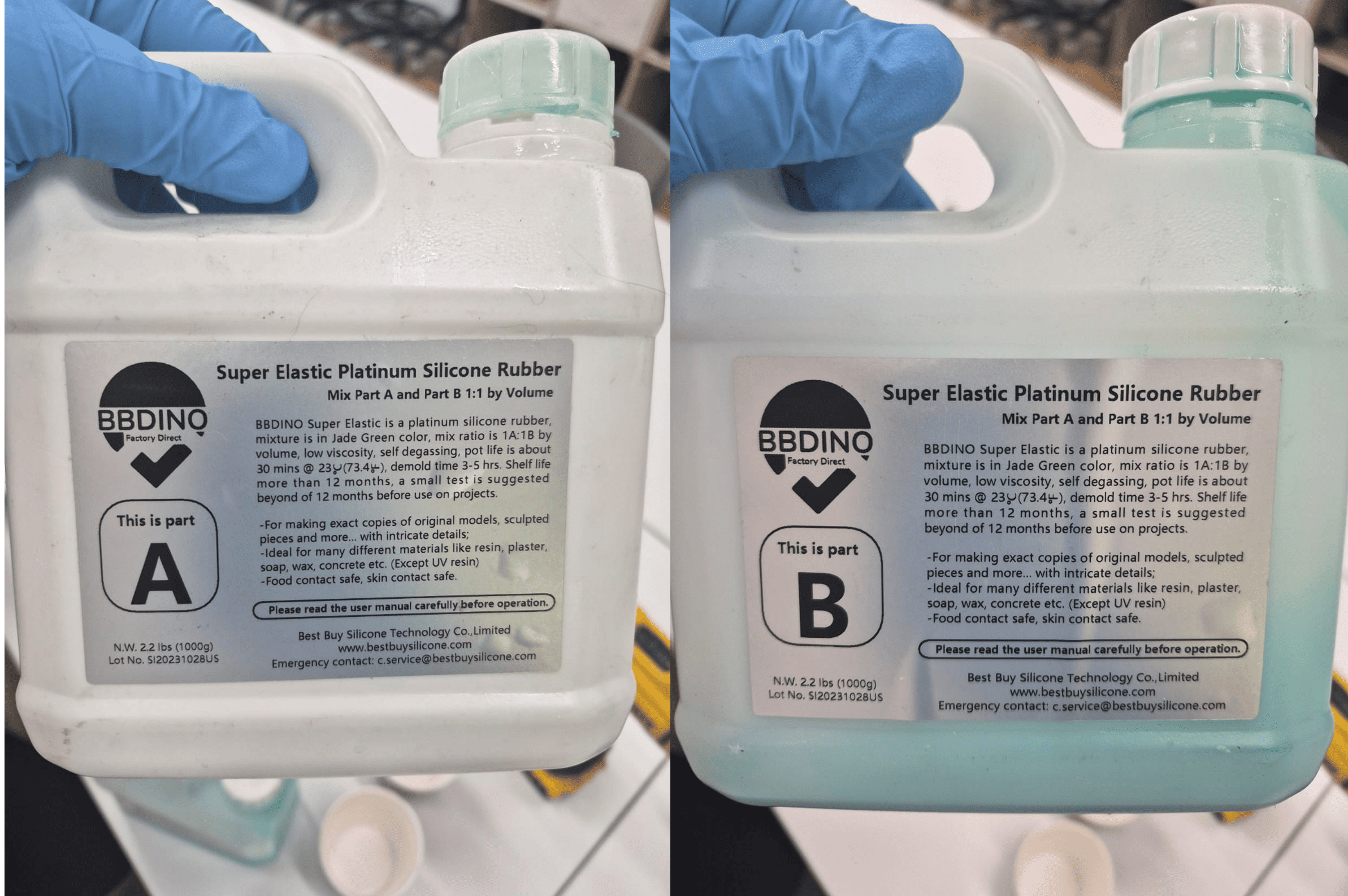
BBDINO Super Elastic Platinum Rubber, Part A and Part B silicone components used for mold fabrication.
Silicone Mold Material
The molds were fabricated using Super Elastic Platinum Rubber manufactured by BBDINO. This material is a two-part platinum-cure silicone system consisting of Part A and Part B, which are mixed in equal proportions to initiate the curing process.
Platinum-cure silicones are widely used in mold making because they provide excellent dimensional stability, low shrinkage, high tear resistance, and the ability to reproduce fine surface details. Their flexibility also facilitates demolding without damaging delicate geometries.
According to the SDS documentation, the material presents relatively low toxicity compared to other industrial molding compounds. However, the use of nitrile gloves, adequate ventilation, and avoidance of direct skin or eye contact are recommended during handling and mixing operations.
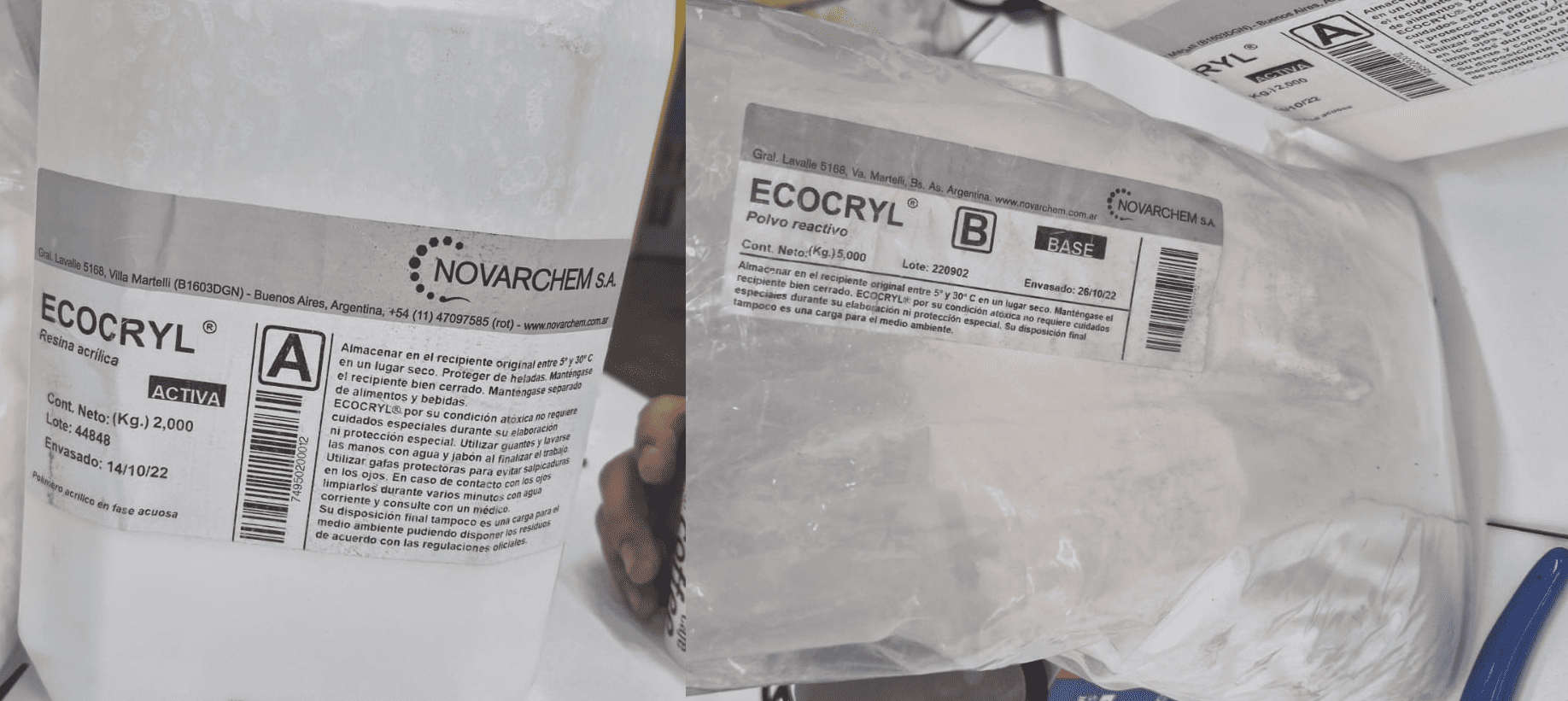
ECOCRYL casting system composed of acrylic resin (Part A) and reactive powder (Part B).
Casting Material
The final cast parts were produced using the ECOCRYL system manufactured by Novarchem S.A.. This material consists of two components: an acrylic resin (Part A) and a reactive mineral powder (Part B), which are combined in a specific ratio to produce a high-strength casting compound.
Once mixed, the material undergoes a chemical reaction that transforms the liquid-powder mixture into a rigid solid structure. The resulting parts exhibit good surface quality, dimensional stability, and mechanical strength, making the material suitable for decorative and functional cast objects.
The SDS documentation highlights the importance of avoiding inhalation of fine powder particles during handling. For this reason, respiratory protection, proper ventilation, and careful cleaning procedures were implemented throughout the casting process.
Material Comparison
| Material | Application | Components | Main Properties |
|---|---|---|---|
| BBDINO Platinum Silicone | Mold Making | Part A + Part B | Flexible, low shrinkage, high detail reproduction, easy demolding |
| ECOCRYL | Casting | Resin A + Powder B | Rigid structure, smooth finish, dimensional stability, high surface quality |
Technical Documentation & Safety Data Sheets
Before using each material, the manufacturer's technical documentation and safety recommendations were reviewed. These resources provide information regarding material properties, mixing ratios, curing behavior, storage conditions, personal protective equipment requirements, and disposal procedures.
🧪 BBDINO Super Elastic Platinum Rubber
Manufacturer information, technical specifications, curing characteristics, and safety recommendations for the platinum-cure silicone system used for mold fabrication.
View Manufacturer Website →🏺 ECOCRYL A/B Technical Sheet
Technical documentation describing mixing ratios, curing times, mechanical properties, and safety recommendations for the ECOCRYL casting system.
Download Technical Sheet →Section 2 – Test Cast Comparison
The objective of this experiment was to evaluate the behavior of the molding and casting materials used throughout the week. Small-scale test casts were produced to analyze dimensional accuracy, detail reproduction, curing characteristics, surface quality, and ease of demolding.
The molding stage was performed using BBDINO Super Elastic Platinum Rubber, while the final cast pieces were produced using the ECOCRYL acrylic gypsum system. Together, these materials form a complete mold-making and casting workflow commonly used for artistic reproduction, prototyping, and low-volume manufacturing.
Mold Performance Evaluation
The platinum-cure silicone demonstrated excellent flexibility and dimensional stability. After curing, the molds preserved fine geometric details from the original resin-printed masters, including surface textures and small features.
The elasticity of the silicone significantly simplified the demolding process, reducing the risk of damaging either the mold or the casted component. No visible shrinkage or deformation was observed during the evaluation period.
Casting Material Evaluation
The ECOCRYL casting compound exhibited good flowability before curing, allowing the mixture to fill complex cavities inside the silicone mold. The addition of a small quantity of isopropyl alcohol helped improve homogeneity and reduced the presence of unmixed powder particles.
Once cured, the resulting parts showed a rigid structure, smooth surface finish, and accurate reproduction of the original geometry. Small air bubbles were observed in isolated areas, highlighting the importance of controlled pouring and vibration techniques when casting intricate parts.
Material Comparison
| Property | BBDINO Silicone | ECOCRYL Cast |
|---|---|---|
| Purpose | Mold Production | Part Fabrication |
| Flexibility | Very High | Very Low |
| Surface Detail | Excellent | Excellent |
| Dimensional Stability | High | High |
| Demolding Performance | Excellent | Good |
| Final Appearance | Flexible Mold | Rigid Cast Piece |
Conclusions from the Test Casts
The combination of platinum-cure silicone and acrylic gypsum proved highly effective for reproducing detailed geometries. The silicone molds successfully captured the fine features of the original masters, while the ECOCRYL casting material produced durable and visually clean replicas.
The experiment demonstrated how material selection directly affects mold longevity, surface quality, and the overall success of the casting process. Proper mixing ratios, air bubble control, and curing times were identified as the most critical variables influencing final part quality.
Section 3 – Comparing Printed and Milled Molds
Modern digital fabrication provides multiple methods for producing molds used in casting processes. Two of the most common approaches are additive manufacturing through 3D printing and subtractive manufacturing through CNC milling.
Although both techniques can produce functional molds, they differ significantly in terms of fabrication workflow, design limitations, achievable surface finish, manufacturing time, and overall production cost. Understanding these differences is important when selecting the most appropriate process for a specific application.
3D Printed Molds
Additive manufacturing creates objects by depositing material layer by layer from a digital model. This approach offers a high degree of design freedom, allowing complex geometries, internal cavities, and intricate details to be fabricated with relatively little design restriction.
Another important advantage of 3D printing is the low preparation time required. Once the model is designed, it can be processed in a slicer and sent directly to the printer without extensive CAM programming. This makes the process particularly attractive for rapid prototyping and low-volume production.
The main limitation of 3D printed molds is the layer-based manufacturing process. Depending on the printing technology and resolution, visible layer lines may appear on the mold surface, potentially transferring to the final cast part. Additional sanding or post-processing may therefore be required when a smooth finish is desired.
CNC Milled Molds
CNC milling is a subtractive manufacturing process in which material is removed from a solid block using rotating cutting tools. This method is widely used for producing molds with excellent dimensional accuracy and high-quality surface finishes.
Because the surface is generated by precision cutting tools, milled molds often require less post-processing than printed molds. For this reason, CNC machining is frequently preferred when manufacturing production molds or components requiring tight tolerances.
However, CNC machining introduces geometric limitations related to tool diameter, cutting depth, and machine accessibility. Internal corners cannot be perfectly sharp, and complex undercuts may be impossible to machine without specialized tooling or multi-axis equipment.
Comparative Analysis
| Criteria | 3D Printing | CNC Milling |
|---|---|---|
| Manufacturing Method | Additive | Subtractive |
| Geometric Complexity | Excellent | Limited by tooling |
| Surface Finish | Moderate | Excellent |
| Dimensional Accuracy | Good | Very High |
| CAM Preparation | Simple | More Complex |
| Material Waste | Low | Higher |
| Prototype Production | Excellent | Good |
| Production Molds | Good | Excellent |
Conclusions
Both technologies offer valuable solutions for mold fabrication. 3D printing provides rapid iteration, low setup requirements, and exceptional geometric freedom, making it particularly suitable for prototyping and experimental development.
CNC milling, on the other hand, excels in applications where dimensional accuracy, repeatability, and surface quality are critical. Although it generally requires more preparation and machining time, it remains one of the preferred methods for producing professional-grade molds.
The selection between both methods ultimately depends on the specific requirements of the project, including geometry, budget, production volume, and desired surface finish.
Final Reflection
This group assignment provided a valuable opportunity to better understand the complete molding and casting workflow from both a practical and theoretical perspective. Beyond producing molds and cast parts, the activity emphasized the importance of material selection, process planning, and safety considerations when working with chemical compounds.
Reviewing the Safety Data Sheets (SDS) highlighted the importance of understanding the properties, risks, and handling requirements of each material before use. Although many molding and casting products are designed to be user-friendly, proper personal protective equipment, adequate ventilation, and correct storage procedures remain essential for maintaining a safe working environment.
The comparison between the platinum-cure silicone and the acrylic gypsum casting system demonstrated how different materials contribute to different stages of the manufacturing process. The silicone provided flexibility, durability, and excellent detail reproduction for mold making, while the casting material offered rigidity, dimensional stability, and a high-quality final appearance.
Another important outcome of this assignment was the analysis of additive and subtractive approaches for mold fabrication. Comparing 3D printed molds and CNC milled molds helped illustrate how manufacturing constraints, surface quality, geometric complexity, and production requirements influence process selection. Neither method can be considered universally superior; instead, each presents advantages that make it more suitable for specific applications.
As a group, we concluded that successful molding and casting projects depend not only on the quality of the materials used, but also on understanding the relationship between design, manufacturing method, material behavior, and post-processing requirements. Small variations in mixing ratios, curing conditions, or mold design can significantly affect the quality of the final result.
Overall, this assignment reinforced fundamental concepts of digital fabrication by connecting design workflows, material science, manufacturing processes, and safety practices. The knowledge gained during this week provides a solid foundation for future projects involving mold fabrication, casting techniques, and low-volume manufacturing applications.