Mid Term Review Requirements
- Present a clear description of the final project.
- Include a system diagram showing how components interact.
- Show progress in weekly assignments and documentation.
- Define remaining tasks to complete the project.
- Create a schedule for project development.
- Review the project with local and global instructors.
Learning Outcomes
- Communicate a clear final project proposal.
- Assess progress across assignments.
- Plan and manage project development.
- Identify next steps for project completion.
Final Project – GameLab Controller
My final project, GameLab Controller, is an interactive embedded system designed as a game-based learning platform. The system consists of two main subsystems: a handheld controller and a robotic car connected through wireless communication.
The controller captures user input such as joystick movement, button interaction, and motion data, while the robotic platform translates these signals into physical actions such as movement and environmental interaction.
The goal of this project is to create an intuitive system where users can learn embedded systems through real-time interaction, combining electronics, programming, and mechanical design.
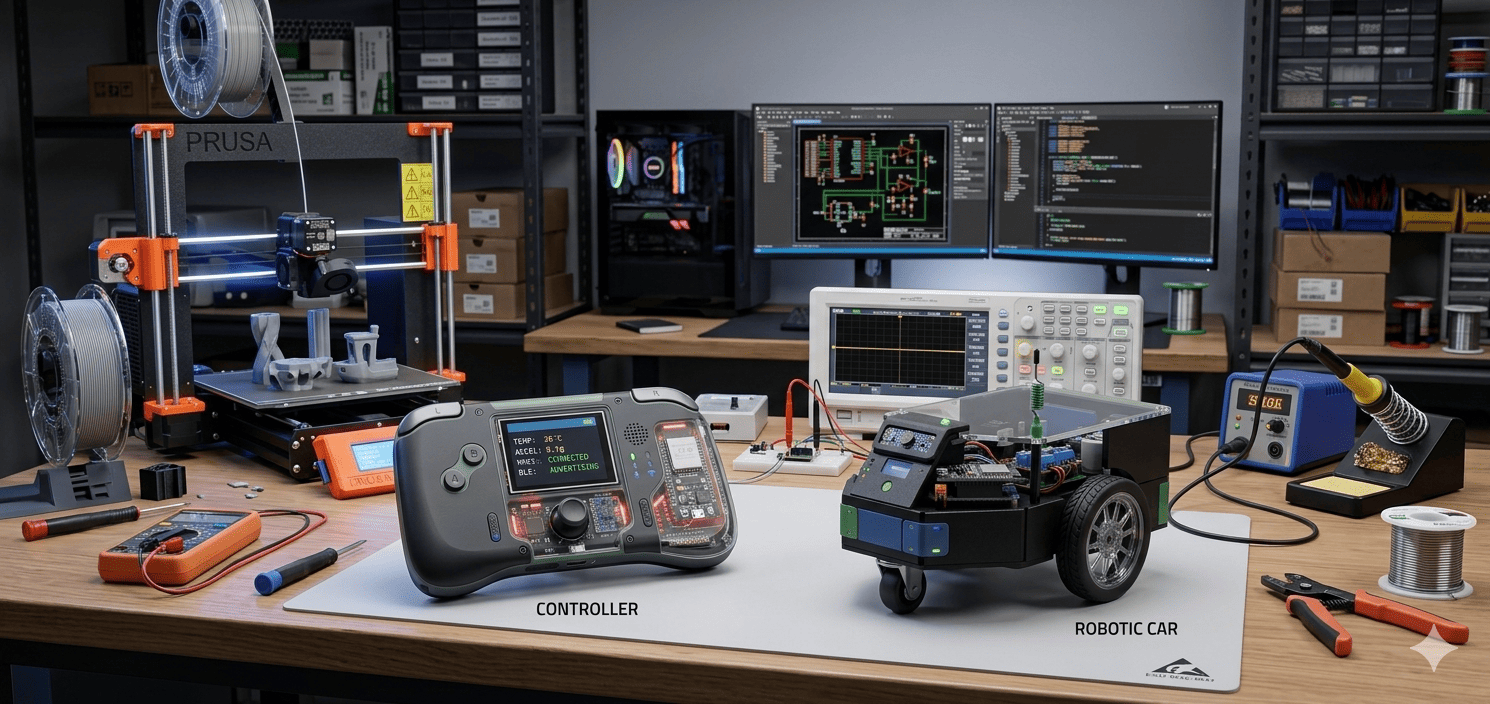
General concept of the GameLab Controller system.
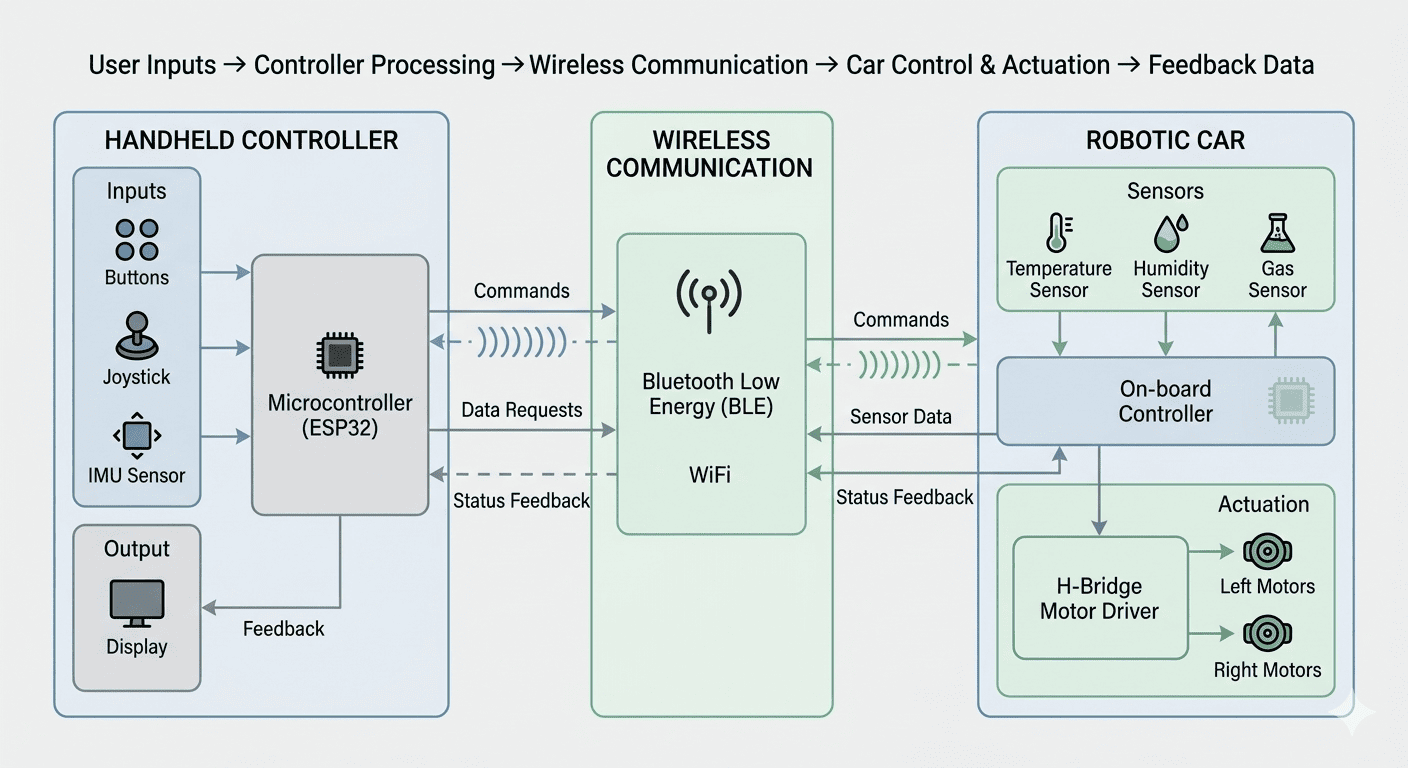
System architecture and data flow.
System Architecture
The system follows a structured interaction flow:
- User input captured through the controller
- Signal processing in the microcontroller
- Wireless communication (BLE/WiFi)
- Execution of actions in the robotic platform
- Sensor feedback returned to the controller
This bidirectional interaction creates a cyber-physical system that allows real-time control, monitoring, and learning through direct interaction.
Remaining Tasks
- Finalize PCB design for controller and robotic system
- Manufacture and assemble electronic components
- Develop communication system (BLE/WiFi)
- Integrate sensors and actuators
- Implement control logic and user interface
- Perform system integration and testing
- Debug and optimize system performance
- Complete documentation and final presentation
Project Planning
The development of the final project is structured over the remaining weeks of the Fab Academy, focusing on a progressive workflow that integrates design, fabrication, programming, and system integration.
The planning strategy prioritizes early definition of the system architecture, followed by fabrication and iterative testing, ensuring that sufficient time is allocated for debugging and refinement before final delivery.
Development Phases
- Week 14: Final system architecture and detailed design
- Week 15: PCB design and mechanical design
- Week 16: Fabrication (PCB production and 3D printing)
- Week 17: Programming (controller and robotic system)
- Week 18: System integration and testing
- Week 19: Debugging, optimization, and final adjustments
- Final Week: Documentation, video, and presentation
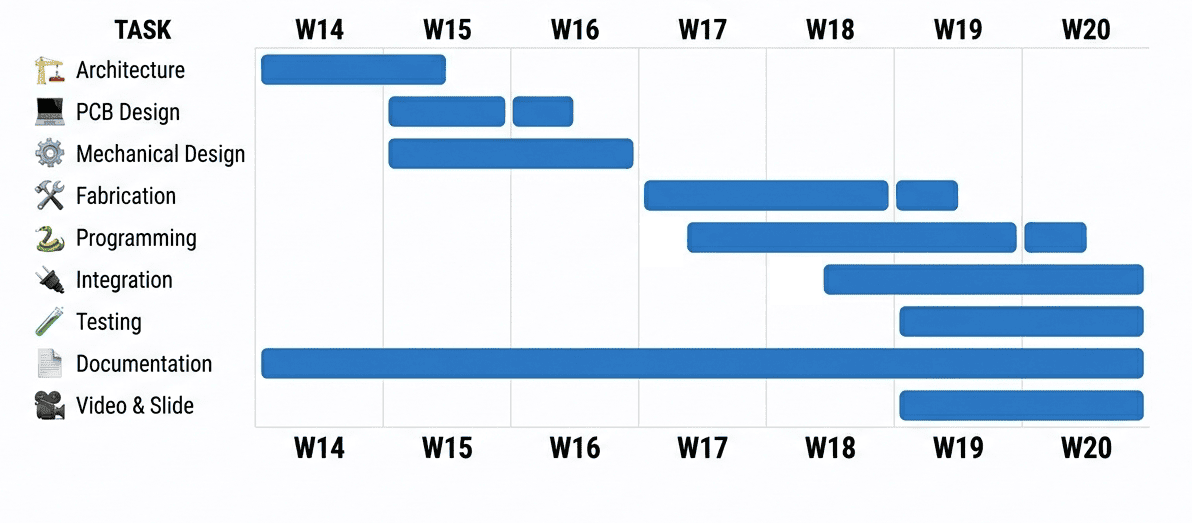
Project timeline showing development phases from design to final delivery.
Development Strategy
The project follows an incremental development approach, starting from a Minimum Viable Product (MVP) and progressively adding functionality. This ensures that the system remains operational throughout the process while allowing iterative improvements.
A dedicated debugging phase is included to address integration issues, ensuring system stability and reliability before final submission.
Weekly Progress Overview
This section summarizes my progress across the Fab Academy assignments. Each card shows completion level and links directly to the corresponding documentation.
Pending Tasks Schedule
⚠ Focus: Completing pending assignments before final integration
In addition to the final project development, the following schedule defines how I will complete pending tasks from previous weeks. Starting from April 20th, 2026, I will focus on completing one major task per week to ensure all assignments are fully documented and aligned with Fab Academy requirements.
| Week | Task | Description |
|---|---|---|
| April 20 – 26 | Complete Week 08 & 09 | Finalize missing documentation, improve explanations, and ensure all requirements are covered. |
| April 27 – May 3 | Finish Group Assignment (Week 10–11) | Document group work, include results, and complete missing sections. |
| May 4 – May 10 | Add Media Content | Include photos, videos, and improve visual documentation across assignments. |
| May 11 – May 17 | Document Week 12 Group Assignment | Complete full documentation of processes, results, and reflections. |
This schedule ensures that all previous work is properly completed before focusing fully on final project integration and delivery.
Evaluation and Instructor Meetings
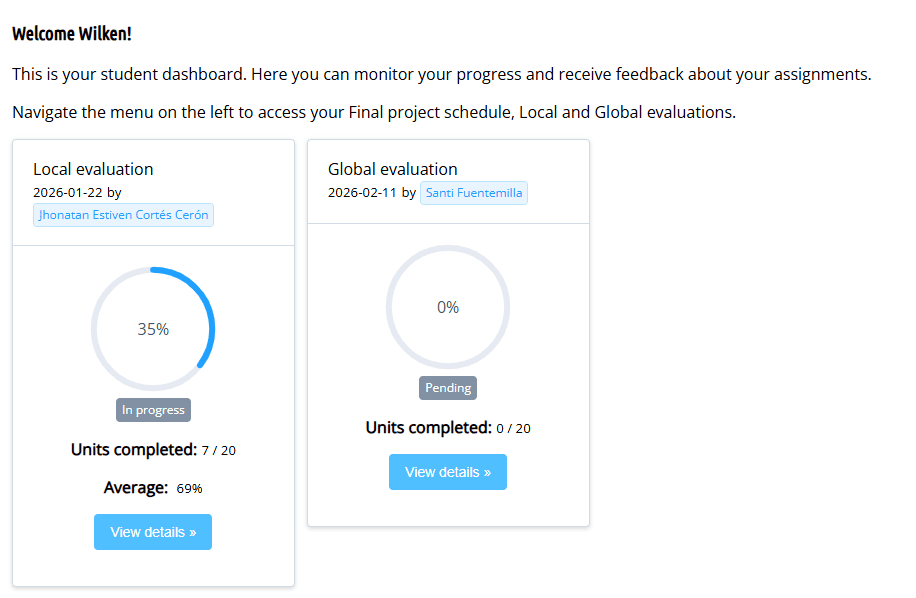
Current evaluation progress and assigned instructors in the Fab Academy platform.
Throughout the Fab Academy process, I have held multiple review sessions with my local instructor, Jhonatan Estiven Cortés Cerón. These meetings have been essential to refine and improve the quality of my weekly documentation, allowing me to correct mistakes, clarify concepts, and strengthen the technical explanations of each assignment.
Thanks to the progress achieved during the first half of the program, on April 18th, 2026, I was officially assigned my global instructor, Santi Fuentemilla.
At this stage, I am currently waiting for our first meeting, where we will review my documentation, discuss my final project progress, and receive feedback to further improve both the technical development and presentation of my work.
This evaluation process has helped me understand the importance of continuous feedback and iterative improvement, not only in design and fabrication, but also in how ideas and processes are communicated.
Midterm Reflection
At this point in the Fab Academy, I can clearly see how each weekly assignment contributes to the development of my final project. What initially felt like independent exercises has gradually become a connected set of skills that now form the foundation of a complete embedded system.
One of the most important lessons so far has been understanding that digital fabrication is not only about making things, but about designing systems with constraints. Each process — from 3D printing to CNC machining and electronics production — imposes limitations that must be considered from the design stage.
I have also improved my ability to document my work. Through feedback from my local instructor, I learned that clear documentation is as important as the technical implementation itself. Explaining decisions, errors, and results has helped me better understand my own process.
In terms of my final project, I now have a well-defined system architecture and a clearer understanding of how to integrate hardware, software, and interaction. However, the biggest challenges ahead will be system integration, communication between subsystems, and ensuring reliability in real-world conditions.
Moving forward, my focus will be on completing the remaining assignments while progressively building and testing each subsystem of the final project. The goal is to avoid leaving integration for the end, and instead develop the system in incremental stages.
Overall, this midterm review marks a transition from learning individual tools to thinking in terms of complete systems. It provides a clear direction for the second half of the program and reinforces the importance of planning, iteration, and continuous improvement.