Group assignment
The lab’s group assignment page should redirect here, since I’m the only student.
We had the master mold made in the CNC machine, the silicon, which works both as a cast and a mold, and cement for the final cast.
Safety
The safety procedures for the CNC master mold are the usual for operating the CNC machine, most importantly:
- stand clear of the operating area while the machine is working
- don’t leave the machine unattended due to fire hazard
- use protective gear, including ear muffs due to the loud noises
For the silicon, this brand is considered non hazardous and can be disposed in the regular trash when no longer needed.
However some precautions are still recommended as with any other sticky material:
- use gloves and safety glasses
- use protective clothes (so you don’t ruin your good clothes)
- wash your eyes profusely if it gets to them, and seek medical attention if irritation persists
For the cement the recommendation is similar to the silicon, but since it comes in very thin powder, one must also be careful not to inhale it.
If it get’s in contact with the skin, washing immediately with water and soap is encouraged.
Cast comparison
I observed that the silicon is quite good at picking the texture of the master mold, including smaller “impurities” that were left in the mold:
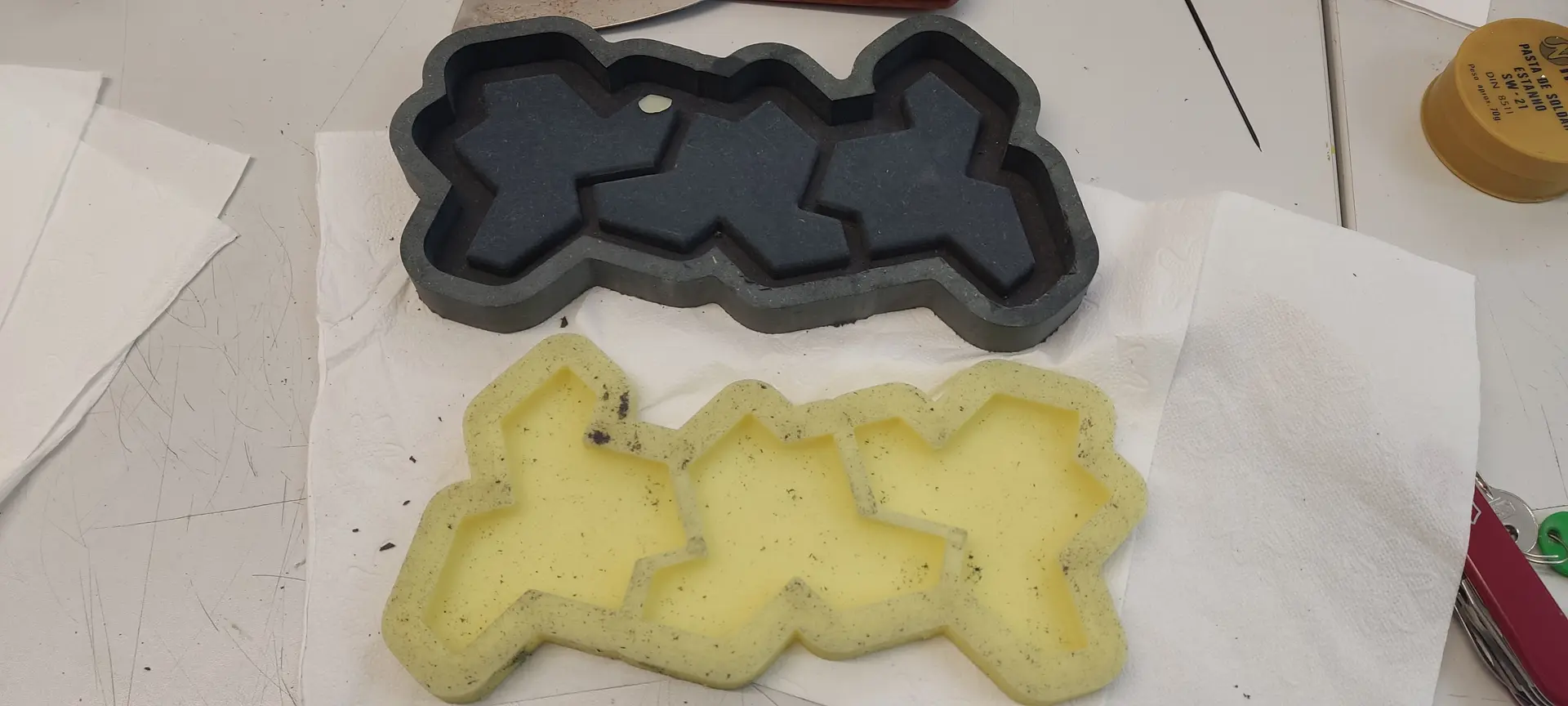
All those dark pigments got stuck to the the silicon as it cured, even though we brushed the mold once it was completed. I think if transferring these small particles was a concern, we could have applied some finish to the mold like a varnish. However this would have prevented picking up the “wooden” texture of the mold.
The silicon is also flexible and makes removing the cast easy.
As for the cement as a cast, I was surprised about how well it picks the texture of the mold:
Here we can see the wooden texture of the mold on one side compared to the other side that had no surface touching it:
And here we can see how the leftover cement picked up the texture of my plastic mixing cup:
I found out however, that cement alone is somewhat brittle and breaks easily, as I broke one tile while removing it from the mold.
For stronger consistency one should mix it with something else, like sand in particular.
Printing vs milling
Milling the master mold achieved a mold with no visible construction lines which was a requirement.
If I was to print it in a regular FDM printer, due to its nature, construction lines would be visible, specially in curves at a lower angle (like the top of a sphere).
The procedure for this, if this is the only possibility, requires some post processing to remove the construction lines. This is usually done in a couple of ways: by using a filament (like ABS) and exposing it to agent (like acetone) that eats away the shape thus removing the construction lines, or by applying layers of another material (like UV resin) and then do some sanding.
Either procedure somewhat alters the shape and is not adequate for casting pieces that require precision.
Another possibility is to use a SLA printer instead, which has a much greater precision and leads to no visible construction lines, which is what I used in my follow up.