Glossary
A more complete glossary:
Another one
Yet another one
| Term | Definition |
|---|---|
| Alignment | Alignment refers to how perpendicular and properly oriented the CNC machine axes are relative to each other and to the machine bed. Good alignment ensures that shapes such as squares and circles are cut accurately and that the machine moves precisely along the X, Y, and Z directions. |
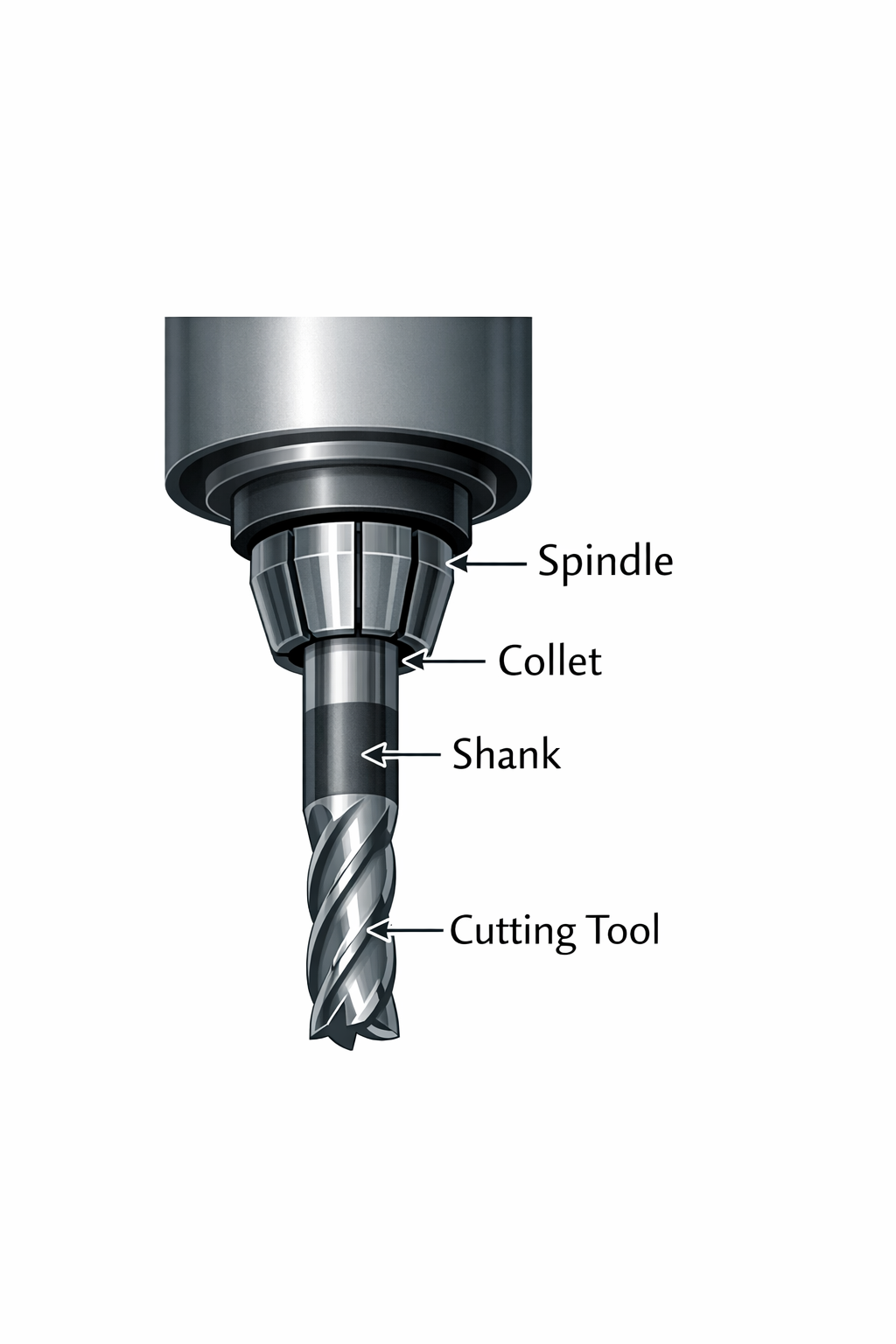
| Collet | A precision clamping sleeve that holds the tool shank inside the spindle. When tightened with a collet nut, it compresses around the tool to keep it centered and secure, minimizing vibration and runout. |
| Dial Indicator | A precision measuring instrument used to detect very small movements or deviations (often hundredths of a millimeter). It is commonly used to measure runout, verify alignment, and assist with tramming. |
| Feeds | Feed rate is the speed at which the cutting tool moves through the material, usually expressed in millimeters per minute (mm/min). Proper feed rates ensure efficient cutting, good surface finish, and prevent overheating or tool breakage. |
| Fixturing | Fixturing refers to the methods used to secure a workpiece to the CNC machine bed during machining. Common methods include screws, clamps, vacuum tables, and double-sided tape. Proper fixturing prevents movement or vibration that could affect accuracy and safety. |
| Materials | Materials are the substances being machined, such as plywood, MDF, acrylic, foam, or aluminum. Each material has different cutting characteristics and therefore requires different feeds, speeds, and tooling strategies. |
| Ridges | Ridges are raised lines or small steps left between adjacent tool passes during a machining operation. They usually occur when the step-over between passes is too large or when the spindle is not properly trammed. |
| Runout | Runout is the amount of wobble or deviation of a rotating cutting tool from its ideal center axis. It can be caused by imperfections in the spindle, collet, or tool and can lead to reduced precision, uneven cuts, and increased tool wear. |
| Shank | The smooth cylindrical part of a cutting tool that is held by the collet inside the spindle. It does not perform cutting; its purpose is to allow the tool to be mounted securely in the machine. |
| Speeds | Speeds usually refer to spindle speed, measured in revolutions per minute (RPM). Spindle speed determines how fast the cutting tool rotates and must be matched with the feed rate to produce proper chip formation and efficient cutting. |
| Spindle | The rotating motor component of a CNC machine that spins the cutting tool at high speed to perform cutting operations. The spindle holds the tool through a collet or tool holder. |
| Stripes | Stripes are visible parallel lines that appear on a surfaced wasteboard or machined surface. They are often caused by incorrect spindle tramming or uneven overlap between tool passes. |
| Toolpath | A toolpath is the programmed route that the cutting tool follows during machining. It is generated by CAM software and defines the movement of the tool in the X, Y, and Z axes, as well as cutting strategies and depths. |
| Toolpaths | Toolpaths refer to the different strategies used to remove material with a CNC machine, such as pocketing, contouring, raster passes, or adaptive clearing. Different toolpaths influence machining time, surface finish, and tool load. |
| Tramming | Tramming is the process of aligning the spindle so that the cutting tool is perfectly perpendicular to the machine bed or wasteboard. Proper tramming ensures even cutting depth and smoother surfaced areas. |
| Wasteboard (Spoilboard) | A sacrificial board mounted on the CNC bed that protects the machine during cutting operations. Workpieces are attached to it, and it can safely be cut into. It is periodically resurfaced to maintain flatness relative to the machine axes. |