Week 19: Invention, Intellectual Property and Income
Final Project: OrquiWall Smart System
Assignment Objective
For this week I focused on communicating my final project as an invention and as a documented Fab Academy development process. The assignment asks me to define how I will share my work, identify future opportunities for the project, and summarize the essence of the development in a clear way for other people to understand what I made and why it matters.
| Fab Academy Requirement | How I Addressed It |
|---|---|
| Develop a plan to share your work | I defined how the project will be published, licensed, presented, and shared with the Fab Academy community and Industrial FabLab UCuenca. |
| Formulate future opportunities and/or development for your final project | I described possible improvements, use cases, and development paths for OrquiWall as an educational, biophilic, and smart gardening prototype. |
| Summarise and communicate the essence of your project development | I summarized the technical and conceptual core of the project: a digitally fabricated orchid care system that integrates structure, electronics, sensing, movement, and irrigation. |
Project Summary
OrquiWall Smart System is my final project: a smart orchid wall module that integrates digital fabrication, electronics, embedded programming, mechanical movement, sensing, and plant care. The invention is not only a pot or an irrigation system; it is a complete bio-digital object designed for biophilic interiors.
What Is the Invention?
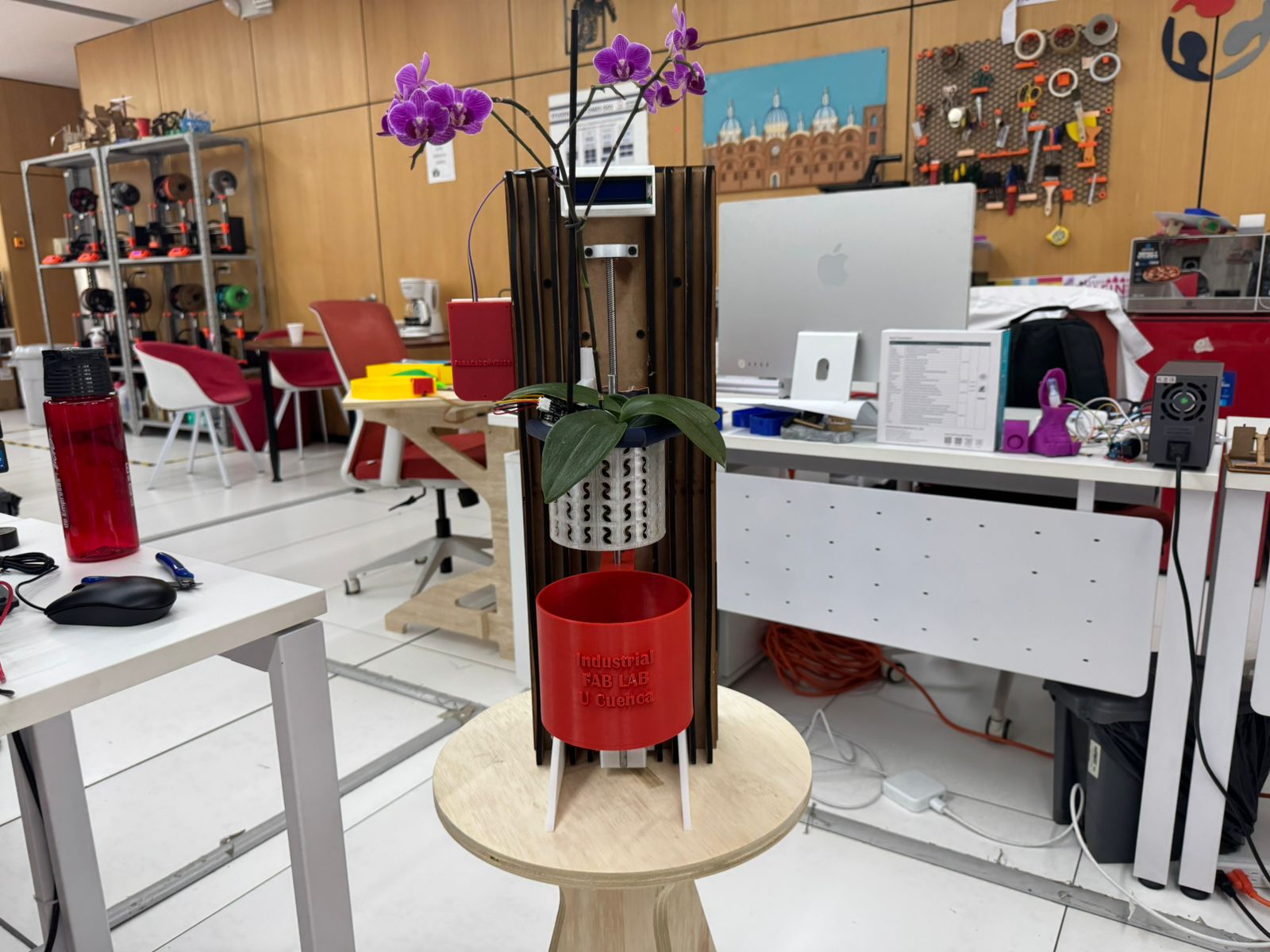
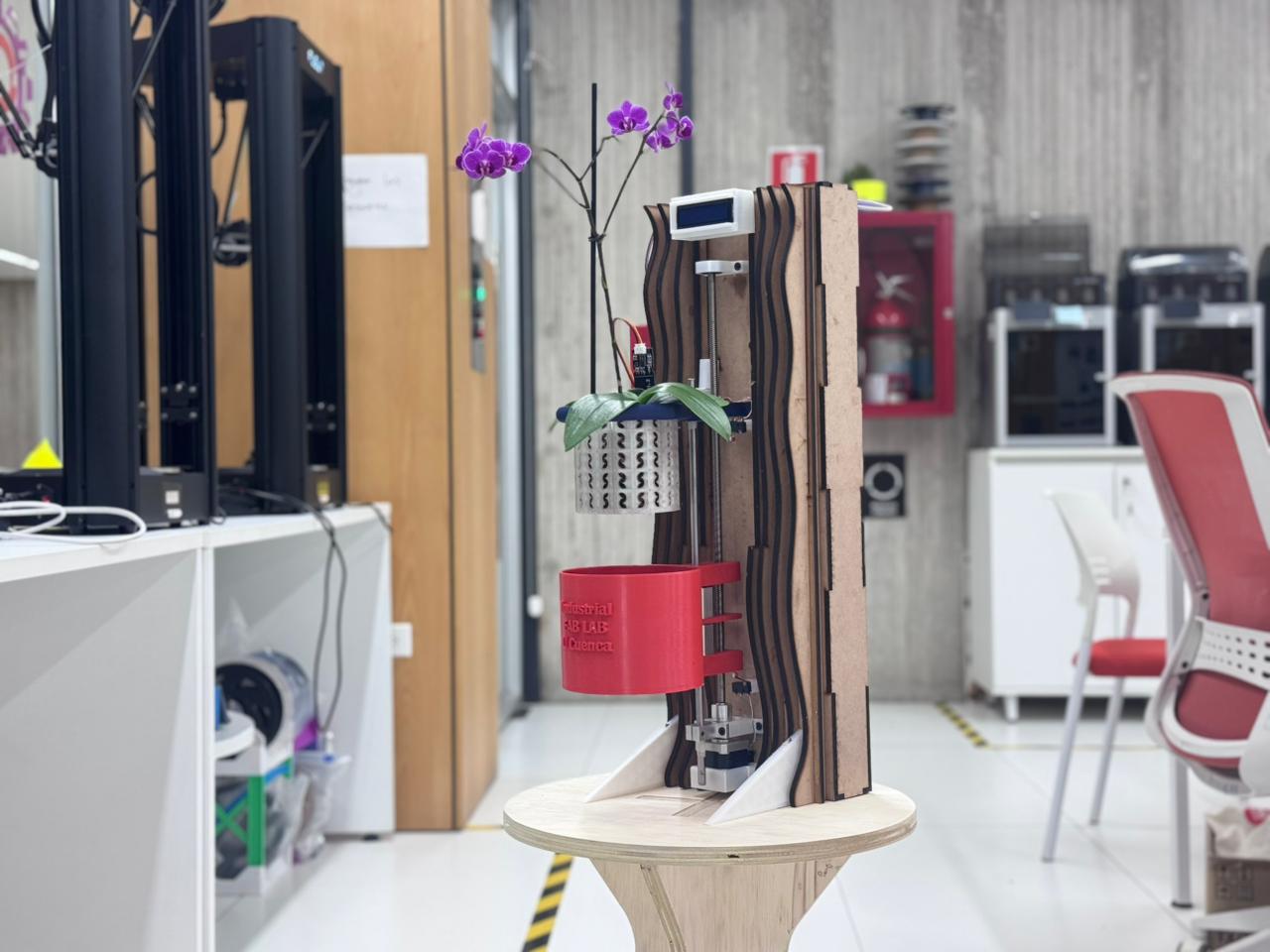
The invention is an integrated orchid care module for wall or vertical display contexts. It combines an organic-looking MDF sliced frame with a motorized system, a custom PCB, a humidity sensor, an LCD interface, a water reservoir, and a 3D printed orchid pot.
The main functional idea is automatic orchid irrigation by immersion. Instead of using only a pump, drip line, or passive reservoir, the system uses a motorized mechanism to move the water reservoir toward the orchid pot, allowing controlled immersion and later drainage.
| Innovation Area | Project Contribution |
|---|---|
| Biophilic design | Turns a technical system into a visible interior object for orchid care. |
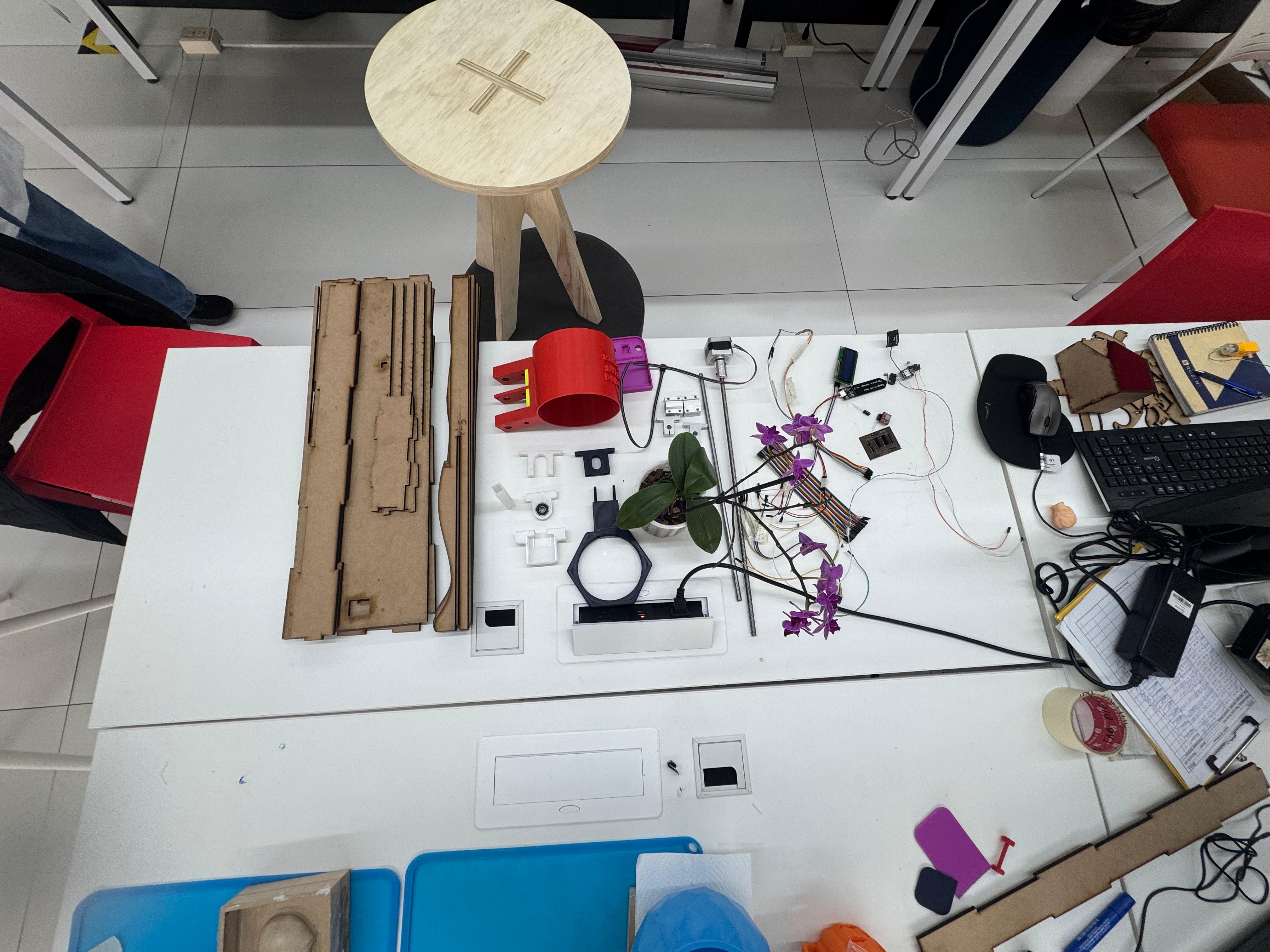
| Digital fabrication | Uses laser cutting, Slicer for Fusion 360, 3D printing, and fiber laser PCB production. |
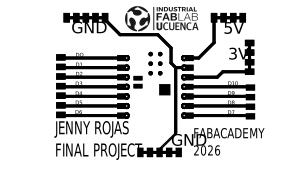
| Integrated electronics | Connects sensing, display, motor control, and wiring in a custom board and case. |
| Mechanical design | Uses stepper motor, 40 cm lead screw, bearing, and printed supports for movement validation. |
| Plant care | Tests orchid presentation, humidity sensing, and irrigation-reservoir logic. |
Develop a Plan to Share My Work
I plan to share OrquiWall as an open academic prototype. My main goal is that another student, maker, or FabLab instructor can understand the complete process: why I designed it, which machines I used, how each part was fabricated, and what still needs improvement before it becomes a more reliable product.
| Sharing Channel | What I Will Share | Purpose |
|---|---|---|
| Fab Academy website | Complete documentation, process photos, videos, bill of materials, downloadable files, source code, and final presentation files. | Make the full development process visible and reproducible for evaluation and future students. |
| Industrial FabLab UCuenca | Prototype demonstration, fabrication workflow, and lessons learned from integrating MDF, PLA, PCB production, and mechanical movement. | Use the project as a local case study for smart gardening and biophilic digital fabrication. |
| Final presentation | Slide, video, project summary, and working prototype evidence. | Communicate the essence of the project in a short and understandable format. |
| Future workshops | Simplified files, assembly steps, and electronics diagrams. | Transform the project into a learning activity about integrated digital fabrication. |
Intellectual Property Strategy
The project is intended to be open for learning and reproduction while keeping attribution to the author. A Creative Commons license is appropriate for documentation and design files, while the code can be shared under a simple educational license.
| Project Element | Suggested License | Reason |
|---|---|---|
| Documentation and images | CC BY-NC-SA 4.0 | Allows sharing and adaptation with attribution, non-commercial use, and share-alike terms. |
| Design files | CC BY-NC-SA 4.0 | Supports academic reuse and remixing while protecting commercial exploitation. |
| Code | MIT-style educational release | Simple reuse for testing and learning, with author attribution. |
| Brand / project name | Author attribution | OrquiWall Smart System remains identified as my Fab Academy project. |
Licensing statement: The documentation, images, and design files of OrquiWall Smart System are shared for educational and non-commercial purposes under a CC BY-NC-SA 4.0 approach. The source code can be reused for academic testing and learning with attribution to Jenny Rojas.
Future Opportunities and Development
At this stage, OrquiWall is a functional Fab Academy prototype, not a finished commercial product. However, I can see several future opportunities because the project combines plant care, digital fabrication, electronics, and interior design. The next version should focus on reliability, waterproofing, easier assembly, and long-term testing with real orchids.
| Possible Model | Description | Next Requirement |
|---|---|---|
| Educational kit | Kit for learning digital fabrication, electronics, and plant automation. | Simplify assembly and create instructions. |
| Interior design module | Biophilic wall object for homes, offices, or labs. | Improve finish, safety, waterproofing, and reliability. |
| FabLab workshop | Workshop where users fabricate a smart plant module. | Reduce part count and standardize files. |
| Custom installation | Adaptable orchid or plant wall system. | Develop modular scaling and professional mounting. |
Development Roadmap
| Stage | Development Goal | Reason |
|---|---|---|
| Prototype 2 | Improve the wiring case, cable routing, waterproof separation, and mechanical supports. | Make the system safer and easier to maintain. |
| Electronics refinement | Design a more compact PCB with clearer connectors and improved power distribution. | Reduce wiring errors and make assembly faster. |
| Plant care validation | Test irrigation timing, humidity values, and orchid response over a longer period. | Validate that the system is useful for real plant care, not only as a mechanical demonstration. |
| Design refinement | Improve the surface finish of the MDF frame, the printed reservoir, and the visible user interface. | Make the object more appropriate for interiors and exhibition. |
What Tasks Have Been Completed and What Tasks Remain?
The following table summarizes the current development state of the project. It separates the completed tasks from the remaining tasks, which is important for understanding the real maturity of the prototype.
| Area | Completed Tasks | Remaining Tasks |
|---|---|---|
| Mechanical structure | MDF sliced frame designed, laser cut, and assembled. | Improve long-term rigidity, wall mounting, and final edge finishing. |
| 3D printed parts | Pot, reservoir, wiring case, motor supports, and bearing holders printed. | Improve waterproofing, tolerances, and surface finish. |
| Electronics | Custom PCB designed, fabricated, soldered, and tested. | Improve connector labeling, power distribution, and enclosure protection. |
| Programming | Basic control logic for sensors, LCD messages, motor, and limit switches implemented. | Optimize the movement sequence, improve error handling, and test longer operating cycles. |
| Irrigation concept | Water reservoir, orchid position, and immersion concept validated in prototype form. | Perform long-term tests with a living orchid and refine immersion time. |
| Documentation | Design process, fabrication, code, files, licensing strategy, and future plan documented. | Continue updating results after long-term plant care testing. |
What’s Working? What’s Not?
This section addresses the current functional state of OrquiWall. The prototype demonstrates the main project idea, but it also shows the limitations that should be improved in a future iteration.
| System Area | What Is Working? | What Is Not Fully Working Yet? | Next Improvement |
|---|---|---|---|
| Frame and physical integration | The MDF sliced frame works as the main visual and structural support. It holds the orchid, electronics, and reservoir concept in a single object. | The final structure still needs better finishing, stronger wall mounting, and improved protection from humidity. | Improve assembly tolerances, add safer mounting points, and seal exposed MDF edges. |
| 3D printed components | The pot, reservoir, supports, and wiring case can be fabricated and assembled with the rest of the system. | Some printed parts need better sealing and smoother surfaces for long-term contact with water. | Redesign the reservoir with thicker walls, better drainage, and improved waterproof finishing. |
| Electronics and PCB | The custom PCB organizes the ESP32 XIAO C3, A4988 driver, sensors, LCD, and limit switch connections. | The electronics still require better physical isolation from water and clearer connector labeling. | Design a second PCB version with improved power routing, labels, and separated wet/dry areas. |
| Motorized movement | The stepper motor, lead screw, bearing, and printed supports demonstrate the movement principle for the immersion mechanism. | The mechanism can still present friction, alignment sensitivity, and movement instability near the end positions. | Improve alignment, add smoother guides, adjust speed/acceleration, and reinforce the supports. |
| Sensor and display logic | The system can read sensor values and display information through the LCD interface. | Sensor thresholds need more calibration with real orchid substrate and long-term environmental changes. | Collect more measurements and define more reliable humidity and irrigation thresholds. |
| Final project communication | The project can be explained through photos, files, slide, video, and documentation. | More long-term evidence would make the project stronger as a real plant-care product. | Continue recording tests after Fab Academy to validate reliability. |
What Questions Need to Be Resolved?
Although the prototype communicates the main idea and integrates the required systems, some questions need to be resolved before considering OrquiWall as a reliable long-term product.
| Question | Why It Matters | Possible Resolution |
|---|---|---|
| What is the best immersion time for the orchid substrate? | Overwatering can damage orchid roots, while short immersion may not hydrate the substrate enough. | Test different immersion times and monitor the plant response during several weeks. |
| How can the electronics be protected from humidity and accidental water contact? | The prototype combines water, electronics, and movement in the same object. | Separate wet and dry zones, add seals, improve cable routing, and redesign the enclosure. |
| How can the movement system be made smoother and more reliable? | The lifting system must operate repeatedly without blocking or losing alignment. | Improve guide rods, reduce friction, tune acceleration, and reinforce motor supports. |
| How can the system be simplified for workshops or replication? | A future educational kit should be easier to assemble and debug. | Reduce part count, standardize screws and connectors, and improve assembly instructions. |
Planned What Will Happen When?
I planned the remaining development as a sequence of short improvement stages. This plan helps me continue the project after the Fab Academy evaluation and convert the current prototype into a more reliable version.
| Time / Stage | Planned Action | Expected Result |
|---|---|---|
| Final review stage | Complete documentation, upload files, check slide/video links, and request new review. | Assignment documentation ready for evaluation. |
| Short term | Improve cable routing, connector labels, and waterproof separation. | Safer and easier-to-maintain prototype. |
| Medium term | Redesign mechanical guides, reduce friction, and improve motor movement reliability. | Smoother immersion mechanism. |
| Long term | Perform long-term orchid care tests and collect humidity/irrigation data. | Better validation of the system as a real plant-care solution. |
| Future dissemination | Prepare simplified documentation for workshops or educational use at Industrial FabLab UCuenca. | Project transformed into a learning activity or demonstrator. |
What Have I Learned?
This project helped me understand that the most difficult part of a final project is not making individual components, but making all of them work together as one system. Each subsystem affected the others: the MDF frame affected the position of the mechanism, the reservoir affected the movement, the wiring affected the enclosure, and the electronics had to be protected from the irrigation area.
| Learning Area | What I Learned | How It Appears in the Project |
|---|---|---|
| System integration | I learned that integration requires constant adjustment between design, fabrication, electronics, and programming. | The final prototype combines MDF frame, PLA parts, PCB, sensors, LCD, motor, reservoir, and plant. |
| Mechanical design | I learned that alignment, friction, support rigidity, and movement speed are critical in motorized systems. | The stepper motor and lead screw mechanism required testing and mechanical adjustment. |
| Electronics production | I learned the importance of clear wiring, connector organization, continuity testing, and protection when electronics are close to water. | The custom PCB and wiring case helped organize the electronic system. |
| Embedded programming | I learned how to connect sensor readings, end-stop logic, motor control, and LCD feedback into one program. | The ESP32 XIAO C3 controls the irrigation sequence and communicates system status. |
| Product thinking | I learned that a technical prototype must also communicate its purpose clearly to users. | The orchid, wall frame, visible reservoir, and final presentation help explain the concept. |
| Future improvement | I learned to identify limitations honestly instead of presenting the prototype as a finished product. | The documentation separates what works, what does not fully work yet, and what needs to be improved. |
Main lesson: OrquiWall taught me that digital fabrication is not only about making separate parts. It is about designing relationships between materials, electronics, movement, code, and the user experience.
Summarise and Communicate the Essence of My Project Development
The essence of my project is the integration of living material and digital fabrication. I wanted to build a system that does more than hold an orchid: it senses conditions, displays information, moves mechanically, stores water, and presents the plant inside a designed frame.
Through the final project I learned how difficult and important integration is, because every part affects the others: the frame size affects the mechanism, the pot affects the reservoir, the cables affect the case, and the electronics affect the final assembly.
| Idea | How It Appears in OrquiWall |
|---|---|
| Digital fabrication as a system | I used laser cutting, 3D printing, PCB fabrication, CAD, and Slicer workflows to make parts that had to work together. |
| Biophilic technology | The project connects electronics and mechanics with plant care, using an orchid as the central living element. |
| Learning through integration | The most important lesson was not one isolated machine process, but the coordination of structure, movement, sensing, display, and irrigation. |
Project Completion Status
| System Layer | Status | Evidence |
|---|---|---|
| Frame | Fabricated and assembled | MDF sliced framework and press-fit construction. |
| Pot and reservoir | Printed and tested | PLA pot, red reservoir, orchid presentation. |
| Electronics | Designed and fabricated | KiCad PCB, fiber laser traces, soldering, continuity tests. |
| Mechanism | Prototype tested | Stepper motor, lead screw, bearing, printed supports. |
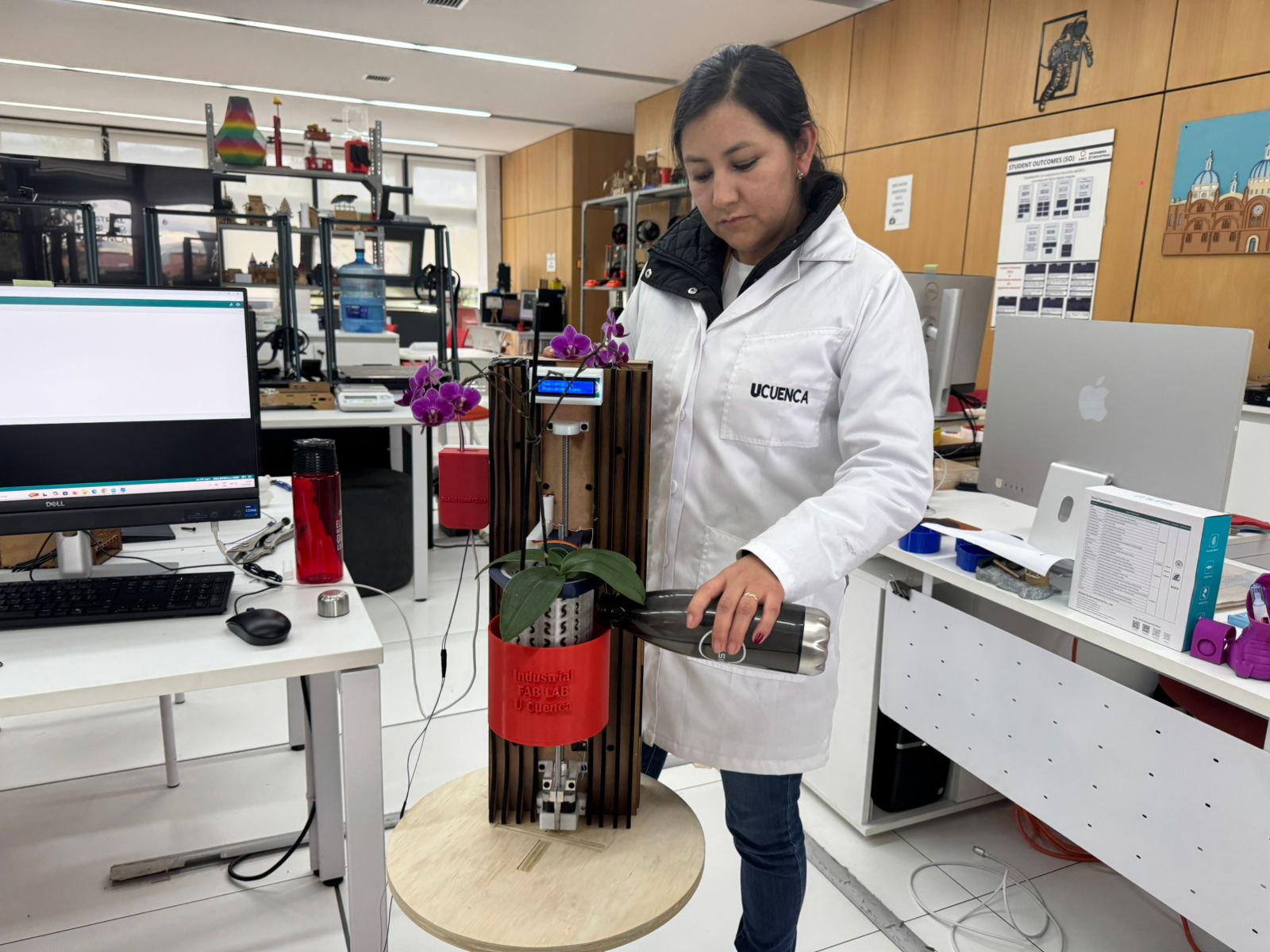
| Integration | Final prototype assembled | Final test image and video with irrigation demonstration. |
Remaining Work
- Improve water sealing and long-term humidity protection for electronics.
- Design a cleaner final enclosure for cables and power supply.
- Refine the movement system for smoother operation and less friction.
- Improve surface finish of 3D printed parts and MDF edges.
- Test the system over longer periods with a living orchid.
Checklist Review
The following checklist confirms that the missing points from the evaluation feedback were addressed in this documentation.
| Checklist Item | Status | Where It Is Documented |
|---|---|---|
| Created a dissemination plan for the final project | Completed | Develop a Plan to Share My Work |
| Outlined future possibilities and described how to make them | Completed | Future Opportunities and Development |
| What tasks have been completed, and what tasks remain? | Completed | What Tasks Have Been Completed and What Tasks Remain? |
| What’s working? What’s not? | Completed | What’s Working? What’s Not? |
| What questions need to be resolved? | Completed | What Questions Need to Be Resolved? |
| Planned what will happen when? | Completed | Planned What Will Happen When? |
| What have you learned? | Completed | What Have I Learned? |