Week 17: Applications and Implications
What will it do?
The device is a self-contained parachute unit that attaches to consumer drones without any electronic or software integration with the host device. An independent onboard sensor monitors flight state and triggers deployment upon detecting free-fall. The system operates entirely on its own power source and logic, making its function unaffected by drone system failures. Compatible with a range of drone form factors via a universal mounting strap.
What has been done before?
The autonomous drone parachute space has roughly 13 active vendors. Every single one targets commercial or enterprise drones weighing 2 kg and above. The category breaks into two tiers.
Fully autonomous, certified — $1,500–4,000
ParaZero [Israel] — $1,757–$3,999 — SafeAir line for Mavic 3, M-350, Phantom. Patented ballistic launcher with independent IMU, flight termination system, and black box. The only publicly traded player in this space.
Drone Rescue Systems [Austria] — quote-based (~$3,000–6,000) — DRS-5/10/15/25. Patented electric catapult with no spring, no pyrotechnic, no gas — entirely its own class of mechanism. Carbon-fibre housing, no dangerous-goods classification, ships on any airline.
AVSS [Canada] — $2,200–$3,400 — PRS series for DJI Matrice and Mavic 3E Enterprise. Field-replaceable Parachute Pod, first system with DJI Dock 3 integration.
Dronavia [France] — €1,599–€3,629 — Kronos line, preloaded spring ejection. Only vendor doing true EU Class C5 conversion of the DJI Mavic 3 and 4 Pro, enabling legal urban overflight. Also just launched the Kronos Nano and Kronos Mini — universal-mount, sub-2 kg, 130 g — the first products to enter your specific target segment.
Component / DIY tier — $150–900
Fruity Chutes [USA] — $150–$900 (bundle-dependent) — Modular: Harrier spring launchers from 81 g paired with Iris Ultra canopies, plus the SATS-MINI autonomous trigger (9-DoF IMU, free-fall + attitude detection). DIY-assembly required; nothing is sold as a finished plug-and-play unit.
Mars Parachutes [USA] — $250–$550 — MARS 58/88/120 spring launchers plus the MayDay auto-deploy module sold separately. Available on Amazon. Closest to consumer pricing but no autonomous fall detection built in and uncertified.
Opale Parachutes [France] — around €330 (ST60X kit) — SafeTech spring-ejection tubes, 150×60 mm carbon, 1.8 m² siliconised nylon canopy, Dyneema/Kevlar lines. No built-in sensor — needs an external PWM trigger. Paraglider heritage since 2012. The most useful open design reference in the market: all physical specs are published.
*Prompt at the very bottom.
What sources will you use?
XIAO ESP32-C3 datasheet · GY-521 (MPU-6050) datasheet · Servo motor datasheet · Passive buzzer (TMB12A05) datasheet · YouTube (parachute deployment & packing tutorials) · Original design files (electronics, housing, mechanical parts) · FabAcademy course materials · FabLab Dilijan inventory & instructors
What will you design?
• The main body of the device, optionally the straps to attche onto a drone.
• The parachute sewing pattern made of synthetical fabric, to be cut on the laser cutter.
• The PCB with all the electronic components responsible for the actuation.
• The firmware responsible for free fall detection and parachute’s deployment.
What materials and components will be used?
• Matte black PLA
• Metalic Springs
• Metalic Shafts
Electronics:
• XIAO ESP32 C3
• GY-521
• LiPo 3.7V Battery
• 5V Servo Motor
• Buzzer
Parachute:
• Nylon Fabric
• Nylon Strings
• Metalic Carabiner
Where will they come from?
Both from online and phyical stores, and our lab. I have ordered a XIAO ESP32 C3 from Seeedstudio.com, some small electronics from Temu.com, parachute parts from local textile district, and the rest from my node’s inventory.
How much will they cost?
Below is a detailed Bill of Materials [BOM] with item links.
Prices are listed per unit. For items like 3D printing filament, costs are calculated proportionally based on the exact amount used per case [retrieved from slicer, including the supports].
Filament Used: 0.154 of a spool
Weight Conversion: 1 spool = 1000 grams [1,000g * 0,154 = 154g]
Cost Formula: [Spool Price / 1000] × 154 grams = Total filament cost per printed case. [13,5 / 1000] × 154 grams = $2,1
| Item | Specification/Description | Price [PPU] | Quantity | Source |
|---|---|---|---|---|
| LiPo Battery | 3.7V, 1200 mAh | $6,80 | 1 | Local Store |
| Case | PLA filament | $13,5 | 0,154 | Inventory |
| Copper Blank | FR-1 4x5 inch | $2,2 | 1 | Inventory |
| Servo Motor | 5V, metallic geared | $19,95 | 1 | Inventory |
| ESP32 | XIAO ESP32 C3 | $4,90 | 1 | Seeed Studio |
| Gyro & Accelerometer | GY-521 | $2,98 | 1 | Inventory |
| Buzzer | 5V, Passive, TMB12A05 | $0,14 | 1 | Inventory |
| Button | 6 pin, push button | $0,13 | 1 | Inventory |
| Resistor | mixed | $0.004 | 6 | Inventory |
| LED | 1206 SMD | $0.007 | 1 | Inventory |
| Screw | – | – | 6 | Inventory |
| Spring | Torsion | $0,24 | 2 | Inventory |
| Shaft Rod | 14x2 mm | $0,02 | 4 | Inventory |
| Pin header | Male | $0,05 | 12 | Inventory |
| Fabric | Water repelling Nylon | $16,5 | 0.2 | Local Store |
| Paracord | Type III, 4mm | $1,5 | 1 | Local Store |
| Carabiner | Looped | $0,75 | 1 | Local Store |


What parts and systems will be made?
These are the major subsets that make up the device into a single system:
• Doors connected to the case using hinges.
• Parachute canopy [sewn] connected to the case via a carabiner.
• The customized PCB serving the system.
What processes will be used?
• 3D printing the case and the doors
• PCB design for the componets to be wired together
• Milling the custom PCB
• Soldering the electronics onto the PCB
• Firmware programming
• Laser cutting the parachute petals
• Sewing the individual petals and cords
• Assembling this all together
What questions need to be answered?
• Will the gyro unit misinterpret drone’s flight speed with free fall?
• Will the parachute deploy?
• Will the servo be powerful enough to unlatch the door?
How will it be evaluated?
• The primary sign of a successful operation is the doors’ unlatching, if this is achieved it means the algorithm is working.
• The second evalution is the parachute deployment, if the doors open, and the parachute stays inside the case then it is a fail… the drone crashes!
• The third point to consider is noise filtration, if say the drone propels at 80km/h will the unit log a false positive?
Project Developement
Once the presentation slide and video were ready, I named the slide “presentation” with .png and .mp4 file extensions respectively [the video should not have exceeded the 20mb mark]. Then I uploaded these into my root directory and checked if the system has logged my uploads or not.
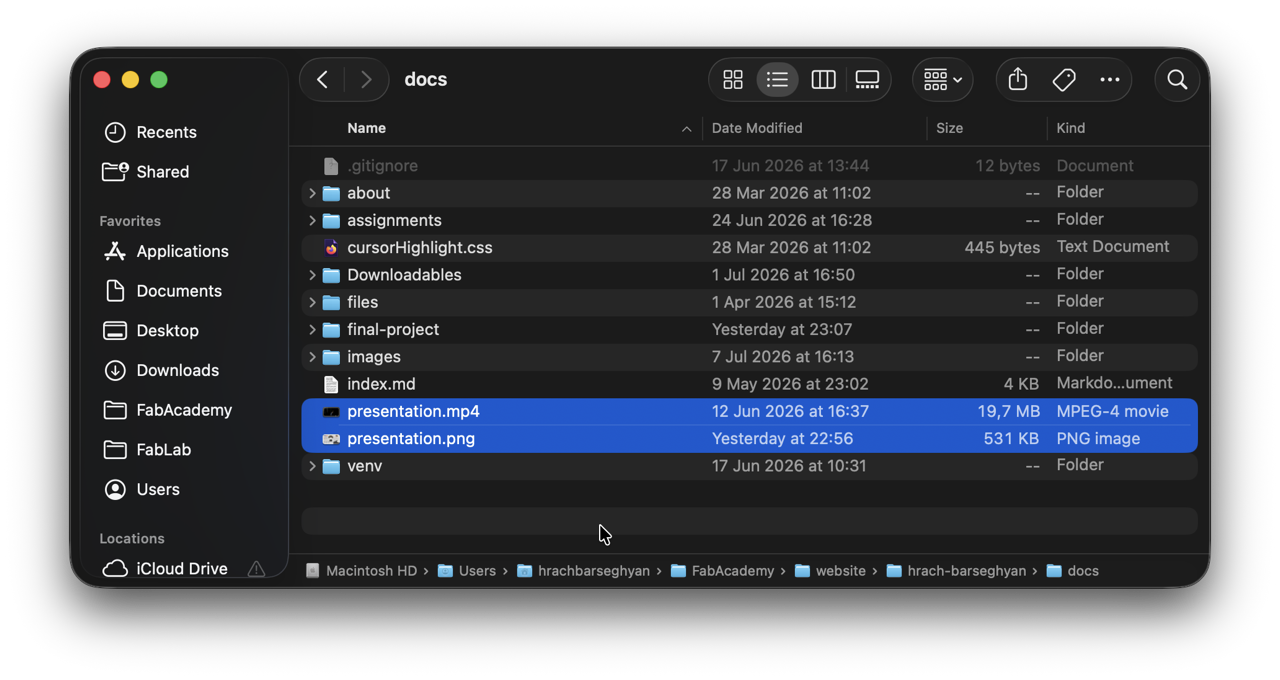
I entered the presentations page and looked for my name under my registered date. As I did not see the warning yellow flag saying “Missing slide” I knew the files were there. I also clicked the linked to make sure they were both present, and that there was no audio issue with the video.

Prompts
I’m developing a self-contained parachute system for consumer drones — fully independent of the host drone [no electronic or software integration], with its own sensor that detects free fall and triggers deployment, its own power source, and a universal mounting strap. The target segment is premium consumer/prosumer drones under 1 kg [DJI Mini Pro, Air series, Autel Nano, Parrot Anafi] priced above $250 retail — excluding FPV/racing drones and cheap toy-grade drones, since those owners are less loss-averse.
I need you to research and deliver every commercial autonomous drone parachute vendor globally. These should exactly fall under my described characteristics, and should be a direct compatitor to my idea.