Week 18. Invention, Intellectual Property and Income
Dissemination Plan
My final project will be shared through the Fab Academy website with complete documentation, including the design process, fabrication methods, electronic schematics, source code, and demonstration videos. The project will also be presented through social media and maker communities to make it accessible to a broader audience and to encourage knowledge sharing and future collaboration.
Future Opportunities
The design will be adapted to different application scenarios and user requirements, ensuring wider applicability. In the future, it is also planned to develop a mobile application through which users will be able to control and adjust the system via phone, for example, change the light intensity (intensity) and adjust other parameters according to their preferences. The metal part preparation process will also be optimized, making it easier, faster and more efficient
Completed Tasks and Remaining Work
The 2D and 3D designs have been completed, along with the fabrication of the mechanical parts, PCB design and production, embedded programming, and the integration of the main system components. The remaining tasks include final testing, refinement of the enclosure, optimization of the system, and completion of the final presentation materials.
What Is Working and What Is Not
The electronic part of the project is fully completed, and the software development has also been finished. However, some parts of the metal structure are still not finalized and require additional soldering work. In addition, the final installation of the electronics and displays has not yet been carried out, which is planned to be done after the completion of the entire metal structure in order to ensure full system integration.
Questions That Need to Be Resolved
The remaining questions mainly concern the final optimization of the system, long-term stability, and improvements in the physical design and user experience. These issues will be addressed through additional testing and evaluation.
Planned Timeline
Planned Timeline
- May 27 – June 5 — Completion of the metal structure, final assembly, and all required welding work, as well as initial connection of the electronic components.
- June 6 – June 9 — Installation of displays, final integration of the electronics into the structure, and ensuring full system connectivity.
- June 10 – June 11 — System testing, combined hardware and software validation, debugging and optimization, as well as final completion of the presentation slides and video.
What I Have Learned?
Through this project, I learned how to integrate multiple digital fabrication technologies into a single functional system. I gained experience in 2D and 3D design, additive and subtractive manufacturing, electronics design and production, embedded programming, and system integration. In addition, I improved my project planning, problem-solving, and documentation skills throughout the development process.
Final Project License
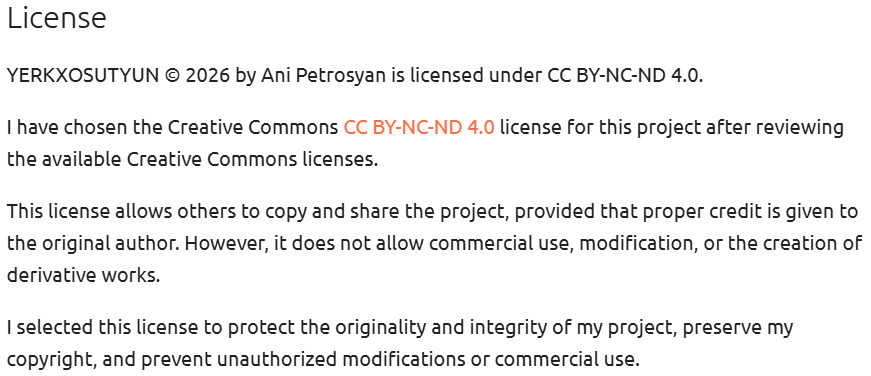
To complete this assignment, I added the selected Creative Commons license to both my Final Project page and my presentation slides. The screenshots below show where the license has been placed.
Selected License
YERKXOSUTYUN © 2026 by Ani Petrosyan is licensed under CC BY-NC-ND 4.0.
I chose the Creative Commons CC BY-NC-ND 4.0 license for this project after reviewing the available Creative Commons licenses.
This license allows others to copy and share the project, provided that proper credit is given to the original author. However, it does not allow commercial use, modification, or the creation of derivative works.
I selected this license to protect the originality and integrity of my project, preserve my copyright, and prevent unauthorized modifications or commercial use.