Concept
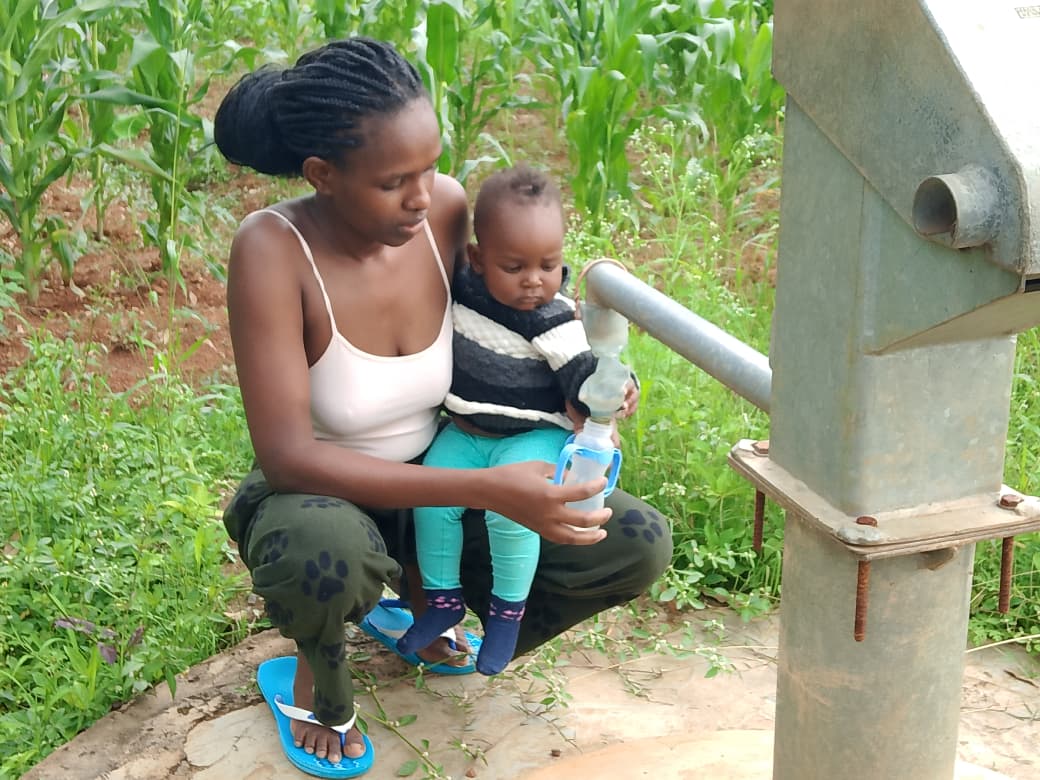
My water purification project, Water 4 Aduvan, is inspired by my daughter, Aduvan, and my desire to contribute to a future where everyone can access clean and safe water. Access to safe drinking water remains a challenge in parts of Kisumu, particularly in underserved communities where some people depend on water sources that may be contaminated. A study of water sources in informal settlements in Kisumu found that 67% of the sources assessed were classified as risky, highlighting the need for better water treatment solutions. This is also a concern recognised by the World Health Organization (WHO), which emphasises that drinking water should be free from faecal and priority chemical contamination. My project aims to address this challenge by developing a water treatment system that combines physical filtration using materials such as pebbles and charcoal, turbidity monitoring, a Polyglue treatment stage, and a photocatalyst. I also plan to integrate biochar as an additional filtration material to improve the treatment process. Through engineering, electronics and digital fabrication, I hope to develop a practical solution that can be tested and improved to support communities in accessing safer water. Above all, I want this project to contribute to a healthier future for children like my daughter, Aduvan.
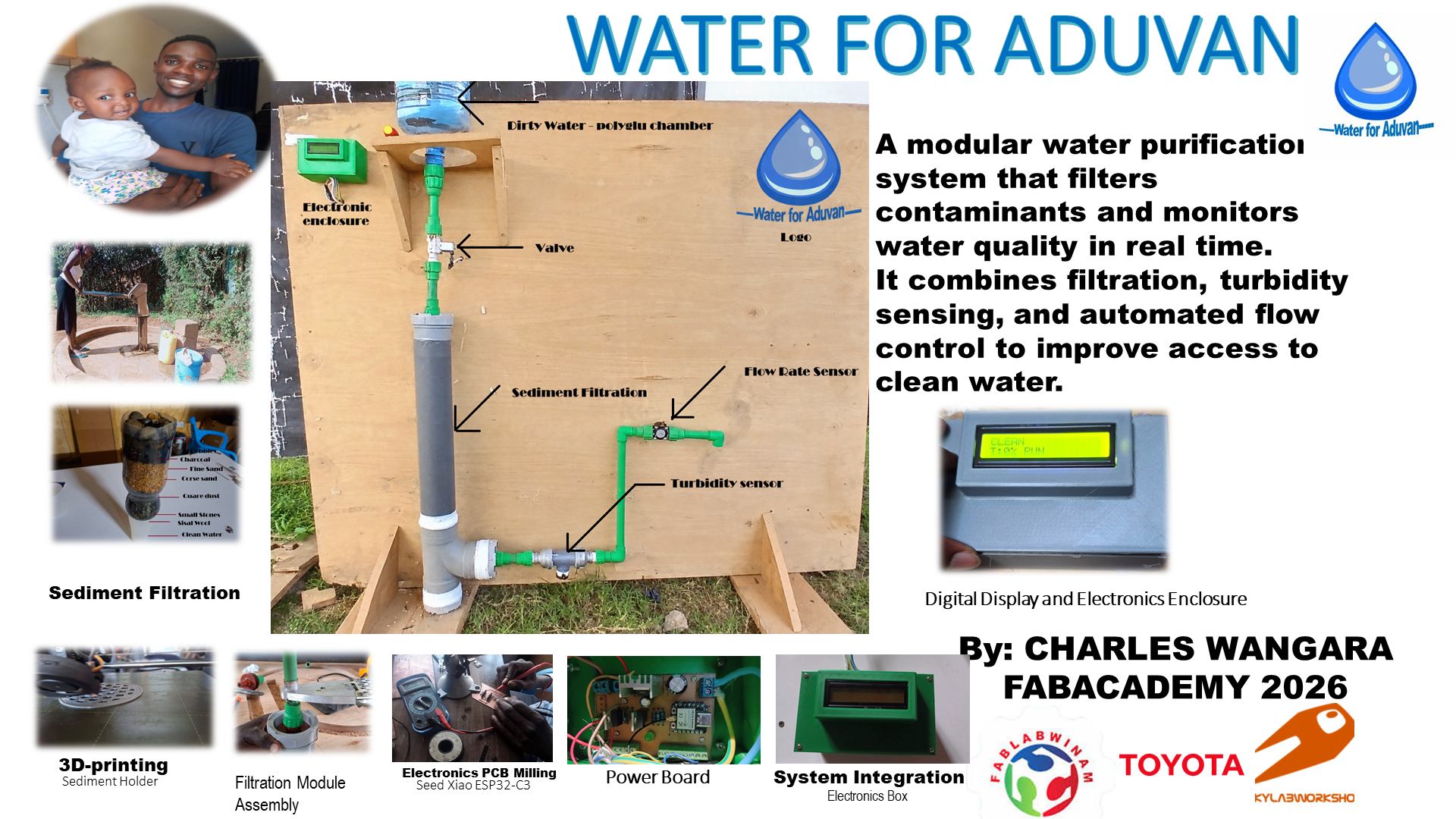

Progress and Roadmap
| Phase | Target | Timeline |
|---|---|---|
| Phase 1 — Pilot | 100 households | Spring 2027 |
| Phase 2 — Scale-up | 1,000 households | Following the pilot review |
The first phase is planned for Spring 2027. During the pilot, the system will be tested under real operating conditions with the aim of identifying areas that need improvement.
Feedback and test results from the pilot will help guide changes to the design before the system is produced and distributed on a larger scale.
Business Model and Sustainability
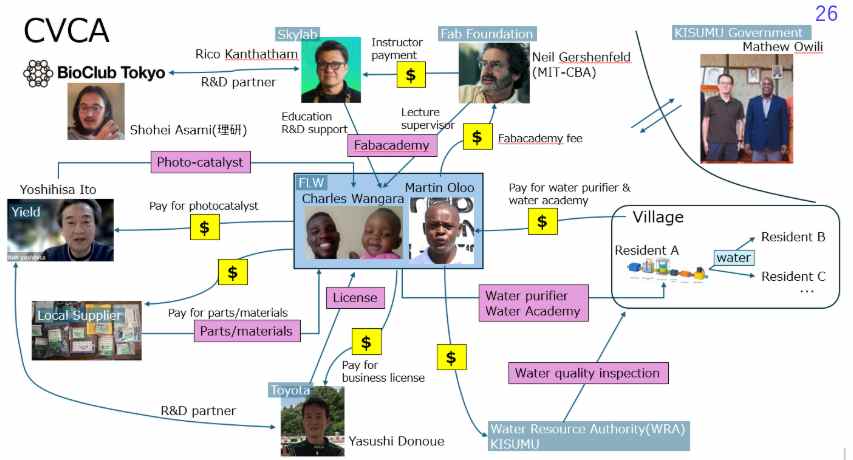
A business model is being developed to support the production, operation and long-term maintenance of the water purification system. Different approaches are being considered to make the project practical and sustainable within the Kenyan context.
DROP Academy
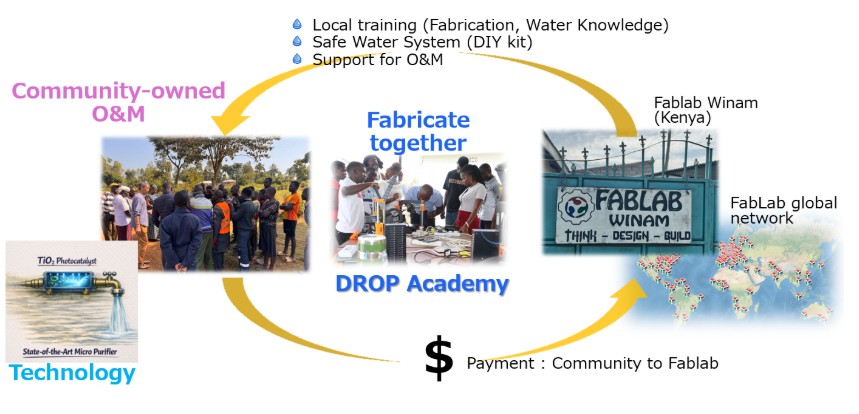
As part of the project, Fab Lab Winam plans to establish the DROP Academy. This will be a community training and support programme focused on safe water technologies.
The academy will train community members in the design, fabrication, assembly, operation and maintenance of the water purification system.
Through a DIY Safe Water Kit, community members will be able to learn how to build, repair and improve their own systems using locally available materials and digital fabrication tools.
The academy will also provide operation and maintenance (O&M) support. The aim is to build local skills, encourage community ownership and support the long-term use of safe water technologies.
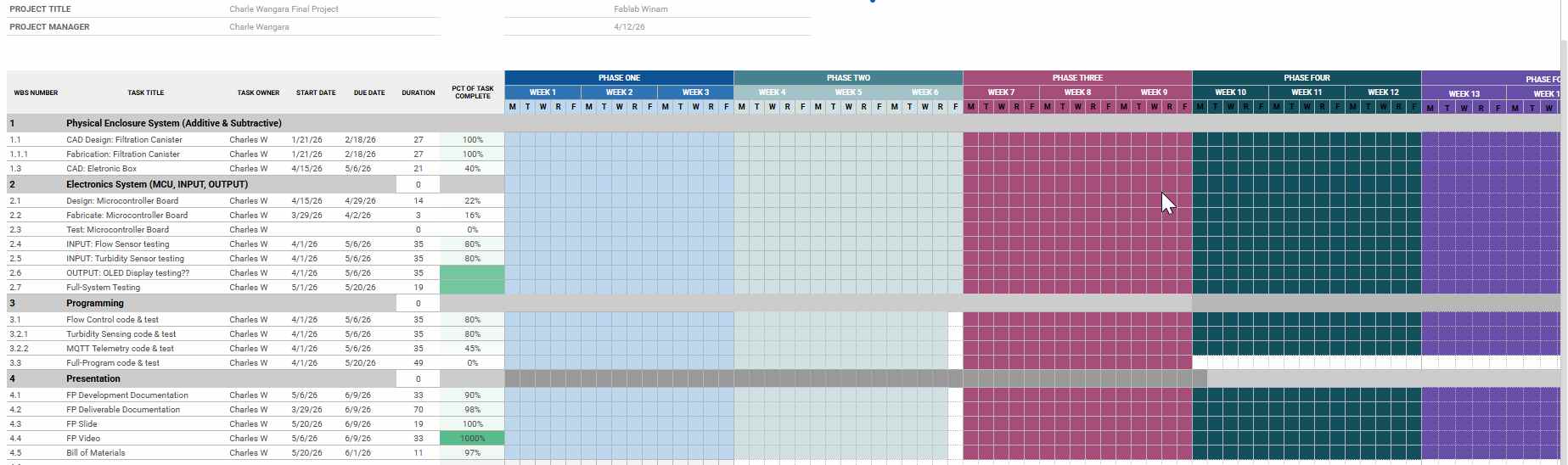
Gant Chart
Bill of Materials (BOM)
| # | Item | Consumable (Y/N) | Quantity | Unit Cost (KES) | Total Cost (KES) | Use / Function |
|---|---|---|---|---|---|---|
| 1 | PVC Pipe 3” (13 feet) | Y | 1 | 500 | 500 | Main water flow channel |
| 2 | PVC Plug 3” | Y | 3 | 150 | 450 | Sealing pipe ends |
| 3 | PPR Welding Machine | N | 1 | 2,500 | 2,500 | Joining plastic pipes |
| 4 | Male Adapter 1/2” | Y | 8 | 50 | 400 | Pipe connection interface |
| 5 | Tank Connector 1/2” | Y | 8 | 300 | 2,400 | Connecting tank to piping |
| 6 | Plain Elbow 1/2” | Y | 8 | 30 | 240 | Changing flow direction |
| 7 | Solfix Gum | Y | 1 | 200 | 200 | Sealing and bonding joints |
| 8 | Female Adapter 1/2” | Y | 4 | 50 | 200 | Pipe-to-device connection |
| 9 | T-Connector | Y | 1 | 200 | 200 | Splitting water flow |
| 10 | Flow Rate Sensor | N | 2 | 820 | 1,640 | Measuring water flow rate |
| 11 | Turbidity Sensor | N | 1 | 1,200 | 1,200 | Monitoring water quality |
| 12 | Seeed Studio XIAO ESP32 | N | 1 | 1,500 | 1,500 | Main controller for system operation |
| 13 | Pump | N | 1 | 2,000 | 4,000 | Pumping water through the purification system |
| 14 | Copper Board (Perfboard) | Y | 1 | 300 | 300 | Mounting and soldering electronic components |
| 15 | 16×2 I2C LCD Display | N | 1 | 500 | 500 | Displaying system status and readings |
| 16 | Solenoid Valve | N | 2 | 1,000 | 2,000 | Automatic water flow control |
| ----- | -------------------------- | ------------------ | ----------- | ------------------ | ------------------ | ------------------------------------------------- |
| TOTAL | 18,230 KES |