Appearance
WEEK 18 – Applications and Implications + Project Development
Individual Assignment
Plan a final project masterpiece that integrates the range of units covered, answering:
- What will it do?
- Who's done what beforehand?
- What sources will you use?
- What will you design?
- What materials and components will be used?
- Where will they come from?
- How much will they cost?
- What parts and systems will be made?
- What processes will be used?
- What questions need to be answered?
- How will it be evaluated?
Your project should incorporate 2D and 3D design, additive and subtractive fabrication processes, electronics design and production, embedded microcontroller design, interfacing, and programming, system integration and packaging
Where possible, you should make rather than buy the parts of your project
Projects can be separate or joint, but need to show individual mastery of the skills, and be independently operable
1. Project Purpose and Scope
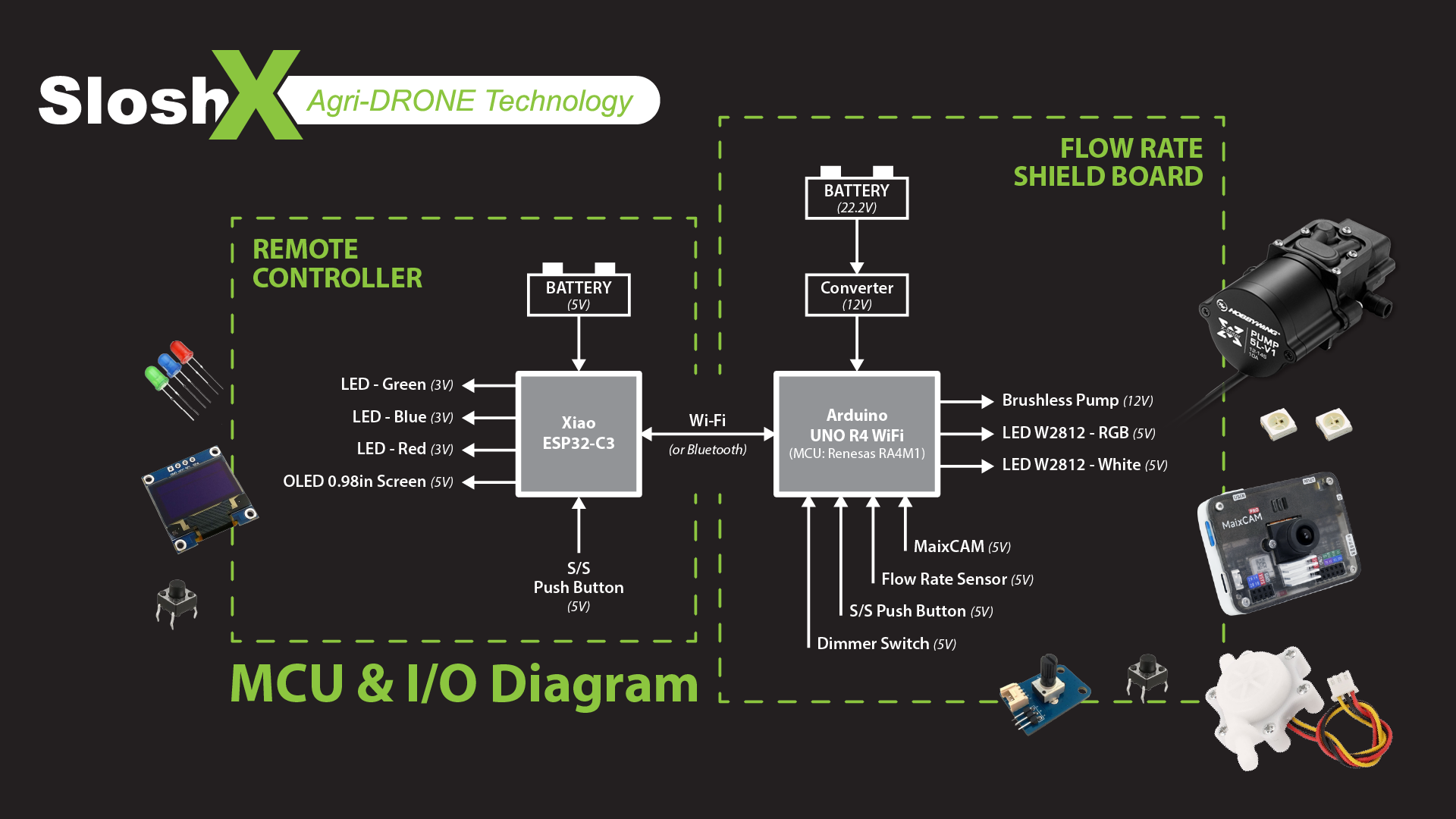
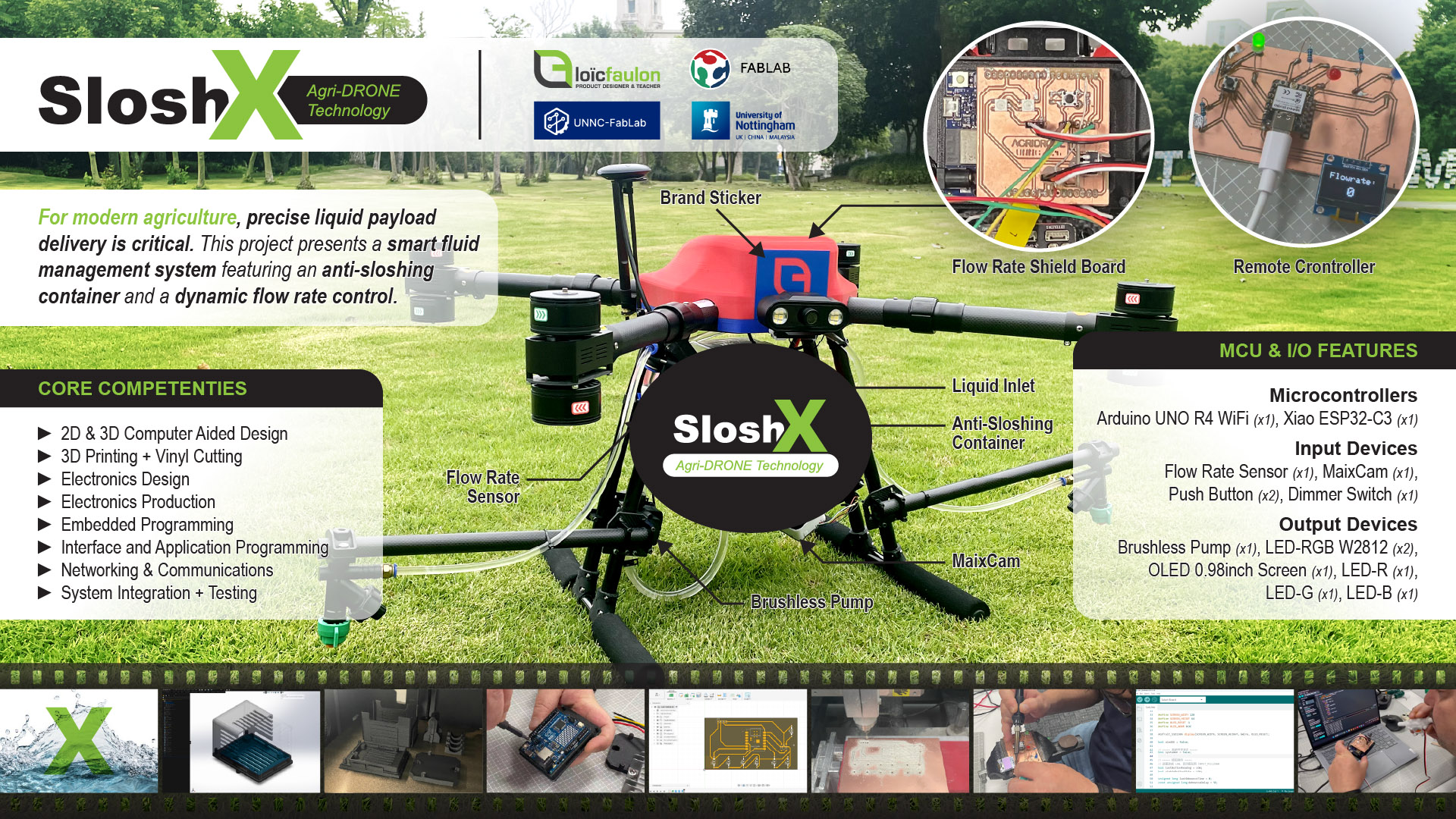
SloshX is a liquid-dispenser demonstrator for agricultural-drone applications. It combines a container assembly, pump, flow-rate sensor, MaixCAM Pro colour-recognition camera, main controller and Bluetooth Low Energy (BLE) remote controller.
The intended functions are to:
- Start and stop liquid dispensing locally or remotely.
- Adjust liquid flow manually.
- Measure flow and communicate operating status through LEDs and a 0.96-inch OLED display.
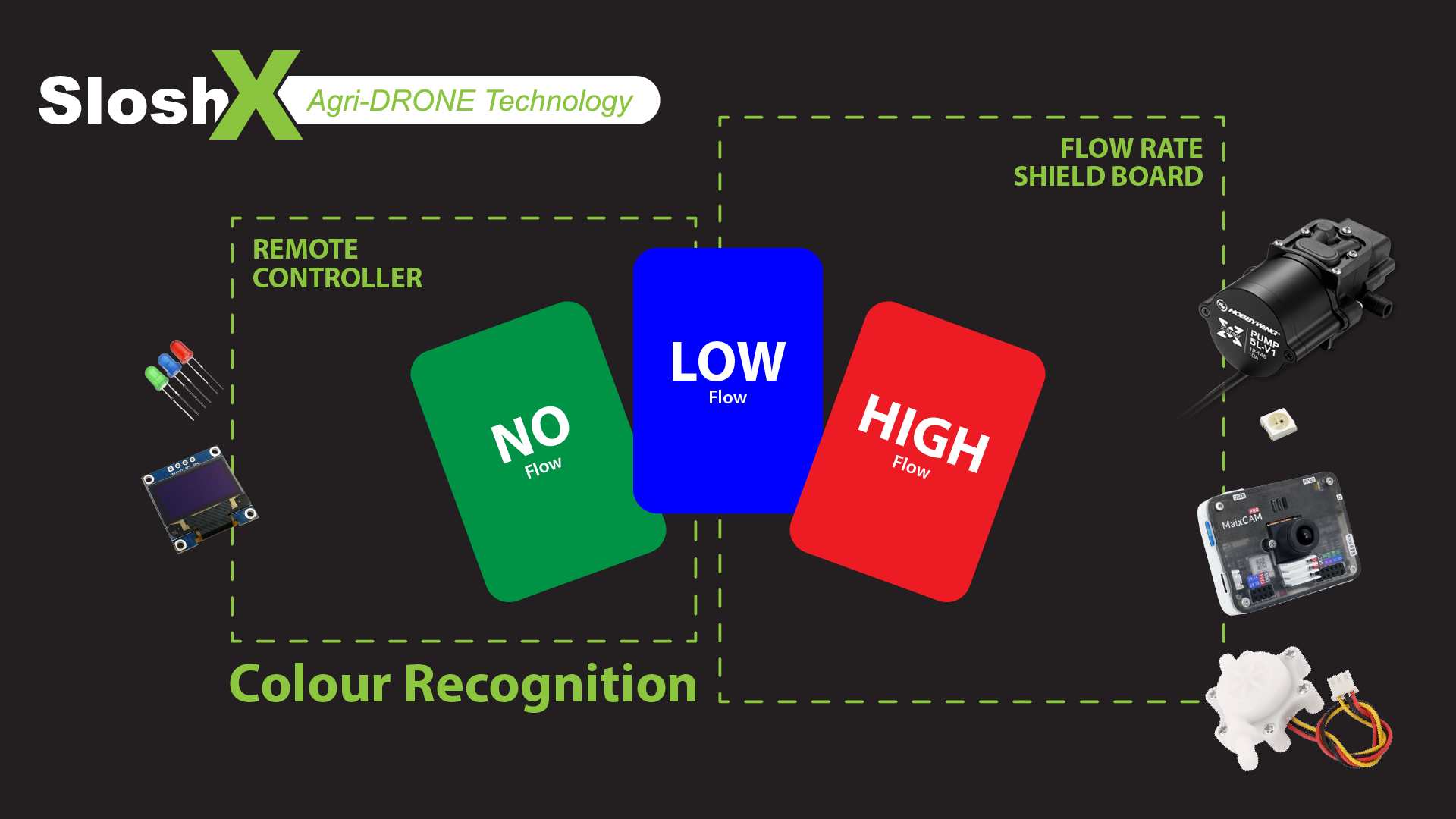
- Use camera-based colour recognition as an input to dispensing control.
The Fab Academy scope was to develop and demonstrate the dispensing and control system. Successful dispensing alone would not establish anti-slosh performance, flight stability or agricultural effectiveness.
Some development work relating to the anti-slosh container remains confidential. This page therefore focuses on the non-confidential design, fabrication and control-system work.
2. Previous Work and Sources
DJI’s Agras T50 provides an existing example of an agricultural drone integrating a liquid tank, delivery pumps and a spraying system. My contribution focused on the custom mechanical parts, electronic boards, interfaces, programming and integration of the SloshX demonstrator.
The technical references for implementation included:
| AREA | DOCUMENTATION |
|---|---|
| Main Controller | Arduino UNO R4 WiFi documentation and getting-started guide. |
| BLE Communication | ArduinoBLE documentation and XIAO ESP32-C3 Bluetooth examples. |
| Remote Controller | Seeed Studio XIAO ESP32-C3 documentation. |
| Camera and Colour Recognition | MaixCAM/MaixPy quick start and colour-block detection documentation. |
3. What I Designed and Made
Where practical, I designed and fabricated project-specific parts rather than purchasing complete assemblies.
| DESIGN/FABRICATION AREA | PROJECT CONTRIBUTION |
|---|---|
| 2D Design | Custom PCB layouts and Logo design for branded sticker. |
| 3D Design | Container/cover components, Arduino enclosure, camera support, camera clamp and component mounts. |
| Additive Fabrication | 3D printing using PLA, PETG-CF and TPU. |
| Subtractive Fabrication | CNC milling the PCB traces and board outline, vinyl cutting the branded sticker |
| Electronics Design and Production | Custom flow-rate shield board and remote-controller PCB, including component assembly and soldering. |
| Embedded Microcontroller Design | A custom remote-controller PCB incorporating the XIAO ESP32-C3 module, start/stop button, three status LEDs and 0.96-inch OLED display. |
| Interfacing and Programming | Flow sensing, camera input, pump control, local controls, status feedback and BLE communication. |
| System Integration and Packaging | Main-controller enclosure, component mounts, connections and cable routing. The remote controller remained unenclosed at the presentation stage. |
I purchased standard components — including the processor boards/modules, camera, sensor and pump — and developed the custom parts needed to connect them into my system. For the drone itself, I used one we already had in-house equipped with a conventional liquid container that I replaced with my new design. The dispensing/control demonstrator was intended to operate independently without requiring the drone to fly.
4. Materials, Sourcing and Cost
My bill of materials (BOM) records component quantities, prices, suppliers and purchasing links. Most items were sourced through Taobao/Tmall. Selected electronic components were listed under JLCPCB, with LCSC product links. (see the downloadable Excel file further below)
| BOM CATEGORY | MAIN ITEMS | RECORDED COST |
|---|---|---|
| Remote Controller | XIAO ESP32-C3, 0.96-inch OLED, button, LEDs, resistors and FR1 board | RMB 47.10 |
| Main Controller and Dispensing Electronics | Arduino UNO R4 WiFi, flow-rate sensor, MaixCAM Pro, pump/switch, dimmer, LEDs, resistor and FR1 board | RMB 966.14 |
| Fabrication Materials | PLA, PETG-CF and TPU (including supports) | RMB 160.59 |
| Miscellaneous | Others | RMB 20.00 |
| ► TOTAL | RMB 1,193.83 |
(Recorded BOM summary, rounded to two decimal places.)
This is a prototype component/material budget, not a complete manufacturing cost. Labour, machine time, delivery, existing equipment and unlisted development waste have not been separately itemised.
SloshX BOM Excel file:
5. Development Plan and Progress
I applied "Spiral" project management: developing initial solutions, testing components and interfaces, and refining successive versions before final integration.
- The schedule below was reconstructed retrospectively from my development records.
| PERIOD | DEVELOPMENT FOCUS |
|---|---|
| 9–22 May | Mechanical concepts, component interfaces and initial iterations. |
| 23 May–5 June | Electronics development, mechanical refinement and main-controller enclosure. |
| Early June | Remote-controller PCB, programming, BLE communication and integrated testing. |
| 6–10 June | Final checks and presentation preparation. |
| 10 June | Online presentation. |
(Retrospective development schedule; activity periods are approximate.)
- These periods match my previous documented work as shown in the Gantt Chart from Week 16 below:
| ACTIVITY | 9–15 May | 16–22 May | 23–29 May | 30 May–5 June | 6–10 June |
|---|---|---|---|---|---|
| Spiral 1: Mechanical Concepts and Initial Tests | ■ | ■ | |||
| Spiral 2: Mechanical Refinement and Electronics Development | ■ | ■ | |||
| Spiral 3: Main-Controller Enclosure and Control Refinement | ■ | ■ | |||
| Remote-controller PCB and programming | ■ | ■ | |||
| System Assembly and Integrated testing | ■ | ■ | |||
| Presentation Preparation | ■ | ||||
| Online Presentation — 10 June | ◆ |
- At the time of completing this documentation:
| PROGRESS CATEGORY | STATUS |
|---|---|
| Completed | All essential parts have been fabricated, boards assembled and subsystems integrated. 😃 |
| Working | All the necessary functions have been demonstrated successfully. 😃 |
| Remaining | Remote-controller enclosure 😦 |
| Next Steps | ... Complete my documentation to get 100% "Completed Units" from my local and global evaluators 😉 😉 😉 |
6. Questions and Evaluation Criteria
I planned to evaluate the demonstrator through observable system behaviour.
| QUESTIONS | EVALUATION METHOD & SUCCESS CRITERION | JUNE 10 |
|---|---|---|
| Can dispensing be controlled locally? | Check that the local button starts/stops dispensing and the dimmer produces an observable change in flow. | 😃 😃 😃 |
| Does remote control work? | Send BLE start/stop commands and check the corresponding pump response. Record repeated trials and any failures. | 😃 😃 😃 |
| Is flow measurement meaningful? | Compare the sensor reading with a measured volume collected over a timed interval and record the difference. | Not done 😦 (Optional 😉) |
| Does colour recognition provide the intended input? | Present the selected colour targets and record whether recognition and the programmed response are correct. | 😃 😃 😃 |
| Is status feedback consistent? | Check that the LEDs and OLED information correspond to the actual operating state. | 😃 😃 😃 |
| Is the system physically integrated? | Check component security, access, cable restraint and leaks. Identify unfinished packaging. | 😃 😃 😃 |
| *Can the demonstrator operate independently?* | Demonstrate dispensing and control using its required power supply and controls, without relying on drone flight. | 😃 😃 😃 |
I believe all important criteria were met for the Fab Academy 2026 programme. The anti-slosh effectiveness would require a separate comparative test (my short coming research project). I did not treat successful dispensing as evidence of reduced sloshing.
I had a GREAT TIME!!!... With up and downs, exhaustive some times (often), but very rewarding afterwards!!!... Thank you to my Local Instructors, the Fab Academy Team in Asia and the "Open Time" on saturdays!!! 😉 😉 😉 😃 😃 😃 THANK YOU