Appearance
FINAL PROJECT
AI-based sensing, control, and operation of a liquid dispenser for agricultural drone
WEEK 1 – Plan and Sketch a Potential Final Project
Potential Final Project Focus (based on my current research projects)
- AI-Based Sensing, Control, and Operations of VTOL Fixed-Wing UAVs for Agriculture
- Main issue to solve: reduce/control liquid sloshing
- Sustainable Indoor Climate Solution: bridging Renewable Energy, Indoor Farming and Experiential Learning for Extreme Heat Mitigation
- Main issue to solve: not defined yet
WEEK 2 – Project Topic Selection
On week 2, I decided to pursue with the "AI-Based Sensing, Control, and Operations of VTOL Fixed-Wing UAVs for Agriculture" project with the following two main challenges:
- Design a liquid container for agricultural drone which can minimise liquid sloshing during operation
- Develop a dynamic flow rate control with crop colour recognition
First Concept Sketch (Confidential) 😉
Inspiration (Confidential) 😉
Initial "Constraints"
Available Drone #1
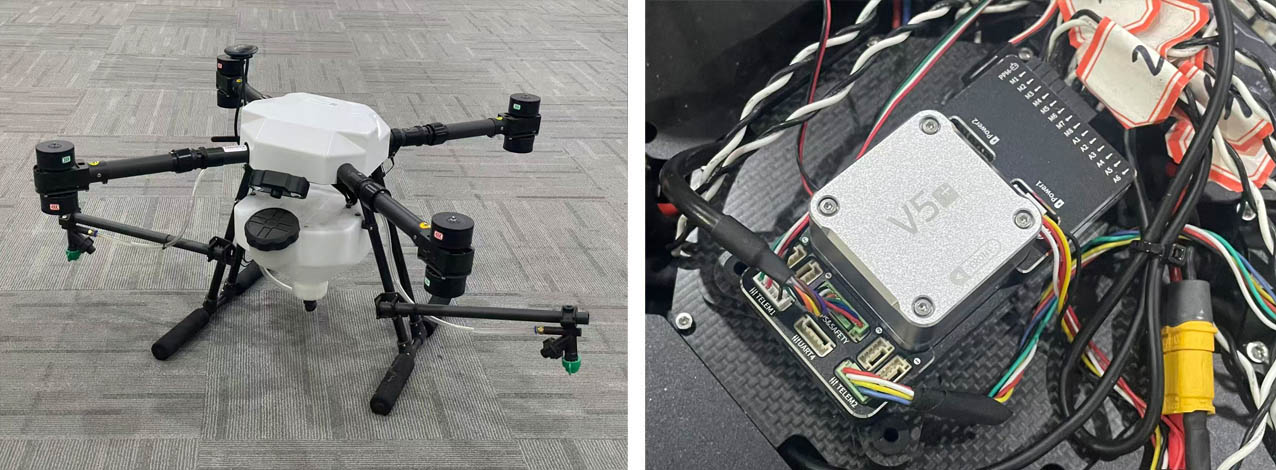
Available Drone #2
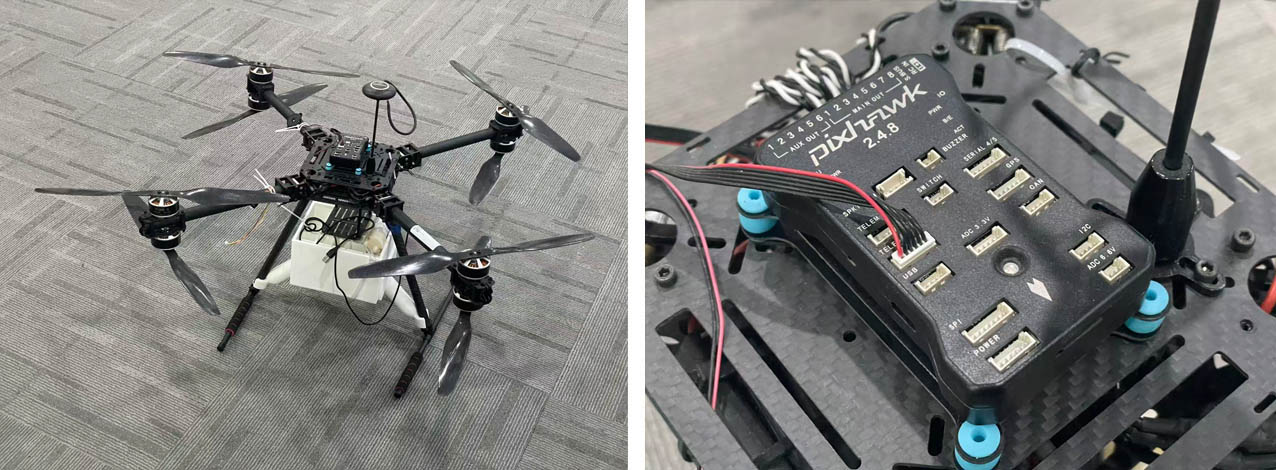
WEEK 5 – Plan and sketch a potential final project
Diagrams


Final Project Summary
SloshX is a liquid-dispenser demonstrator for agricultural-drone applications. This section brings together the key information from my Week 16, 18 and 19 documentation.
1. Project Overview
What does it do? SloshX starts and stops liquid dispensing, either locally or remotely. Liquid flow can also be adjusted by hand. The main controller is an Arduino UNO R4 WiFi with my custom flow-rate shield board. It has a start/stop button, a dimmer for manual flow adjustment and two RGB LEDs: one shows flow status in red, green or blue, and the other gives white light when the system is on. It also connects to a flow-rate sensor, a MaixCAM Pro colour-recognition camera and a brushless pump. A separate remote controller, a custom XIAO ESP32-C3 PCB, communicates with the main controller via Bluetooth Low Energy (BLE). It provides remote start/stop, three status LEDs and a 0.96-inch OLED display showing flow status. The demonstrator works independently, without the drone needing to fly.
Who has done what beforehand? DJI's Agras T50 already combines a liquid tank, delivery pumps and a spraying system on an agricultural drone. My contribution is the custom mechanical parts, electronic boards, interfaces, programming and integration of the SloshX demonstrator.
What sources did I use? Arduino UNO R4 WiFi and ArduinoBLE documentation, Seeed Studio XIAO ESP32-C3 documentation and Bluetooth examples, and MaixCAM/MaixPy colour-block detection documentation.
What did I design and make?
- 2D design: Custom PCB layouts and a logo for a branded sticker.
- 3D design: Container/cover components, Arduino enclosure, camera support and clamp, and component mounts.
- Electronics: Custom flow-rate shield board and remote-controller PCB, both assembled and soldered by me.
- Programming: Flow sensing, camera input, pump control, local controls, status feedback and BLE communication.
- Bought or existing: Processor boards/modules, camera, sensor and pump were purchased. The drone was an existing in-house unit; I replaced its conventional container with my own design.
What processes were used? 3D printing (PLA, PETG-CF, TPU), CNC milling of PCB traces and outlines, vinyl cutting, electronics design and production, embedded programming, and system integration and packaging.
2. Bill of Materials (summary)
| Category | Main items | Cost |
|---|---|---|
| Remote controller | XIAO ESP32-C3, 0.96-inch OLED, button, LEDs, resistors, FR1 board | RMB 47.10 |
| Main controller and dispensing electronics | Arduino UNO R4 WiFi, flow-rate sensor, MaixCAM Pro, pump/switch, dimmer, LEDs, resistor, FR1 board | RMB 966.14 |
| Fabrication materials | PLA, PETG-CF, TPU (including supports) | RMB 160.59 |
| Miscellaneous | Others | RMB 20.00 |
| Total | RMB 1,193.83 |
Most items were sourced through Taobao/Tmall, and some electronic components through JLCPCB/LCSC. This is a prototype component and material budget, not a full manufacturing cost. Full details: Wk18-SloshX-BOM-(All)-(v1).xlsx
3. Evaluation and Results
| Question | Result |
|---|---|
| Local start/stop and manual flow adjustment | Working |
| Remote BLE start/stop | Working |
| Colour recognition as a dispensing input | Working |
| LEDs and OLED match the operating state | Working |
| Physical integration (security, access, cables, leaks) | Working |
| Independent operation without drone flight | Working |
| Flow-sensor reading compared with measured volume | Not done (optional) |
What worked: All essential parts were fabricated, the boards assembled and the subsystems integrated. One integration issue with the sensor/camera/pump response was found and fixed.
What didn't / remaining: The remote controller has no enclosure yet.
Implications: A working demonstrator is not a validated product. Anti-slosh performance, user demand and commercial potential need separate evidence. The confidential anti-slosh invention is not shown publicly; patent applications are in preparation, and a Proof of Concept funding application has been submitted.
4. Development Pages
Week 16: System Integration: packaging, enclosure, mounts, BLE subsystems and integrated testing.
Week 18: Applications and Implications + Project Development: scope, sources, BOM, schedule and evaluation.
Week 19: Invention, Intellectual Property, and Income: dissemination, IP, funding and lessons learned.
5. Files and Licence
CAD, ECAD and code files: see Week 16 Reference Files. (Scroll-down to the end of the webpage.)
LICENCE: This project's original, non-confidential documentation, design files and code are licensed under CC BY-NC-SA 4.0. No patent or trademark rights are granted. Third-party code and libraries retain their original licences.**
WEEK 20 – Final Presentation Material
Poster
