
Week 18 — Applications & Implications; Project Development
Group assignment
- There was no group assignment for this week.
Individual assignment
- Plan a final project masterpiece that integrates the range of units covered; prepare drafts of the final project summary slide and video clip, and ensure they are linked in the final presentation schedule.
Learning outcomes
- Define the scope of a project.
- Develop a project plan including a schedule and a bill of materials (BOM).
- Track the progress of the project.
- Summarise and communicate the essence of the project development.
Checklist
- What will it do?
- Who has done what beforehand?
- What sources will you use?
- What will you design?
- What materials and components will be used?
- Where will they come from?
- How much will they cost?
- What parts and systems will be made?
- What processes will be used?
- What questions need to be answered?
- How will it be evaluated?
- Prepare a summary slide and video clip.
Documentation
Applications and implications
This page defines the scope, required parts, fabrication processes, cost, open questions, and evaluation criteria for my final project, Seebscribe. It connects the original idea of sharing a heartbeat with the practical work needed to produce and evaluate a complete wearable prototype.
What will it do?
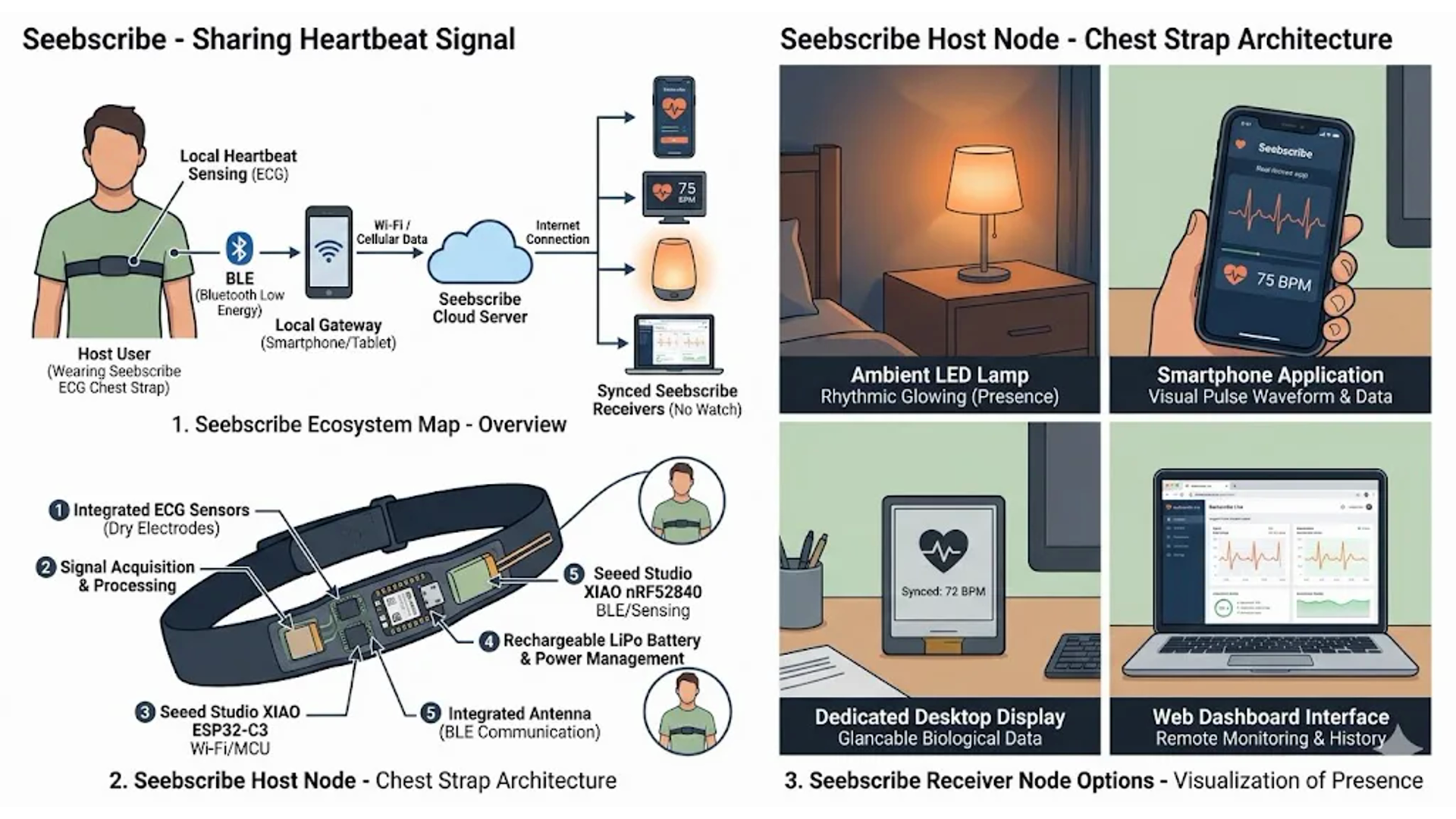
Seebscribe is an open-source wearable ECG device that captures electrical heart signals and streams them wirelessly to a live dashboard. The project explores how biometric data can be shared in real time, allowing users to visualize and communicate their heartbeat with others.
Unlike traditional health-monitoring devices, Seebscribe is not designed only to measure heart activity. It also explores heartbeat sharing as a new form of communication. The device combines sensing, embedded electronics, networking, mechanical packaging, and visualization in one compact wearable system.
This prototype is an experimental and creative device, not a certified medical instrument. Its purpose is to demonstrate live signal capture and communication, rather than provide medical diagnosis.
Who has done what beforehand?
Commercial ECG monitors, Holter monitors, chest straps, and wearable fitness trackers have existed for many years. Open-source ECG experiments using ESP32 microcontrollers and AD8232 sensor modules are also widely available. These projects demonstrate that a small embedded system can acquire and transmit a heartbeat signal.
My contribution is a fully integrated wearable prototype developed through Fab Academy processes. It combines a custom carrier PCB, embedded programming, 3D-printed packaging, an elastic chest mounting system, wireless communication, and a custom real-time ECG visualization dashboard. The focus is on making the signal open and available for creative communication instead of locking it inside a proprietary fitness application.
What sources will I use?
- Official documentation and pinout information for the XIAO ESP32-C3.
- AD8232 documentation and reference circuits for ECG signal acquisition.
- ESP32 networking, wireless communication, and embedded programming documentation.
- Fab Academy documentation for electronics design, PCB production, 3D printing, networking, interface development, and system integration.
- Existing commercial and open-source ECG projects as references for signal quality, electrode placement, wearable construction, and data presentation: SparkFun AD8232 Hookup Guide, SparkFun AD8232 hardware repository, AD8232 datasheet, ArduinoAD8232ECG open-source dashboard, Polar H10 product specifications, and the Polar H10 technical manual.
- My own experiments and documentation from the electronics, networking, interface, and system-integration assignments.
The broader project background is documented on the final project page, while the physical packaging and complete wearable assembly are documented in Week 16 — System Integration.
What will I design?
- A custom ECG carrier PCB.
- A wearable 3D-printed enclosure and fitted cover.
- A chest-strap mounting and electrode connection system.
- Embedded firmware for reading and transmitting the ECG signal.
- A wireless communication system between the wearable and receiving device.
- A real-time ECG dashboard for displaying the waveform and heartbeat information.
What materials and components will be used?
Electronics
- XIAO ESP32-C3 microcontroller.
- AD8232 ECG sensor module.
- 3.7 V LiPo battery.
- Copper-clad material for the custom PCB.
- Connectors, headers, electrodes, wires, and an on/off connection.
Mechanical components
- 3D-printed enclosure and cover.
- Elastic chest strap.
- Metal snap fasteners that connect the enclosure and body-contact electrodes.
- Screws, fastening hardware, insulation, and low-temperature 3D-pen filament for reinforcement.
Where will the materials and components come from?
The XIAO board, ECG sensor, battery, connectors, wiring, strap, and fastening hardware are purchased standard components or parts already available in the laboratory. The PCB is milled from copper-clad stock in the Fab Lab. The enclosure and cover are produced from standard 3D-printing filament, while the carrier board, embedded code, dashboard, and mechanical layout are designed and made as part of the project.
What parts and systems will be made?
Some electronic modules are purchased because fabricating the microcontroller, ECG integrated circuit, and LiPo cell themselves is outside the project scope. The project-specific parts are designed and produced by me:
- The custom milled carrier PCB and its electrical routing.
- The integrated enclosure, cover, snap positions, and strap attachment.
- The firmware that samples and transmits the ECG data.
- The wireless data workflow.
- The live visualization dashboard.
- The complete mechanical and electrical system integration.
What processes will be used?
- Electronic design and schematic development.
- PCB layout, milling, drilling, soldering, and testing.
- 3D CAD modeling and iterative enclosure design.
- 3D printing and local reinforcement with a low-temperature 3D pen.
- Electronics assembly and cable management.
- Embedded programming and signal sampling.
- Networking and wireless communication.
- Interface development and real-time data visualization.
- Wearable testing and complete system integration.
How much will it cost?
| Item | Estimated cost (RMB) |
|---|---|
| XIAO ESP32-C3 | ¥27 |
| AD8232 ECG sensor | ¥20 |
| LiPo battery | ¥10 |
| PCB materials | ¥5 |
| Connectors and wiring | ¥5 |
| Strap and hardware | ¥10 |
| 3D-printing materials | ¥5 |
| Estimated total | ¥82 |
The estimated material cost is approximately ¥82 RMB. This does not include machine operation, tools, development time, failed prototypes, or repeated fabrication during design iterations.
Project development plan
- Signal validation: test electrode placement and confirm that the AD8232 produces a readable ECG signal.
- Electronics integration: design, mill, assemble, and debug the custom carrier PCB.
- Communication: transmit live samples from the XIAO ESP32-C3 to the receiving computer.
- Interface: develop and test the real-time ECG dashboard.
- Mechanical integration: iterate the enclosure, snap positions, component arrangement, and chest-strap attachment.
- Final testing: operate the device from its battery, wear it, verify the complete data path, and document the result.
- Presentation: prepare the summary slide, demonstration video, project page, and final presentation materials.
What questions remain?
- How reliable is the ECG signal while the user is moving?
- How comfortable is the wearable design during extended use?
- How closely do the calculated heart-rate values match a reference device?
- How can electrode contact, filtering, and cable placement reduce motion noise?
- How long can the system operate from its battery?
- How can heartbeat sharing become a meaningful form of communication?
- What additional biometric information could be shared in future versions?
How will it be evaluated?
The project will be considered successful if it can:
- Capture a recognizable ECG signal from a user.
- Process and stream the data wirelessly in real time.
- Display live heartbeat information on a dashboard.
- Operate from its own battery as a standalone wearable device.
- Remain mechanically assembled and attached to the chest strap during a demonstration.
- Demonstrate successful integration of electronics, digital fabrication, programming, networking, and interface design.
Evaluation will focus on whether the complete workflow functions reliably: electrodes to sensor, sensor to controller, controller to wireless connection, wireless data to dashboard, and all components into the wearable enclosure. Medical-grade accuracy is outside the scope of this prototype.
Future development
Seebscribe is intended to remain open source. Future versions may improve signal quality, filtering, battery life, enclosure comfort, electrode contact, and the communication experience. Additional biometric sensors or wearable feedback systems could also be integrated.
The long-term goal is to explore new ways of sharing physiological information between people, allowing heartbeats and other biological signals to become part of digital communication and human connection.
Presentation drafts
The following files are the current summary-slide and video locations used for the final project presentation. They can be replaced with the final exported versions while keeping the same filenames and links.
Reflection
This planning exercise helped me separate the core function from possible future features. The essential project is a complete wearable path from the body signal to the live dashboard. Signal reliability, wireless transmission, independent power, and physical integration must work before adding more advanced sharing modes.
I also learned that the final result depends on relationships between many small systems. Electrode placement affects signal quality, the PCB affects enclosure dimensions, the enclosure affects comfort, and the data format affects the dashboard. Defining the evaluation criteria makes it clearer which problems must be solved for the final prototype and which improvements can remain future work.