Final
Links
Questions
What does it do?
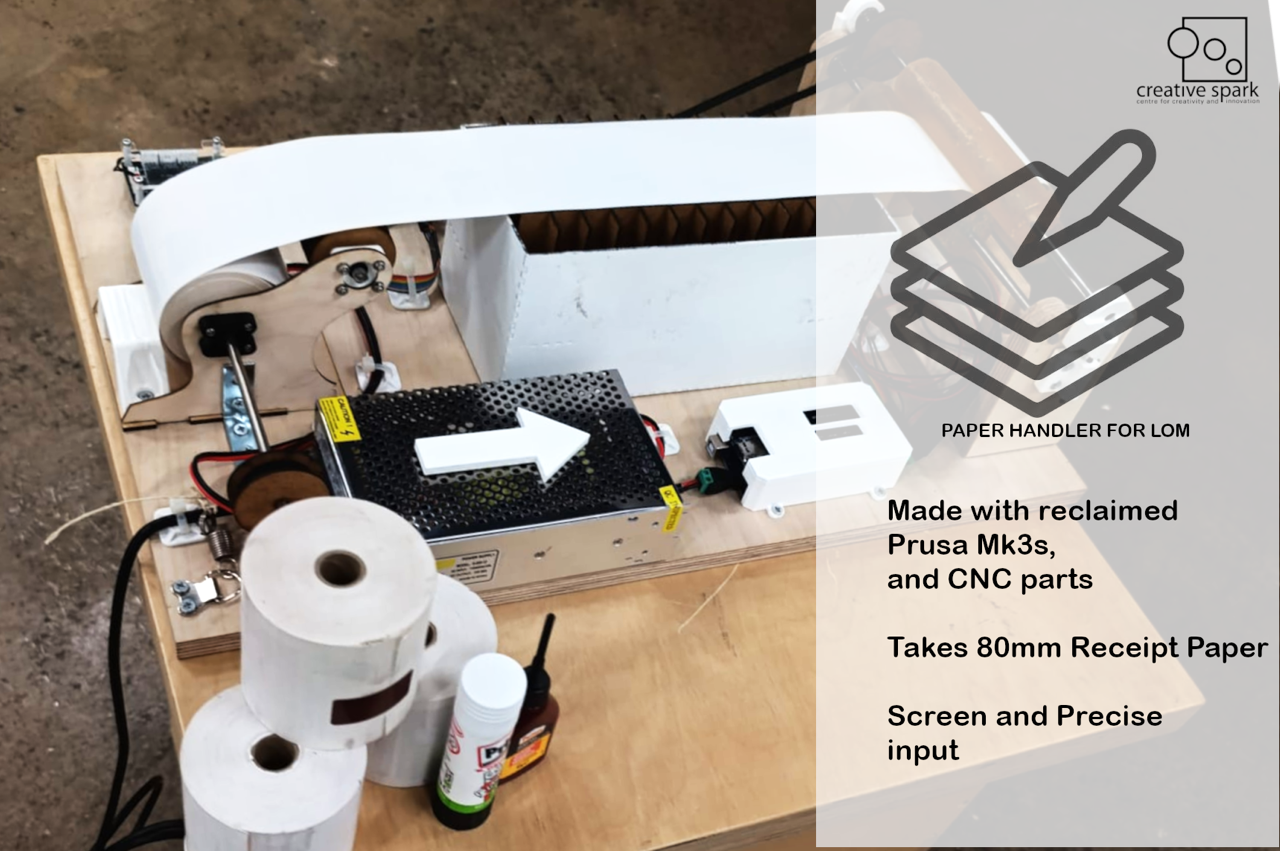
It is a paper-handler, not unlike a “rotary tool”, for using inside a laser cutter. The original intention was to build a paper 3D printer, and this is one of the steps in the process.
* Additional documentation on the System integration (Week 15) page.
Who’s done what beforehand?
LOM machines by Helisys Inc., patent expired. LOM (SDL or colour 3D) machines by M-Cor. Many examples of stacked/sliced models. Incl. this project on Printables.com, by user @JindrichCerny_999259.
What sources did you use?
- Helisys and Mcor LOM machines, as the reference for how paper stacking and cutting works.
- This Printables project above, was initial inspiration.
- Boxes.py, for various laser cut parts.
- 3D printed handles by Emkatech (Mike).
- AI
- Fab Academy lectures and documentation.
What did you design?
Initially, and for the Midterm assignment, I did a more complex design, and set out a number of itterations. I got to somewhere between version 0.3 and version 0.4.
The machine now moves the paper, but still requires manual intervantion to jog it onwards.
Designed: the frame and rod supports, the wiring mounts, the electronics enclosures, the number-tag typeface used for assembly, and the Grasshopper scripts to generate the cutting files.
What materials and components were used?
Salvaged mechanical parts, stepper motors rods and bearings from old printers Full BOM
Where did they come from?
The laser module came from Laser Tree, which I think is in Shenzhen, CN. The Duroflex came from Northern Ireland, MFS, which is a very popular company for resins and fibreglass materials.
How much did they cost?
The laser module was the most expensice part, which I believe was €82.58 incl. VAT. (And there was €25 delivery from Digikey Marketplace) Exlcuding salvaged parts, a little less than €220.
What parts and systems were made?
Custom scripts in Grasshopper (and an attempt in FreeCAD, but it’s not solved yet).
Laser cut parts made use of Boxes PY, customised from templates. And original parts designed in Inkscape and Rhino.
3D printed components, were mostly original designs. 3D printed handles by Emkatech (Mike) added at the end.
What tools and processes were used?
- Electronics design, input, output and production including manual SMD.
- CNC cutting for the frame,
- Laser Cutting for the smaller brackets,
- 3D Printing,
- Casting,
- AI, documented in respective parts of this site. Used for generating code, and researching electronic components.
- Embedded programming (Arduino Mega, SD card reader) and Grasshopper scripting for the interface and cutting files,
What questions were answered?
- Can I save pins, so I can use the Xiao ESP32C3? (with a resistance ladder) No. Multiple button presses were too complicated. I ended up resorting to an Arduino Mega. with a shield.
- Can the machine control the paper? Once set up, the paper rolls pretty easily. Sometimes the paper overruns.
- Can tabs keep the cut pieces in place until assembly? Only inconsistently. Intersections on every slice are too expensive for 0.4mm layers, computationally. I will try other scripts.
- Can I number each cut to help assembly? I made a custom typeface so that compound paths weren’t moved incorrectly in my script.
What worked?
- Paper on the roller is stable, and the rollers can be adjusted with a bolt to adjust one wheel.
- The SD card reads successfully on the Arduino Mega.
- The structure: rigid plywood base, wiring mounts, handles (survived a small drop test), and 3D printed enclosures.
- Number tags on each cut.
And What didn’t?
- The paper skews with use, and is hard to fix.
- The paper rolls too easily - added a breaking system (friction on the paper roll).
- Tabs are inconsistently placed.
- The machine still needs manual intervention to jog the paper onwards.
- No integrated cutting/motion system, no full enclosure yet.
How was it evaluated?
- the paper moves and cuts as intended?
- the cut files includes number tags for assembly?
- the system runs consistently for the duration of a job, and cycles, doesn’t burn out if left on
- someone else can use it?
What are the implications?
Paper is cheap and plentiful, so a low-cost LOM-style machine could make layered fabrication accessible to makers and Fab Labs. It’s not consumer-ready. It’s for tinkerers, and people to develop further, which is why I’m releasing it under CC BY-SA 4.0 (code under GPL, see Week 18). Cutting paper with a laser is also a fire and fumes risk, so an enclosure is needed before it can be used unattended.