Week 19 - Invention, Intellectual Property & Income
After months of debugging ESP32 networks, routing custom PCBs, and tuning acoustic geometries, my electro-acoustic Morin Khuur is finally a working reality. The physical strings are resonating, the I2S microphone is capturing the raw audio, and the Web UI is reacting perfectly in real-time.
However, as we learned throughout Fab Academy, building a functional prototype is only the first half of the journey. Week 19 forces us to step out of the "maker" mindset and adopt the perspective of an inventor. I had to ask myself a critical question: What happens to this instrument now that the program is ending?
This project is unique because it is not just a standard IoT gadget; it is a fusion of traditional Mongolian cultural heritage and modern digital fabrication (3D printing, CNC, and embedded software). Because of this dual nature—having both a physical acoustic body and a digital, open-source soul—deciding how to share it with the world, protect its intellectual property, and potentially turn it into a sustainable business is actually a very complex challenge.
Intellectual Property (My Licensing Strategy)
Because this project is a hybrid of a physical acoustic instrument and a digital interface, a single license doesn't cover all my concerns. I need to protect the cultural integrity of the physical instrument while embracing the collaborative spirit of the software world. Therefore, I chose a Dual Licensing approach:
For the Physical Design & Hardware: CC BY-NC-SA 4.0
I am releasing all the 3D STL files, CNC routing parametric files, and PCB gerbers under the Creative Commons Attribution-NonCommercial-ShareAlike 4.0 International License.
-
The Reason: The Morin Khuur is not just a structural object; it carries the beautiful, soulful timbre of Mongolian cultural heritage. My biggest fear is that a large manufacturing factory might take my 3D models and mass-produce cheap, shoddily made plastic replicas to make a quick profit.
-
The Impact: A poorly manufactured version would ruin the acoustic resonance and compromise the visual LED effects. More importantly, it could give the public a completely wrong and disrespectful impression of what a Morin Khuur actually sounds and looks like.
-
The Rule: By using the "NonCommercial" (NC) clause, I ensure that makers, students, and musicians can download, 3D print, and modify the physical design for personal joy and education. However, mass commercial production is strictly prohibited. If others improve upon my physical design, they must share it under the exact same terms (ShareAlike).
For the Software & Firmware: MIT License
The ESP32-C3 firmware, the FFT audio processing code, and the WebSocket Web Dashboard are released under the MIT License.
-
The Reason: My entire journey in Fab Academy—learning to code, parsing data, and building interfaces—relied heavily on the generosity of the open-source community. I want to respect and contribute back to that culture.
-
The Goal: I want more people to experience the pure joy and inspiration that happens when traditional music meets modern technology. By keeping the software fully open and unrestricted, I hope other creators will join in. They can take my FFT visualizer code and apply it to a guitar, a violin, or a completely new interactive art installation. I want the digital soul of this project to be as free and adaptable as possible.
Dissemination Plan (Sharing it with the World)
To ensure this project doesn't just collect dust on a lab shelf, my primary goal is active dissemination. Because this instrument bridges digital fabrication and traditional art, my strategy targets both the maker community and the professional music world.
-
The Open-Source Foundation (GitLab & GitHub): The core of dissemination is accessibility. The complete source files—including the 3D STL files, PCB Gerber files, and ESP32 firmware—will permanently live in my Fab Academy GitLab repository. I will also mirror this to a public GitHub repository with a highly detailed
README.mdand assembly guide to encourage community forks and pull requests from other tech-art enthusiasts. -
Audio-Visual Storytelling (Social Media & YouTube): Text and code cannot fully capture the soul of a musical instrument. I am producing a high-quality showcase video demonstrating the rich acoustic timbre of the Morin Khuur side-by-side with the real-time LED and Web UI reactions. Sharing short, high-impact clips of the instrument reacting to traditional Mongolian melodies on platforms like YouTube, Instagram, and Hackaday will visually demonstrate the magic of the project.
-
Physical Exhibitions (Maker Faires & Art Spaces): An instrument must be touched and heard in person. I plan to take the electro-acoustic Morin Khuur on the road to events like Maker Faire and local technology-art exhibitions. Setting it up as an interactive booth where attendees can pluck the strings and instantly see the digital visualizer react will be the most powerful way to spread the concept.
-
Seeding to Professional Musicians: The ultimate validation for this project is having real musicians play it. I plan to reach out to professional folk and world-music artists, offering them the instrument for jam sessions or studio recordings. When a respected artist plays the Morin Khuur and shares it with their audience, it provides organic, high-credibility dissemination that reaches far beyond the engineering community.
Income & Business Model
While my primary motivation is cultural preservation and maker education, I recognize that for a project to grow, evolve, and reach more people, it needs to be financially self-sustaining. I have designed a brief multi-tiered business model that respects the open-source nature of the project while generating income across different markets.
Tier 1: The Maker & Hobbyist Market
-
Revenue Stream 1: "Digital Morin Khuur" DIY Maker Kits During my own Fab Academy journey, I realized that one of the biggest barrier to entry for hardware projects is sourcing specific components. Buying M3 heat-set inserts, specific acoustic foam tapes, LiPo batteries, and custom PCBs from different vendors is exhausting. My entry-level business model is to sell a curated DIY Kit. It will include the pre-milled wooden neck, populated PCBs, LED strips, and all necessary hardware. Users simply download my free STL files, 3D print the resonance box themselves, and enjoy the assembly process. This solves the supply chain headache for the user while providing a steady margin of profit.
-
Revenue Stream 2: Cultural Tech Workshops Building the instrument is only half the magic; the other half is playing it. I plan to host weekend Maker Bootcamps for parents, children, and tech enthusiasts. Participants will pay a workshop fee to spend a weekend assembling their own electro-acoustic Morin Khuur, learning basic soldering, flashing the ESP32, and concluding with a basic music lesson on how to play a traditional Mongolian melody. This shifts the model from selling a "product" to selling a premium "educational experience."
Tier 2: The Professional Music & Performance Market
-
Revenue Stream 3: Interactive Digital Concerts The highly visual nature of this instrument—with its integrated 160-LED array and real-time Web UI—makes it a ready-made performance art piece. I plan to organize and perform in "Digital Concerts" where the acoustic sound of the Morin Khuur directly drives immersive stage lighting and visual projections. Revenue will be generated through ticket sales, performance booking fees, and cultural arts grants aimed at modernizing traditional heritage.
-
Revenue Stream 4: Custom Commissions for Professional Musicians While the DIY kits serve the maker community, there is a distinct market for high-end, stage-ready instruments. I intend to collaborate with professional Mongolian folk, rock, or world-music bands, offering a bespoke service to build ruggedized, tour-ready versions of the electro-acoustic Morin Khuur. Securing premium custom commission fees from professional musicians not only generates income but acts as the ultimate organic sponsorship, giving the project massive credibility.
Tier 3: The B2B Institutional Market
- Revenue Stream 5: Cultural Exhibitions & STEAM Education Because this instrument beautifully translates invisible audio data into light, it serves as a perfect interactive exhibit. I can lease or sell fully built instruments to cultural heritage museums, modern art galleries, or tech expos as standalone interactive installations. Furthermore, the unique combination of acoustic physics, 3D printing, and embedded coding can be packaged into a comprehensive STEAM (Science, Technology, Engineering, Art, and Math) curriculum and licensed to educational institutions.
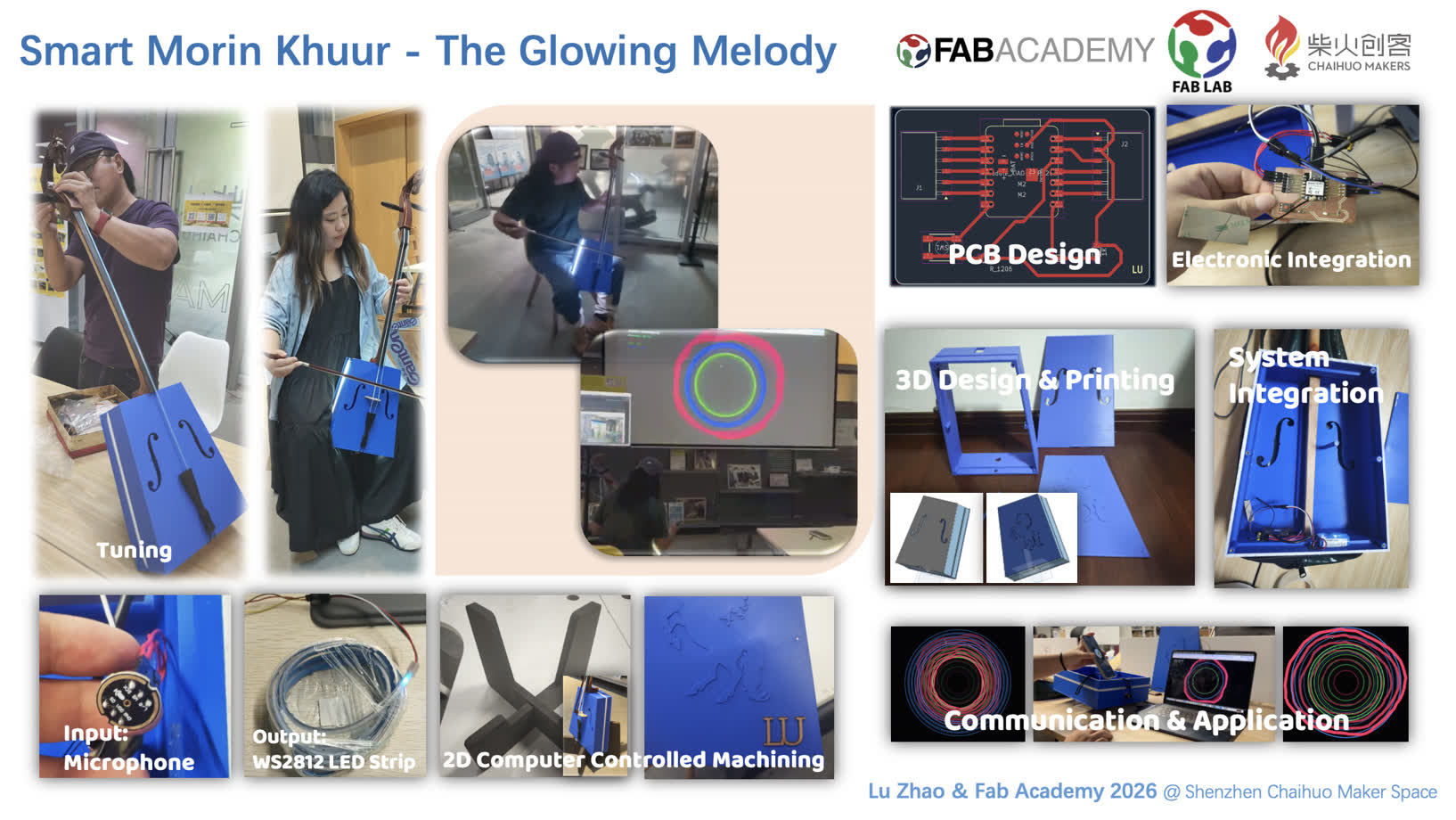
Final Project Presentation Drafts
Slide:
https://fabacademy.org/2026/labs/chaihuo/students/lu-zhao/presentation.png
Video:
https://fabacademy.org/2026/labs/chaihuo/students/lu-zhao/presentation.mp4