PROJECT DEVELOPMENT
18
Project Development
Project documentation of the Pill Dispenser
View Details
Intellectual Property (IP) refers to the legal rights that protect creations, inventions, designs, written work, branding, and other original ideas developed by individuals or organizations.
Intellectual Property is explained by the World Intellectual Property Organization (WIPO) as :
“Intellectual property (IP) refers to creations of the mind, such as inventions; literary and artistic works; designs; and symbols, names and images used in commerce.”
Since Fab Academy projects combine electronics, design, software, fabrication, and documentation, understanding Intellectual Property is important when deciding how a project can be shared, modified, or commercially used.
A patent is an exclusive right granted for an invention. Patents benefit inventors by providing them with legal protection of their inventions. However, patents also benefit the society by providing public access to technical information about these inventions, and thus accelerating innovation.
A patent protects the functional and technical aspects of an invention. It gives the inventor exclusive rights to manufacture, use, or sell the invention for a limited period of time.
For MediBee, possible patent-related elements could include the pill dispensing mechanism, rotating compartment system, automated dispensing workflow, and integration between hardware and firmware.
At the current stage, MediBee is developed as an educational prototype within Fab Academy, and no patent application has been filed.
Patents may be granted for inventions in any field of technology, from an everyday kitchen utensil to a nanotechnology chip. An invention can be a product – such as a chemical compound, or a process, for example – a process for producing a specific chemical compound. Many products, in fact, contain a number of inventions. For example, a laptop computer can involve hundreds of inventions, working together.
The patent owner has the exclusive right to prevent or stop others from commercially exploiting the patented invention for a limited period within the country or region in which the patent was granted. In other words, patent protection means that the invention cannot be commercially made, used, distributed, imported or sold by others without the patent owner's consent. If such acts are carried out by third parties without such consent, the patent owner can go to court to seek remedies for patent infringement.
To obtain a patent, an inventor should draft a patent application and then submit it to a national or regional intellectual property (IP) office. This process includes several steps and entails diverse costs, depending on the regional or national laws of the country or countries in which the application is filed.
An invention can be protected in one or multiple countries, depending on the business strategy and financial resources of the inventors.
In India, patents are governed by the Patents Act, 1970 (amended in 2005) and administered by the Office of the Controller General of Patents, Designs & Trade Marks (CGPDTM). A patent in India is valid for 20 years from the date of filing.
India has four regional patent offices that accept applications:
Before filing, verify that your invention meets the three core criteria under the Patents Act:
Search existing patents and publications to confirm your invention is genuinely novel. Useful databases include:
Applications are filed online through the Indian Patent Office e-filing portal (ipindiaonline.gov.in). There are two types of applications:
Key documents required:
After 18 months from the date of filing (or priority date), the application is automatically published in the Official Journal of the Patent Office. The applicant can also request early publication by filing Form 9 with the prescribed fee.
Publication alone does not trigger examination. The applicant must file a Request for Examination (Form 18) within 48 months from the date of filing. Without this request, the application is treated as withdrawn.
A Patent Examiner reviews the application and may issue a First Examination Report (FER) citing objections related to novelty, inventive step, or formal requirements. The applicant must respond to the FER within 12 months of its issuance, providing clarifications or amendments to the claims.
Once all objections are resolved and the Controller is satisfied, the patent is granted and registered. The grant is published in the Official Journal of the Patent Office. The patent is valid for 20 years from the filing date, subject to payment of annual renewal fees.
Fees vary based on the type of applicant. As of the current schedule:
The complete fee schedule is available on the official Indian Patent Office website at ipindia.gov.in.
| Stage | Timeframe |
|---|---|
| Filing Date (Priority Date Secured) | Day 0 |
| Complete Specification (if provisional filed) | Within 12 months |
| Automatic Publication | 18 months from filing |
| Request for Examination (RFE) Deadline | Within 48 months from filing |
| Response to FER | Within 12 months of FER |
| Patent Grant | Upon clearance of all objections |
| Patent Validity | 20 years from filing date |
Patent applications in India are filed online through the Indian Patent Office e-filing portal. The portal allows inventors to submit provisional and complete applications, pay fees, track application status, and respond to examination reports.
Apply on the Indian Patent Office e-Filing PortalAdditional official resources:
A patent granted in India only provides protection within India. If an inventor wants to protect their invention in other countries, separate applications must be filed in each jurisdiction — or a single international application can be filed through a treaty system.
The Patent Cooperation Treaty (PCT), administered by the World Intellectual Property Organization (WIPO), is the most widely used route for seeking patent protection in multiple countries simultaneously. A single PCT application, filed in one language, can cover over 150 member countries.
An Indian applicant can file a PCT application through the Indian Patent Office, which acts as a Receiving Office. The application must be filed within 12 months of the Indian priority date to retain the original filing date internationally.
WIPO arranges for an International Searching Authority (ISA) to conduct a prior art search and issue an International Search Report along with a written opinion on the patentability of the invention. This gives the applicant early feedback before entering individual countries.
Within 30 months from the priority date, the applicant must enter the national phase in each country where protection is desired. This involves paying national fees, providing translations where required, and appointing local patent agents in each jurisdiction.
In addition to the PCT route, several regional patent offices allow a single application to cover multiple countries within that region:
An applicant can also file directly in the patent office of any country where protection is sought, without using the PCT route. This is generally cost-effective for one or two countries but becomes complex when targeting many jurisdictions simultaneously. Common direct-filing destinations include:
Key consideration: International patent protection requires significant investment — translation costs, national filing fees, and local agent fees can add up quickly. Inventors typically prioritize the markets where commercial activity is most likely, rather than filing everywhere at once.
“Copyright (or author’s right) is a legal term used to describe the rights that creators have over their literary and artistic works. Works covered by copyright range from books, music, paintings, sculpture, and films, to computer programs, databases, advertisements, maps, and technical drawings.”
All project documentation and design work created for MediBee automatically belongs to the creator once it is produced.
“A trademark is a sign capable of distinguishing the goods or services of one enterprise from those of other enterprises. Trademarks are protected by intellectual property rights.”
A trademark protects names, logos, symbols, or branding elements associated with a product or organization.
The name MediBee functions as the identity and branding of the project. Future branding elements could include a logo, packaging design, interface visuals, and promotional materials.
MediBee is currently an academic prototype and is not registered as an official trademark. However, trademark registration may become relevant if the project evolves into a commercial healthcare product in the future.
“In a legal sense, an industrial design constitutes the ornamental aspect of an article.” "An industrial design may consist of three dimensional features, such as the shape of an article, or two dimensional features, such as patterns, lines or color."
It is a form of intellectual property that protects the visual design of objects that are not purely utilitarian.
“A geographical indication (GI) is a sign used on products that have a specific geographical origin and possess qualities or a reputation that are due to that origin. In order to function as a GI, a sign must identify a product as originating in a given place."
In addition, the qualities, characteristics or reputation of the product should be essentially due to the place of origin. Since the qualities depend on the geographical place of production, there is a clear link between the product and its original place of production.
“Trade secrets are intellectual property (IP) rights on confidential information which may be sold or licensed."
In general, to qualify as a trade secret, the information must be:
The unauthorized acquisition, use or disclosure of such secret information in a manner contrary to honest commercial practices by others is regarded as an unfair practice and a violation of the trade secret protection.
Choosing the right business structure is one of the most important decisions when commercializing an invention or product. In India, the structure you choose determines your legal liability, tax obligations, ability to raise funding, and operational complexity.
The simplest business form in India, where a single individual owns and operates the business. There is no legal distinction between the owner and the business — they are treated as the same entity. Registration is minimal and typically involves obtaining a GST number, trade licence, or Shop & Establishment Act registration depending on the nature of business.
A partnership firm is formed when two or more people agree to share profits and losses of a business. It is governed by the Indian Partnership Act, 1932. A Partnership Deed is drafted defining each partner's roles, profit share, and responsibilities. Registration with the Registrar of Firms is optional but recommended for legal protection.
An LLP combines the flexibility of a partnership with the limited liability protection of a company. Introduced in India through the LLP Act, 2008, it is a popular choice for small startups, consultancies, and professional services. LLPs are registered with the Ministry of Corporate Affairs (MCA) and require at least two designated partners.
Introduced under the Companies Act, 2013, OPC allows a single individual to incorporate and run a company with full liability protection. The founder is both the sole shareholder and director. A nominee director must be appointed who takes over in case of incapacity or death of the founder. OPCs are registered with the MCA.
The most preferred structure for scalable, investor-backed startups in India. Incorporated under the Companies Act, 2013 and registered with MCA, it requires a minimum of two directors and two shareholders. Shares are not publicly traded. This structure is required to receive funding from most angel investors, venture capital firms, and government startup schemes like Startup India.
A public limited company can offer shares to the general public through a stock exchange, making it the preferred structure for large established businesses seeking wide-scale capital. It requires a minimum of three directors and seven shareholders and is regulated by both the Companies Act, 2013 and the Securities and Exchange Board of India (SEBI).
Product development extends beyond design and fabrication. Understanding intellectual property, international patent protection, and suitable business structures is important when transforming an idea into a commercially viable product.
The CC BY-NC-ND 4.0 license used for this project falls under Copyright.
Creative Commons licenses are copyright-based licenses that help creators define how their creative work can be shared, distributed, and reused by others.
Different licenses define different rules for how software, documentation, designs, and creative work can be used, modified, and shared. The licenses discussed below range from highly permissive licenses to more restrictive reciprocal licenses.
Permissive licenses are flexible licenses that allow people to freely use, modify, redistribute, and even commercially use the work with very few restrictions.
The MIT License is one of the simplest and most commonly used open-source licenses.
The BSD License is another permissive license commonly used in academic and networking software projects.
The Apache License is similar to MIT but includes additional patent protection clauses.
Reciprocal licenses allow people to modify and distribute the work, but require modified versions to also remain open-source.
GPL is a strong copyleft license that requires all modified versions of the software to also be released under the GPL license.
LGPL is a weaker version of GPL mainly used for software libraries.
AGPL extends GPL requirements to web and server-based software.
Creative Commons licenses are mainly used for creative and educational content such as documentation, images, videos, websites, and design files.
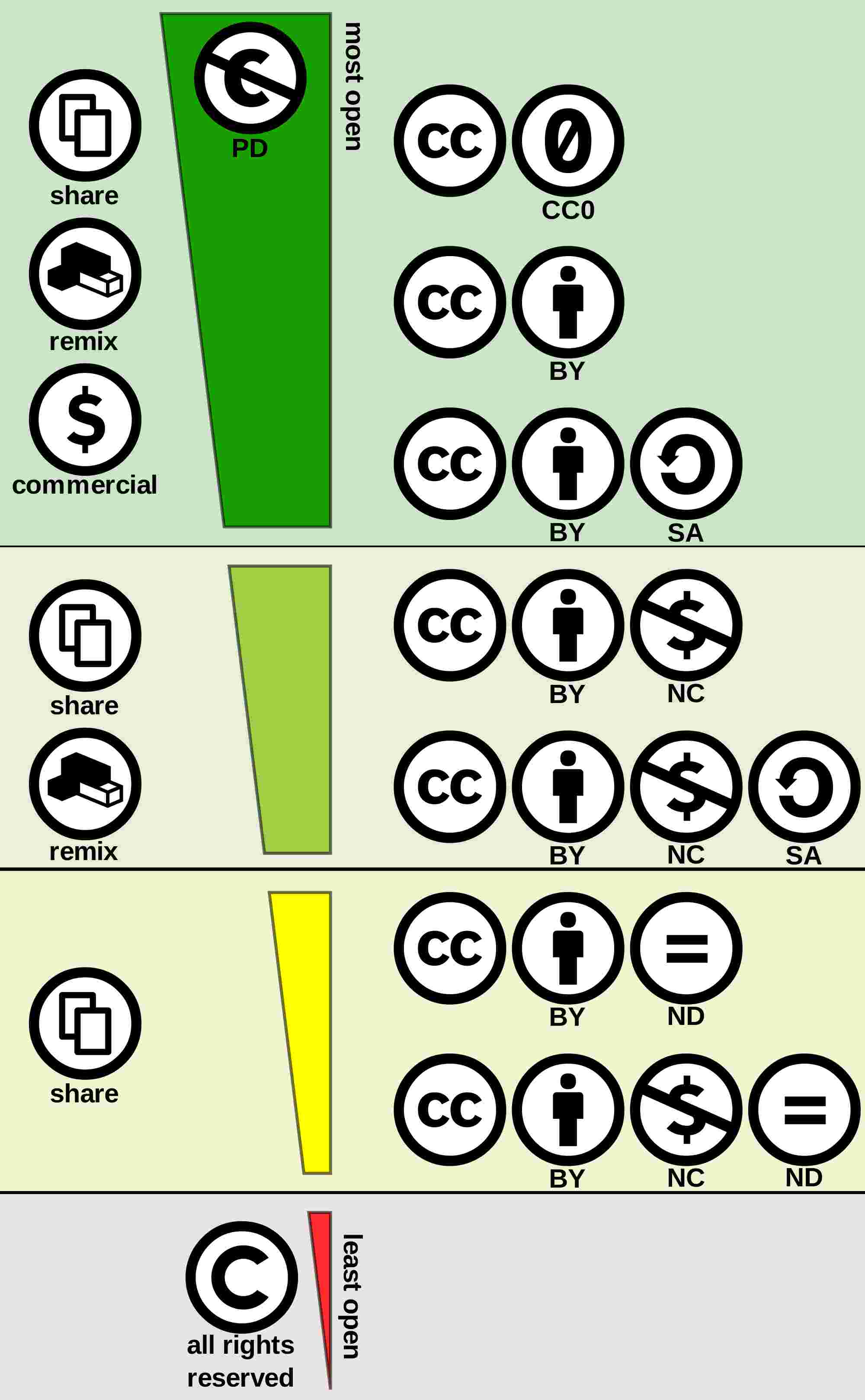
This is the license used for the MediBee project.
The Creative Commons license for this project was selected using the official Creative Commons license chooser tool.
After reviewing the available licensing options, I selected the CC BY-NC-ND 4.0 license because it allows the project to be shared publicly for educational purposes while protecting it from unauthorized commercial use and redistribution of modified versions.
License chooser website:https://creativecommons.org/chooser/
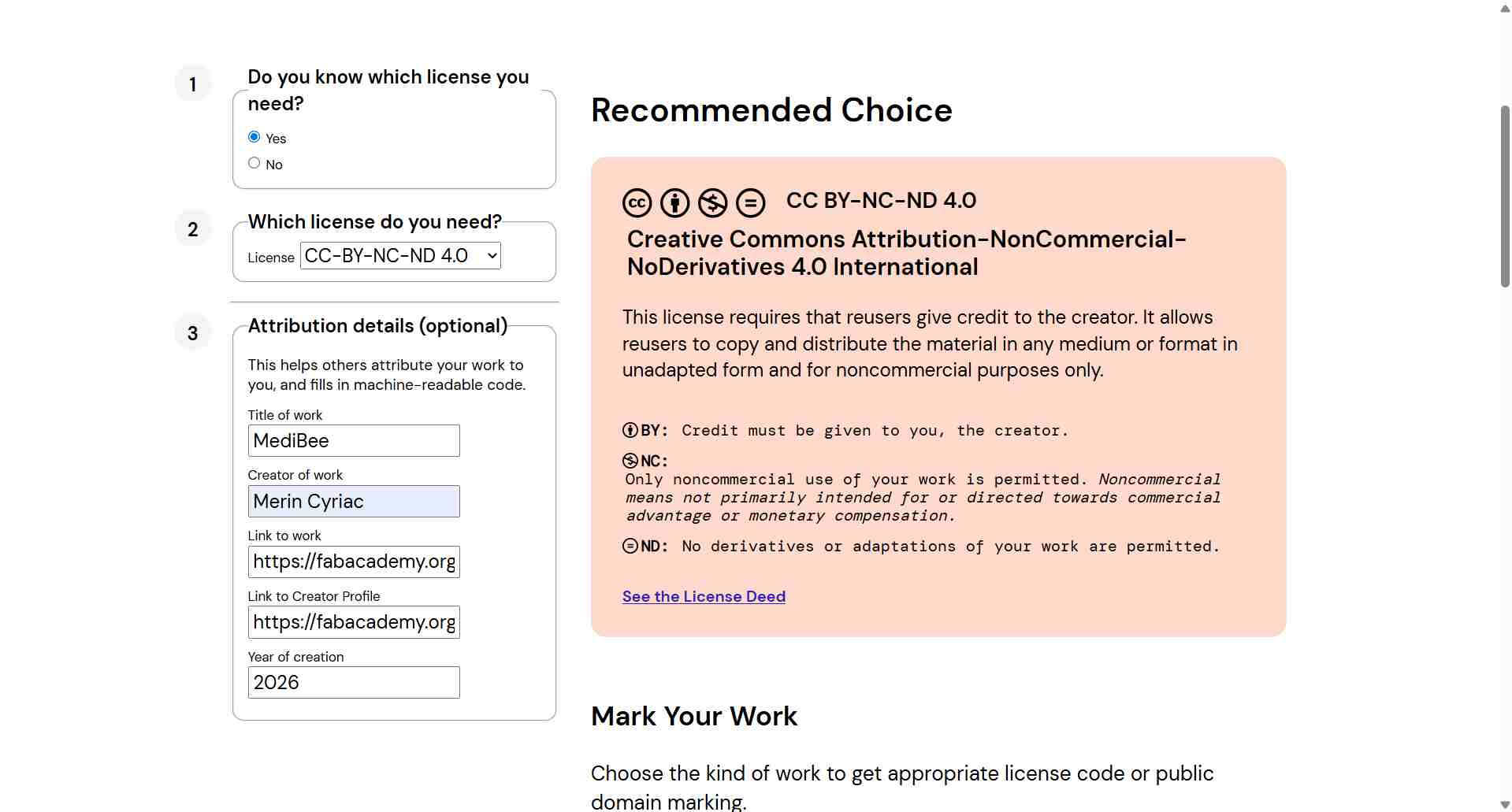
Fab Academy encourages open documentation and collaborative learning. To support this approach, MediBee is shared under the:
This license includes:
This allows students, makers, and researchers to study and share the project for educational purposes while protecting the original work from unauthorized commercial use or modification.
I chose the CC BY-NC-ND 4.0 license because I wanted to openly share the project documentation while still protecting the originality of the work.
The license supports educational learning and allows others to study the project, reference the design process, and learn from the documentation.
At the same time, it prevents unauthorized commercial exploitation and redistribution of modified versions without permission. This creates a balance between open knowledge sharing and creator protection.
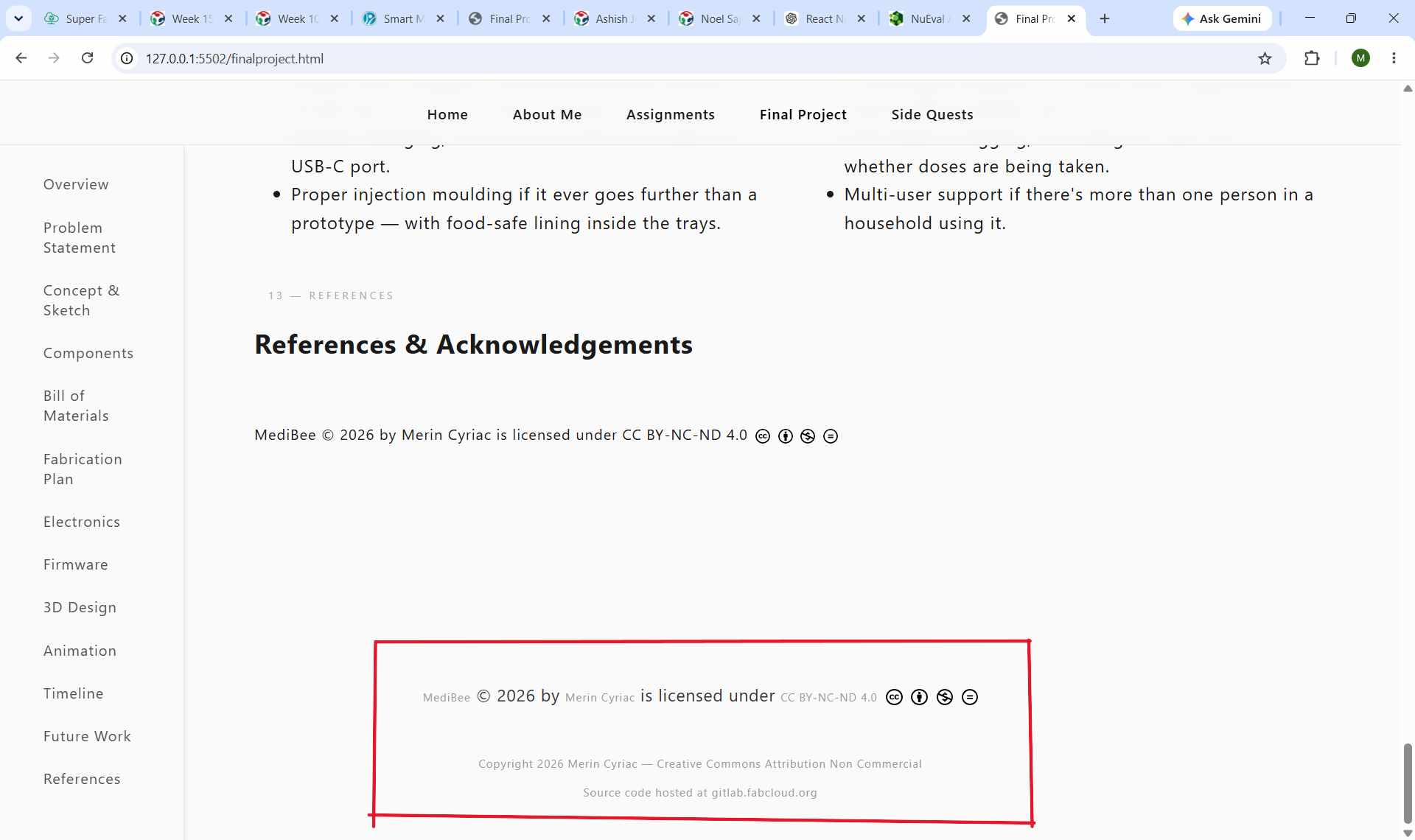
MediBee © 2026 by Merin Cyriac is licensed under CC BY-NC-ND 4.0


A dissemination plan defines how MediBee — the pill-shaped automatic pill dispenser — will be shared with the world after Fab Academy. This covers the target audience, sharing channels, licensing constraints, and a path toward future development.
People managing multiple medications who need a reliable, visible reminder that feels pleasant to own.
Family members or healthcare workers who fill weekly trays for someone else and need a tamper-evident, organised system.
Digital fabrication students and hobbyists who want to learn from a documented hardware project combining 3D printing, electronics, and firmware.
Fab Labs and engineering colleges looking for a complete, well-documented project to use as a teaching reference.
The primary channel. The complete project documentation — including all design files, firmware, fabrication process, and weekly progress — is publicly available on the Fab Academy student site at fabacademy.org/2026/labs/kochi/students/merin-cyriac. This is the canonical reference for anyone wanting to replicate or learn from the project.
All source files — Fusion 360 CAD models, KiCad schematics, PCB layouts, and firmware — are hosted on the Fab Academy GitLab instance at gitlab.fabcloud.org/academany/fabacademy/2026/labs/kochi/students/merin-cyriac. This provides version-controlled access to every file and allows anyone to track changes.
After Fab Academy, a step-by-step build guide will be published on Instructables and/or Hackaday.io. These platforms reach a large maker audience and allow MediBee to be discovered by people who are not part of the Fab Academy network.
MediBee is published under CC BY-NC-ND 4.0. This shapes exactly what is and is not possible with the project files and documentation.
| Action | Allowed? | Condition |
|---|---|---|
| Read and study the documentation | Yes | No conditions |
| Build a personal copy for learning | Yes | Non-commercial use only |
| Share the original documentation | Yes | Attribution required (credit Merin Cyriac) |
| Use in a classroom or Fab Lab | Yes | Non-commercial, attribution required |
| Sell a product based on MediBee | No | NC clause prohibits commercial use |
| Publish a modified version publicly | No | ND clause prohibits redistributing derivatives |
Complete final assembly, test all three rotor discs reliably, film a demo video, and publish the build guide on Instructables. Archive all files with proper README documentation on GitLab.
Improve the dispensing mechanism reliability, explore a companion mobile app for dose tracking, and refine the enclosure finish for a more product-like feel. Explore presenting at local health-tech or maker events in Kerala.
If a commercial version is pursued, the license would need to be renegotiated and a startup structure considered — likely an OPC or Private Limited Company as described above. A provisional patent application would be worth filing at that stage to protect the dispensing mechanism and rotary disc system.
MediBee will be shared openly through the Fab Academy documentation site, GitLab, and maker platforms, under a CC BY-NC-ND 4.0 license that keeps it free for educational use while reserving commercial rights. The target audience is the maker and healthcare community. If the project evolves beyond an educational prototype, the IP and business structure choices outlined on this page provide a clear starting point.
Project documentation of the Pill Dispenser