18. Invention, Intellectual Property and Income
← Back to Final Project: Vahan
Dissemination Plan
Vahan will be published in full on the Fab Academy documentation platform, including all schematics, PCB files, source code, and fabrication files. The project is intended to be open and reproducible.
The primary audience is educational institutions — vocational schools, university labs, and workshops where students and staff are exposed to combustion byproducts or forge environments. This is not an abstract use case. The problem Vahan addresses exists in my own laboratory, and I designed it with that reality in mind.
Wider sharing will happen through maker platforms and relevant communities, with the goal of reaching educators and safety-conscious makers who can put it to practical use.
Regarding a business model — I am not opposed to the idea of generating income from this project in the future, for example through assembling and selling ready units or offering installation services. However, I draw a clear line: anyone using Vahan for educational or safety purposes is welcome to do so freely. If the project is used for commercial gain, I expect fair acknowledgment and, where appropriate, compensation. Educational institutions with limited budgets are a different case — for them, access should remain as open as possible.
Future Opportunities
Several directions exist for developing Vahan further. The most meaningful next step would be integrating a mobile application, allowing real-time monitoring and remote adjustment of alarm thresholds and system parameters. A second direction is adapting the system for a wider range of environments — laboratories, schools, and small industrial spaces beyond the forge context it was designed for. The enclosure and hardware could also be optimized to make replication faster and more accessible.
My plan is to pursue these developments after Fab Academy, while the momentum is there. I intend to approach my instructors about collaborating — they have relevant knowledge and I believe this could be a project worth continuing together. That said, if that collaboration doesn’t materialize, I’m confident I can move forward independently. The foundation is solid enough to build on.
Completed Tasks and Remaining Work
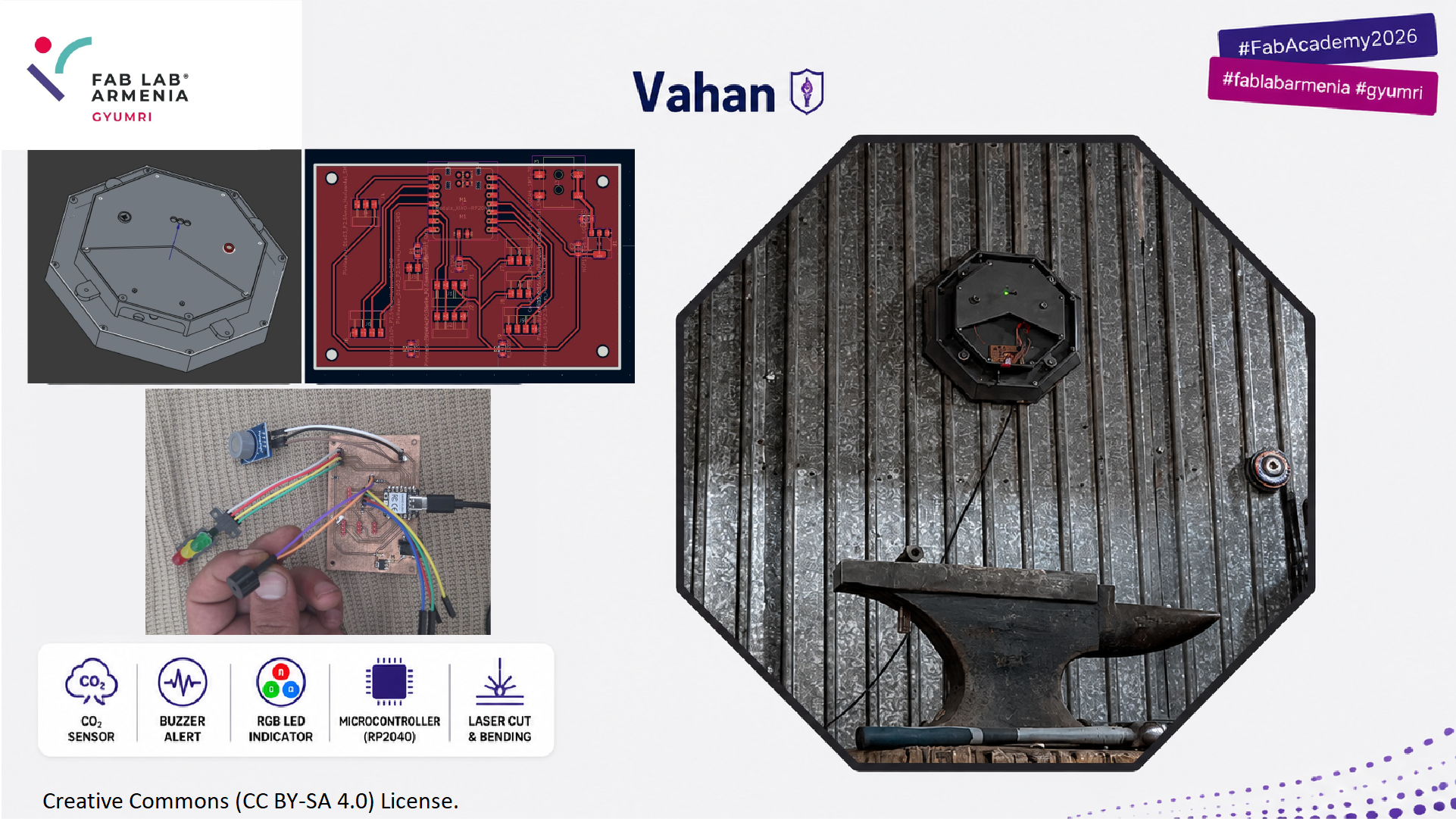
The main system design, including the electronic schematics, PCB design, and embedded programming, has already been completed. The 3D model of the enclosure is also finished. The remaining tasks include final mechanical assembly, integration of all components into the enclosure, final wiring connections, and system calibration and testing under real conditions.
What Is Working and What Is Not
The electronic part of the system is already functioning, including sensor readings, microcontroller logic, and output signals. The software development is also completed. However, the full mechanical assembly is still in progress. The final enclosure assembly and proper mounting of all components are yet to be completed, along with final adjustments to ensure stable and reliable operation.
Questions That Need to Be Resolved
Additional testing is required to ensure the long-term stability of the system, sensor calibration accuracy, and correct definition of threshold levels for different danger conditions. It is also necessary to evaluate the response speed of the alarms and the effectiveness of the ventilation activation under real working conditions.
Planned Timeline
May 29 – June 2 — Completion of the embedded programming, sensor integration, software debugging, and initial functional testing of the system.
June 3 – June 5 — Finalization of the 3D enclosure design, installation of the electronic components, and mechanical assembly of the system.
June 6 – June 8 — System calibration, real-world testing, performance optimization, completion of the documentation, and preparation of the final presentation.
Note: a proper project management schedule (Gantt-style, built in Google Sheets or a similar tool) will be added to this page separately, as suggested in feedback.
What I Have Learned?
During this project, I learned how to integrate electronic design, embedded programming, and digital fabrication into a single functional system. I gained experience in PCB design, sensor integration, system debugging, and hardware-software interaction. In addition, I improved my skills in project planning, problem-solving, and technical documentation.
License
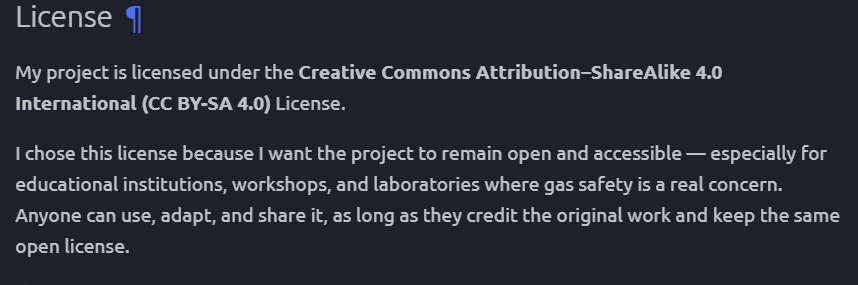
My project is licensed under the Creative Commons Attribution–ShareAlike 4.0 International (CC BY-SA 4.0) License.
I chose this license because I want the project to remain open and accessible — especially for educational institutions, workshops, and laboratories where gas safety is a real concern. Anyone can use, adapt, and share it, as long as they credit the original work and keep the same open license.
That said, my intention goes beyond the legal terms. I actively encourage anyone who uses or builds upon Vahan to reach out and collaborate. The project started from a real problem in my own workplace, and I believe it can be improved through shared experience. Open doesn’t have to mean anonymous.
The license is placed on my final project page, shown below:
I also added the license to my final project presentation slide.