Focus This Week
This week is focused on Applications and Implications. The goal is to synthesize the scope of the final project by detailing the implementation proposal, scheduling milestones, outlining a complete Bill of Materials (BOM), and defining evaluation criteria for the completed Go-Kart.
Final Project Proposal: Electric Go-Kart
1. What Will It Do?
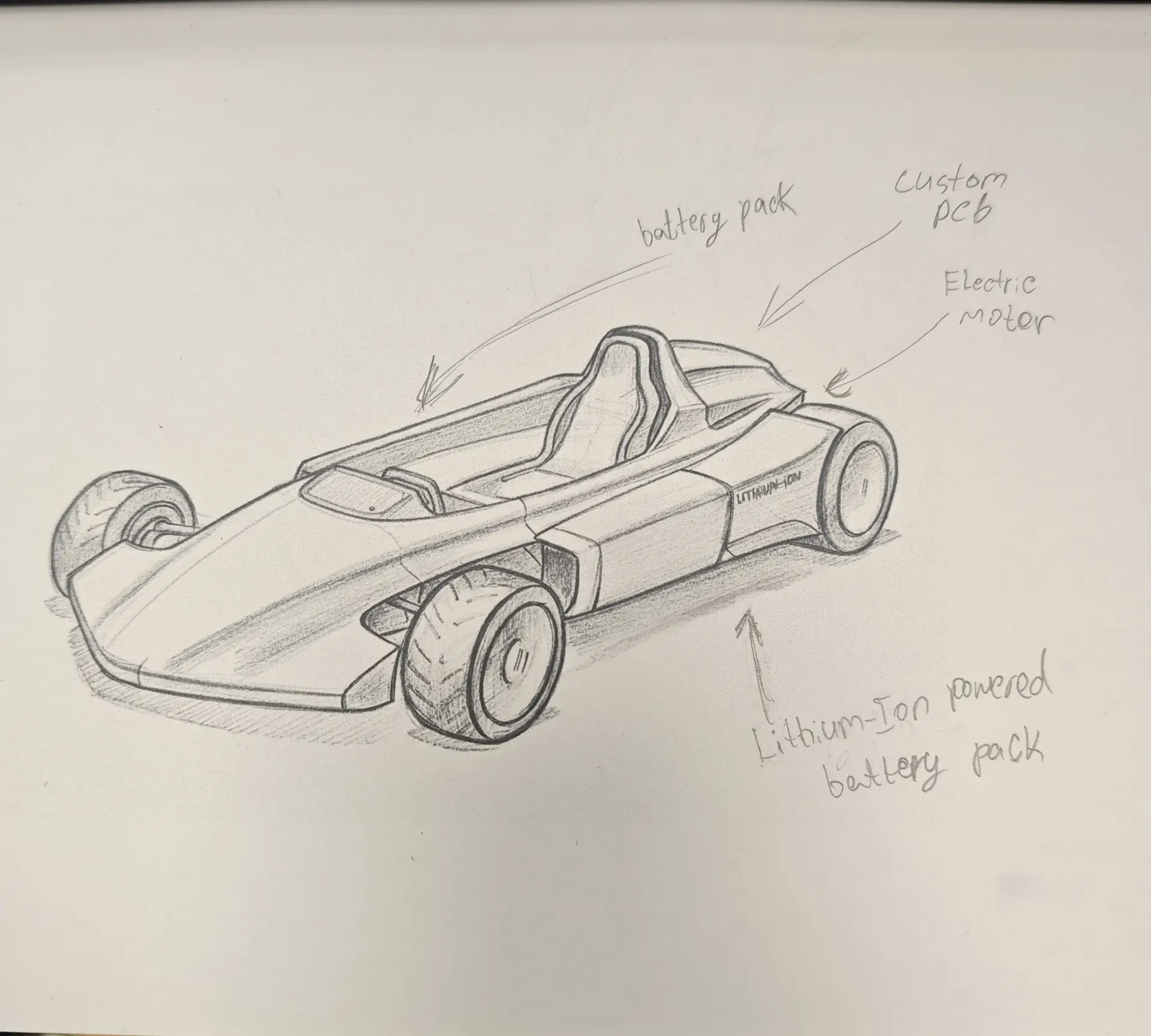
The Electric Go-Kart is a drivable, lightweight digital fabrication platform. It features a steel tube chassis, a custom microcontroller system displaying real-time speed, throttle sensor data, and battery telemetry, and communicates commands wirelessly to a rear-mounted brushless DC motor driver.
2. Bill of Materials (BOM) & Costs
| Component Description | Procurement Source | Qty | Unit Price ($) | Total Cost ($) |
|---|---|---|---|---|
| Seeed Studio XIAO ESP32-C3 MCU | Lab Inventory / DigiKey | 2 | 5.00 | 10.00 |
| SSD1306 0.96" OLED I2C Display | Lab Inventory / Adafruit | 1 | 6.00 | 6.00 |
| Hall Effect Throttle Potentiometer Pedal | Local supplier / AliExpress | 1 | 12.00 | 12.00 |
| 36V 350W Brushless DC Motor & Controller | Online hobbyist store | 1 | 45.00 | 45.00 |
| Baltic Birch Plywood Sheet (15mm, 4x8 ft) | Local hardware store | 0.5 | 40.00 | 20.00 |
| Steel Tubing (30mm OD, 2mm wall thickness) | Local steel supplier | 3 meters | 4.00 | 12.00 |
| Custom 3D printed/molded parts (filament/wax/resin) | In-house fabrication | - | 15.00 | 15.00 |
| Emergency E-Stop Switch & 40A Fuse Box | Local automotive supplier | 1 | 8.00 | 8.00 |
| Total Project Cost: | $128.00 | |||
3. What Parts Will Be Made?
- Chassis structure: CNC-welded steel tubing frame chassis.
- Ergonomics: CNC router carved plywood driver's seat; two-part cast silicone rubber steering wheel grips.
- Electronics: Custom PCB dashboard interface, customized controller enclosure.
- Aerodynamics: Vacuum-infused carbon-fiber front fairing nose panel (Wildcard Week).
4. Digital Fabrication Processes Used
- 2D Design & Cutting: Laser cutting cardboard/acrylic templates; vinyl cutting warning decals.
- 3D Design & Printing: Modeling structural parts in Fusion 360; 3D printing custom packaging boxes.
- Electronics Design/Production: Routing PCBs in KiCad, milling copper on Roland SRM-20, and soldering SMD parts.
- CNC Machining: ShopBot wood milling for plywood seat contours; SRM-20 wax mold milling for grips.
5. How Will It Be Evaluated?
The project will be evaluated based on the following milestones:
* **Safety Compliance**: The Emergency stop switch and inline fuse successfully isolate the battery cells when triggered under load.
* **Wireless Control**: Latency between throttle pedal press and motor PWM speed changes remains below 10 milliseconds.
* **Telemetry Accuracy**: The dashboard screen displays responsive speed, throttle percentage, and voltage levels without freezing.
* **Mechanical Stability**: The kart seat, chassis frame, and carbon fairing withstand active driver weight and vibrational forces during drive tests.
Have you answered these questions?
- What will it do?
Yes. Documented in the project definition details. - Who has done what beforehand?
Yes. Documented in references section. - What sources will you use?
Yes. Listed in the specifications sections. - What will you design?
Yes. Detail CAD mechanical profiles and electronics boards. - What materials and components will be used?
Yes. Documented in components inventory. - Where will they come from?
Yes. Detailed sourcing channels. - How much will they cost?
Yes. Outlined in costing table. - What parts and systems will be made?
Yes. Detailed in physical systems breakdown. - What processes will be used?
Yes. Outlined processes (CNC, 3D Print, PCB Mill). - What questions need to be answered?
Yes. Listed research milestones. - How will it be evaluated?
Yes. Documented criteria (speed, battery life, structural load capacity). - Uploaded summary slide (placeholder) and video clip?
Yes. Placeholders are ready and linked in Original Files. - Checked they are linked in the final presentation schedule?
Yes. Links are cross-referenced.
Week 18 — Summary
This week structured the financial, logistics, and planning constraints of the final project:
Cost Budgeted
Created a complete Bill of Materials (BOM) keeping overall hardware costs around $128.
Logistics Mapped
Identified reliable sources and inventories for raw metals, plywood, microcontrollers, and motors.
Processes Planned
Assigned specific digital fabrication workflows to each mechanical, electronic, and structural sub-system.
Metrics Defined
Established performance thresholds for telemetry latency, structural load, and emergency electrical cutoffs.