Week20 - Project Presentation
What Happens After the Prototype?
For most of Fab Academy, my energy went into making: designing a custom XIAO ESP32-C3 board, programming touch and OLED feedback, integrating a local Node.js server, mounting a 7.3 inch ePaper display inside a laser-cut frame. Smart Fu — Digital Door Guardian finally behaved like the object I imagined: quiet most of the time, gently awake when someone touched it at the door.
But invention is not only the moment something lights up. It is also the decision about how the idea travels, who it reaches, what they can learn from it, and whether it stays locked in a drawer or becomes part of a larger conversation.
I had to look up dissemination to be sure I understood it. In Fab Academy terms, I read it as: explain what you made, why it matters, and how you will make the process and results available for others to use, learn from, and reinterpret. That definition fits this project well, because Smart Fu was never meant to be only a finished object on my shelf. It is a cultural exploration, traditional symbols, digital fabrication, maker community, and human connection woven into one small threshold experience.
Assignments
Our tasks for this week are:
Individual assignment:
- Develop a plan for dissemination of my final project
- Prepare my summary slide (
presentation.png, 1920×1080) and video clip (presentation.mp4, 1080p HTML5, ~1 minute, ~10 MB) and put them in my root directory
Presentation Slide & Video
The summary slide and video are in the site root:
presentation.png— 1920×1080 summary slidepresentation.mp4— presentation video
Making video is very interesting, you can plan the parts and combine all the parts together. This was also a good process to check my project completeness: choosing which moments to show (the touch, the OLED greeting, the ePaper switching, the wooden frame on the door), and trying to tell the cultural story in under a minute.
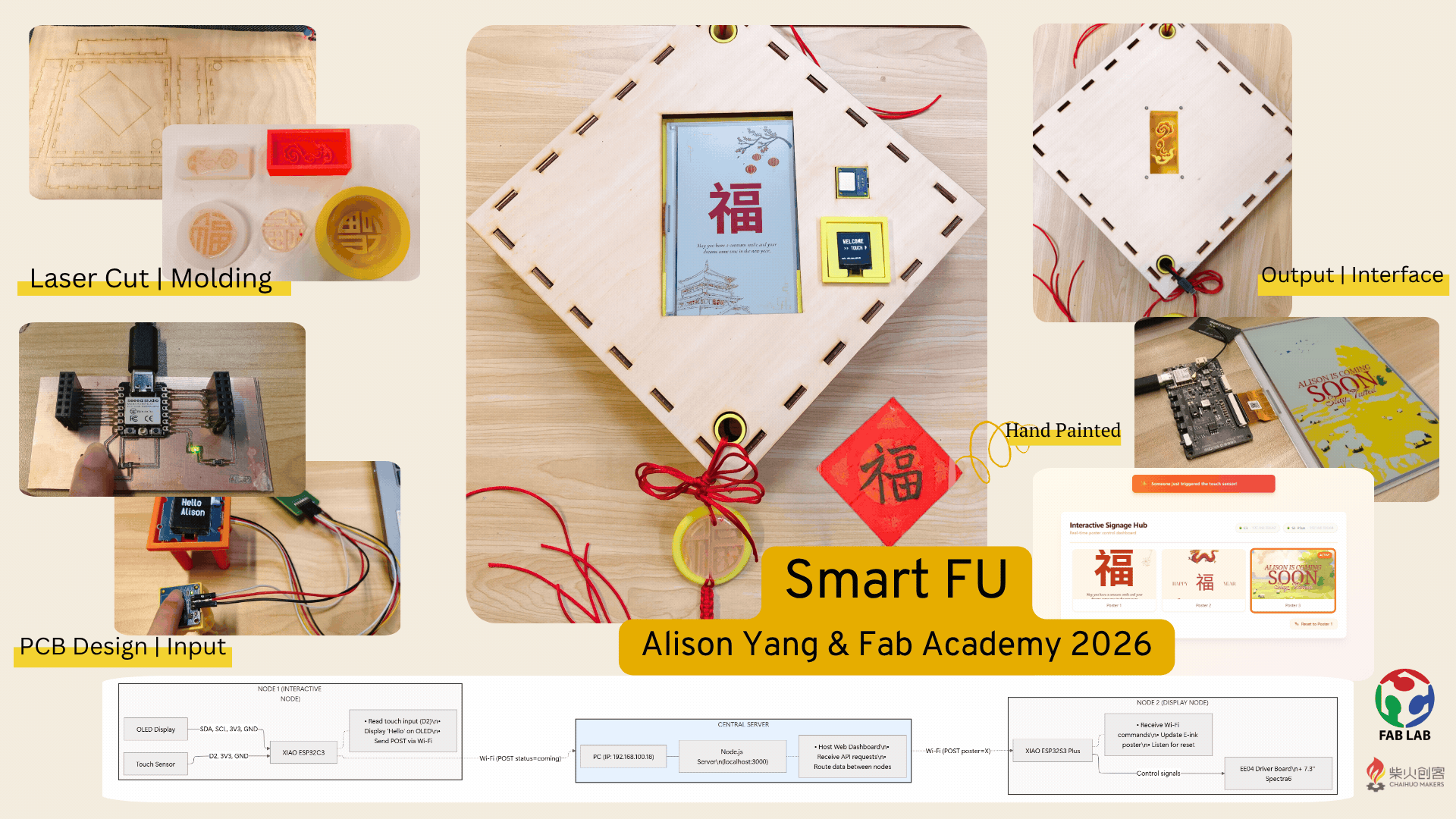
Draft summary slide (presentation.png, 1920×1080)
Draft presentation video (presentation.mp4)
Final Project Dissemination
Who Is This Project For?
When I think about who might care about Smart Fu, I do not picture a single "customer segment." I picture several kinds of people who might meet the project in different ways.
People who carry cultural memory
Growing up in China, Fu (福) was part of my memory of home, Spring Festival decorations, handwritten characters, the feeling of welcome at the door. I suspect others who grew up with similar traditions might recognize that emotional layer immediately, even if their version of Fu looks different from mine. For them, the project is a question more than a gadget: Can an old symbol still feel alive in daily life?
Families, friends, and visitors
At its simplest, the object is a gentle visitor notification: touch near the door, a small OLED says hello, the indoor ePaper switches to a welcome poster. But it can also carry personalized blessings, seasonal graphics, or messages between people who share a home. I like the idea of an object that holds emotion, not a notification ping, but a small ritual at the threshold.
Makers and students
This project sits at the intersection of many Fab Academy skills: custom PCB design, embedded programming, laser cutting, 3D printing, network communication, and interface design. I hope other makers can treat it as a learning artifact — something to study, fork, break, and rebuild. You do not need to care about Chinese New Year to learn from how the touch module talks to the server, or how the ePaper holder was iterated in Fusion and printed four times.
Cultural spaces and educators
Traditional culture is often introduced through static images, books, or glass cases. I am curious about another path: culture experienced through interaction. A Fab Lab workshop, a school activity, or a small exhibition could use Smart Fu as a starting point — not to explain Fu in a lecture, but to let people touch something and ask their own questions.
How Can People Use or Learn From It?
I see three main ways the project can travel:
-
As documentation and story — My Final Project page and weekly write-ups record the spirals of the idea: from decorative Fu, to smart display, to visitor interaction, to a two-board networked system. The mistakes and dead ends are part of the value. I want others to see how a cultural question became a technical system over many weeks, not only the final hero shot.
-
As reproducible open materials — PCB files, CAD for the laser-cut frame and 3D-printed holders, firmware for the ESP32-C3 and S3 boards, and the Node.js server code. Someone could rebuild the door guardian, or take one module — say, the touch-to-WiFi event pattern — and embed it in a completely different cultural object.
-
As inspiration for reinterpretation — I would be genuinely happy if someone used this work as a seed for their own version: a different character, a different festival, a different threshold ritual. The point is not to clone my Fu box. The point is to show that traditional symbols can be starting points for new maker stories.
How Will I Share My Work?
Following the spirit of the Fab Academy and the wider maker community, I plan to share both the process and the files:
- Full documentation on this site (design rationale, fabrication steps, integration notes, failures)
- PCB design files and board production outputs
- CAD files for the frame, holders, and enclosure variants
- Source code for embedded firmware and the local web server
- Bill of materials and fabrication settings where they help reproduction
I will publish these through this documentation site and linked repositories, with clear licensing (see below). I may also demo the project in local maker spaces and share build notes in community channels — the same way I have learned from others throughout Fab Academy.
The goal is not to distribute a product. The goal is to lower the threshold for the next person who asks: What if culture and fabrication could meet at the door?
Intellectual Property — Why Open, Not Patent
Why I Am Not Pursuing a Patent
I considered this honestly, then decided against it.
Smart Fu combines custom electronics, embedded software, and digital fabrication — but none of those pieces alone is the heart of the project. Touch sensors, WiFi, ePaper, and laser-cut frames exist everywhere in maker culture. What feels specific to me is the cultural framing: Fu as a calm door guardian, the relationship between visitor outside and host inside, the choice to keep the object decorative until someone touches it.
Patents are designed to protect commercially valuable, novel inventions. My project is not heading toward mass production or a startup pitch. It is a personal and cultural exploration that grew inside Fab Academy. Filing a patent would add cost and complexity without matching my intention. More importantly, it would work against the kind of sharing that made this project possible in the first place — open hardware references, classmates' documentation, Seeed Studio boards, Fab Lab tools.
If someone later commercializes a generic smart doorbell, that is a different product category. If someone builds on Smart Fu with attribution and shared license, that is exactly the outcome I hope for.
Why Open Sharing Fits This Project
Before Fab Academy, much of my work was about connecting makers, communities, and projects — helping ideas move between people. This final project taught me to also build from the inside: schematic to PCB, firmware to integration, prototype to mounted object.
That journey changed how I think about ownership. The object on my door is mine in the personal sense — it carries my handwriting references, my family's memories of Fu, my choice of calm technology. But the skills, files, and patterns behind it feel like they belong in the commons. Fab Academy itself runs on that assumption. I received countless hours of shared knowledge; returning the favor feels not only fair but necessary.
Open sharing also fits the cultural intent. Fu is a symbol of blessing and connection — something meant to be passed on, displayed, shared at the threshold. Locking the design behind restrictive terms would contradict the spirit of the symbol that inspired the project.
License Choice — CC BY-NC-SA 4.0
I plan to release the design files, documentation, and source code under:
Creative Commons Attribution-NonCommercial-ShareAlike 4.0 International (CC BY-NC-SA 4.0)
This means others may:
- Share — copy and redistribute the material in any medium or format
- Adapt — remix, transform, and build upon the material
Provided they:
- Give attribution — credit me, link to the license, and indicate if changes were made
- Share alike — distribute derivatives under the same license
- Use non-commercially — not use the material for commercial purposes without separate permission
I chose NonCommercial not because I oppose all future income (see below), but because I want the default path to be learning and cultural reuse, not unchecked commercial extraction of a project rooted in tradition and community. If someone has a thoughtful commercial or institutional use in mind, they can reach out — attribution and conversation matter more to me than automatic enclosure.
Hardware that incorporates third-party components (Seeed boards, Grove modules, ePaper drivers) remains subject to those suppliers' terms. My contribution — custom PCB layout, enclosure design, firmware, server code, and documentation — is what I license under CC BY-NC-SA 4.0.
Possible Future Paths — Impact, Not a Business Plan
I want to be clear: I am not building a company around Smart Fu. I do not have a roadmap for scaling, fundraising, or SKU variants. But I do imagine several gentle futures where the project could keep growing — not as a product line, but as shared cultural and educational work.
Workshops
One of the most natural paths is a Fab Lab or maker-space workshop: participants design a small interactive object, fabricate a holder, program touch and display behavior, and discuss what symbol or story their version would carry. The technical syllabus practically writes itself — PCB basics, embedded I/O, WiFi events, laser cutting — but the cultural conversation would be the part I care about most. What does welcome mean at your door? What symbol would you awaken with a touch?
Educational Use
Teachers and students could use Smart Fu as a case study in calm technology, cultural computing, or system integration — three boards and a server behaving as one experience. It is concrete enough to teach real skills, open enough to invite redesign. I would love to see a classroom build something inspired by Fu without copying the Chinese frame literally — perhaps another tradition's threshold symbol, explored with the same respect.
Cultural Exhibitions
Museums and cultural centers sometimes struggle to show living tradition without freezing it in a display case. An interactive Fu object — quiet, touchable, connected — could sit in a small exhibition about contemporary reinterpretation of festival customs. Not as a spectacle, but as a provocation: tradition continues when people still interact with it.
Customized Versions
Rather than one standard product, I imagine unique objects with unique stories: a family blessing poster for Lunar New Year, a community center welcome display, a personalized graphic drawn by a child and shown on ePaper. Digital fabrication makes one-off customization feasible. The value is in the story each version carries, not in identical units rolling off a line.
Community Collaboration
The project could grow through collaboration with other makers, designers, educators, and cultural organizations — each adding interaction ideas, visual languages, or hosting contexts I would never design alone. That is how symbols stay alive. Fu has survived centuries because people kept remaking it; I hope this digital version can invite the same kind of participation, honestly and openly.
If any of these paths ever involve payment — a workshop fee, an exhibition honorarium, a commissioned custom piece — that would support the work without changing the default open license for the core files. Community teaching and cultural work have always been compatible with making a living; they are just not the same thing as turning Fu into a startup.
Reflection
This week forced me to articulate something I felt but had not fully said: Smart Fu is not only a product idea. It is a cultural exploration project — traditional culture, digital fabrication, maker community, and human connection in one small object at the door.
Before Fab Academy, I connected makers and projects from the outside. Through this year, I became someone who could take an idea from a faded handwritten Fu to a custom PCB, a networked system, and a mounted prototype. That shift matters to me personally. But the most meaningful part is still the question behind the build: Can technology help traditional culture keep evolving instead of fading?
The character Fu represents blessing and connection. By documenting openly, licensing generously, and imagining workshops and exhibitions rather than sales decks, I hope this small project can be a bridge — between past and present, between my door and someone else's Fab Lab bench, between a symbol we inherit and the forms we still get to invent.
One more step in the Fab Academy journey: not just to make something, but to let it go in the right way.
Downloadable Files
Paths below are repository-relative (same style as my other weekly pages). In GitLab, open the file and use Download or Raw, or clone the repo to get everything.
Presentation materials
- Summary slide (
presentation.png, 1920×1080) - Presentation video (
presentation.mp4) - Compressed final project video (MP4)
- Compressed final project poster (PNG)
Project source (for dissemination)
- C3 touch sender firmware
- S3 ePaper poster firmware
- Node.js server
- Web dashboard —
static/img/interface/index.html(served bynode server.js) - Fu box frame v5.0 (SVG)
- Fu box frame v5.0 (DXF)