Creature of the night
# Creature of the Night
About
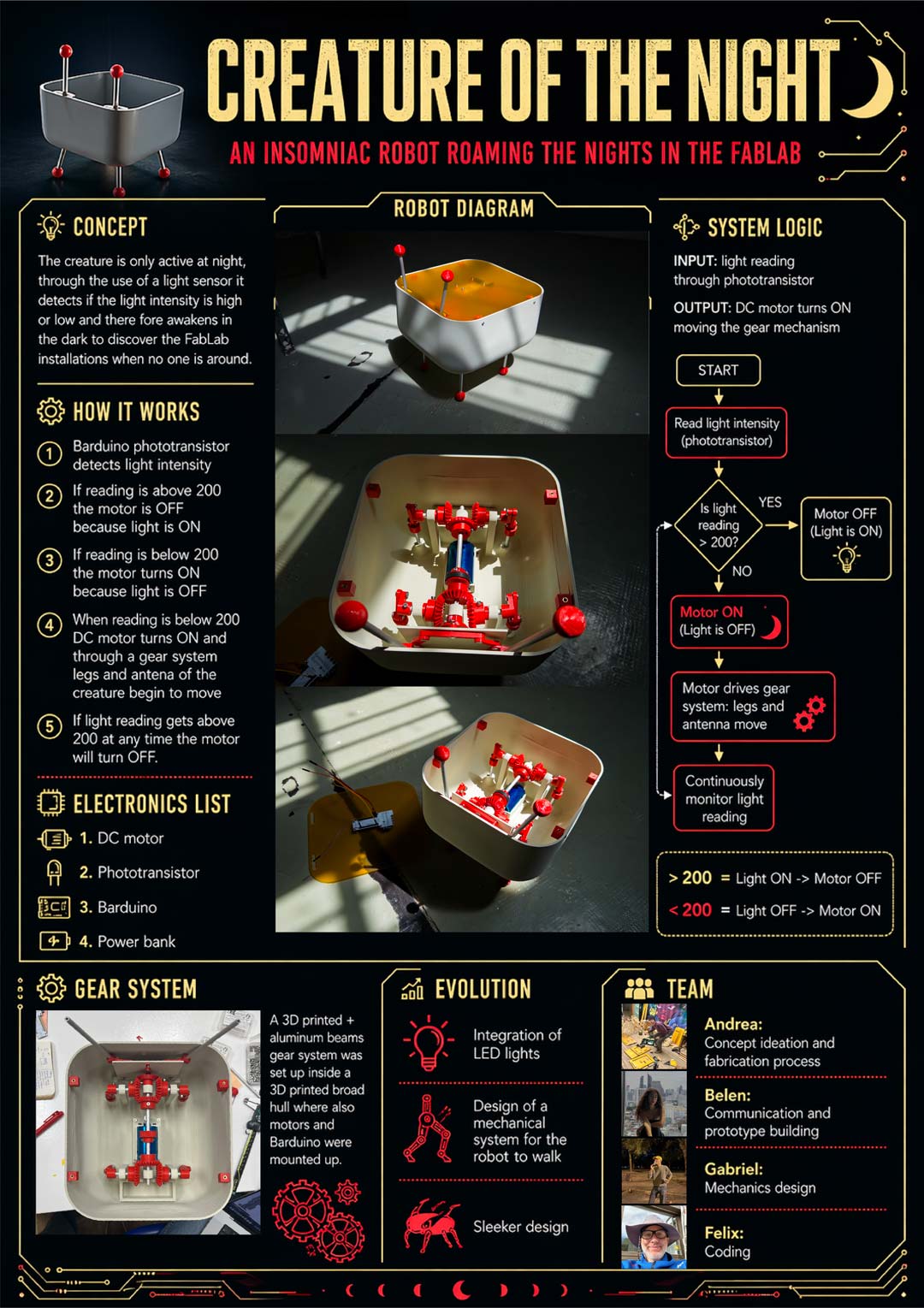
Creature of the Night is a dancing robot that moves when it's dark and stops when the lights come on. It uses a Barduino with a built-in phototransistor and a 3.3V relay to control a DC motor. The motor drives a crank-and-slider mechanism that makes the legs go up and down, plus a secondary antenna mechanism on the same axle. The body and all mechanical parts were 3D printed in PLA. The Barduino sits under a laser-cut amber acrylic lid so the phototransistor can read ambient light while the electronics stay enclosed. The team made the final video and slide.
Gabriel's individual documentation
Task allocation
Gabriel designed and built the mechanical system, wrote the firmware, and assembled the final robot. The rest of the team built the cardboard prototype. The group produced the final video and slide together.
Cardboard prototype
Before building the final robot, the group built a small walking robot out of popsicle sticks and cardboard as a proof of concept, to test the Barduino, relay, and motor together.
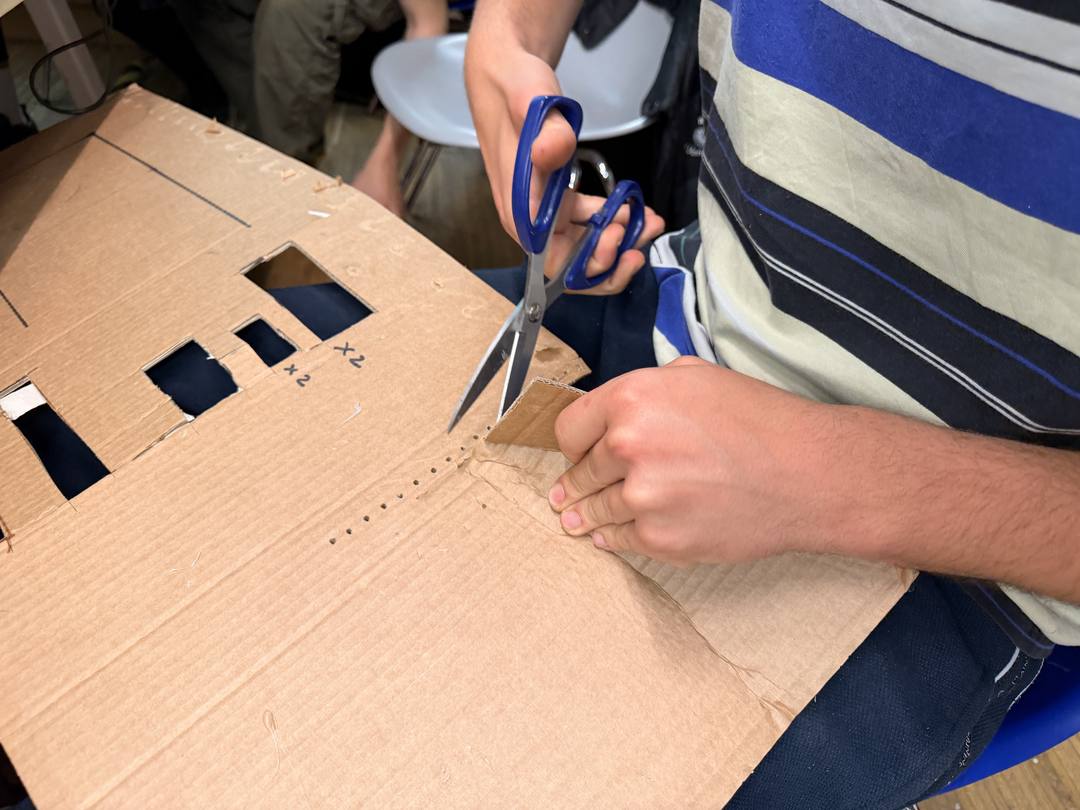
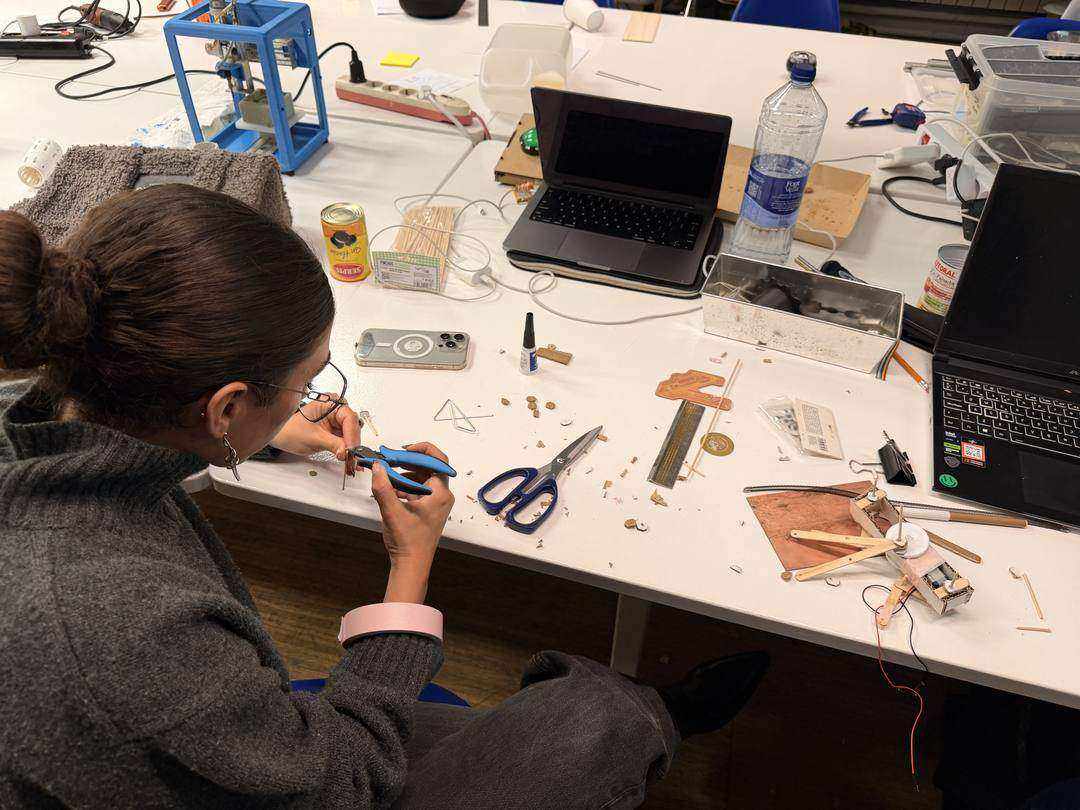
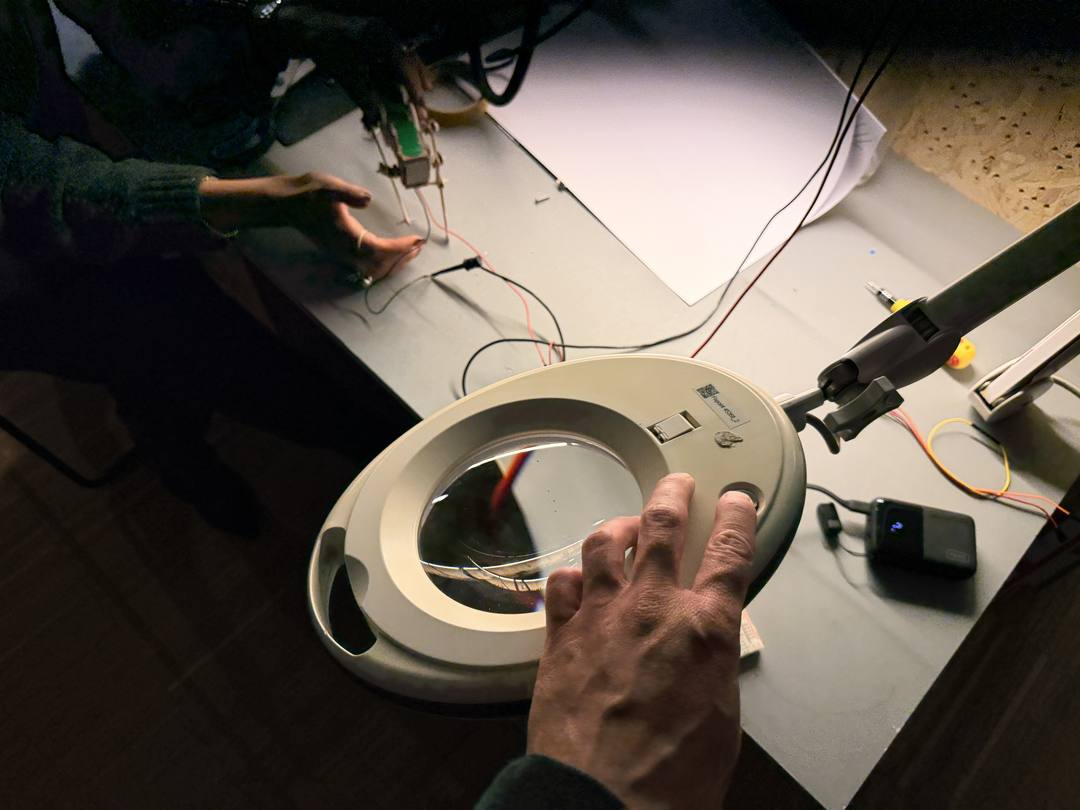
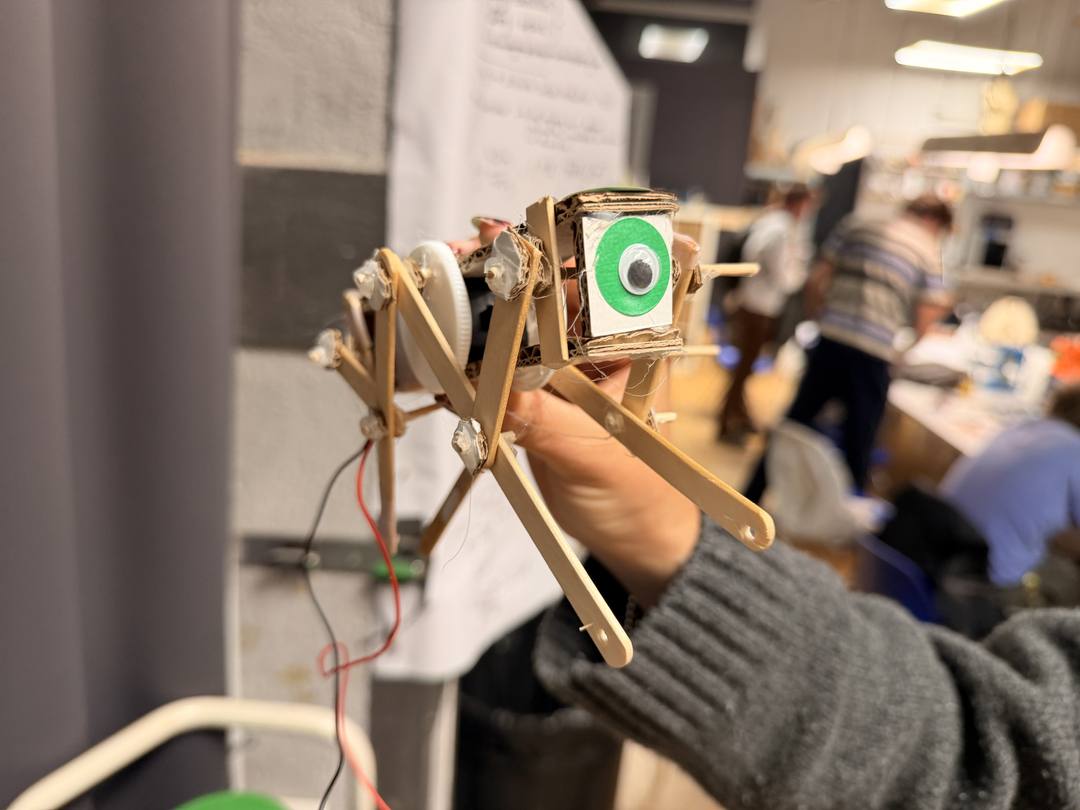
The cardboard robot walked when the lights were off and stopped when the lights came on. The body was too narrow and kept falling over, which led to the decision to redesign with a more stable mechanism that dances in place rather than walks.
Problems and solutions
Motor driver: The IRF520 MOSFET driver module did not work with the Barduino's 3.3V output signal; its gate threshold voltage is 2 to 4V, which was not reliably above the threshold. The team switched to a Seeed Studio Grove Relay v1.3, which accepts a 3V input signal.
Light threshold: The ambient light level in the room only read up to around 430 on the analog scale. The initial threshold of 50 was too low and caused flickering. It was adjusted to 150.
Cardboard prototype: The robot's body was too narrow and the feet provided insufficient support, so it kept falling over. This led to the decision to design a stationary dancing mechanism instead of a walking one.
Gear binding and tolerances: In the final assembly, the gears bound under load and some joints had too much or too little play. PWM was added to reduce motor speed and torque, which helped. The robot worked but was rough.
Possible improvements
- Stronger axle supports in the body (the printed ones snapped off)
- Tighter gear and joint tolerances
- A motor with lower RPM and higher torque natively, to reduce the amount of gearing needed
- Better body print orientation to avoid side delamination
- More secure lid attachment