Final Project Development
My final project idea is Smart Car side Mirror Anti-Theft by Alarming high Siren during detachment
Introduction
In Addis Ababa and several other cities across Ethiopia, the theft of vehicle side mirrors is a frequent and persistent issue. This problem leads to financial loss and daily inconvenience for car owners. Because side mirrors can be removed quickly and with minimal tools, they are especially vulnerable, making them a common target in public parking areas and residential streets.
This project proposes the design and development of a smart anti-theft system specifically integrated into a vehicle’s side mirror and other easily detachable components (with the current focus on side mirrors). The system is intended to detect any unauthorized removal or tampering in real time, immediately notify the vehicle owner, and continue to track the mirror’s location after it has been stolen. In addition, the device will trigger a continuous alarm upon tampering, which can help deter theft and draw attention from nearby people. The loud audible alert can also assist the owner in locating and potentially recovering the stolen mirror.
The proposed solution emphasizes affordability, compact design, and ease of installation, ensuring it is practical for widespread use in urban environments like Addis Ababa. By integrating sensing, communication, and tracking technologies, this project aims to provide a practical and locally relevant approach to reducing side mirror theft and enhancing overall vehicle security.
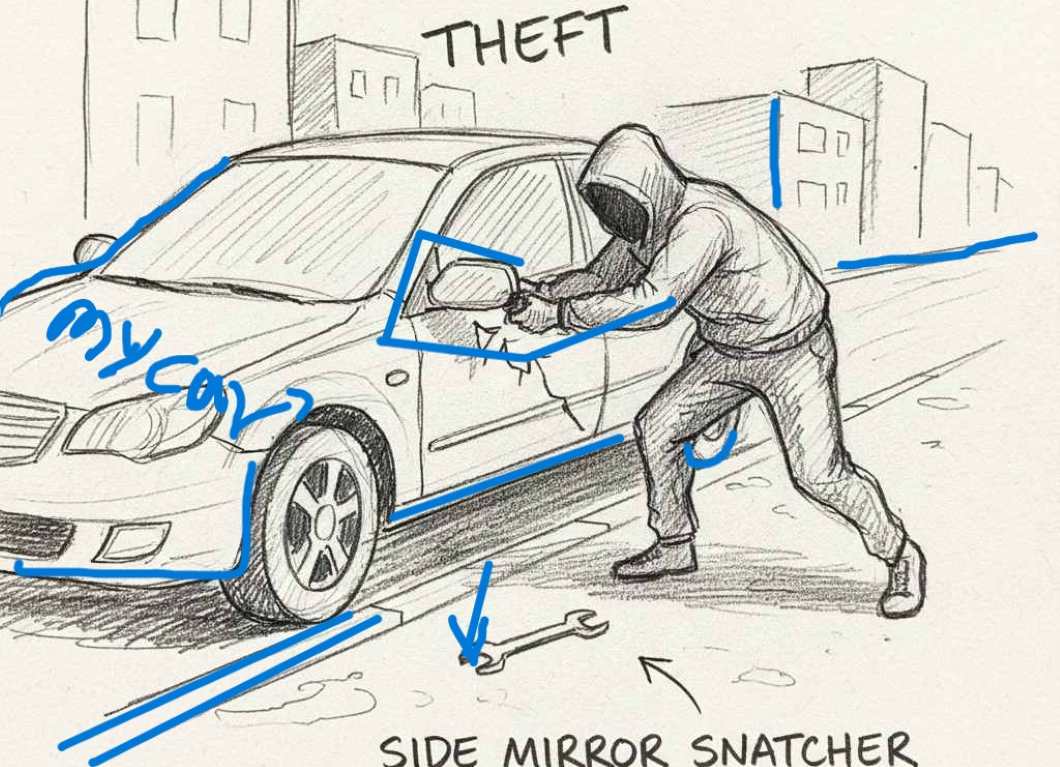
Theft on side mirror snach
Theft trying removing the side mirror
Project Description
This project aims to design a smart system that detects unauthorized removal of a car side mirror, alerts the car owner immediately or someone attend/parking area of the cars by Siren Alarming on the mirror’s stollen to enable recovery immediately.
Project Objectives
- Detect mirror removal and protect the theft to take and be hidden around
- Alert the owner in real time someone around the areas
- Create a compact and affordable solution
How It Works
- Sensors detect mirror movement or removal and Alarm triggered on the stolen parts
- Micro controller processes the event with the added sensors
project concept drawing
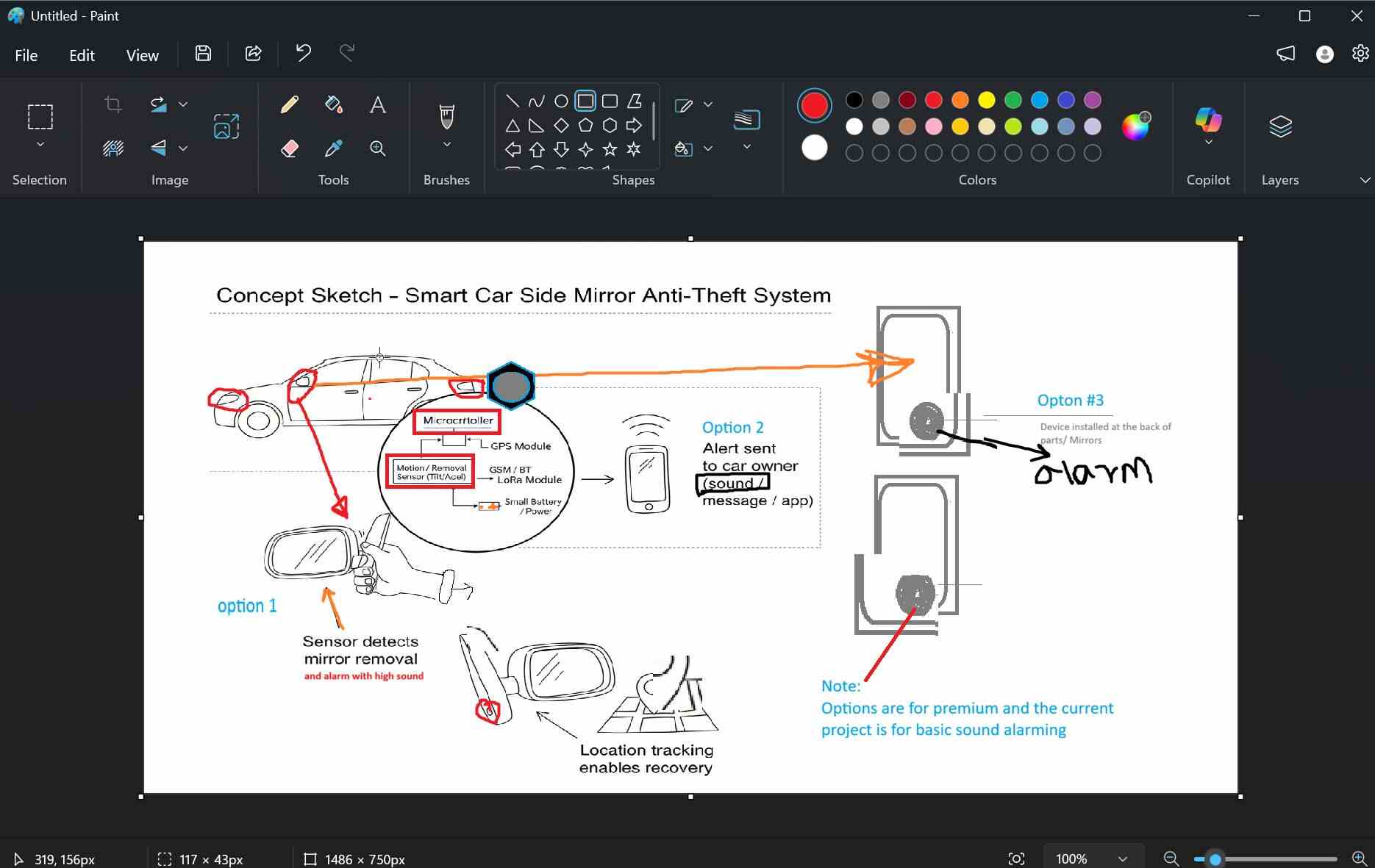
Sketch Concept
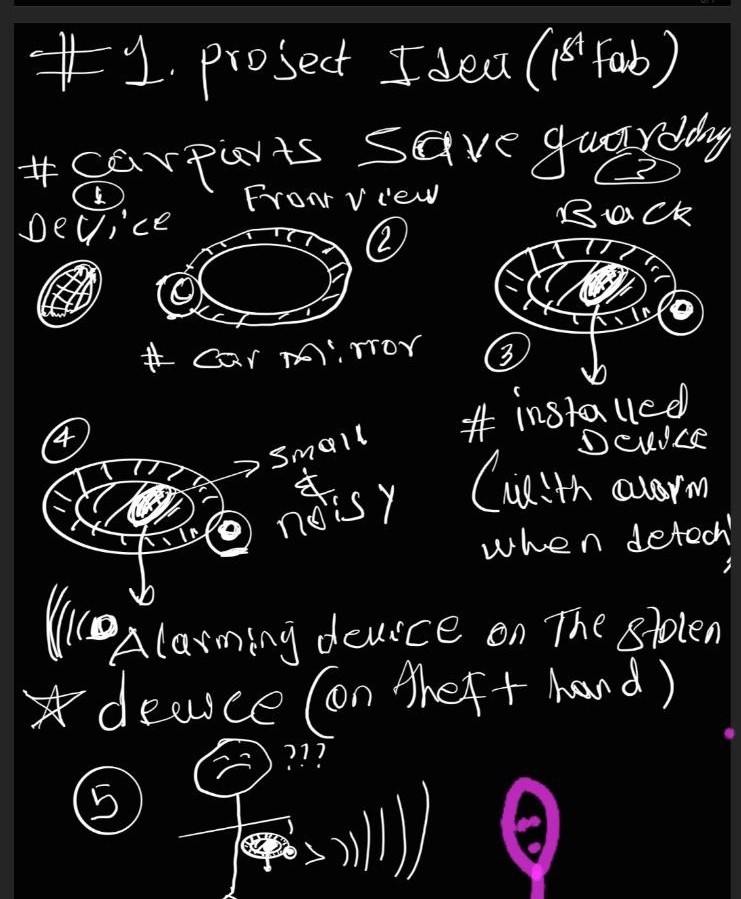
Planned Components
- Hall Sensors (motion / magnetic)
- MCU - ESP32 XIAO C3
- Communication module
- GPS (optional)
- Power source
Project progress
All the above was my first concept to electronics/fabrication to the final project (Started at the second week/week02 of the course journey). Below in each weeks title I will updated on my project ongoing improvement and additions to the web page appeared below.
Week 02 – Introduction to Digital Fabrication
This week marked the beginning of my final project journey.
Initial Project Concept
- Detect when a car side mirror is removed
- Trigger a loud alarm when detachment occurs
What I Learned
- How to define a real-world problem
- Breaking a project into inputs, processing, and outputs
- Basic electronic system thinking
- Project Considerations
- Selecting a suitable sensor for detection
- Power source planning
- Physical placement inside the mirror housing. This was the foundation stage of my final project.
From week 02 first design of physical models
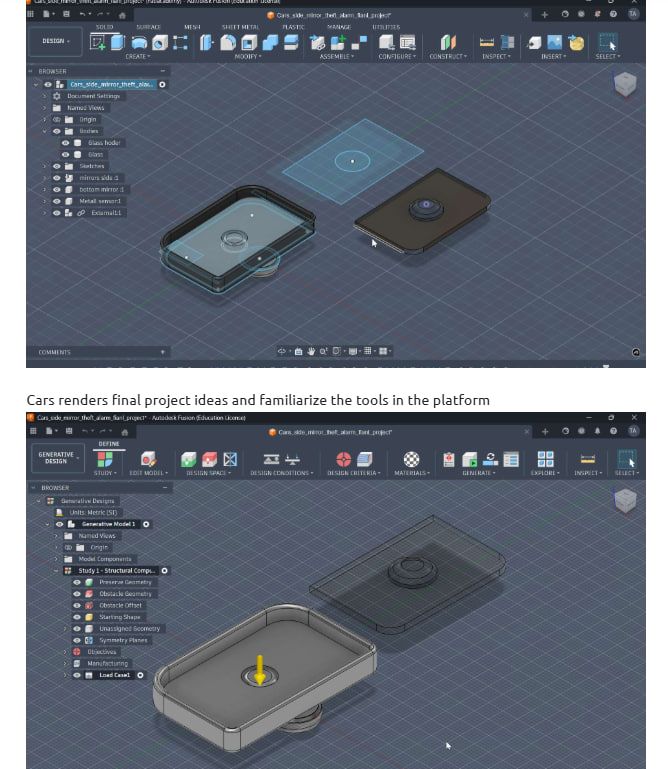
Week 03 – Introduction to Electronics
This week was my first hands-on experience with electronic components.
What I Learned
- Understanding resistors, LEDs, and push buttons
- How current flows in a circuit
- Difference between input and output devices
- Reading simple circuit diagrams
Tools Used
- Tinkercad for circuit simulation
- Arduino IDE for programming and testing
- Practical Skills Gained
- Controlling an LED using Arduino
- Understanding HIGH and LOW digital states
- Importance of correct wiring and resistor values
- This week helped me understand how an alarm system could be controlled using a microcontroller.
Week 04 – Embedded Programming & Input/Output
Global Session Presentation
This week I was got a chance to present my FP to our Prfessor, Proff Neil, I recieved feedback which will strengthened my programming and hardware integration skills to my final acheivement. It was at the beginning of Week 04, during the global session, I had the opportunity then present my Final Project to our professor, Prof. Neil and online class mates.
I introduced my project idea:
- Car Side Mirror Theft Protection System, explaining:
- The problem of side mirror theft
- The detection mechanism concept
- The alarm activation system
- How a microcontroller would control the process Presenting my idea helped me improve my confidence in explaining technical concepts and organizing my thoughts clearly.
Feedback and Improvement Suggestion
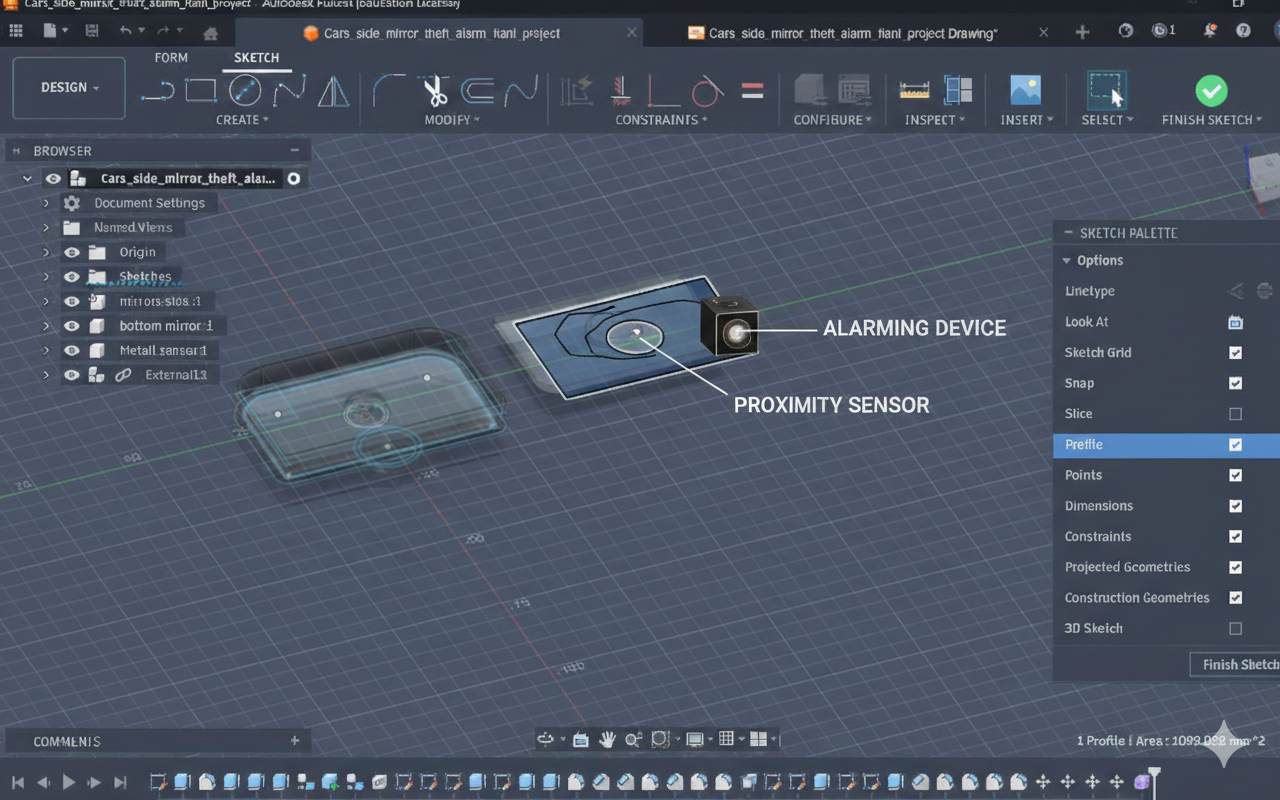
After the presentation, Prof. Neil suggested that it would be beneficial to add a proximity sensor to enhance the system. And the benefit is: - A proximity sensor can: Detect movement or presence near the side mirror - Trigger a warning before physical detachment happens - Improve the overall security level of the system - Make the system more intelligent and preventive, not only reactive This suggestion expanded my project from simple detachment detection to a smarter multi-layer protection system
Car Side Mirror with Proximity Consideration
Updated Project Direction
With this new idea, my system include:
- A proximity sensor for early detection
- A vibration or limit switch for physical tampering detection
- A buzzer for high alarm sound
- A microcontroller to manage logic and decision-making
This week’s important take away is:
- Programs Developed
- Turning an LED ON and OFF
- Using a button as input to control an output
- Testing circuits in simulation and on real hardware
- Structure of Arduino programs (setup() and loop())
- Using pinMode() for pin configuration
- Using digitalRead() and digitalWrite()
- Basic debugging of code and wiring
My ELectronics production paused due to supply chain
XIAO C3 out of stook … soon fix…
Local session discussion
clarify the problem
- We have to protect mirror and EV ports
- stollen when few people nearby
- Stollen daytime and night time
- contact or proximity sensor?
- proximity: <20cm for 10 sec
Component list:
- MCU: ESP XIAO C3
- Input: PIR sensor?, Ultrasonic water proof sensor
- Out put: Speaker, mini mp3 player
- Power: Lithium ion battery (how to charge)
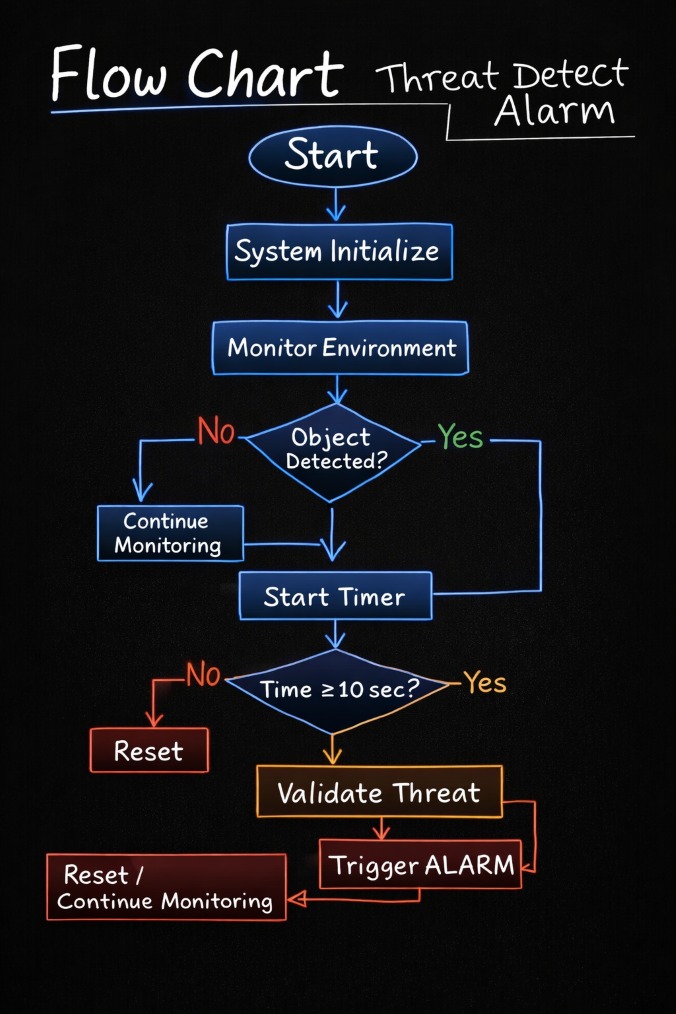
Flow chart
Flowchart hand
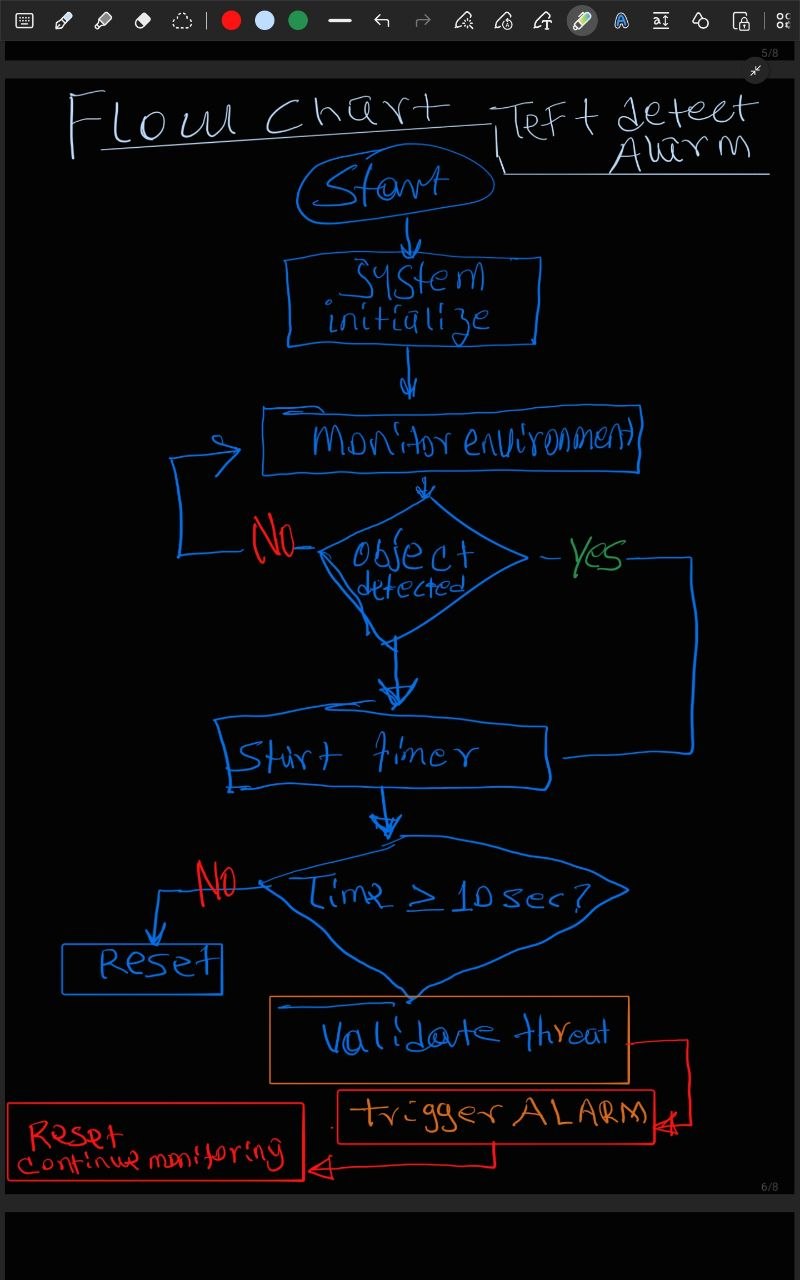
AI corrected my hand sketch
Expected Outcome
A working to prototype and demonstrating of car parts detection and alarming or alerting (Noisy sound) to show the part is stolen by alarming, and tracking (Premium concept) functionality for side mirror theft prevention.
problem to be solved

Sensors selection for FP
After studying the the sensors class my final project my use different two layers of sensing as:
- Detachment detection (is the part removed?) tbe main idea
-
Tracking + proximity detection (is it far from the car?), Professor Neil’s recommendation during presenting my FP including this proximity sensors.The aim of the project is to triggering Alarm on the detached or stollen part of the car. By now I decided to continue on the second idea, since it provide the alarm during detachment; I think it will fulfill to tracking and proximity detection or (is it far from the car?).
-
Research these sensors and learn how they work and how to use them in my final project, as they involve the physical, electrical, and coding design of the projects. Below, I Googled and read from sources what is described herein after, along with their controller integration using Arduino.
-
Recommended sensors were selected after studying input sensors such as:
1. PIR Sensor (Passive Infrared)
-
A PIR sensor detects motion by measuring changes in the infrared (heat) levels emitted by surrounding objects (like humans or animals).
-
How it works: It has two slots made of a special material sensitive to IR. When a warm body passes in front, it intercepts one slot first and then the other. The “differential” change between these two slots is what triggers the “motion detected” signal.
Arduino Connection: Usually has 3 pins: VCC (5V), GND, and OUT (Digital).
- Key Adjustment: Most PIRs have two potentiometers (small orange screws) on the back. One adjusts Sensitivity (distance) and the other adjusts Time Delay (how long the signal stays “High” after sensing motion.) The PIR sensors are digital. While we can read them with digitalRead(), they don’t give a “range” of how much motion occurred—just a “Yes” or “No.”
Best Source:PIR Sensor Tutorial – This is widely considered the “gold standard” beginner guide.
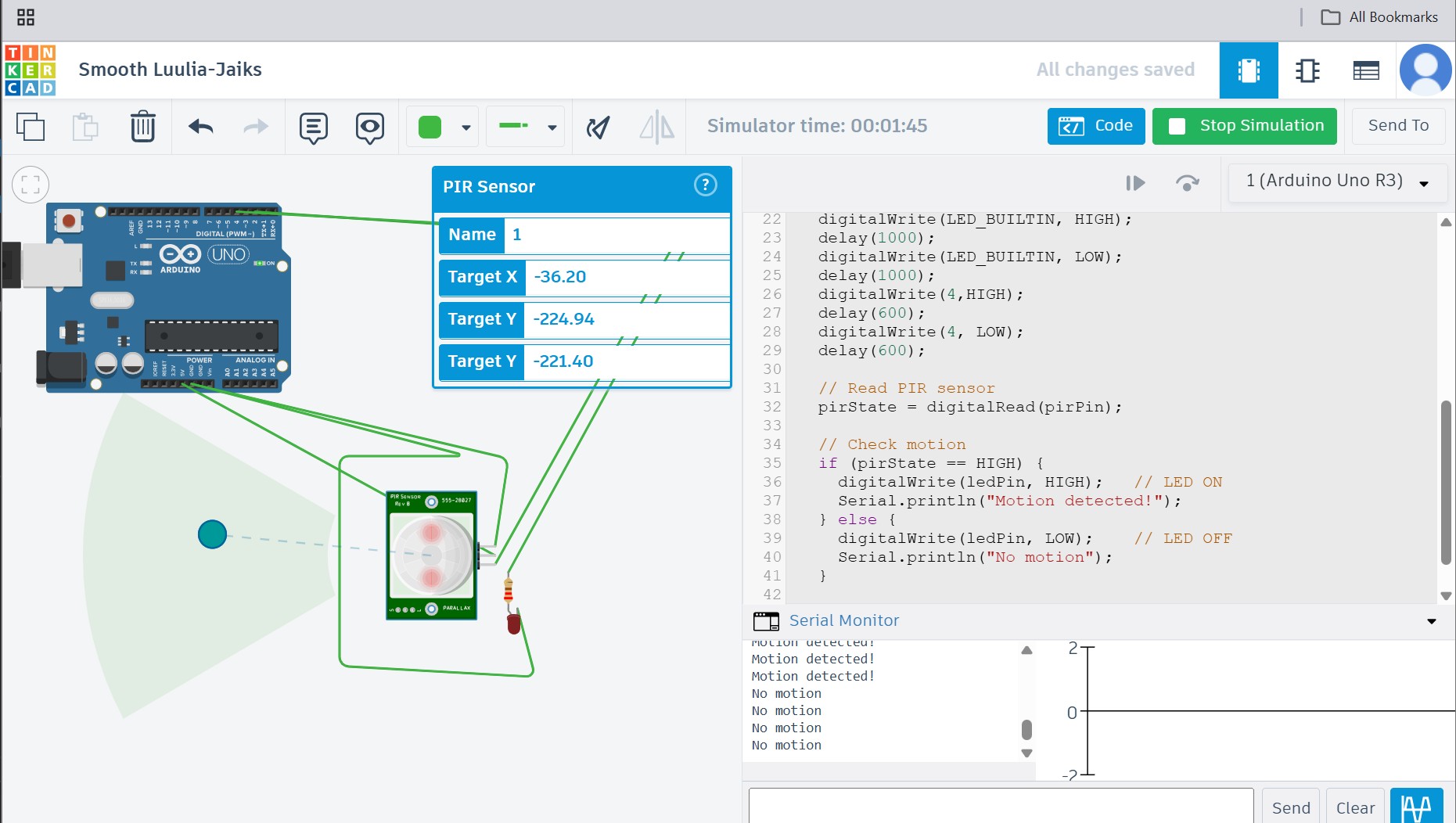
https://youtu.be/sMPC8fa8tVE
2. Capacitive Touch Sensor (TTP223 or similar)
-
This sensor acts like a smartphone screen. It detects the electrical capacitance of the human body.
-
How it works: The sensor creates an electric field. When our finger (which is conductive) touches the pad, it increases the capacitance of the circuit. The onboard chip detects this change and flips a switch.
-
Arduino Connection: 3 pins: VCC, GND, and SIG. Connect SIG to any digital or analog pin.
-
Libraries: For simple modules like the TTP223, no library is required—it works with a simple digitalRead(). However, if we are making our own touch sensor out of aluminum foil, we will need the CapacitiveSensor library.
i can hide these sensors behind a thin sheet of plastic or wood (up to 3mm), and they will still work!
Best Source: Arduino Get Started: Capacitive Touch Sensor – Excellent for clear wiring diagrams and basic code.
3. Step Response Sensor (DIY Pressure/Proximity)
-
This is less of a “bought” sensor and more of a technique. It measures how long it takes for a capacitor (or a DIY conductive pad) to charge.
-
How it works: i can use two pins on the Arduino and a high-value resistor (e.g., 10 Megaohm). One pin sends a “Step” (a pulse), and the other pin measures how long it takes for the receiving end to feel that pulse. If a human is touching or near the receiving end, their body “absorbs” some of that energy, changing the timing.
-
Arduino Connection: You bridge a Send Pin and a Receive Pin with a large resistor. The “Sensor” is just a wire attached to the Receive Pin.
-
This provides Analog Signal Data (a range of numbers), allowing us to detect how close someone is, not just if they touched it.
-
Libraries: Use the CapacitiveSensor library by Paul Stoffregen.
Reflection
This project addresses a real local problem in Ethiopia by using digital fabrication and embedded systems, aligning with FabAcademy’s learning goals.
Refernce
- Theft on side mirror snach sketch AI Generated and I redraw with Prompt “Provide me with Someone theft on the cars side mirror sketch”
- Introduction part is edited with Chat GPT with Prompt “Correct the following paragraph for any grammar error without modify my Ideas”