Applications and Implications
YeFab Leba Trap
1. My “YeFab Leba Trap” will do…
(WHAT WILL IT DO?)
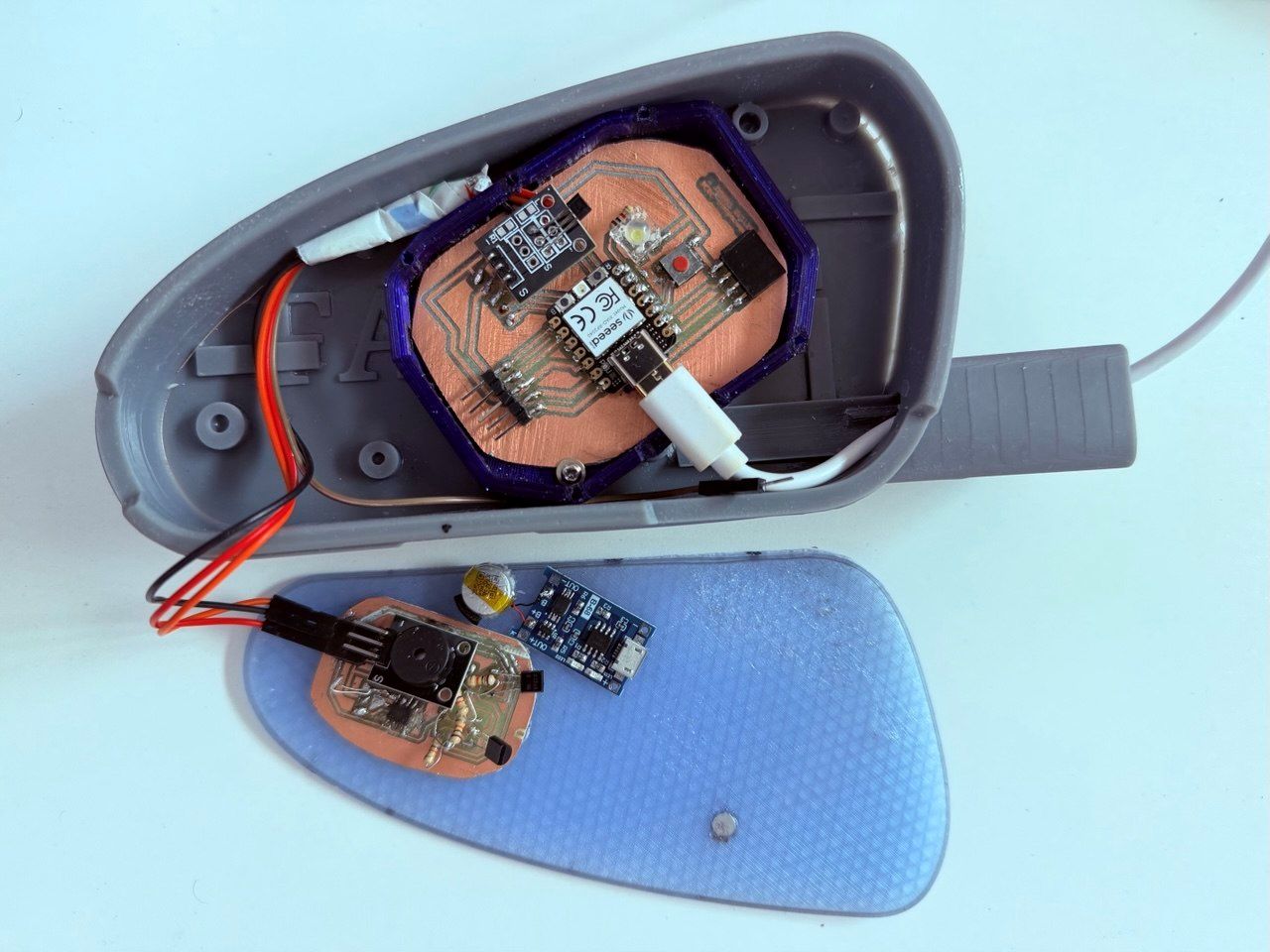
My “YeFab Leba Trap” is a small to be mounted on the existing cars body like the one I printed as model that is a detachable magnetic anti-theft alarm system designed to protect those detachable devices and valuable objects from theft. The system continuously monitors the connection between a fixed part and a detachable part using a Hall effect magnetic sensor with bother (optionally will have the battery system alone).
When the detachable part is removed without authorization, the Hall sensor detects the loss of the magnetic field and immediately sends a signal to the XIAO ESP C3 or RP2040 microcontroller. The microcontroller then activates a transistor-based latch circuit located on the detachable PCB.
The detachable PCB contains its own rechargeable battery and buzzer system, allowing the alarm to continue sounding independently even after the detachable part is physically disconnected from the main system.
“YeFab Leba Trap” combines embedded programming, PCB design, magnetic sensing, battery charging, and smart security logic into a complete anti-theft solution inspired by real-world protection needs in Ethiopia.
2. Before me as a benchmark someone was doing…
(WHO HAS DONE WHAT BEFOREHAND?)
Before developing “YeFab Leba Trap,” many anti-theft systems were built using on main car alarm system, but not alone for parts to be siren on the theft hand.
“YeFab Leba Trap” improves this idea by introducing an independent detachable alarm architecture with a locally powered buzzer latch system that continues operating even after physical separation.
3. I used the Fab Academy resources, Google, ChatGPT with prompts…
(WHAT SOURCES WILL BE USED?)
During the development of “YeFab Leba Trap,” I used multiple learning and research resources including Fab Academy documentation, electronics datasheets, online engineering references, Google research, and ChatGPT-assisted design exploration.
Fab Academy resources were used for: - PCB design workflow - Embedded programming - System integration - Digital fabrication processes - Electronics production - Mechanical design inspiration
Google resources and electronics references were used to study: - Hall effect sensor behavior - TP4056 battery charging systems - Transistor latch circuits - Li-ion battery protection - Anti-theft architectures
ChatGPT was used as an engineering assistant to: - Debug electronics connections - Improve system architecture - Generate embedded code - Explain KiCad schematic design - Optimize latch circuit logic - Validate PCB integration
Example prompts used:
- “Design a magnetic-triggered independent buzzer power logic”
- “How to create a transistor latch alarm system”
- “How to integrate Hall sensor with RP2040”
- “How to build detachable anti-theft PCB architecture”
4. I designed to solve one problem with Fab solution in Addis…
(WHAT WILL YOU DESIGN?)
I designed “YeFab Leba Trap” to solve the problem of detachable component theft and unauthorized removal, especially in environments where portable or externally mounted devices can easily be disconnected.
The project is inspired by real security challenges observed in Addis Ababa, where detachable accessories, electronic modules, and mounted components are vulnerable to theft.
Using Fab Academy digital fabrication techniques, I designed a compact smart security system that combines magnetic sensing, embedded control, independent alarm activation, and rechargeable battery power into a locally fabricated anti-theft solution.
5. I used the equipment, electronics, and components…
(WHAT MATERIALS AND COMPONENTS WILL BE USED?)
“YeFab Leba Trap” uses both digital fabrication equipment and embedded electronic components.
Electronics Components
- XIAO RP2040 microcontroller
- KY-003 Hall effect sensor
- KY-012 active buzzer
- BC547 transistor
- BC557 transistor
- TP4056 Li-ion charging module
- Li-ion rechargeable battery
- Fuse
- Resistors
- Capacitors
- Connectors and headers
- LED indicator
Fabrication Equipment
- KiCad for PCB design
- Fusion 360 and FreeCAD for 3D modeling
- 3040 CNC milling machine for PCB fabrication
- Laser cutter for enclosure and structural parts
- Soldering station for electronics assembly
- Multimeter and debugging tools
Materials
- FR4 copper board
- PLA filament
- Notice sticker
- Wiring and connectors
6. Components from SKYLab, Innobiz-Ethiopia Center, and marketplace…
(WHERE WILL THEY COME FROM?)
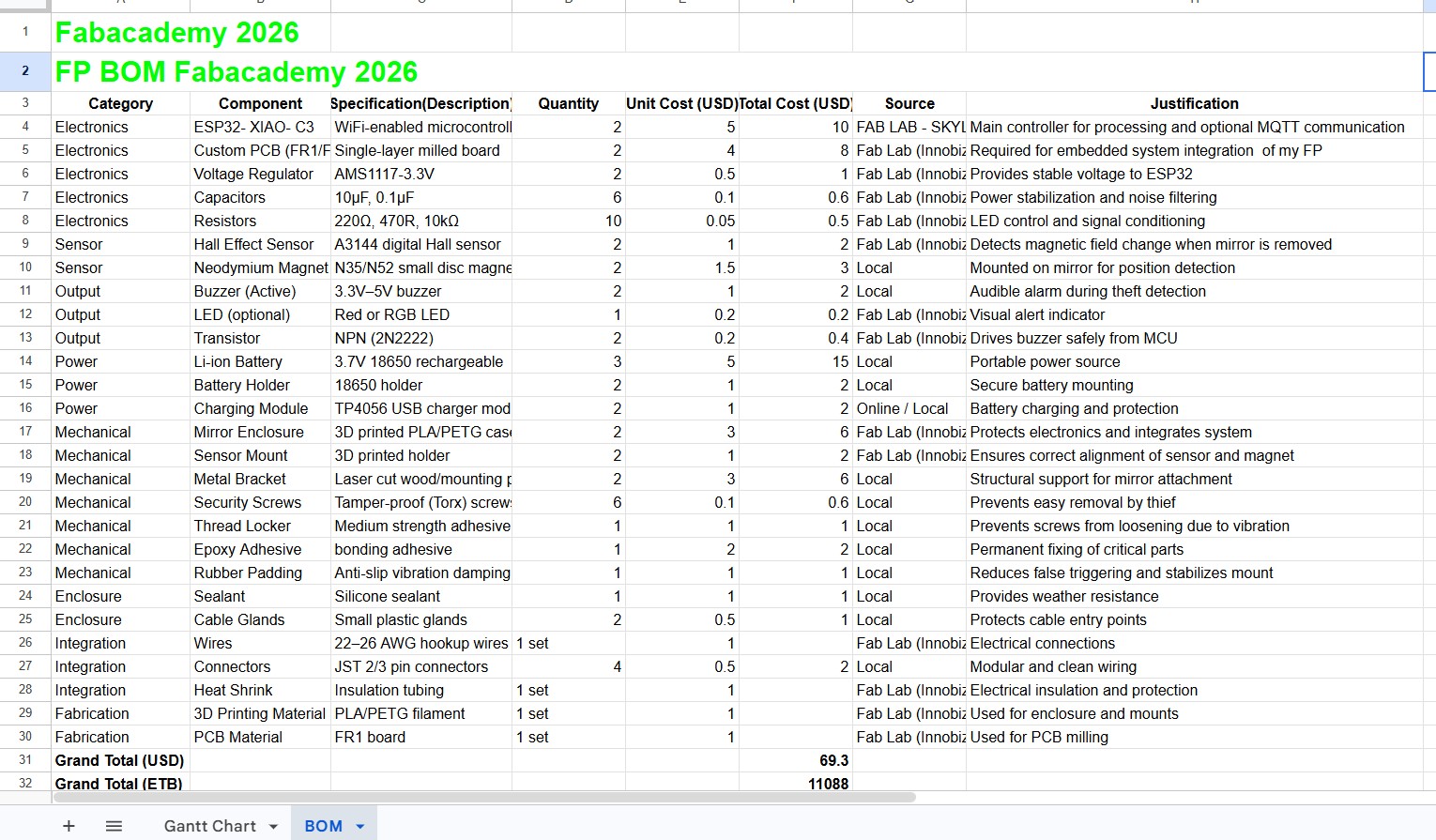
The components used for “YeFab Leba Trap” are sourced from: - SKYLab makerspace - Innobiz-Ethiopia Center - Local electronics markets - Online Ethiopian engineering marketplace:
Some reusable electronic components are also collected from salvaged electronics to reduce cost and support sustainable fabrication practices.
Estimated costs include: - Microcontroller board - Sensors - Battery and charging module - PCB materials - Connectors - Fabrication materials
The overall system is designed to remain affordable, locally manufacturable, and accessible for prototyping in Ethiopia.
7. The part and system made to run my project are…
(WHAT PARTS AND SYSTEMS WILL BE MADE?)
The following systems and subsystems are designed and fabricated for “YeFab Leba Trap”:
Fixed System
- Main PCB
- XIAO RP2040 controller section
- Hall effect sensing system
- LED status indication
- Trigger communication interface
Detachable System
- Rechargeable battery-powered PCB
- Transistor latch alarm circuit
- Buzzer alarm system
- Charging and power management system
- Fuse protection system
Mechanical System
- Protective enclosure
- Mounting structure
- Connector alignment mechanism
- Magnet positioning system and secure
Embedded System
- Hall sensor monitoring firmware
- Trigger pulse logic
- Alarm activation logic
8. Process I followed…
(ADDITIVE MANUFACTURING AND SUBTRACTIVE MANUFACTURING)
The development of “YeFab Leba Trap” follows both additive and subtractive digital fabrication workflows.
Additive Manufacturing
Used for: - 3D printed enclosures with (both SLA and FDM) - Structural holders - Mechanical supports - Sensor mounting systems
Tools used: - Fusion 360 - FreeCAD - 3D printer
Subtractive Manufacturing
Used for: - PCB milling - Vinyl cutting
Tools used: - 3040 CNC milling machine - Vinyl cutter - PCB engraving process
Electronics Production
- Schematic design in KiCad
- PCB routing
- Soldering and assembly
- Embedded programming
- Electrical debugging and testing
System Integration
- Mechanical assembly
- Electronics integration
- Firmware upload
- Functional testing
- Final anti-theft system with battery installed validation