Final Project: Robotic Gripper
Project summary
My final project is a robotic gripper that explores how mechanical design, electronics, and programming can work together to pick up and hold objects. It combines a gear-based gripping mechanism with servo actuation and a microcontroller-based control system.
As a product design student, I'm interested in how products work inside, not just how they look. A gripper is a good test of that: the fingers have to move together, the gears and linkages have to line up, the servo needs enough torque, and the electronics have to control it all reliably.
I'm not trying to invent a new kind of gripper. My goal is to develop my own implementation, understand how its mechanical and electronic parts behave, and document the whole process of turning a concept into a working prototype.
Current status
The project is in development. I'm testing the MG90S servo with a Seeed Studio XIAO RP2040 on its own. The full gripper still has to be assembled, driven by the servo, and tested with real objects. Nothing on this page should be read as a tested result unless it says so.
How it works
- The gripper starts in an open position.
- The XIAO RP2040 sends a control signal to the servo.
- The servo drives the gear mechanism.
- The gears and linkages move the fingers towards each other.
- The fingers close around and hold the object.
- The servo reverses to open the fingers and release it.
Main parts
Mechanical
- Base and support structure
- Gear mechanism that transfers motion to the fingers
- Gripping fingers, linkages, and pivots
- Servo mount, designed so the servo can be removed or replaced
Electronics and control
- Seeed Studio XIAO RP2040 microcontroller
- MG90S servo motor (suitability for the final load not yet verified)
- Regulated 5 V supply for the servo (the servo is not powered from the XIAO's 3.3 V pin)
- Custom PCB (in progress)
Bill of materials (estimated)
| Component / material | Source | Est. cost (₹) | Status |
|---|---|---|---|
| 3D-printed parts (PLA) | Fab Lab | 150–300 | Fabricated / being refined |
| Gears | 3D-printed or bought | 0–200 | Fit and movement need validation |
| Shafts, pivots, fasteners | Local hardware store | 100–250 | To be finalised |
| MG90S servo motor | Robu.in / ElectronicsComp | 200–300 | Standalone testing |
| Seeed Studio XIAO RP2040 | Robu.in / Seeed Studio | 450–650 | Standalone testing |
| PCB copper board and components | Fab Lab inventory | 150–400 | Design in progress |
| Wires, headers, connectors | Fab Lab inventory / Robu.in | 100–200 | Being checked |
| Regulated 5 V supply | Robu.in / local electronics shop | 200–400 | To be matched to the servo |
| Estimated total | ≈ 1,350–2,700 |
These are typical Indian prices, not actual receipts. I'll replace them with real costs as I confirm them.
How my weekly assignments feed into the project
| Week | Assignment | Link to the final project |
|---|---|---|
| 1 | Principles and Practices | Set up this documentation website, where the whole project is recorded. |
| 2 | Computer-Aided Design | CAD modelling practice, later used to model the gripper parts and assembly. |
| 3 | Computer-Controlled Cutting | 2D design and laser/vinyl cutting. |
| 4 | Embedded Programming | First servo control code (Arduino, multiple servos, ultrasonic sensor), the starting point for my servo tests. |
| 5 | 3D Scanning and Printing | 3D printing, now my main process for fingers, gears, supports, and mounts. |
| 6 | Electronics Design | Circuit design, the basis for the control board. |
| 7 | Computer-Controlled Machining | CNC-routed plywood gripper side plates and circular base plate (AutoCAD → Fusion 360 CAM → CNC router). |
| 8 | Electronics Production | PCB milling and the EasyEDA workflow I'm using for the gripper's control board. |
| 9 | Input Devices | Buttons and switches as digital inputs. |
| 10 | Output Devices | Driving outputs from a microcontroller. |
| 11 | Networking and Communications | Board-to-board communication; wireless control is a possible future addition. |
| 12 | Machine Design | Taking apart and understanding motors, electronics, and structure in a real machine. |
| 13 | Molding and Casting | CAD → CAM → milling a mould; not used directly in the gripper. |
| 14 | Interface and App Programming | Interactive interfaces; not used directly in the gripper. |
| 15 | System Integration | Planned the earlier version of the project, a gesture-controlled manipulator arm with a parallel-jaw gripper. |
| 16 | Wildcard Week | Turned a custom servo coupler on the lathe to connect the MG90S to the mechanism. |
| 17 | Applications and Implications | Final project plan: what it does, materials, processes, questions, evaluation. |
| 18 | Invention, IP and Income | IP, dissemination plan, and progress tracker. |
| 19 | Project Development | Current status of each part and the staged test plan. |
Development process
Concept → CAD and mechanical design → fabrication and machining → electronics and PCB → embedded programming → assembly → testing → refinement → final demo
I'm testing in stages, so I can tell where any problem comes from:
- Move the mechanism by hand and check for binding or misalignment.
- Test the servo on its own with the XIAO RP2040.
- Connect the servo to the mechanism, starting with a small range.
- Test the PCB on its own, then integrate it.
- Grip objects of different sizes and shapes and record what happens.
- Refine the CAD, fabrication, actuator, or code based on the results.
The full plan and progress are in Week 17, Week 18 and Week 19.
How the project evolved
Stage 1: camera-assisted robotic arm
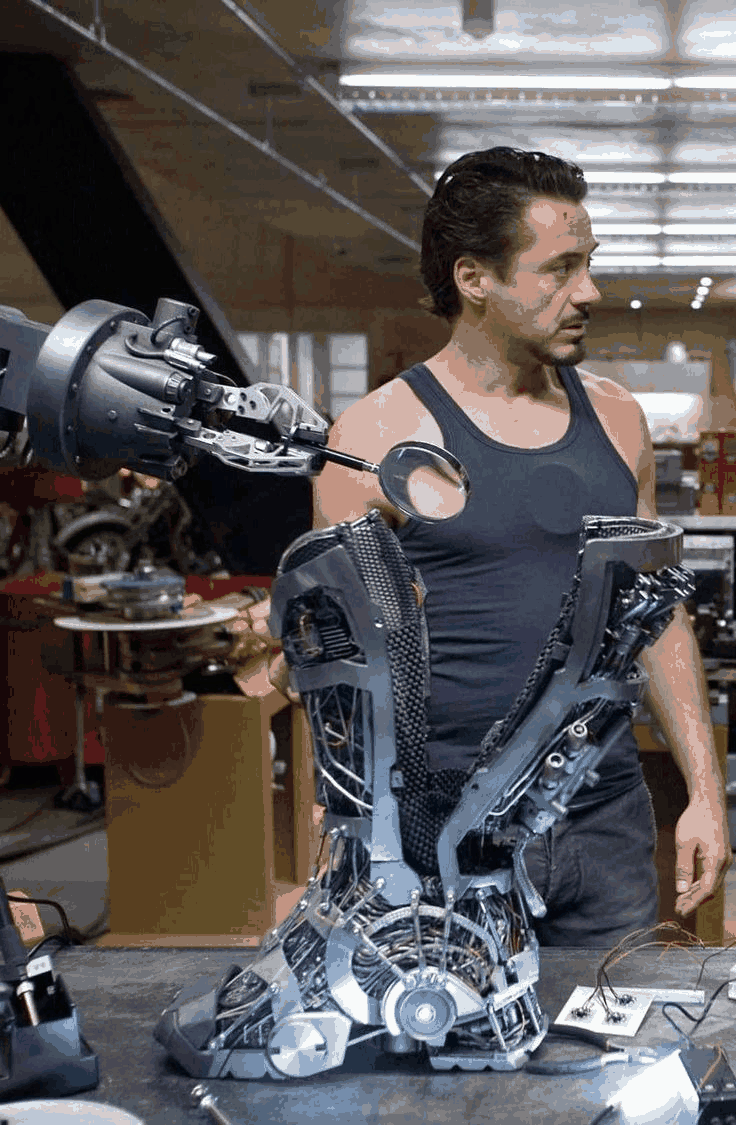
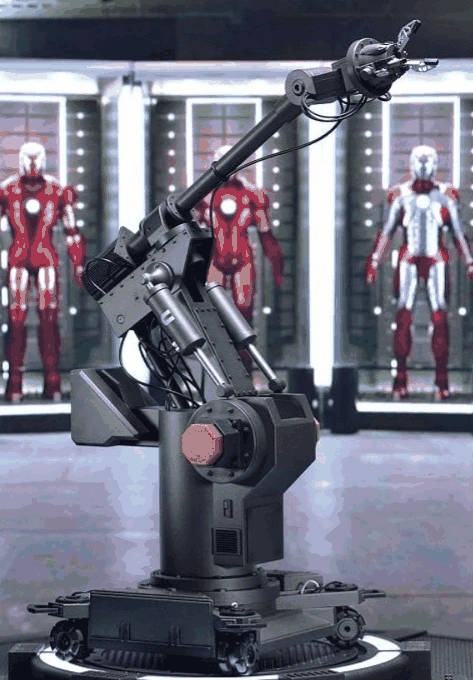
My first idea came from advanced robotic arm systems seen in films and industry. The first reference was a mechanically expressive robotic arm with visible actuators, layered structures, and human-like movement. The second helped me understand stable arm construction, articulated joints, and controlled directional movement.
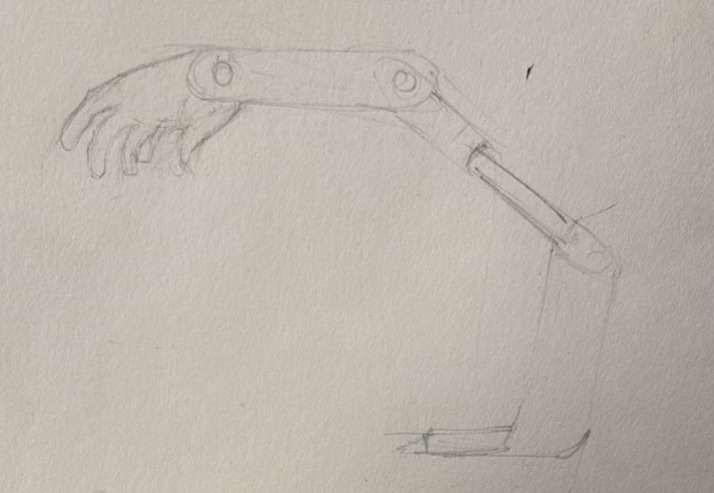
I sketched the placement of actuators, joint movement, arm proportions, and the relationship between the base and the arm. The plan was a multi-servo arm (base rotation, shoulder, elbow, and gripper) controlled with joysticks or potentiometers, with a mounted camera for live visual feedback.
Stage 2: gesture-controlled manipulator arm
In System Integration week, I developed the idea into a robotic manipulator arm controlled by a glove with flex sensors, with a parallel-jaw gripper, a wrist and forearm, an upper arm, and a rotating base.
Stage 3: the robotic gripper
I then narrowed the project down to the gripper itself, the part where the gears, linkages, and actuator have to work together most precisely. The camera, joysticks, glove, and arm sections are no longer part of the project. The current design and progress are documented in weeks 17, 18 and 19.