18. Applications and Implications, Project Development
Assignments and Assessment this week
Applications and Implications
-
Plan a final project masterpiece that integrates the range of units covered.
-
Your project should incorporate
- 2D and 3D design
- Additive and subtractive fabrication processes
- Electronics design and production
- Embedded microcontroller interfacing and programming
- System integration and packaging.
- Where possible, you should make rather than buy the parts of your project.
-
Projects can be separate or joint, but need to show individual mastery of the skills, and be independently operable.
-
See Final Project Requirements for a complete list of requirements you must fulfil.
Project Development
- Prepare drafts of your final project summary slide (presentation.png, 1920x1080) and video clip (presentation.mp4, 1080p HTML5, < ~minute, < ~25 MB), put them in your root directory, and check that they are linked in the final presentation schedule
Learning outcomes
- Define the scope of a project
- Develop a project plan including a schedule and a bill of materials (BOM)
- Track the progress of your project
- Summarise and communicate the essence of your project development
Have you answered these questions?
- What will it do?
- Who has done what beforehand?
- What sources will you use?
- What will you design?
- What materials and components will be used?
- Where will they come from?
- How much will they cost?
- What parts and systems will be made?
- What processes will be used?
- What questions need to be answered?
- How will it be evaluated?
- Uploaded summary slide (placeholder)
- Uploaded video clip (placeholder)
- Checked they are linked in the final presentation schedule
What will it do?
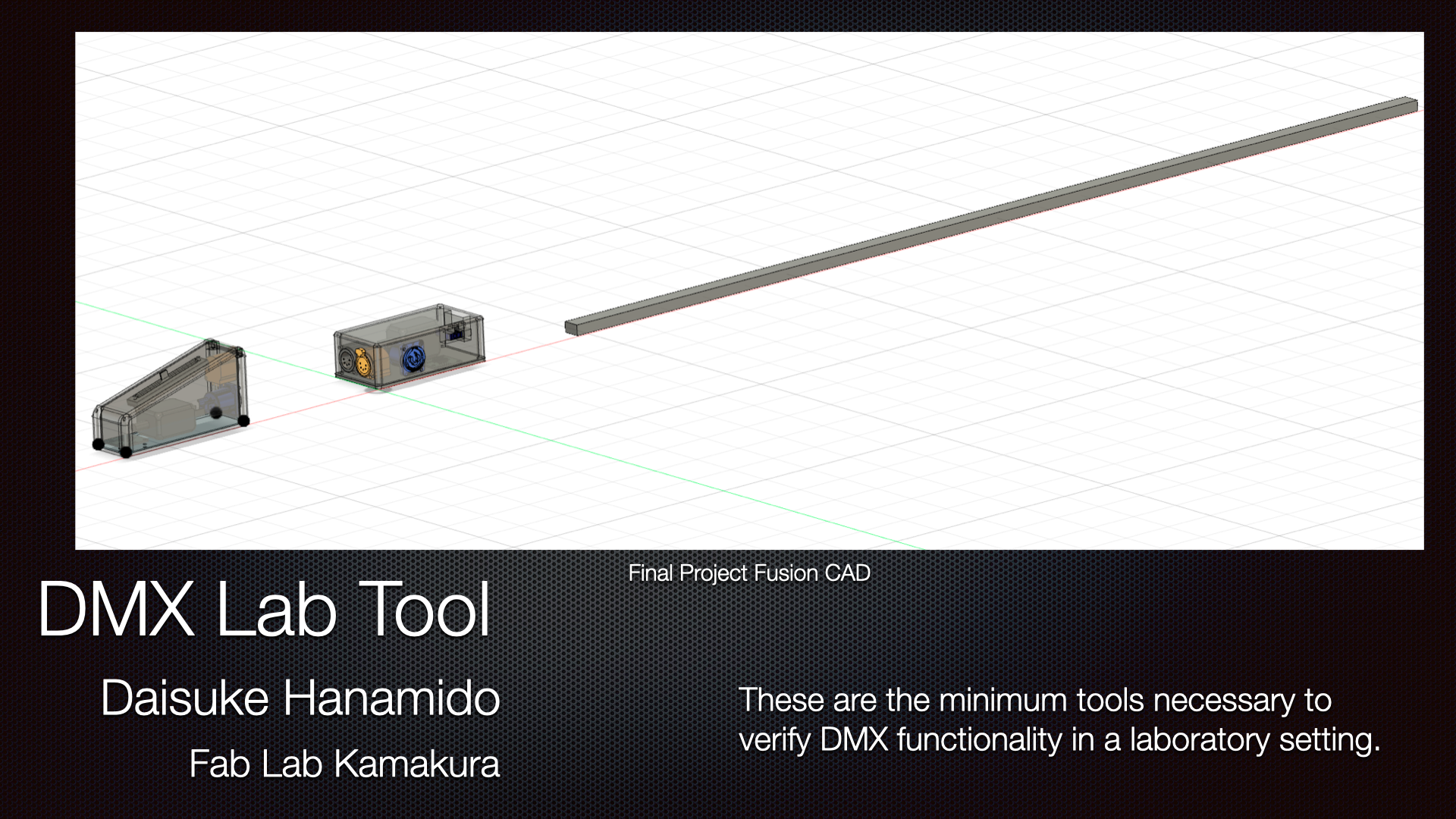
This is a set of modules for easily testing DMX signals.
DMX signals are output in accordance with the fader movement, displaying the current DMX value on the monitor, and controlling the RGB brightness of the NeoPixel LEDs with the DMX value.
Who has done what beforehand?
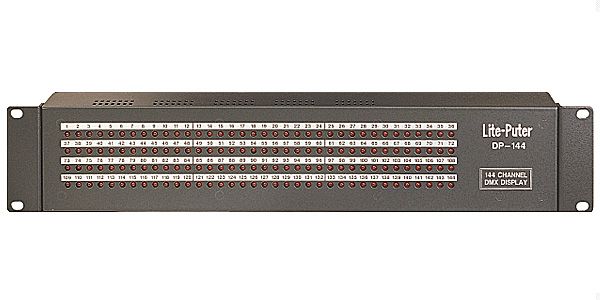 by SOUND HOUSE
Similar displays have existed before, such as the Lite putter DP-144, but they were mainly simple 3mm bullet-shaped LEDs that blinked or required connecting to a computer, and weren’t very user-friendly.
What sources will you use?
FabAcademy class page, Fab Community, Google Search, YouTube tutorials, ChatGPT, and friendly instructors! And I also received various advice from my mentor at the company, Toshihiro Hosoda.
What will you design?
DMX output control device, Monitor device to observe changes in DMX input, Control output device to check DMX input.
What materials and components will be used?
Look at the BOM
Bill of Materials(BOM)
DMX output control device - BOM
| Component | Material | Description | Qty | Vender | Cost |
|---|---|---|---|---|---|
| PCB | Seeed Studio XIAO RP2040 | Main MCU assembly for control and signal generation | 1 | DigiKey / Fab Lab Inventory | Approx. ¥1,200 ($8.00) |
| PCB | MAX485 Transceiver IC | IC component to convert MCU UART to DMX signal | 1 | Akizuki Denshi / Fab Lab | Approx. ¥200 ($1.30) |
| PCB | Slide Fader | Assembled analog fader component for level input | 1 | Fab Lab Inventory | Approx. ¥300 ($2.00) |
| PCB | 5-pin Connector (Female) | Pre-fabricated connector component for DMX output | 1 | Sound House / Retail | Approx. ¥400 ($2.60) |
| PCB | SMD Passive Materials | Raw resistors, capacitors, and resistors for the PCB assembly | 1 | Fab Lab Inventory | Included in lab fee |
| PCB | FR-1 Single-sided Board | Raw copper-clad laminate for milling the PCB | 1 | Fab Lab Inventory | Included in lab fee |
| Case | 3D Printing Filament (PLA/PETG) | Raw filament material for printing the enclosure | 1 | Fab Lab Inventory | Approx. ¥600 ($4.00) |
| Case | MDF Board (2.5 mm) | Raw sheet material for laser cutting the under panel | 1 | Fab Lab Inventory | Included in lab fee |
DMX monitoring device - BOM
| Component | Material | Description | Qty | Vender | Cost |
|---|---|---|---|---|---|
| PCB | Freenove ESP32-Wroom | Assembled Wi-Fi/Bluetooth MCU core module | 1 | DigiKey / Fab Lab Inventory | Approx. ¥700 ($4.50) |
| PCB | MAX485 Transceiver IC | IC component for single-universe receiver line | 1 | Akizuki Denshi / Fab Lab | Approx. ¥200 ($1.30) |
| PCB | LCD Monitor Display | Complete display module salvaged from an old toy | 1 | Witch or Iris elongated LCD Display | ¥10000 (discount take off) |
| PCB | 5-pin Connector (Male) | Pre-fabricated connector component for DMX input | 1 | Sound House / Retail | Approx. ¥400 ($2.60) |
| PCB | 5-pin Connector (Female) | Pre-fabricated connector component for DMX output | 1 | Sound House / Retail | Approx. ¥400 ($2.60) |
| PCB | Passive Materials | Raw electronic elements (resistors, caps, pins) for assembly | 1 | Fab Lab Inventory | Included in lab fee |
| PCB | FR-1 Single-sided Board | Raw copper plate material for milling the adapter PCB | 1 | Fab Lab Inventory | Included in lab fee |
| Case | MDF Board (2.5 mm) | Raw sheet material for laser cutting the structural box | 1 | Fab Lab Inventory | Approx. ¥300 ($2.00) |
| Case | Black Spray Paint | Finishing material for painting the MDF exterior | 1 | Retail | Approx. ¥200 ($1.30) |
| Case | Molding & Casting Resin / Silicone | Liquid chemical materials for casting the support feet | 1 | Fab Lab Inventory | Approx. ¥600 ($4.00) |
| Case | 3D Printing Filament (PLA/PETG) | Raw filament material for small assembly joints | 1 | Fab Lab Inventory | Approx. ¥200 ($1.30) |
DMX input NeoPixel LED - BOM
| Component | Material | Description | Qty | Vender | Cost |
|---|---|---|---|---|---|
| PCB | Seeed Studio XIAO RP2040 | Main MCU assembly for parsing and | 1 | DigiKey / Fab Lab Inventory | Approx. ¥1,200 ($8.00) |
| PCB | MAX485 Transceiver IC | IC component to receive differential DMX signals | 1 | Akizuki Denshi / Fab Lab | Approx. ¥200 ($1.30) |
| LED | NeoPixel Addressable LED Strip | Assembled 144 LED strip component for visual output | 1 | Amazon / Fab Lab Inventory | Approx. ¥1,200 ($8.00) |
| PCB | 5-pin Connector (Male) | Pre-fabricated connector component for | 1 | Sound House / Retail | Approx. ¥400 ($2.60) |
| PCB | 5-pin Connector (Female) | Pre-fabricated connector component for | 1 | Sound House / Retail | Approx. ¥400 ($2.60) |
| PCB | SMD Passive Materials | Raw electronic components for the LED decoder | 1 | Fab Lab Inventory | Included in lab fee |
| PCB | FR-1 Single-sided Board | Raw fiberglass board material for milling the PCB | 1 | Fab Lab Inventory | Included in lab fee |
| Case | 3D Printing Filament (Diffusive PLA) | Raw filament material for fabricating the | 1 | Fab Lab Inventory | Approx. ¥500 ($3.30) |
Where will they come from?
Amazon, Rakuten Market, Mercari (a Japanese used goods sales site similar to eBay), Digi-Key, Akizuki Denshi, Marutsu Elecs, Sengoku Densho, Sound House, Tomoka Denki, Monotaro, etc.
How much will they cost?
Look at the BOM
What parts and systems will be made?
DMX output control device, DMX input NeoPixel LED, DMX monitoring device
What processes will be used?
2D Design
Monitor Case, bottom cover of each devices.
3D Design
Slide fader case Neo pixel controller case
Additive process
3D printing of Slide fader and Neo pixel controller case
Subtractive process
Molding and casting of silicon foot parts Laser cutting of Monitor case
Electronics design and production
Two pcb with XIAO and a couple of pcb to connect output signal lines.
One pcb with ESP32 and LCD connection with DMX receiver of MAX485.
Embedded microcontroller design, interfacing and programming
Program to PCB with XIAO (slider input control by DMX to control Neo pixel on XIAO)
Program to PCB with ESP32 (Outputting a graph of DMX signals to the LCD)
System integration and packaging
The wiring has been converted to connectors and bundled with cable ties. A shake test was performed on all devices to confirm that they were functioning correctly after the test.
What questions need to be answered?
It is possible to create changes in the DMX and visually observe the movement.
How will it be evaluated?
It will be perfect if all devices are connected and the changes follow the fader movements.
Uploaded summary slide (placeholder)