Week 17 - Applications and Implications #
What will it do? Ideation of Zenbience #
Developing a final project idea took longer than I expected. From the beginning, I knew I wanted to create something that would live on a desk and become part of a person’s daily environment. One of my earliest concepts was a kinetic sculpture, but despite exploring the idea for some time, I never felt fully connected to it.
Eventually, I realized that the project needed to address something meaningful in my own life.
Concentration has always been a challenge for me while studying or working on projects. Unless I am completely immersed in a task, even minor background noises can easily pull my attention away. Over time, I discovered that listening to ambient soundscapes helped me stay focused and maintain a sense of calm. I often relied on ambience videos and virtual environments to create a more productive atmosphere and help myself get into a focused state.
This personal experience became the starting point for Zenbience.
Inspired by these experiences, I decided to create Zenbience, a desktop ambient sound device that helps users focus, relax, and disconnect from distracting screens.
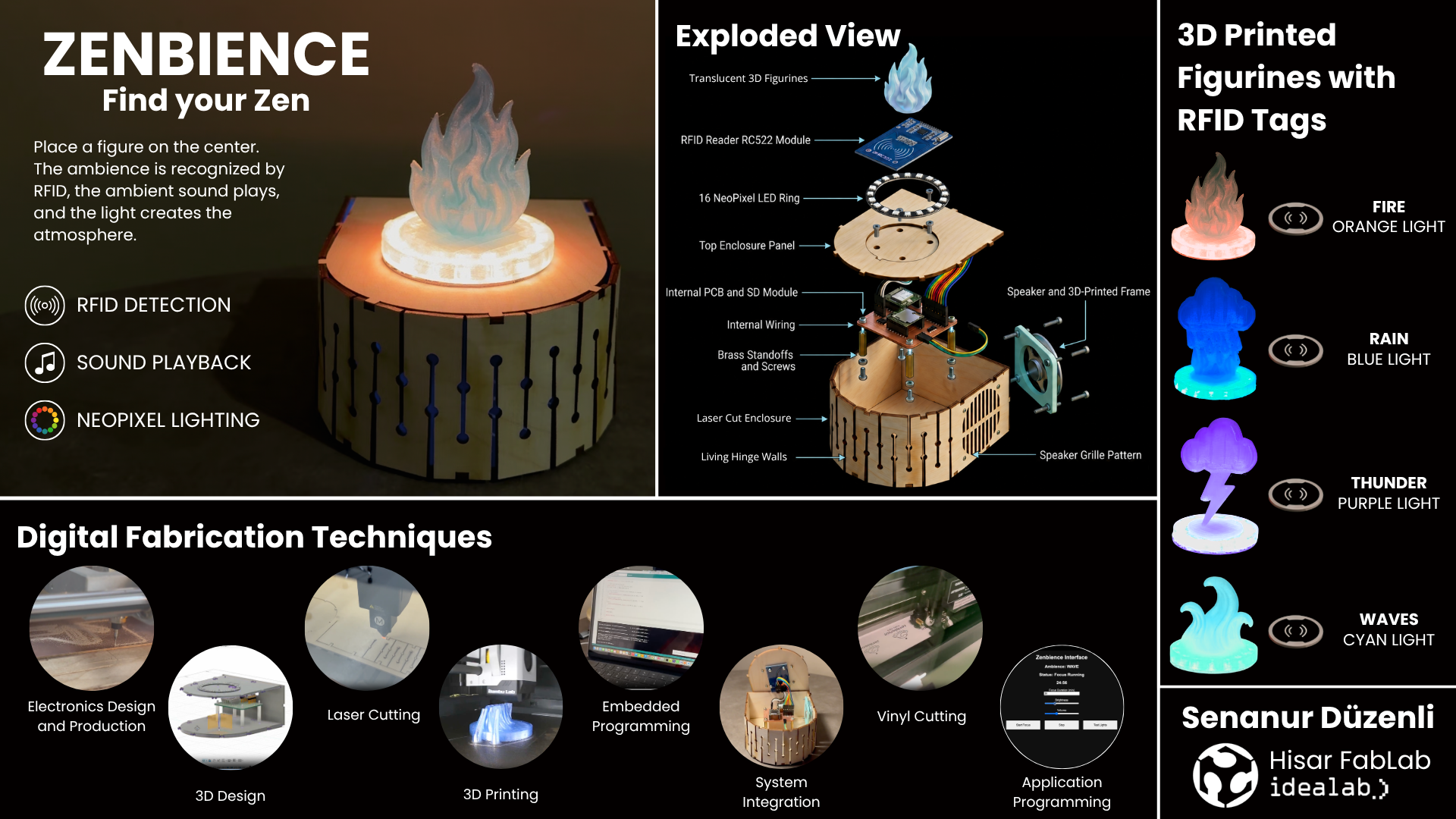
Zenbience is a physical ambience device that combines sound, light, and tangible interaction. Users can select different ambient environments by placing themed figurines onto the device. Each figurine represents a unique ambience, such as rain, thunderstorm, fireplace, or cricket sounds. When a figurine is placed on the device, the system automatically detects it and plays the corresponding audio while displaying matching light effects through addressable LEDs.
The project aims to:
- Help users stay focused and calm during work, study, or focus sessions.
- Provide immersive ambience without requiring a phone, computer, or browser window.
- Create a pleasant and decorative object for a desk environment.
- Encourage intentional interaction through physical objects rather than digital interfaces.
Who’s done what beforehand? #
Several existing products and experiences inspired this project.
Examples of ambience sources that I have personally used include:
- Hogwarts Library Ambience (YouTube)
- Cozy Scottish Castle Fireplace Ambience (YouTube)
- Thunderstorm in the Library Ambience (YouTube)
- A Soft Murmur ambient sound mixer
In addition, several Fab Academy final projects influenced the development of Zenbience. These projects demonstrated successful integration of electronics, fabrication, interaction design, and storytelling through physical products. They provided inspiration for enclosure design, embedded programming, user interaction, and system integration.
What sources will you use? #
The project development will rely on a combination of technical documentation, tutorials, component datasheets, and Fab Academy documentation.
Sources include:
- Fab Academy weekly assignments and documentation
- XIAO ESP32-C3 documentation
- DFPlayer Mini datasheet and examples
- RC522 RFID module documentation
- NeoPixel library documentation
- Arduino IDE documentation
- KiCad documentation
- Fab Academy student project archives
- Ambient audio recordings and royalty-free sound resources
What will you design? #
I will design and fabricate the following custom parts and systems:
- Main enclosure structure
- Laser-cut wooden housing
- Living-hinge side wall
- Custom electronics PCB
- Speaker mounting frame
- RFID figurine detection system
- Interchangeable 3D-printed ambience figurines
- LED diffusion system
- Internal mounting and assembly features
- User interaction and firmware architecture
The final product will integrate all mechanical, electronic, and software subsystems into a single desktop device.
What materials and components will be used? #
Materials #
- 3 mm plywood
- PLA filament
- Translucent filament for light diffusion
- Copper-clad PCB material
- Jumper wires and connectors
- Fasteners and spacers
Electronics #
- Seeed XIAO ESP32-C3
- DFPlayer Mini audio module
- RC522 RFID reader
- NeoPixel Ring 16
- 8 Ω 0.5 W speaker
- MicroSD card
- Custom PCB
Hardware #
- M3 bolts, screws, spacers, and nuts
- M2 bolts and nuts
Where will they come from? #
| Source | Parts |
|---|---|
| Hisar Fab Lab Inventory | Plywood, filament, PCB material, soldering equipment |
| Fab Academy GitLab | Documentation and project hosting |
| Robotistan | Electronic components |
| Direnc.net | Electronic components |
How much will they cost? #
| Component | Estimated Cost (TRY) | Estimated Cost (USD) |
|---|---|---|
| SEEED XIAO ESP32-C3 | 350 | 7.61 |
| DFR0299 DFPlayer Mini | 120 | 2.61 |
| WS2812 NeoPixel Ring 16 | 250 | 5.44 |
| 8Ω 0.5W Speaker | 50 | 1.09 |
| RC522 RFID Module | 100 | 2.18 |
| 64GB SD Card | 700 | 15.23 |
| Fasteners and Wiring | 100 | 2.18 |
| Copper Clad Board | 100 | 2.18 |
| 3mm plywood | 150 | 3.26 |
| Transparent PETG Filament | 500 | 4.36 |
| PLA Filament | 100 | 2.18 |
| Estimated Total | 2520 | 48.32 |
What parts and systems will be made? #
The project consists of the following subsystems:
Mechanical System #
- Main enclosure
- Living hinge structure
- Speaker mount
- Figurine holders
- Internal component mounts
Electronic System #
- Custom PCB
- ESP32-C3 microcontroller
- RFID reader
- DFPlayer Mini
- NeoPixel lighting system
Software System #
- RFID identification logic
- Audio control system
- LED animation control
- System state management
- Device startup and interaction routines
- Pomodoro interface with timer
What processes will be used? #
During the fabrication of Zenbience, I used:
- 2D and 3D design,
- additive manufacturing (3D printing),
- subtractive manufacturing (laser cutting),
- electronics design and production,
- embedded microcontroller interfacing and programming,
- system integration and packaging.
| Process | Tool / Machine / Software |
|---|---|
| 2D CAD Design | Fusion 360 |
| 3D CAD Design | Fusion 360, Meshy.ai |
| Laser Cutting | xTool Studio, xTool P3 |
| 3D Printing | Bambu Lab P1S |
| Slicing | Bambu Studio |
| PCB Design | KiCad |
| PCB Milling | Roland SRM-20 |
| Soldering | Fab Lab soldering tools |
| Assembly | Hand tools |
| Embedded Programming | Arduino IDE |
| Wireless Networking | ESP32-C3 Wi-Fi |
| Documentation | GitLab |
What questions need to be answered? #
Several technical questions must be resolved during development:
- How reliably can RFID tags be detected through the enclosure material?
- What is the optimal distance between the RFID reader and figurines?
- How can sound quality be improved within the enclosure constraints?
- What LED animations best match each ambience type?
- How should figurines be designed to maximize recognition and user experience?
- How can the enclosure be assembled while remaining serviceable?
- How can all subsystems be integrated into a compact and visually appealing product?
How will it be evaluated? #
The project will be evaluated based on whether it functions as a complete, integrated, and user-friendly system.
Success means:
- The custom PCB successfully operates the entire device.
- The ESP32-C3 correctly identifies each RFID figurine.
- The correct ambience audio plays when a figurine is placed on the device.
- NeoPixel lighting responds appropriately to the selected ambience.
- Audio playback is clear and reliable.
- The enclosure securely houses all electronic components.
- The laser-cut and 3D-printed parts fit together properly.
- The device operates as a standalone desktop product without requiring a computer.
- The final artifact demonstrates integration of 2D design, 3D design, additive fabrication, subtractive fabrication, electronics production, embedded programming, and system integration.
- Users can easily interact with the device and understand its purpose without additional instructions.
The project will be considered successful when it provides an immersive ambient experience through a tangible, aesthetically pleasing desktop object that helps users focus and relax while remaining completely functional as an integrated fabrication and electronics project.
Slide #