RESISTORS
A resistor is a two-terminal passive electronic component that limits, regulates, or restricts the flow of electric current in a circuit
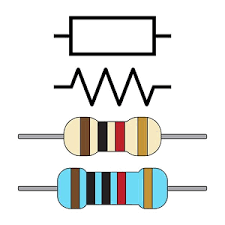
If too much electricity flows, components can overheat, LEDs can burn out, and circuits can get damaged.
A resistor protects components by limiting current, dividing voltage, and controlling signal levels in a circuit.
Measured in ohms, they convert electrical energy into heat to protect components, divide voltages, and bias active elements.
Very Simple Example
If you connect an LED directly to a battery, it may burn out because too much current flows through it.
But if you add a resistor in series, it reduces the current, keeps the LED safe, and allows it to glow properly.
Property of Resistance
Resistance is the property of a material to oppose the flow of electric current.
Resistance Formula
The resistance (R) of a conductor depends on:
- Length (L) – directly proportional
- Area of cross-section (A) – inversely proportional
- Resistivity (ρ) – material property
The mathematical expression is:
R = ρ (L / A)
Where:
- R = Resistance
- ρ = Resistivity of the material
- L = Length of the conductor
- A = Area of cross-section
Unit of Resistance
Resistance is measured in Ohms (Ω).
Classification of Resistors
Resistors are mainly classified into two types:
- Fixed Resistors
- Variable Resistors
1. Fixed Resistors
Fixed resistors have a constant resistance value that cannot be changed.
Types of Fixed Resistors
- Carbon Composition: Made from a mixture of carbon granules and a binding material.
- Carbon Film: A thin layer of carbon is deposited on an insulating core. The resistance value depends on the thickness of the carbon film.
- Metal Film: Similar to carbon film but uses metal (such as Nichrome). It provides better stability, accuracy, and lower noise.
- Wire-Wound: Constructed by winding a metal wire (usually Manganin or Nichrome) around an insulating core.
2. Variable Resistors
Variable resistors allow the resistance value to be adjusted manually.
Types of Variable Resistors
- Potentiometer: A three-terminal device used as a voltage divider. It uses a sliding contact called a wiper to vary resistance.
- Rheostat: Usually a two-terminal variable resistor used to control current in a circuit.
- Trimmers (Presets): Small variable resistors used for occasional adjustments and calibration on circuit boards.