Week 17 — Applications and implications - project development
What will it do?
Bidirectional Braille device that converts information between conventional text and Braille. It features dynamic Braille cells and a six-button keyboard similar to that of a Perkins machine. The cells operate through a mechanism composed of servo motors, gears, and notched linear sliders that control the vertical movement of the Braille pins.
Who has done what beforehand? What sources will you use?
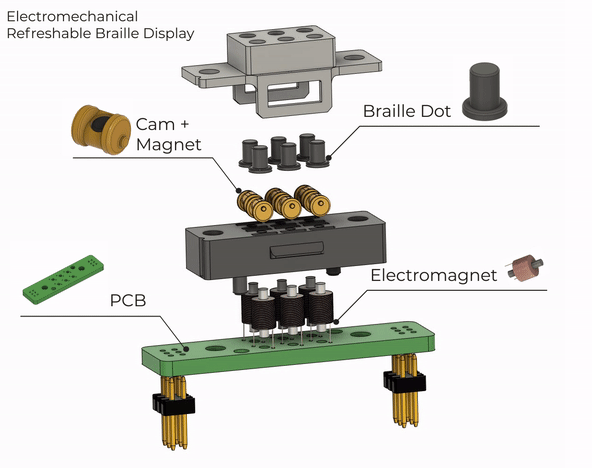
Varada V. R. (2023) developed a dynamic Braille module using an electromechanical mechanism with 3D-printed eccentric cams. Each cam incorporates a small permanent magnet that allows its position to be changed by an electromagnet with reversible polarity. The rotation of the cams controls the vertical movement of the Braille pins and keeps them raised or retracted without requiring a continuous power supply.
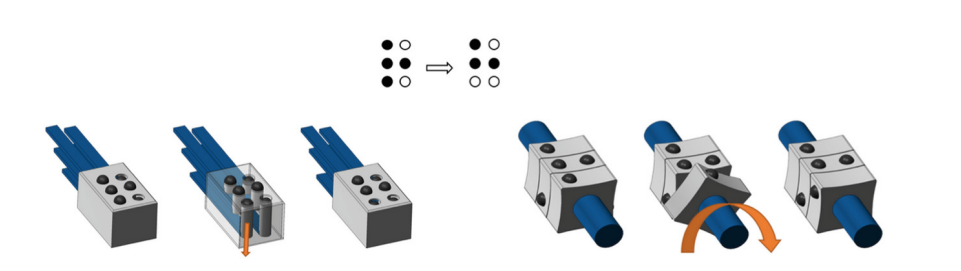
Zagler W. L., Treml M., Busse D., Busboom M., and Deák I. (2018) proposed BrailleRing, a dynamic Braille device based on a rotating ring containing small prismatic elements with Braille dots on their surfaces. Unlike conventional mechanisms that raise and retract pins, this system uses the rotation of the prisms to generate different tactile patterns. The characters are configured by actuators located in a section of the ring.
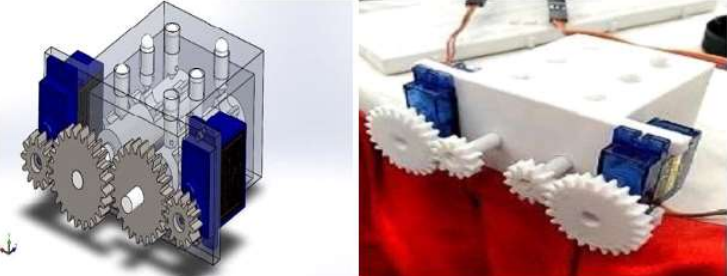
Aryan, Rajkumar E., and Doshi S. (2021) developed a dynamic Braille cell that uses a camshaft mechanism driven by two servomotors and gears. The system employs two concentric shafts with distributed cam profiles to control the vertical movement of the six pins and generate different Braille patterns.
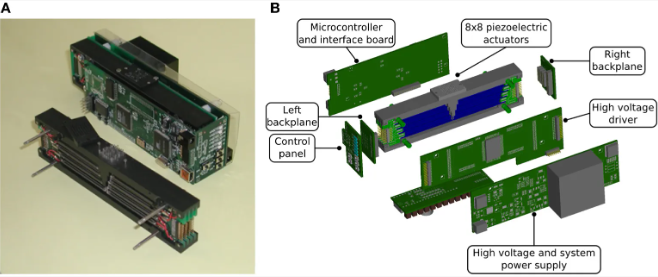
Motto Ros P., Dante V., Mesin L., Petetti E., Del Giudice P., and Pasero E. (2014) developed a dynamic tactile display consisting of an 8 × 8 array of 64 plastic pins. The system uses piezoelectric actuators arranged in layers and sublayers to control the vertical movement of the pins and reduce the size of the device. The display can represent configurable Braille patterns and other tactile shapes.
What will you design?
Dynamic Braille cells with movable pins (parametric design and 3D printing), notched linear sliders and gears driven by servomotors (parametric design and 3D printing), six-button Perkins-style Braille keyboard (3D design and 3D printing), main enclosure and mounting panels (2D and 3D design, laser cutting and 3D printing), custom printed circuit board (electronic design and CNC milling), Braille cell control and keypad input system (embedded programming, input and output devices).
What materials and components will be used?
Where will they come from?
The materials and electronic components will come from the Fab Lab in Mexico City and commercial suppliers. The mechanical parts will be manufactured in the laboratory using the available equipment.
How much will they cost?
The estimated cost of the project is **$4,794.18 MXN (approximately $258.89 USD)**. Although the necessary equipment is already available in the laboratory, this estimate considers the cost of building the device from scratch. The budget includes manufacturing materials, electronic components, tools, and consumables used in its development.
What parts and systems will be made?
Dynamic Braille cells with their respective pins, notched linear sliders, gears, Perkins-style keyboard buttons, the main enclosure, structural panels and a PCB.
What processes will be used?
- Parametric CAD Design with Fusion 360 and OpenSCAD.
- FDM 3D Printing.
- 2D Design and Laser Cutting.
- Electronic PCB Design.
- CNC PCB Milling.
- Soldering and Assembly.
- Embedded Programming.
- Mechanical and Electronic Integration.
What questions need to be answered?
- How can the alignment and stability of the pins be ensured during operation?
- What equipment or manufacturing process is most suitable given the size of the Braille cells?
- How can the components be integrated into a compact design?
How will it be evaluated?
The system must interact with the six-button keyboard, allowing Braille characters to be entered and interpreted as conventional text. The dynamic Braille cells must also represent Braille patterns through the movement of their pins, enabling bidirectional conversion between conventional text and Braille.