Week 18: Applications & Implications
Plan a final project Overview
This proposal outlines a comprehensive final project that integrates various units of study. The project will be designed to demonstrate mastery of multiple skills, including 2D and 3D design, fabrication processes, electronics design and production, and system integration.
Project Objectives:
What will it do?
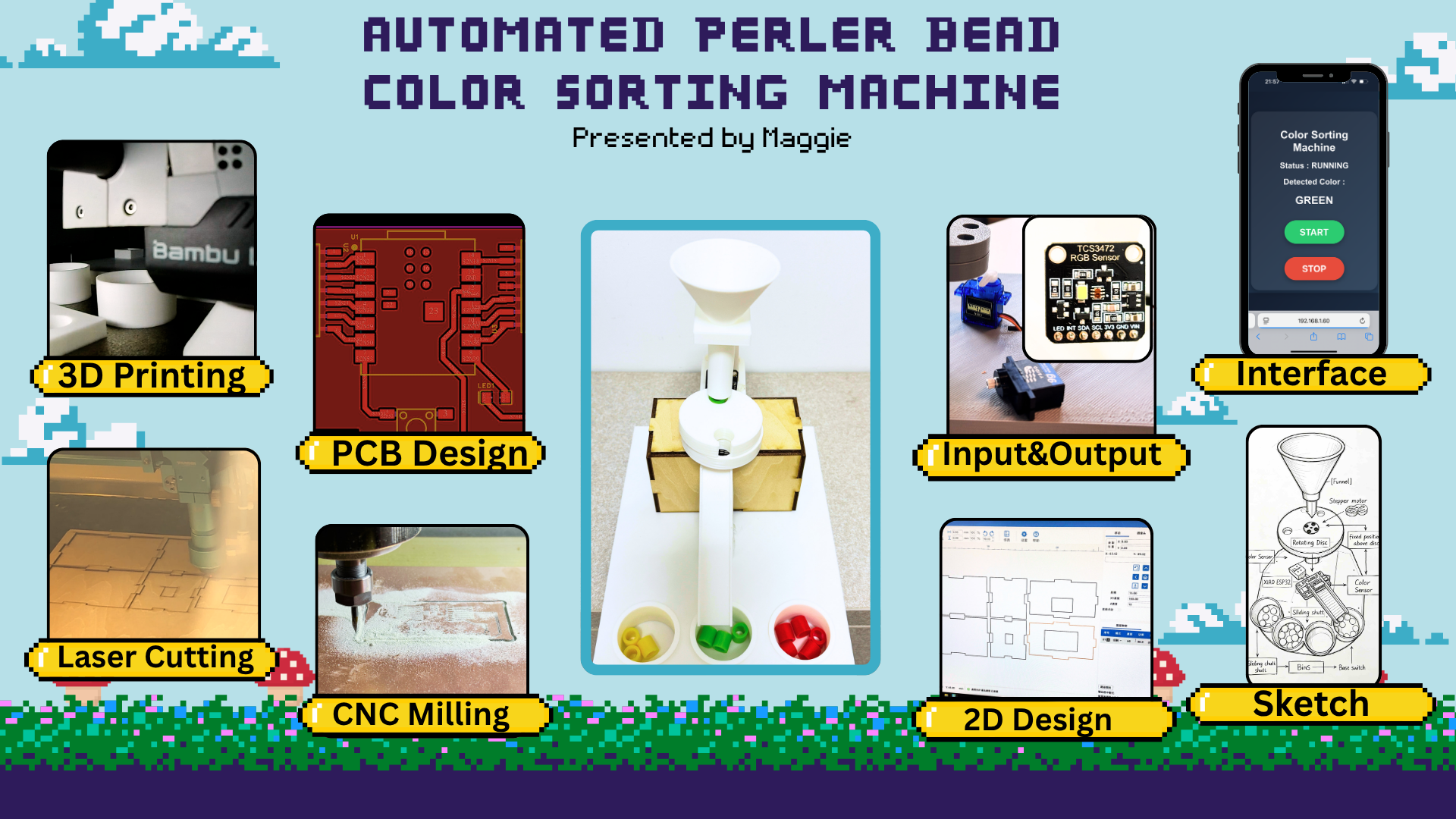
Mixed Perler beads are poured into a funnel. A vibrating motor (optional) helps them feed onto a rotating disc (or a disc with small pockets). The disc rotates continuously, bringing beads one‑by‑one over a fixed RGB color sensor. After color identification, a second motor rotates a sliding track / curved ramp to align with the correct bin, and the bead rolls down into it. An optional base switch (limit switch) detects when a bin is full.
Who has done what beforehand?
- Color sorting machines are available in industry, but they are expensive and not easy to use. YouTube — color sorting example 1, YouTube — color sorting example 2
- No open-source Perler bead sorter uses an ESP32-C3 microcontroller
What sources will be used?
- Color sensing: TCS34725 RGB sensor (Arduino library, I²C).
- Motor control: Stepper or DC motors with driver (DC 28BYJ-48 or SG90).
- XIAO ESP32-C3: Official documentation, pinout, PWM, and interrupt handling.
- Mechanical design: Fusion 360 for disc, curved ramp, and sliding track; laser-cut acrylic for chassis.
- Vibration motor: Simple DC0612 motor.
Design process demonstration
| Design Item | Tool | Process Demonstrated |
|---|---|---|
| Funnel + rotating disc + pockets | Fusion 360 | 3D design (additive) |
| Curved ramp + rotating sliding track | Fusion 360 | 3D design (additive) |
| Chassis (box frame) | Laser maker | 2D design (subtractive) |
| Custom PCB (breakout for motors, sensor, ESP32) | KiCad /Easy EAD | Electronics design |
| Firmware (color detection → track positioning) | ESP32-C3 | Embedded programming |
| Full assembly (disc + ramp + bins) | Physical integration | System integration |
Where will they come from? And how much will they cost?
The color sensor, motors, and ESP32-C3 will be purchased from Taobao online stores. Laser-cut acrylic or wood will come from our school Keytech lab. The total cost would be around ¥70
| Component | Source & estimated cost |
|---|---|
| XIAO ESP32-C3 | Taobao, ≈ ¥30 |
| TCS34725 color sensor module | Taobao, ≈ ¥15 |
| SG90 micro servo | Taobao, ≈ ¥10 |
| Vibration motor (optional) | Taobao, ≈ ¥5 |
| PLA filament (3D-printed parts) | Office own stock, ≈ ¥10 |
| Laser-cut acrylic/wood (chassis) | School lab, included in lab materials |
What processes will be used?
| Process | Application |
|---|---|
| 2D design | Laser-cut acrylic base, motor mounting plates, bin holders |
| 3D design | Funnel, disc, curved ramp, sliding track |
| Additive fabrication | 3D printing all plastic moving parts |
| Subtractive fabrication | Laser cutting the chassis frame |
| Electronics design | Custom PCB to connect XIAO, sensor, two motors, vibration, limit switch |
| Electronics production | Milling PCB on Roland SRM-20 |
| Embedded programming | XIAO ESP32-C3: color reading, motor (stepper/servo) control, vibration PWM |
| System integration | Mount disc axis, align sensor above disc, couple sliding track to servo |
What questions need to be answered?
- How fast can the rotating disc present beads without jamming the sensor?
- What angle of the curved ramp ensures beads roll reliably into the sliding track?
- Can one servo rotate the sliding track fast enough for 1–2 beads/second?
- Does the vibration motor improve bead feed consistency, or cause beads to jump off the disc?
- How to calibrate TCS34725 for the specific 3–4 Perler colors under ambient light?
What parts and systems will be made?
- Self-designed and produced: 3D-printed funnel, rotating disc (with pockets or friction pads), curved ramp, rotating sliding track; laser-cut chassis; firmware.
- Assembled from modules: RGB sensor (I²C), motor drivers, vibration motor, limit switch.
- Integrated system: Funnel → vibrating feed → rotating disc → color sensor → rotating track → bins.
How will it be evaluated?
-
Step 1: Calibration
Train the TCS34725 RGB sensor with 5 beads of each color (red, blue, yellow, green, orange). Store min/max RGB ranges.
Set servo angles for each bin (0°, 45°, 90°, 135°, 180° for 5 bins).
-
Step 2: Accuracy test
Prepare a mixed batch of exactly 50 beads: 10 of each of 5 colors.
Pour into funnel. Run machine until empty.
Manually inspect each bin. Count correct vs. incorrect.
Formula: Accuracy = (correct beads in correct bin) / (total beads) × 100%
-
Step 3: Throughput test
Run the same 50 beads. Use a stopwatch from the moment the first bead leaves the funnel to the last bead entering a bin. Repeat 3 times and average.
Project Gantt chart — Fab Academy weeks
Which Fab Academy weeks contributed work to the Automated Perler Bead Color Sorting Machine final project. Coloured cells link to that week’s documentation.
| Project task | W1 | W2 | W3 | W4 | W5 | W6 | W7 | W8 | W9 | W10 | W11 | W12 | W13 | W14 | W15 | W16 | W17 | W18 | W19 | W20 | |
|---|---|---|---|---|---|---|---|---|---|---|---|---|---|---|---|---|---|---|---|---|---|
| Concept & motivation | ● | ||||||||||||||||||||
| 2D/3D CAD & laser-cut chassis | ● | ● | |||||||||||||||||||
| 3D printing — funnel, disc, chute | ● | ||||||||||||||||||||
| PCB design & electronics production | ● | ● | |||||||||||||||||||
| Color sensor (TCS34725) input | ● | ||||||||||||||||||||
| Servo output & power (SG90) | ● | ||||||||||||||||||||
| Wi-Fi web control firmware | ● | ||||||||||||||||||||
| System integration | ● | ||||||||||||||||||||
| Applications & implications | ● | ||||||||||||||||||||
| Dissemination & presentation | ● | ● |
Coloured week = documented final-project work that week (click to open)
Summary slide for the final project