Week 19: Invention, Intellectual Property and Income
Assignments
This week I documented dissemination, future development, project status, and lessons learned for my final project — the Color Sorting Machine.
1. Dissemination Plan
Created a dissemination plan for the final project.
Dissemination Plan
I will present the Color Sorting Machine through:
- A poster explaining the system structure and working principle.
- A short video showing the machine sorting colored beans automatically.
- Sharing the Arduino code and circuit diagram on GitHub.
- Creating a presentation that explains the hardware, software, and future applications.
2. Future Possibilities
Outlined future possibilities and described how to make them probabilities.
Future Possibilities
The color sorting machine can be improved and used in:
- When combined with image recognition technology, once a player enters a pattern, the color-sorting machine can automatically identify the corresponding colors and calculate the number of beads required for each color, helping the player organize the necessary colors and quantities of beads. If the player wishes, the machine can automatically assemble the beads after recognizing the pattern, functioning as an automatic bead-assembly machine.
- Educational robotics projects for students to learn about color sorting and automation by using Lego bricks and sensors.
How to Make Them Reality
- Replace the servo-driven turntable with a stepper motor for higher precision.
- Improve the color recognition algorithm using calibration data.
- Add Wi-Fi control and a web interface.
- Increase the number of sorting channels.
- Use machine learning for more accurate color identification.
- Design a 3D printed enclosure for industrial applications.
3. Completed and Remaining Tasks
What tasks have been completed, and what tasks remain?
Completed Tasks
- Built the mechanical structure.
- Connected the ESP32 XIAO C3.
- Installed and tested the TCS34725 color sensor.
- Programmed Servo1 to rotate the turntable.
- Programmed Servo2 to direct beans into different holes.
- Implemented color detection for red, green,and yellow objects.
- Successfully tested the system with colored beans.
Remaining Tasks
- Improve sorting accuracy.
- Optimize servo speed and timing.
- Reduce repeated color detection.
- Add Wi-Fi monitoring and control.
- Design a better power supply system.
- Build a protective enclosure.
- Perform long-term reliability testing.
4. What's Working? What's Not?
What's Working
- The ESP32 communicates correctly with the color sensor.
- The TCS34725 can recognize different colors.
- Servo1 rotates between positions smoothly.
- Servo2 moves the slide to the correct sorting angle.
- The machine can automatically sort colored beans.
What's Not Working
- Color detection is affected by ambient light.And sometimes the color sensor is not working correctly, because the height of the color sensor, sometime, impossilbe to accurately identify the colors.
- Similar colors may sometimes be misclassified.
- Servo motors occasionally vibrate.
- Sorting speed is relatively slow.
- The power supply is not yet optimized for larger motors.
5. Questions to Be Resolved
Several issues still need further investigation:
- How can color recognition accuracy be improved?
- How can ambient light interference be reduced?
- What is the best power supply configuration for the motors?
- Would a stepper motor provide better precision than a servo motor?
- How can Wi-Fi control and remote monitoring be added?
- How can the system sort objects faster while maintaining accuracy?
6. Planned Timeline
Planned what will happen when:
| Time | Planned Activities |
|---|---|
| May11 - May16 | 3D designing and printing and assemble themechanical parts for the final project |
| May17 - May23 | Program Servo1 and Servo2 & Connect ESP32 and TCS34725 & Test the color detection |
| May24 - May31 | Improve reliability and power supply |
| June1 - June3 | Add Wi-Fi monitoring and optimize the sorting algorithm |
| June 4 - June 7 | Complete final testing and presentation materials |
| June8 - June10 | Prepare a summary slide and a one minute video showing its conception, construction, and operation. |
7. What Have You Learned?
Through this project, I learned:
- How to program the ESP32 XIAO C3 using Arduino IDE.
- How servo motors work and how to control them.
- How the TCS34725 color sensor detects RGB values.
- How to integrate hardware and software into an automated system.
- How to debug electrical and programming problems.
- The importance of power management and timing control.
- How automation systems are used in industry.
- How engineering projects require testing, troubleshooting, and continuous improvement.
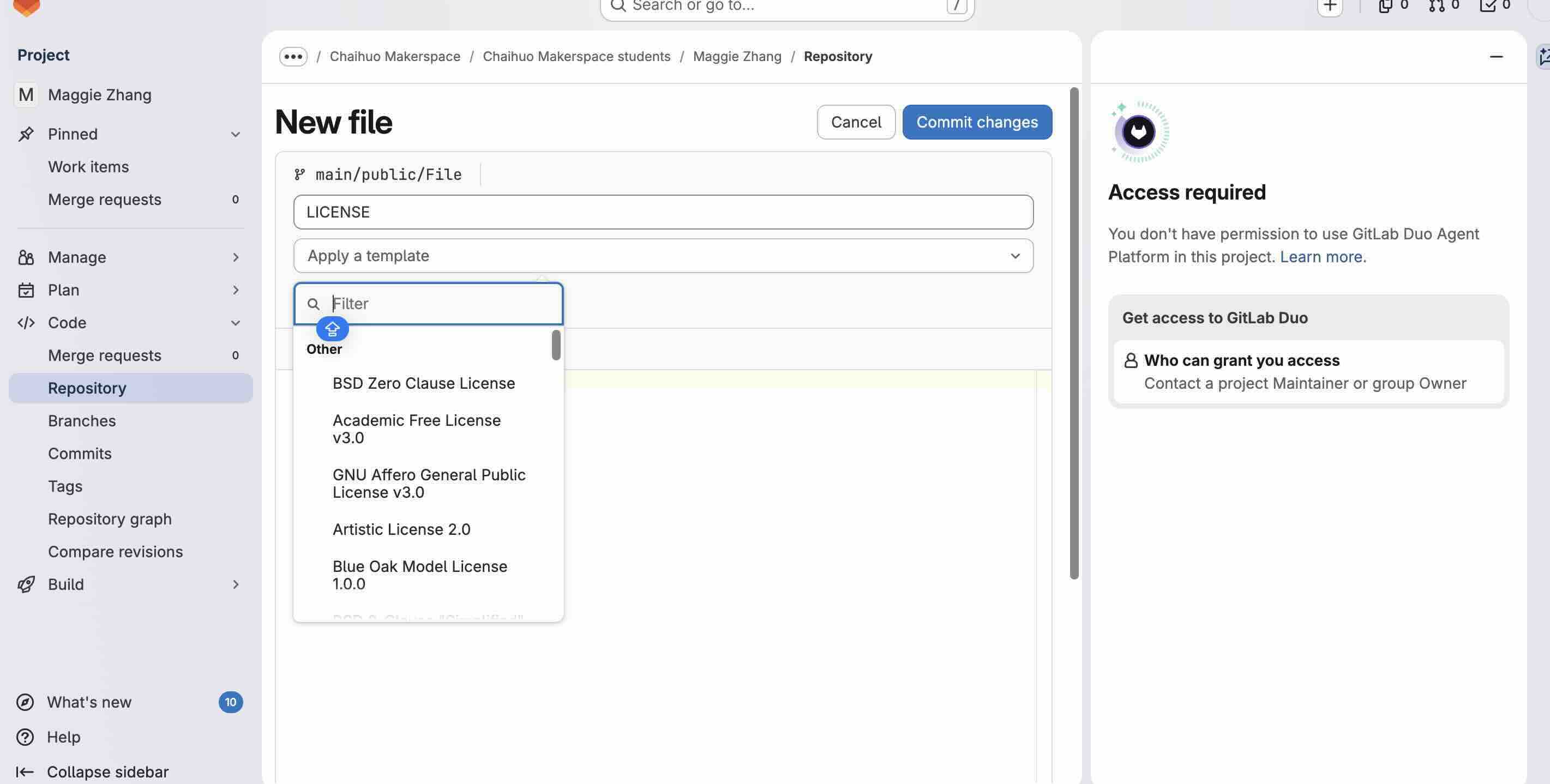
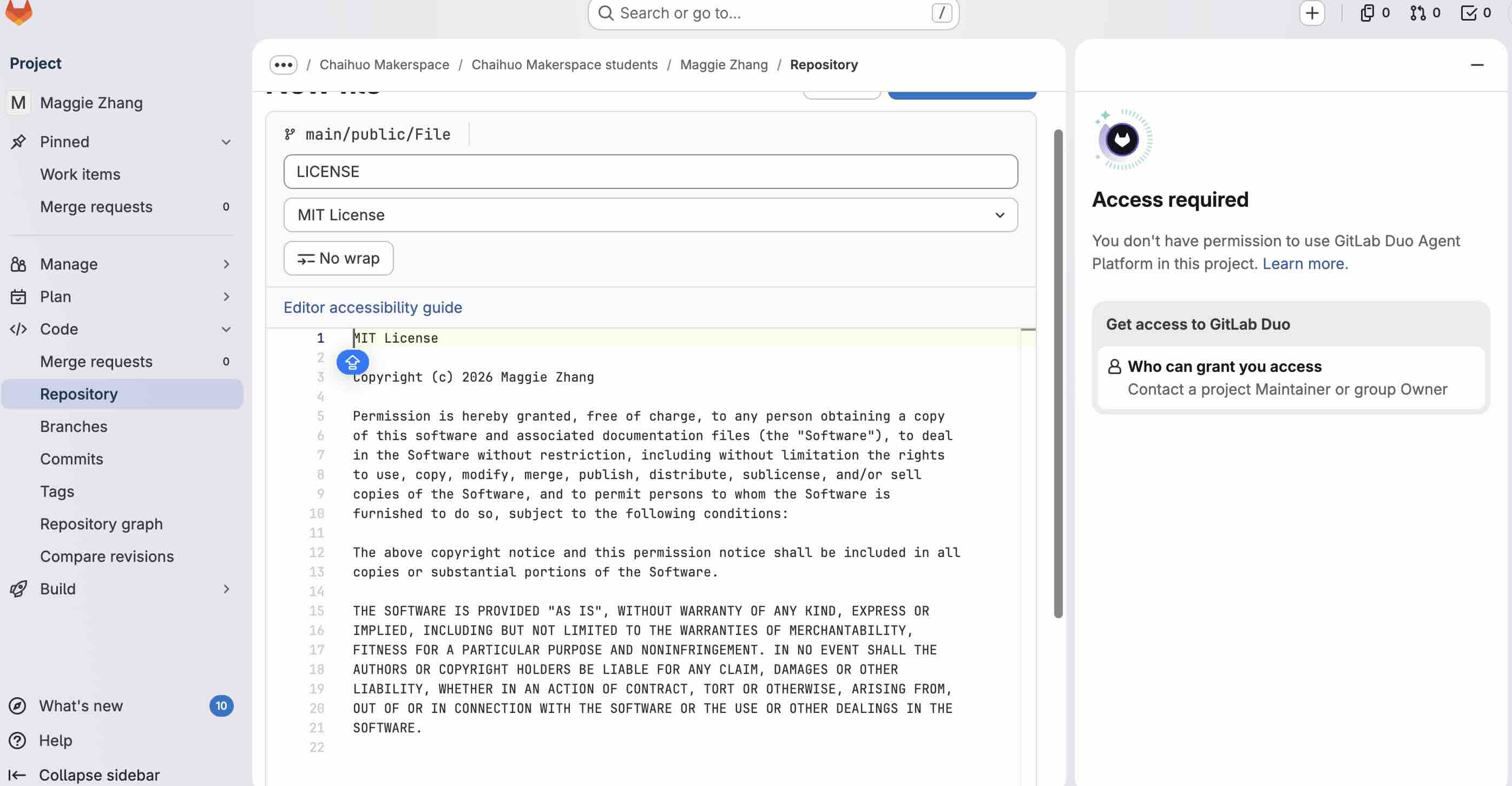
License
This project is licensed under the MIT LicenseMIT License.
- Share — copy and redistribute the material in any medium or format
- Adapt — remix, transform, and build upon the material Under the following terms:
- Attribution — You must give appropriate credit, provide a link to the license, and indicate if changes were made
- NonCommercial — You may not use the material for commercial purposes
- ShareAlike — If you remix, transform, or build upon the material, you must distribute your contributions under the same license
You are free to:
Conclusion
The Color Sorting Machine successfully demonstrates the principles of sensing, automation, and control. It combines mechanical design, electronics, and programming to create an intelligent sorting system. With further optimization, the project could be applied in industrial automation, recycling, and smart manufacturing systems.