Applications and Implications, Project Development
Project Title: Mini Catamaran for Caspian Sea Research
What will it do?
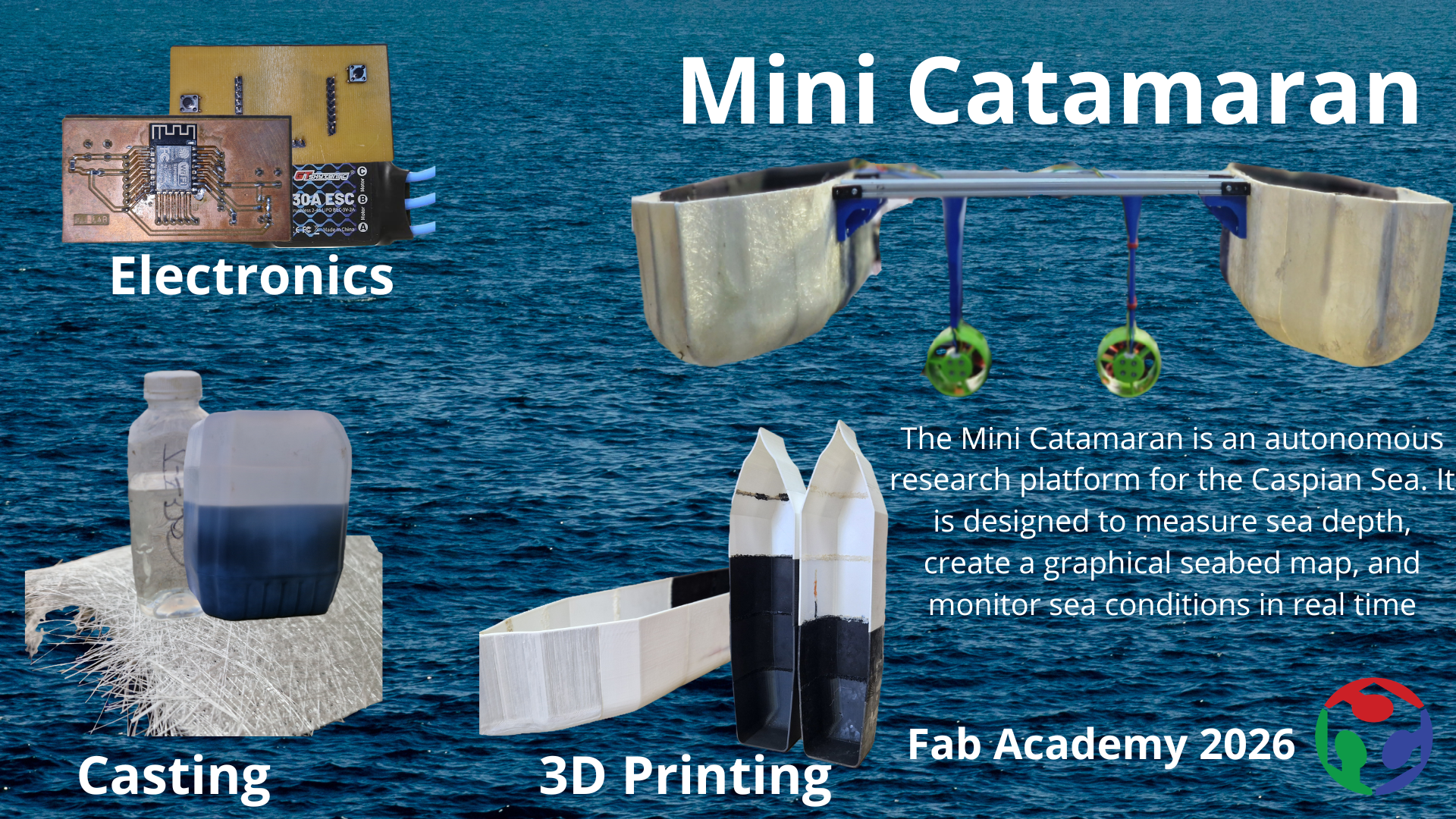
The Mini Catamaran is a small research platform designed for the Caspian Sea. Its purpose is to monitor sea conditions, measure sea depth, collect environmental data, and create graphical maps of the seabed.
At the current stage, the catamaran is manually controlled using a remote controller and can move across the water surface.
In the future, it will become an autonomous marine research platform.
Who has done what beforehand?
Many researchers and engineers have developed autonomous surface vehicles and marine monitoring systems. Their work inspired this project.
However, this project focuses on creating a low-cost, compact, and customizable research platform that can be adapted for the Caspian Sea.
What sources will you use?
The following sources were used:
- Fab Academy documentation;
- ESP32 official documentation;
- FlySky FS-A8S documentation;
- Arduino IDE documentation;
- online engineering tutorials;
- marine research articles.
What will you design?
I will design:
- the 3D catamaran body;
- electronic connections;
- motor control system;
- sensor integration;
- waterproof housing;
- system packaging.
What materials and components will be used?
Materials and components:
- PLA filament;
- ESP32 microcontroller;
- FlySky FS-A8S receiver;
- FlySky transmitter;
- two DC motors;
- motor drivers;
- battery;
- wires and connectors;
- screws and mounting hardware.
Where will they come from?
Most electronic components will be purchased from local suppliers or online stores.
The body components will be manufactured in the Fab Lab using 3D printing.
How much will they cost?
Estimated cost:
| | | |
|-|-|-|
|ESP32| 8 USD| Amazon |
| FlySky FS-A8S| 15 USD| Amazon
| FlySky transmitter| 50 USD | Amazon
|Two DC motors| 20 USD| Amazon
| Battery |25 USD | Aliexpress
| PLA filament| 15 USD | Amazon
Total estimated cost: approximately 150 USD.
What parts and systems will be made?
The following systems will be developed:
- catamaran body;
- motor propulsion system;
- electronic control system;
- remote-control system;
- sensor integration system;
- future autonomous navigation system.
What processes will be used?
The project includes:
- 2D design;
- 3D design;
- additive manufacturing (3D printing);
- electronics integration;
- embedded programming;
- system integration;
- testing and packaging.
What questions need to be answered?
The following questions still need to be answered:
- Which depth sensor should be used?
- How should autonomous navigation be implemented?
- How will data be transmitted?
- Which mapping software will be used?
How will it be evaluated?
The project will be evaluated according to:
- stability on water;
- motor performance;
- control accuracy;
- electronic reliability;
- future expandability.
Summary Slide
A summary slide named presentation.png has been prepared and placed in the project root directory.
Video Clip
A one-minute presentation video named presentation.mp4 has been prepared and placed in the project root directory.
Final Presentation Schedule
The summary slide and video clip have been linked to the final presentation schedule.
This project demonstrates the integration of engineering, digital fabrication, electronics, embedded programming, and system integration skills developed during Fab Academy.