Week 18 | Invention, Intellectual Property and Income
Overview
This week had two main parts. The first was learning about intellectual property, licensing, and commercialization. The second was continuing to develop the final project, working on the dissemination plan, tracking progress, and preparing the presentation slide and video.
These are the key points I toke from Neil and Ivan lectures:
- Intellectual property (IP): is not just about patents; it covers copyright, trademarks, trade secrets, and licenses.
- Patent: protects an invention for ~20 years, but it requires disclosure. After expiry, anyone can use it.
- Copyright: applies automatically when someone creates something, so no need to register it. It covers creative works, code, and documentation.
- Trade secrets: are protected by keeping them confidential, no registration needed, but no protection if revealed.
- The choice between open and closed IP depends on a goal: commercialization vs. community impact.
- FabAcademy itself uses open licensing, and encourages students to do the same.
Local Lecture by Ivan
Ivan's lecture focused on practical IP strategies relevant to our projects. The main points I noted:
Types of IP:
| Type | What it protects | Duration |
|---|---|---|
| Patent | Inventions, processes | ~20 years |
| Copyright | Creative works, code, documentation | Life + 70 years |
| Trademark | Brand name, logo | Renewable |
| Trade secret | Confidential business info | As long as kept secret |
Licensing:
- A license: lets others use my work under conditions I define, without giving up ownership.
- Open source licenses: There are three open source licenses: MIT, GPL, CC allow free use, modification, and sharing.
- Proprietary licenses: restrict use and require payment or permission.
- The key question is: does someone want to share freely or control use commercially?
Creative Commons (CC):
CC licenses are commonly used for documentation and hardware designs in FabAcademy. The main options:
- CC BY: use freely, just credit me.
- CC BY-SA: use freely, but share under the same license.
- CC BY-NC: use freely, but not for commercial purposes.
- CC BY-NC-SA: non-commercial + same license required.
Commercialization paths:
- Startup: build a company around the product.
- Licensing: let others manufacture and sell, you receive royalties.
- Spin-off: separate entity from a university or research group.
- Open source: release freely, build reputation or services around it.
License for This Project
For this project, I chose the Creative Commons Attribution-NonCommercial-NoDerivatives (CC BY-NC-ND) license.
I picked this license because it gives me the most control for now. In Creative Commons, you can always move to a less restrictive license later, but you cannot go the other way. So starting strict and relaxing later is possible but starting open and restricting later is not. That is why I chose it.
What this license means in practice:
Attribution, If you use this work, you must credit me and link to the license. NonCommercial, You cannot use it to make money. NoDerivatives, You can share it, but you cannot modify it or publish a changed version.
I may consider a more open license in the future, for example if the project moves into a research or open-source direction. But for now, this is where I start.
Final Project: Sleep Monitoring Device
Project Overview
Sleep Monitoring is a small, wearable device that detects snoring, correlates snore events with physical sleep positions using an IMU, and monitors temperature and humidity. The system integrates 2D & 3D design and printing, UV printing, electronic design and production, input and output devices, embedded programming, wireless communication, and a web dashboard interface.
Progress Summary
Status: Final polishing stage, reviewing, rechecking, and preparing for presentation.
Task Checklist
2D & 3D Design
| Task | Status |
|---|---|
| Drawing a 2D sketch of the device enclosure | 100% |
| 2D & 3D modeling designed in Inkscape and Fusion 360 | 100% |
Fabrication
| Task | Status |
|---|---|
| Laser cutter — custom breadboard for component placement | 100% |
| 3D printing — enclosure and lid printed on Prusa with PLA, snap-fit design | 100% |
Electronics
| Task | Status |
|---|---|
| Electronic Design — custom PCB in KiCad | 100% |
| Electronic Production — PCB milled and components soldered | 100% |
| Input Devices — I2S Microphone (ICS-43434), IMU (ICM20948), DHT22 | 100% |
| Output Devices — OLED display and wireless data output | 100% |
System Integration & Programming
| Task | Status |
|---|---|
| System Integration — full assembly inside custom enclosure | 100% |
| Embedded Programming | 100% |
| Communication & Networking — WiFi + WebSocket | 100% |
| Interface and Application Programming | 100% |
Final Phase
| Task | Status |
|---|---|
| Presentation Slide & Video | 100% |
Documentation
| Task | Status |
|---|---|
| Documenting Final Project | 20% |
Dissemination Plan
My goal is to make this project available and useful beyond FabAcademy.
Short-Term (now - 6 months)
All design files, firmware, and documentation will be shared openly on GitHub and through the Fab Academy archive. Anyone can view, download, and use them.
Medium-Term (6 - 18 months)
The next step is adding a physiological sensor such as a SpO₂ or heart rate sensor to the current device. This would make it possible to detect patterns related to sleep apnea. .
Future Opportunities
This project has potential beyond FabAcademy. Once a physiological sensor is integrated and tested, I plan to apply for a Proof-of-Concept (PoC) grant at the University of Oulu Innovation Centre to fund a small validation study. The goal would be to test the device on real participants and compare results with a reference sleep monitor.
Presentation Slide
The slide is a 1920 × 1080 px image placed in the root directory.
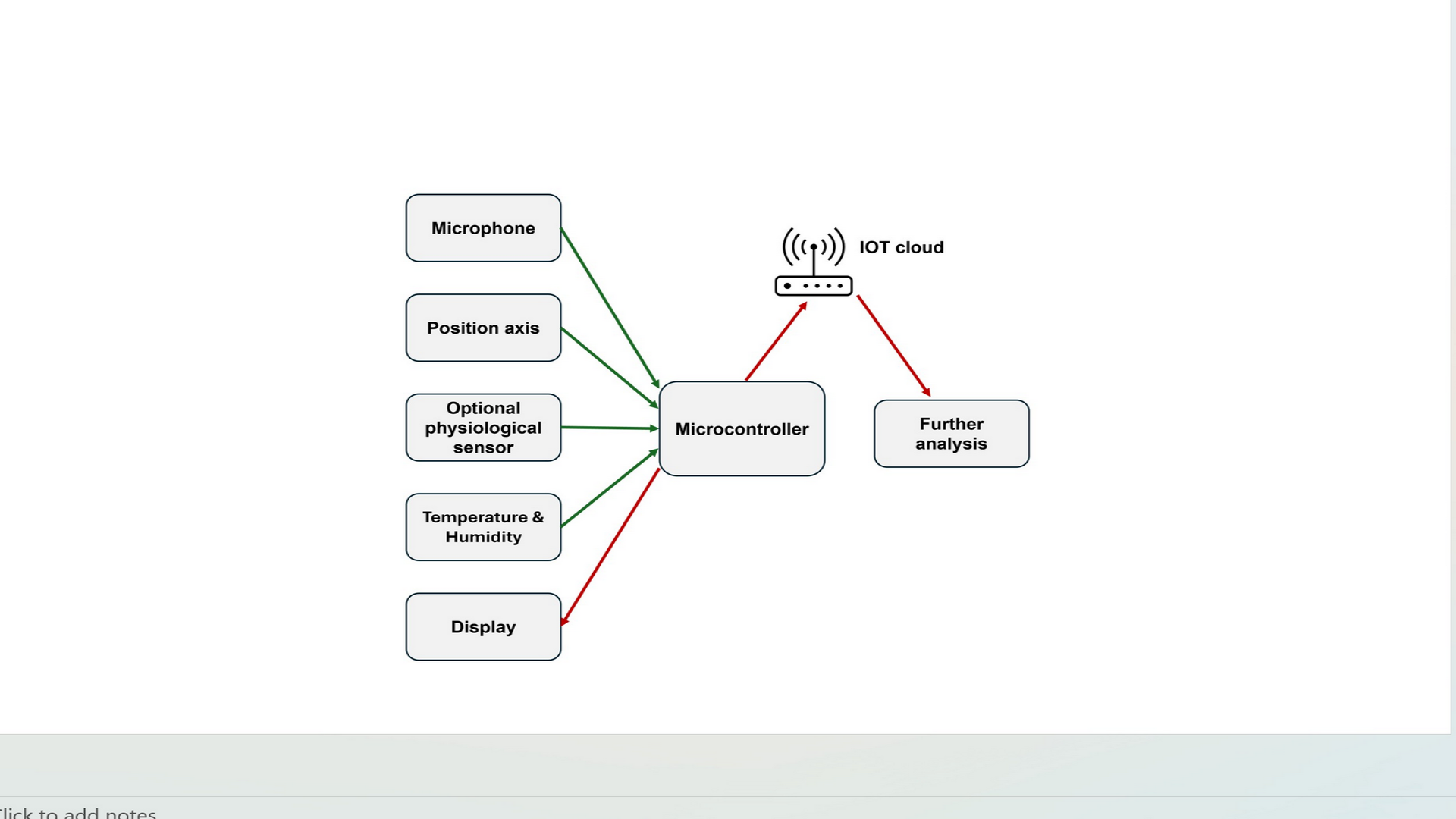
Download: presentation.png
Presentation Video
1 minute video for presentation.
Watch: ▶ presentation.mp4
Reflection
This week made me think seriously about what happens to this project after FabAcademy. The IP lectures helped me understand that choosing the right license is not just a formality but it shapes who can use the work and how.
I chose open licenses for everything because the goal right now is to share. If the PoC validation succeeds, I can always move toward a more structured commercialization path later.
The dissemination plan and the PoC opportunity feel like a realistic next step, especially with support from Oulu super FabLab.