Sediment trap versions
Version 0
This prototype was built to test the installation procedure. It doesn't have an "intervalometer".
Exploded view
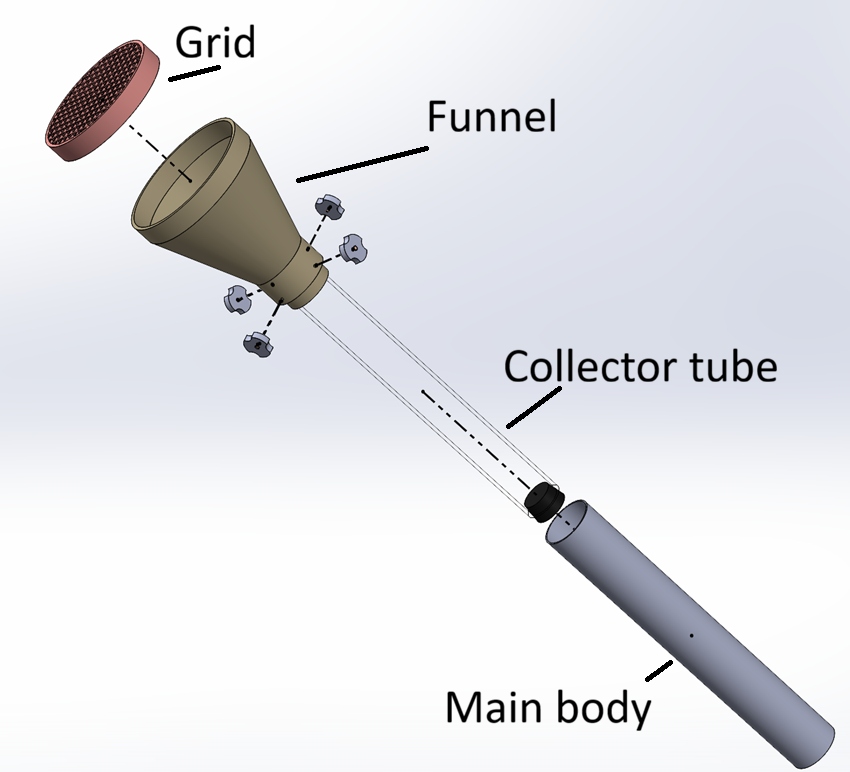
It has four main parts:
-
The main body is a PVC tube. PVC is a anti-fouling material and is robust enough to serve as a shell to protect the collector tube. It has a cap at the bottom to serve as base for the collector tube.
-
The collector tube is a PMMA tube. Its bottom is sealed by a rubber cap. It stands on the bottom cap of the PVC tube. It's held in place at he top by the funnel.
-
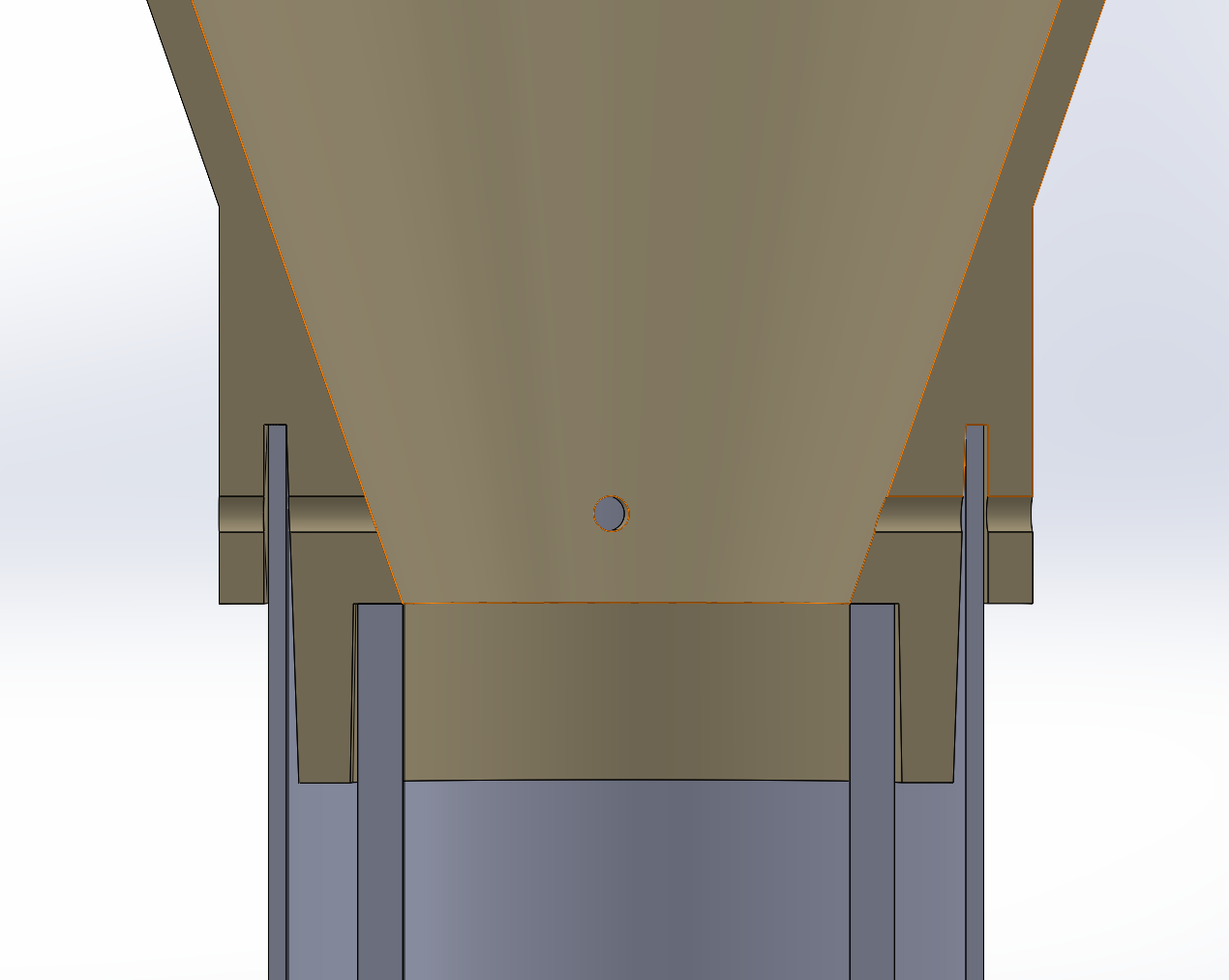
The funnel is 3D-printed in ABS. ABS is sturdy and has anti-fouling properties. It's attached to the main body by four M3 screws.
The main body will be attached on a concrete base at the bottom of the sea. Hence, the funnel has to be attached and detached form it under water.
That's why The screws have 3D-printed "handles", to avoid having to use a tool under water.
Here is a cross-view of the assembly:
Lessons learned
This first prototype installation teaches us two lessons:
- 3D-printed ABS is still susceptible to bio-fouling
- Using screws to attach the funnel to the main body makes the trap installation complicated.
Version 1
This version was used for the first three traps installed.
It has a two-part funnel to accommodate the disc dispenser.
It has the first version of the disc dispenser
Version 2
This version was used for the first three traps installed.
It has a two-part funnel to accommodate the disc dispenser.
It has the second version of the disc dispenser, with less 3D-printed part, only one sensor and improved cable management.