Final project: The sediment trap
Origin of the project
I was contacted by Alexia, a marine biology researcher, whose studying "the ecological factors that influence tropical shallow-water black coral diversity by focusing on the functional link between their habitat and diversity."
One of these factors is the sedimentation occurring in the coral reef.
They need a device that will be put on a coral reef to catch the sediments over 1 year: a sediment trap.
The sediment will be catch in a cylindrical container. The sediments will form different layers allowing to study how their density and composition change across time.
Markers should be dropped each month in the container as timestamps.
This project's goal is to develop an affordable, compact sediment trap that should transportable as extra-luggage by plane.
Existing devices
Sediment traps already exist.
We found two main structures described here.
Multi Sediment Trap MST 6
Col
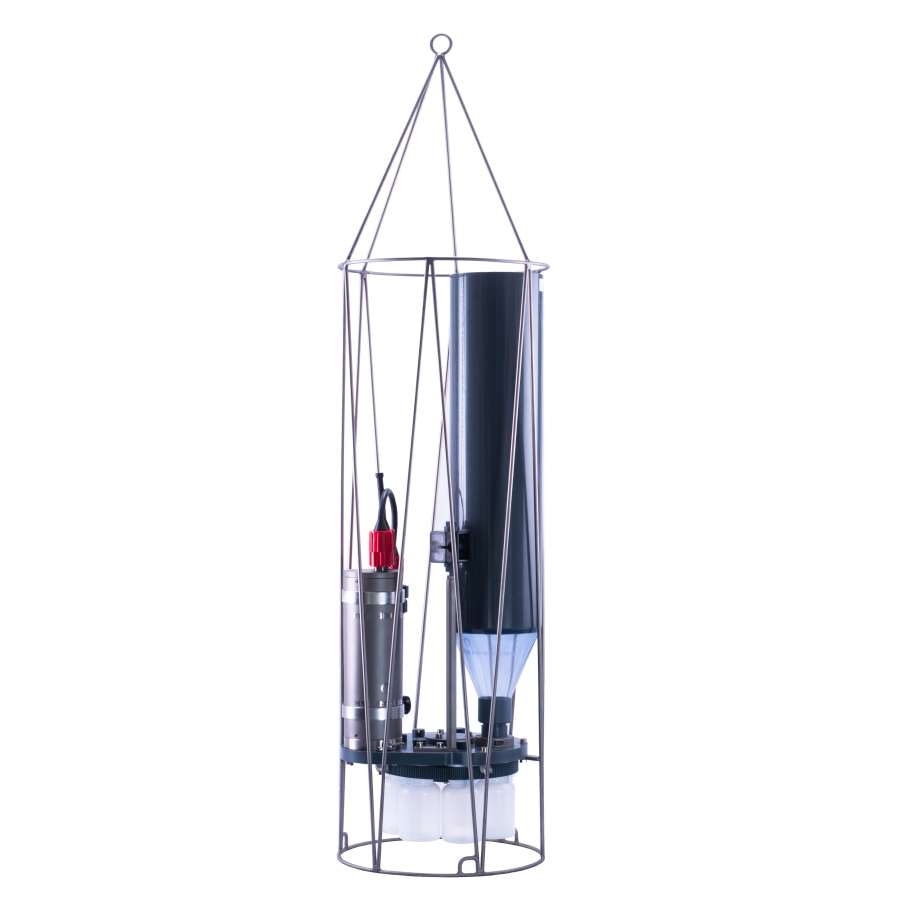
This picture is a commercial solution: the Multi Sediment Trap MST 6.
The black tube on the right is the sediment collector. It ends with a funnel that guide the sediment in a plastic bottle.
Several bottles are mounted on a disc plate.
The mechanism (in the PVC tube on the left) can rotate this plate to change the bottle filled by the collector.
Hence, each bottle will contain the sediment of a given time frame.
Its main disadvantage is its size. The MST 6 is 1.2 m high and 0.32 m wide.
It also can't be easily disassembled for transportation.
Col
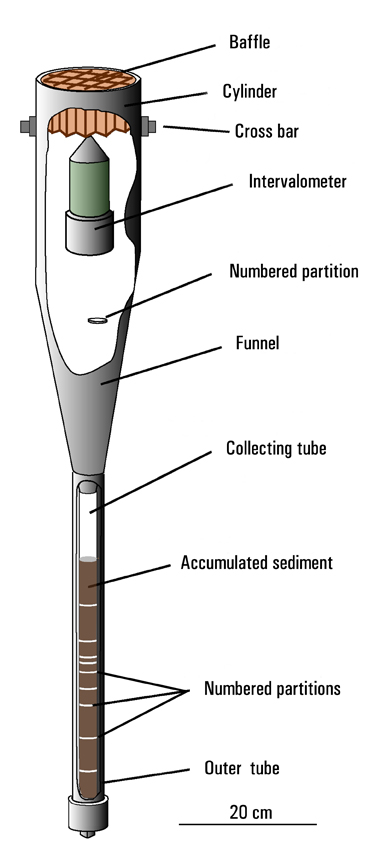
"Anderson-type" sediment trap
Col
Another structure was develop by Roger Y. Anderson, from the Department of Geology, University of New Mexico.
It described it in this article.
Other researchers used the same structure.
For example, this web page described another sediment trap.
There is only one container for the sediment: the collecting tube.
The sediment are driven in the collecting tube by a funnel.
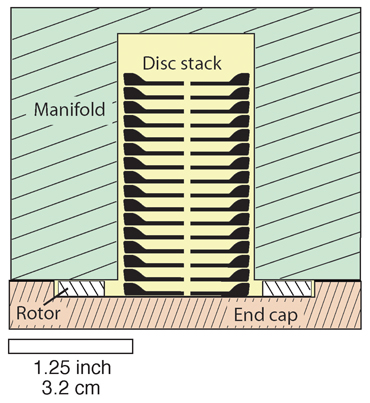
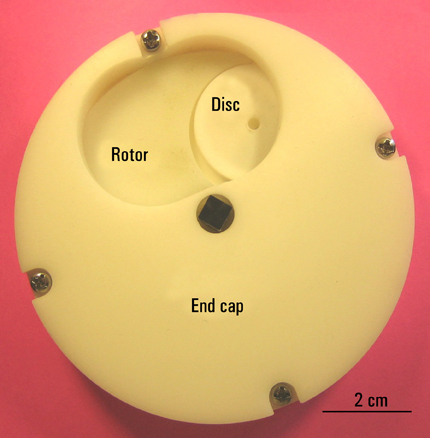
In the funnel, there is a mechanism, called intervalometer.
It's purpose is to periodically drop a disc in the collecting tube.
This discs are time markers: they divide the sediment column in the tube in different layers.
Each layer correspond to a given period of time.
The second picture shows the discs stacked in the intervalometer
The last picture shows the intervalometer's bottom. We can see the rotor that takes the bottom disc and guide it above the exit hole.
This structure is much more compact and can be designed to be modular and easy to (dis)assembled.
Col
Col
Requirements
- The device must survive one year in the ocean at a depth of 30 m to 50 m
- Sediment storage will be a plexiglass tube. Transparency eases the retrieving manipulations.
- Sediment input will be a grid with 1 cm square holes. It will be 3 cm high.
Its purpose is to create calm spaces where the water will be still and the sediment able to fall down in the trap (it will be installed in a coral reef with strong water flow). - The grid will be a circle with a 20 cm diameter.
- A marker will be dropped in the sediment storage every 30 days to act as timestamps.
- The trap will be attached to the bottom of the sea.
- The sediment storage must be easily retrieved from the trap while underwater (to be sealed).
Previous work
I started to work on this project before the Fabacademy's beginning.
Structural choices were already made:
- We'll use only one PMMA tube as collector (see Global structure)
- A first prototype without disk dispenser was deployed during a scientific mission in November 2025 near Madagascar. It's described here
- The disks' delivery mechanism will use a threaded rod mechanism (see disk dispenser)
Organisation
Alexia has a scheduled mission leaving on April 15th.
She'd like to deploy three sediment traps during this mission.
If the traps aren't ready for this mission, another one is scheduled for November 2026.
Hence, I organized my schedule with April as a deadline.
I'm not very good at guessing a task's duration: I'm always involved in several projects. Some have well defined schedule, some don't.
Hence, I prefer to work with roadmaps showing the different tasks and milestones.
Each Monday, I look at my current projects' state and decide how I'll distribute my week time between them.
My final project's roadmap can be found here.
Sub-systems details
License
This project is licensed under Creative Commons Attribution-ShareAlike 4.0 (CC BY-SA 4.0)
Further spirals
Material
- Search and testing for natural anti-fouling materials
Waterproof enclosure
- DIY watertight enclosure
- Silicon encapsulation. That would also mean wireless battery charge.