17 : Applications and Implications<
Learning Outcomes<
What did I learn this week ?
- Make a bill of materials
Assignments<
This seventeenth week's asignments are :
- Individual :
- Plan a final project masterpiece that integrates the range of units covered, answering:
- What will it do?
- Who's done what beforehand?
- What sources will you use?
- What will you design?
- What materials and components will be used?
- Where will come from?
- How much will they cost?
- What parts and systems will be made?
- What processes will be used?
- What questions need to be answered?
- How will it be evaluated?
- Prepare drafts of your final project summary slide (presentation.png, 1920x1080) and video clip (presentation.mp4, 1080p HTML5, < ~minute, < ~25 MB), put them in your root directory and check that they are linked in the final presentation schedule
- Plan a final project masterpiece that integrates the range of units covered, answering:
What will it do ?<
My final project will be a device measuring the liquid water content (g/m³) of the fog generated by our lab's test bench. This measurement will allow us to characterize more precisely the collect efficiencies of our net prototypes. Indeed, the latter are defined as a ratio of the collected water mass rate and the incoming water mass rate. Until now, we estimated the incoming water mass rate by looking at the mass difference of the water tank between the beginning and the end of the experiment.
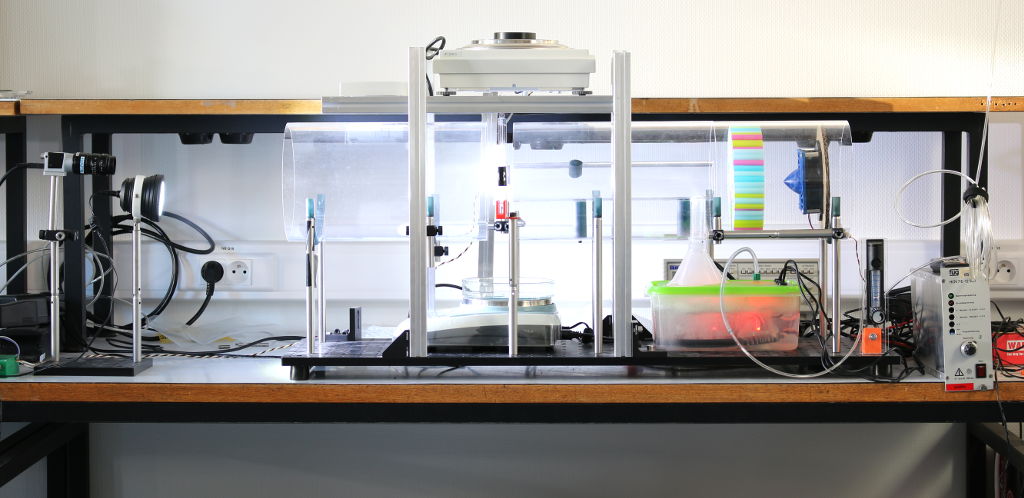
Who's done what beforehand ?<
One should be carefull when talking nd searching about fog density because the tools and techniques to be used completely depends on the scale of the phenomenon one is studying.
For 10 meters to kilometer scale, visibility measurment can be used :
At a few centimeter scale like ours, the following article makes a comparative overview of the existing techniques :
The reviewed techniques can be shortly identified as :
- Average scattered laser flux
- Single particle counter (using light scattering)
- Wire resistance influenced by droplets impaction
- UV absorbtion
- Fog Collection
Visibility is never mentionned and the mainly used techniques are based on light scattering.
A frequently used device in researches is the FM-120 by Droplet Measurement Technologies, Envea Group as mentionned by :
- Narendra Nelli, Diana Francis, Rachid Abida, Ricardo Fonseca, Olivier Masson, Emmanuel Bosc, In-situ measurements of fog microphysics: Visibility parameterization and estimation of fog droplet sedimentation velocity, Atmospheric Research, Volume 309, 2024, 107570, ISSN 0169-8095
- L'Observatoire de Recherche Atmosphérique SIRTA
However, in the next research was developed a "homemade" fog liquid water content meter that also relies on light scattering :
What sources will you use ?<
Theory<
Scientific papers :
- Narendra Nelli, Diana Francis, Rachid Abida, Ricardo Fonseca, Olivier Masson, Emmanuel Bosc, In-situ measurements of fog microphysics: Visibility parameterization and estimation of fog droplet sedimentation velocity, Atmospheric Research, Volume 309, 2024, 107570, ISSN 0169-8095
- Kos, Gerard, and Kevin Noone. “Comparison of Techniques for Measurements of Fog Liquid Water Content.” Tellus B, 1992.
- Ovsenik, Lubos & Turán, Ján & Mišenčík, Pavol & Bito, Janos & Csurgai-Horváth, László. (2012). Fog density measuring system. Acta Electrotechnica et Informatica. 12. 10.2478/v10198-012-0021-7.
Research Center Documentation :
ScienceDirect :
Wikipedia :
AI chatbots :
3D Models<
What Will You Design ?<
-
Printed Circuit Board
PCB DESIGN PICTURE
-
PCB Container
PCB CONTAINER PICTURE
-
Adapted UC2 Containers
UC2 CONTAINERS PICTURE
-
UC2 Crown Support
UC2 CROWN SUPPORT PICTURE
-
System Integration
SYSTEM INTEGRATION SKETCH PICTURE
Bill of Materials<
The materials were ordered years ago. The elctronics were ordered on one of the two websites below :
The mechanical materials were ordered on one of the websites below :
- ???
- ???
| Parts | Materials and Components | Quantity | Cost |
|---|---|---|---|
| Electronics | Copper Plate | 1 | |
| AtTiny412 | 1 | ||
| Resistor | 4 | ||
| Capacitor | 1 | ||
| Transistor | 1 | ||
| 6-Pin Headers | 2 | ||
| 2-pin Headers | 3 | ||
| Laser | 1 | ||
| LED | 1 | ||
| Phototransistor | 2 | ||
| PCB Container | PLA | ||
| Screws | |||
| UC2 Containers | PLA | ? g | |
| Screws | 32 | ||
| UC2 Crown | PLA | ? g | |
| Magnets | 24 | ||
| Felt Textile | 5cm² | ||
| System Integration | Wires | ||
| FTDI Cable |
What processes will be used ?<
The digital fabrication processes will be :
- 3D printing
- Laser Cutting
- PCB milling
The electonics production processes will be :
- Manual Soldering
What questions need to be answered ?<
- Does my final project give repeatable and replicable measurements ?
- Can it work during more than one hour ? two hours ? three hours ?
- Is it easy to use for someone else ?
How will it be evaluated ?<
Since my final proect is a measurement tool that I will use for my research, it has to be evaluated as a measurement tool :
- Does it give repeatable and replicable measurements ?
- Does it give good measurements (no bias) ?
- Does it give accurate measurements (not too much noise) ?