Output devices
Group assignment:
- Measure the power consumption of an output device.
Objective
The objective of this group assignment is to measure the actual power consumption of an output device: here, a servo motor controlled by an ESP32 board. We used a stabilized lab power supply to directly measure the voltage, current, and power consumed by the setup.
Materials used
| Item | Description |
|---|---|
| Microcontroller board | ESP32 |
| Actuator (output device) | SG90 servo motor |
| Power supply | Stabilized lab power supply (voltage, current, and power displayed) |
| Wiring | Jumper wires, breadboard |
| Software | Arduino IDE |
🔌 Wiring diagram
- Signal (PWM) of the servo motor → GPIO 23
- VCC of the servo motor → ESP32 VCC
- GND → ESP32 GND
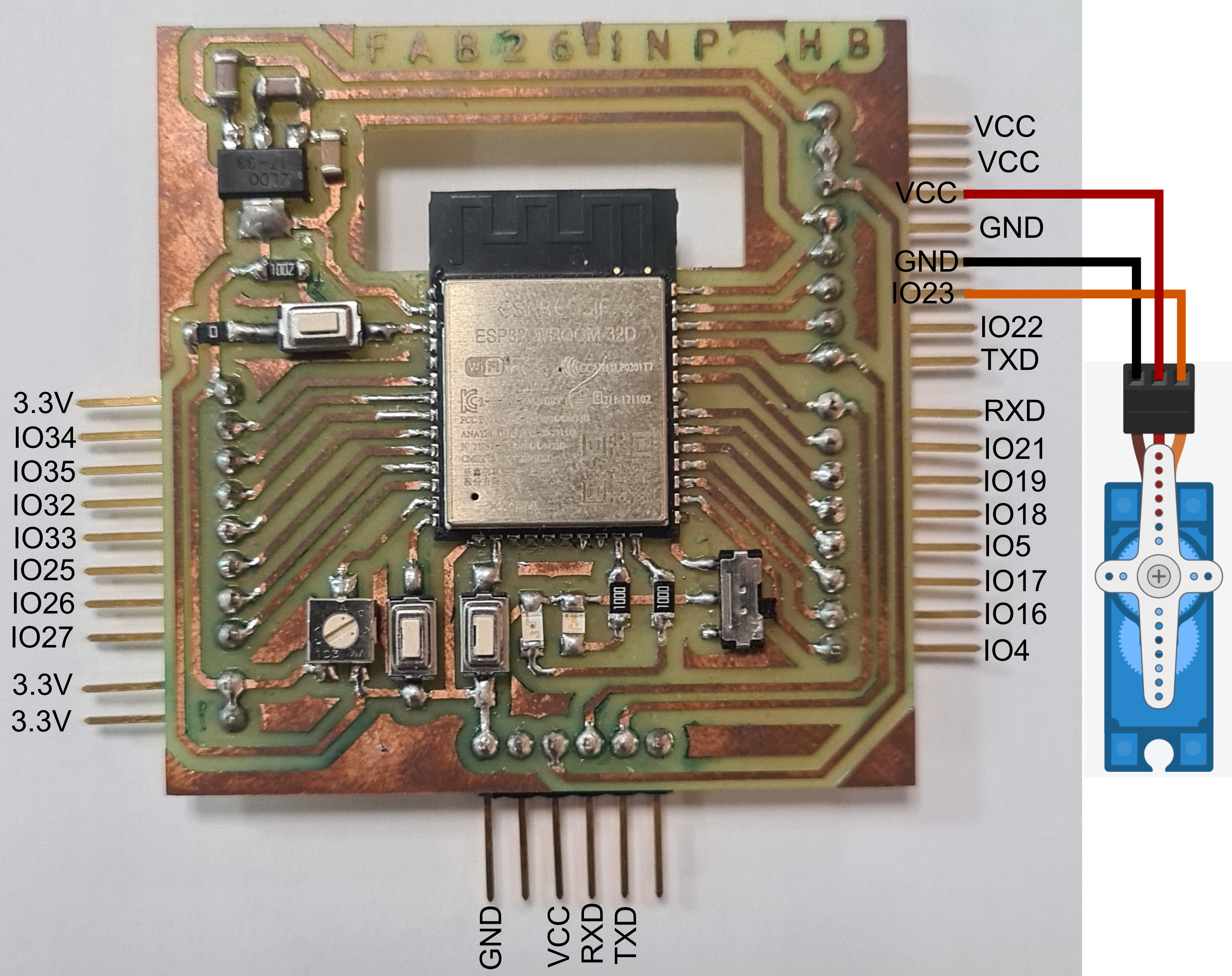
💻 Code used
We used the example provided by the Servo library in the Arduino IDE (File > Examples > ESP32Servo > Sweep), which sweeps the servo motor from 0° to 180° continuously.
#include <ESP32Servo.h>
Servo myservo;  // create servo object to control a servo
// 16 servo objects can be created on the ESP32
int pos = 0;    // variable to store the servo position
// Recommended PWM GPIO pins on the ESP32 include 2,4,12-19,21-23,25-27,32-33
// Possible PWM GPIO pins on the ESP32-S2: 0(used by on-board button),1-17,18(used by on-board LED),19-21,26,33-42
#if defined(ARDUINO_ESP32S2_DEV)
int servoPin = 23;
#else
int servoPin = 23;
#endif
void setup() {
    // Allow allocation of all timers
    ESP32PWM::allocateTimer(0);
    ESP32PWM::allocateTimer(1);
    ESP32PWM::allocateTimer(2);
    ESP32PWM::allocateTimer(3);
    myservo.setPeriodHertz(50);
    myservo.attach(servoPin, 1000, 2000);
}
void loop() {
    for (pos = 0; pos <= 180; pos += 1) { // goes from 0 degrees to 180 degrees
        // in steps of 1 degree
        myservo.write(pos);    // tell servo to go to position in variable 'pos'
        delay(15);             // waits 15ms for the servo to reach the position
    }
    for (pos = 180; pos >= 0; pos -= 1) { // goes from 180 degrees to 0 degrees
        myservo.write(pos);    // tell servo to go to position in variable 'pos'
        delay(15);             // waits 15ms for the servo to reach the position
    }
}
Note: on the ESP32, it is recommended to use the ESP32Servo library (instead of the standard Arduino
Servo.hlibrary, which is not natively compatible with the ESP32).