Week 18: Invention, Intellectual Property, and Income
Assignment
Develop a plan for dissemination of your final project
Complete your final project, tracking your progress:
- What tasks have been completed, and what tasks remain?
- What's working? What's not?
- What questions need to be resolved?
- What will happen when?
- What have you learned?
Dissemination Plan
My final project is Vision Voice — a wearable ASL glove that translates hand gestures into speech and text in real time, fully standalone with no phone or laptop needed.
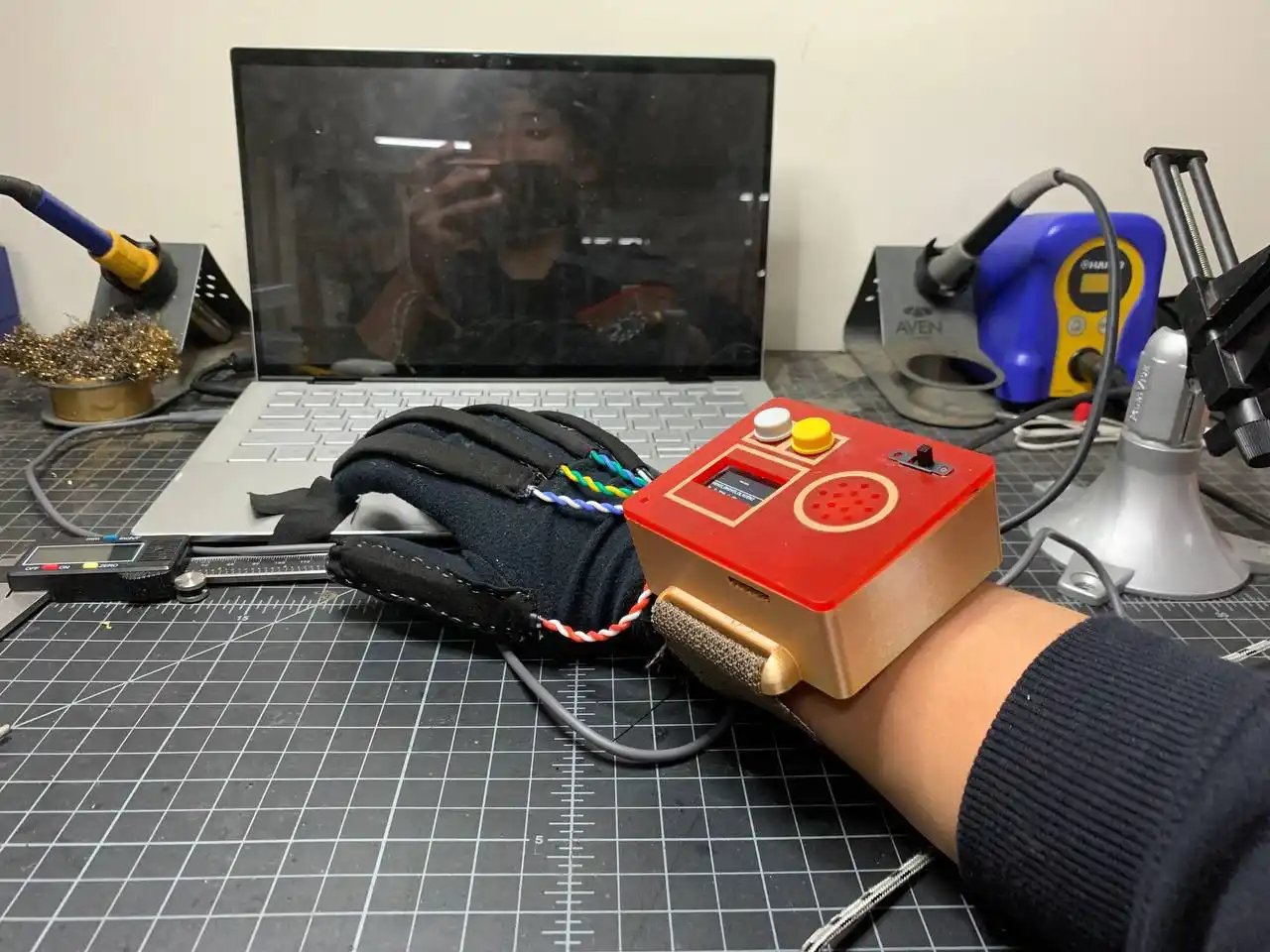
Who is it for?
Vision Voice is made for people who are Deaf or hard of hearing and use ASL to communicate. The problem is that most people around them don't know sign language, so simple conversations become really difficult. Vision Voice lets the user sign naturally and the glove does the translation on its own.
It's also useful for anyone who talks to someone who signs, like family members, teachers, or just strangers in everyday life. The goal is to make communication feel normal on both sides. :D
How will I share it?
Fab Academy Documentation
Everything about Vision Voice is on my Fab Academy website. The whole development process, what worked, what didn't work, the code, the PCB files, the enclosure design, all of it is there. I think sharing the failures is just as important as sharing the final result because that's honestly what helps people the most. ^_^
Demonstrations
I would love to show Vision Voice at school events, Fab Lab exhibitions, and tech showcases. Watching the glove sign a letter and hearing it speak out loud in real time is really the best way to explain what it does. Describing it with words just doesn't do it justice.
Online Sharing
I plan to share photos and short demo videos online so more people can see it beyond just the Fab Academy community.
Open Source
All the design files, PCB files, enclosure files, and code will be open for anyone to use. I really hope other students working on assistive technology projects can use Vision Voice as a starting point and take it further than I did. If someone builds something better from this, that would make me really happy. :D
Future Opportunities
Vision Voice works well right now for 15 ASL gestures using flex sensor data, but there is a lot of room to improve it.
Adding the MPU6050 IMU
I actually had the MPU6050 on my PCB from the start but I ran out of time to include it in the recognition pipeline. Adding it back would give the glove wrist orientation data on top of the finger bend values, which would make it much better at telling apart gestures that have the same finger shape but different hand positions. A lot of ASL letters are like that so this would be the biggest improvement I could make.
Smaller and More Compact Enclosure
The current enclosure works but it is a bit bulky. I really want to redesign it to be much smaller and cleaner, something that actually looks like a product you could buy rather than a prototype from a Fab Lab. Making it more compact would also just make the whole glove more comfortable to wear.
More Gestures
Right now the glove recognizes 15 ASL gestures. Expanding that to cover the full alphabet and eventually common words would make it actually useful for real everyday conversations.
Intellectual Property
I want Vision Voice to be something anyone can learn from and build on.
For all the documentation, CAD files, PCB designs, and enclosure files I will use the Creative Commons Attribution-NonCommercial-ShareAlike 4.0 International License (CC BY-NC-SA 4.0). This means anyone can share and adapt my work as long as they give credit, don't use it commercially, and share their version under the same license.
For the firmware and code running on the XIAO ESP32-C3 I will use the MIT License. This lets anyone use, modify, and share the code freely while keeping the original copyright notice.
I picked these licenses because I want Vision Voice to actually be useful to people, especially students working on assistive technology. The best thing that could happen is someone uses this as a base and builds something even better. ^_^
Final Project Progress Tracking
What tasks have been completed?
- Initial concept and planning
- Wokwi simulation
- Cardboard prototyping
- Single flex sensor testing with XIAO
- OLED integration and testing
- DFPlayer Mini and LiPo audio testing
- ADS1115 module testing with all 5 flex sensors
- Custom PCB design in KiCad
- PCB milling on Roland SRM-20
- PCB soldering
- Enclosure design in Fusion 360
- 3D printing the enclosure base
- Laser cutting the enclosure lid
- Sewing flex sensor slots into the glove
- Making the Velcro adjustable wristband
- First prototype assembly and testing
- Gesture template capture for 15 ASL signs
- Final firmware deployment (v5.1)
- Final assembly and testing
What tasks remain?
- Fine tuning gesture recognition accuracy
- Recording and organizing final MP3 audio files
- Final enclosure finishing
- Shooting the final project video
- Completing all documentation
What's working?
- All 5 flex sensors read cleanly through both ADS1115 modules over I2C with no conflicts
- The weighted distance matching correctly identifies gestures when templates are captured cleanly
- The stability vote filter stops false triggers between gestures
- DFPlayer plays audio reliably after fixing the VCC wiring to go directly to LiPo positive
- The OLED shows gesture text in real time with no flickering
- The Velcro wristband holds the enclosure firmly while signing
- The whole glove runs on battery with no phone or laptop needed. Yay!! :D
What's not working?
- Some ASL letters that have very similar finger shapes still get confused sometimes
- Wearing the glove at a slightly different angle each time can affect recognition
- The enclosure works fine but it's bulkier than I'd like
What questions need to be resolved?
- What is the best reject threshold to reduce false positives without making the glove too slow?
- How many templates per gesture gives the most stable recognition across different wearing positions?
- Can the enclosure be made significantly smaller without changing the PCB layout?
What will happen when?
The remaining tasks will be done one by one before the final presentation. First priority is finishing the audio files and getting recognition as accurate as possible. After that it's the final video and wrapping up documentation. I'll get there!! 🫡
What have you learned?
I honestly can't believe how far Vision Voice has come since I sketched it out on a Canva board back in Week 01.
The biggest thing I learned is that building something real is completely different from planning it. Nothing ever went exactly according to plan and that turned out to be the whole point. Every PCB redesign, every component that fried, and every bug I had to fix at 2am taught me something I couldn't have learned any other way.
I also learned that it's okay to simplify. I had this whole plan to train a kNN model in Python and export it onto the chip, but time ran out and I switched to on-device template matching instead. It works great. Sometimes the simpler thing is just the right thing.
If I could go back to Week 01 and tell myself one thing it would be: just start building, because that's where all the actual learning happens. Solid 11/10 experience. ^_^