Applications and Implications, Project Development

This week is about planning the final project — defining what I'm making, why, what questions need answering, how it will be evaluated, and what the schedule and bill of materials look like. My final project is the Smart Beehive — a Raspberry Pi 5-powered hive monitoring system with cameras, environmental sensors, a servo-controlled entrance, LED lighting, and PoE connectivity.

Assignment Requirements

Individual Assignment:

Project Development:

Learning Outcomes:

Project Documentation

The Project — Smart Beehive

An integrated beekeeping monitoring system that combines remote camera viewing, environmental sensors, automated entrance control, and LED illumination — all powered and connected through a single Power over Ethernet cable. The Pi 5 onboard the hive runs a Python application that reads sensors, streams video, controls the servo gate and LEDs, and publishes data to a cloud dashboard via MQTT.

What It Will Do

  • Monitor bee activity — dual cameras at the entrance stream live video to a web dashboard
  • Track hive health — 3× SHT45 sensors measure temperature and humidity inside the brood box, super, and ambient air
  • Measure hive weight — load cells under the hive track honey production and colony health
  • Control the entrance remotely — servo-driven gate opens/closes on command (useful for transport, winter, or pesticide events)
  • Provide nighttime viewing — red LEDs (invisible to bees) for night camera operation
  • Phone home reliably — PoE connection, MQTT to AWS IoT Core, offline buffer for resilience

What Won't Be in This Version

  • Bee counting / image recognition (future work, possibly using on-Pi ML)
  • Automated honey harvesting
  • Multi-hive fleet dashboard (single-hive UI for now)
  • Battery/solar backup (PoE provides power; battery would add cost and complexity)

Who It's For

  • Beginner beekeepers — guided alerts and remote monitoring lower the barrier to entry
  • Commercial operations — scalable monitoring for managing dozens of hives
  • Researchers — detailed time-series data for studying colony behavior
Hardware Questions

  • Will PoE deliver enough power? The Pi 5 + 2 cameras + servo + LEDs need to fit in the PoE+ budget (25.5 W). Servo inrush current is the main risk. → Answered: Yes, with a 470 µF cap on the servo rail.
  • Will ASA hold up outdoors? The entrance housing needs to survive rain, UV, and temperature swings for at least one season. → Answered: Yes, ASA is specifically engineered for outdoor UV resistance.
  • Will the cameras autofocus on close-flying bees? Pi Camera Module 3 Wide has continuous autofocus. → Answered: Yes, tested and working.
  • Can the servo break propolis buildup? Bees seal moving parts with propolis. Daily small movements should prevent this. → Answered: Yes, daily anti-propolis movement programmed in.

Software Questions

  • How reliable is the MQTT connection over residential internet? → Need to measure dropout frequency. Offline buffer designed for 7 days of outage.
  • How much bandwidth does dual 1080p MJPEG use? ~5–10 Mbps per camera at 15 FPS. Fine for home internet.
  • Will the SD card wear out from telemetry writes? SQLite buffer + periodic flush is gentle — A2-class card should last years.

The project is successful if all of the following work end-to-end:

Functional Requirements

  1. Remote viewing: Both cameras stream live video to a web dashboard accessible from outside the local network
  2. Sensor telemetry: All 3 SHT45 sensors publish temperature/humidity data every 60 seconds to the cloud dashboard
  3. Weight tracking: Load cells produce stable readings within ±100 g
  4. Entrance control: Servo opens/closes the gate on command from the dashboard, with state confirmation back to the UI
  5. LED control: White LEDs activate during day camera viewing; red LEDs activate at night
  6. Network resilience: System recovers automatically from internet outages, replays buffered data on reconnect
  7. PoE power: Single Ethernet cable powers everything — no separate power supply at the hive

Quality Criteria

  • Looks like a finished product — clean enclosures, no exposed wires, weatherproof housing
  • Operates without intervention — set up once, runs unattended

Skills Demonstrated

  • 2D design: KiCad PCB layouts (sensor extension, multiplexer, LED boards)
  • 3D design: Fusion 360 for entrance housing, bottom board, drill jigs
  • Additive fabrication: 3D printing in PLA and ASA for housings
  • Subtractive fabrication: CNC cedar roof, milled PCBs
  • Electronics design and production: Custom PCBs, sensor shield, milled at the lab
  • Embedded programming: Python on Pi for sensor reading, camera control, servo, MQTT
  • System integration: Everything packaged in two enclosures, single PoE cable to the house
  • Networking: MQTT over mTLS to AWS IoT Core, REST API for bootstrap, device shadow

Estimated cost for one Smart Beehive unit (excluding the actual beehive woodenware and bees, which I'm building / sourcing separately).

Category Item Qty Est. Cost Make/Buy
Compute & Power
ComputeRaspberry Pi 5 (8GB)1$175Buy
Storage128 GB MicroSD A21~$15On hand (est. cost)
PowerWaveshare PoE HAT (F)1$20Buy
NetworkPoE+ injector / switch1~$25On hand (est. cost)
NetworkOutdoor Ethernet cable (150 ft)1~$35On hand (est. cost)
Sensors & Cameras
SensorsAdafruit SHT45 with PTFE3$13.50 eachBuy
SensorsAdafruit PCA9548 I²C mux1$6.95Buy
SensorsSensor extension PCB (custom)1~$1 (mat'l)Make ✓
SensorsSTEMMA QT cables4$8Buy
CamerasPi Camera Module 3 Wide2$29.25 eachBuy
CamerasCSI ribbon cables2Included with cameras
Weight50 kg load cells + HX7111$3.19Buy
Actuators & Lighting
ServoMG996R servo1$2.95Buy
LightingLED PCB white (custom)2~$1 (mat'l)Make ✓
LightingLED PCB red (custom)2~$1 (mat'l)Make ✓
Enclosures & Structure
3D PrintBottom board (PLA)1$5 (mat'l)Make ✓
3D PrintEntrance housing (ASA)1$30 (mat'l)Make ✓
3D PrintRotating gate (PLA)1$2 (mat'l)Make ✓
CNCCedar roof + dowel joints (6× boards)1$109.62Make ✓
CNCInner cover (cedar, dovetail)1Make ✓ (same cedar)
HiveLangstroth hive boxes (cedar)2On hand
TOTAL (estimated)~$5407 made / 11 bought

Notes:

  • Material costs are for the parts I make myself — the actual lab time and tool wear isn't included.
  • The hive boxes are cedar wood I'm cutting myself, but I'm budgeting them as "buy" cost since I'm sourcing the cedar lumber.

Project Timeline

Task Target Week Status
Camera housing CAD (Fusion 360)Week 2✓ Complete
CNC cedar roof (V2)Week 7✓ Complete
Sensor extension PCB (KiCad + mill)Week 9✓ Complete
LED PCBs (white + red)Week 10✓ Complete
Networking — Pi to AWS IoTWeek 11✓ Complete
Solder paste tool head (Machine week)Week 12✓ Complete
Local web dashboard (cameras + sensors)Week 15In Progress
3D models — bottom board + entrance housingWeek 16✓ Complete
Steel hive stand (MIG welding)Week 17In Progress
Project plan + BOM (this week)Week 18In Progress
ASA print of entrance housingWeek 19In Progress
Final assembly + integration testingWeek 19Upcoming
Cloud dashboard polishWeek 19In Progress
Final presentation slide + videoWeek 20In Progress
FINAL DEADLINEJune 12, 2026Hard deadline

Risk Assessment

Risk Likelihood Mitigation
ASA print fails (warping, delamination)MediumTest print on Bambu A1 first; adjust settings if needed
Cloud dashboard not finished by deadlineMediumLocal dashboard already works — fall back to that for demo
Servo brownouts the PiLow470 µF cap on servo rail; ramp slowly in code

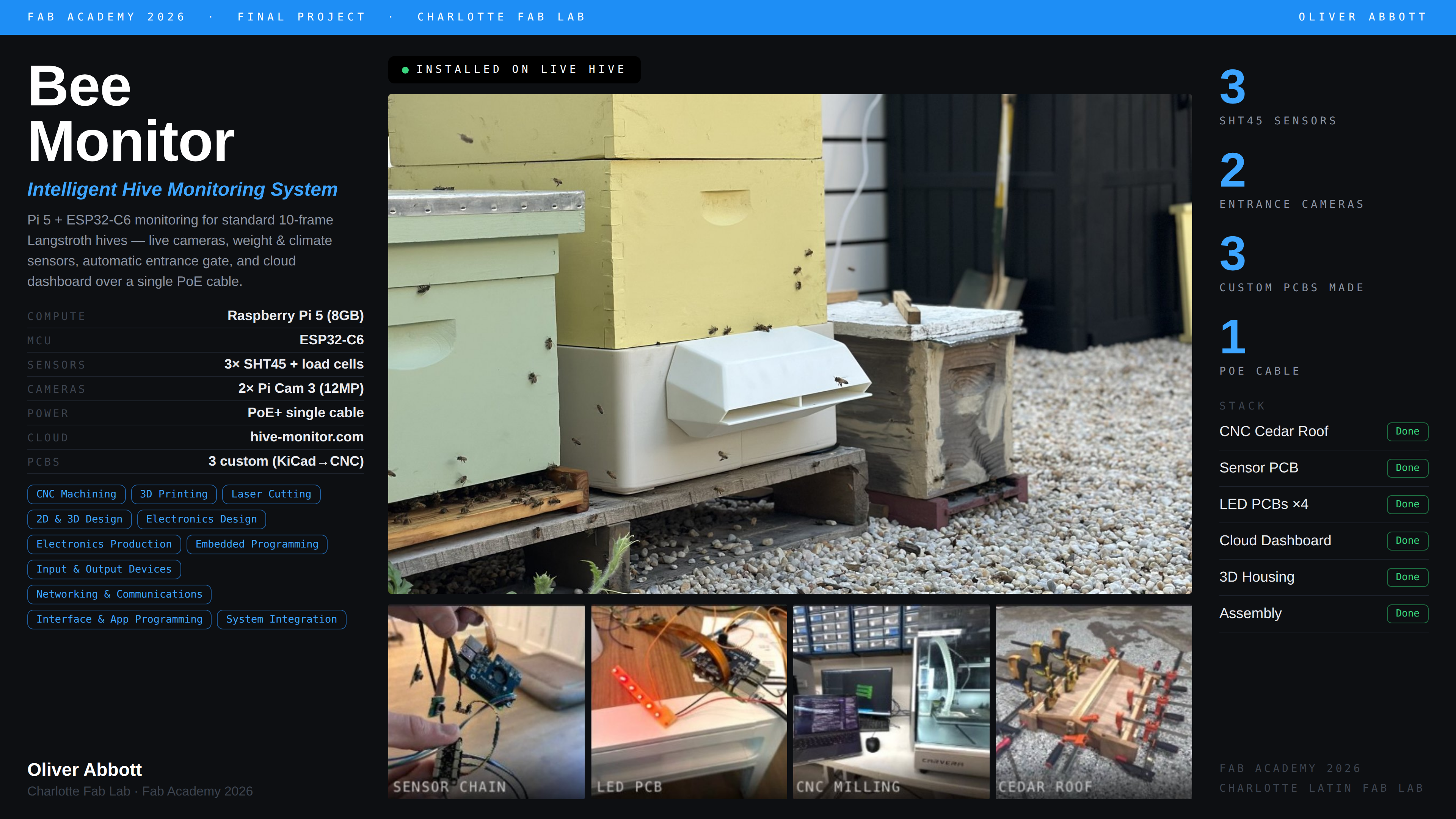
Summary Slide (presentation.png)

Required format: 1920×1080, includes name, project name, Fab Lab name, photo/render of the project, and brief description.

Smart Beehive
Raspberry Pi 5-powered hive monitoring system with live entrance cameras, environmental sensors, servo-controlled gate, and cloud dashboard — connected via a single PoE cable.
📷 Dual cameras
🌡️ 3× SHT45 sensors
🚪 Servo entrance gate
💡 Day/night LEDs
⚡ PoE powered
☁️ hive-monitor.com
Oliver Abbott
Fab Academy 2026 · Charlotte Latin Fab Lab
Smart Beehive — CNC cedar roof assembly

Video Clip (presentation.mp4)

Target: ≤1 minute, 1080p, <25 MB, in the root of the repo. Should show:

  1. Bees flying in/out of the hive (camera POV)
  2. The cloud dashboard updating with sensor data in real time
  3. Remotely opening/closing the entrance gate via the dashboard
  4. Day/night LED switching demonstration
  5. Time-lapse of weight tracking during a nectar flow (if available)

Status: Will record once final assembly is in the field. Placeholder using prototype B-roll for now.

Checklist Responses

Question Answer
What will it do? Monitor beehives remotely — live camera feeds, temperature/humidity sensors, weight tracking, servo-controlled entrance, LED lighting — all powered and connected via a single PoE cable, with data pushed to a cloud dashboard at hive-monitor.com.
Who has done what beforehand? DIY hive monitors exist on GitHub and forums (basic temp/humidity loggers, some with weight). None offer live camera streaming as a consumer product. Commercial options (BroodMinder, Arnia) focus on sensors only — no live video. My project combines cameras + sensors + remote control in one package.
What sources will you use? Raspberry Pi documentation, AWS IoT Core docs, Adafruit sensor libraries, picamera2 Python library, MQTT protocol specs, Fusion 360 for CAD, KiCad for PCB design.
What will you design? Entrance camera housing (Fusion 360), bottom board electronics enclosure (Fusion 360), sensor extension PCB (KiCad), LED PCBs (KiCad), I²C multiplexer PCB (KiCad), CNC cedar roof, rotating entrance gate, custom Pi OS image, cloud dashboard web app.
What materials and components will be used? PLA and ASA filament (3D printing), cedar wood (CNC roof), mild steel (welded stand), FR4 copper-clad (PCBs), Raspberry Pi 5, Pi Camera Module 3 Wide, SHT45 sensors, PCA9548 multiplexer, MG996R servo, PoE HAT, load cells + HX711.
Where will they come from? Adafruit (sensors, multiplexer, cables), Raspberry Pi resellers (Pi 5, cameras), Amazon (servo, load cells, PoE hardware), local lumber yard (cedar), lab stock (PCB blanks, PLA filament).
How much will they cost? ~$500–$550 total for one unit. See BOM section above for full breakdown.
What parts and systems will be made? 7 parts made: sensor extension PCB, 2× white LED PCBs, 2× red LED PCBs, bottom board enclosure (3D print), entrance housing (3D print), rotating gate (3D print), CNC cedar roof, inner cover. Plus the full software stack (Pi agent, cloud backend, web dashboard, custom OS image).
What processes will be used? 3D printing (FDM — PLA and ASA), CNC milling (ShopBot — cedar), PCB milling (Carvera), MIG welding (steel stand), embedded programming (Python on Pi), web development (cloud dashboard), electronics design (KiCad), CAD (Fusion 360).
What questions need to be answered? All hardware questions answered (PoE power budget ✓, ASA durability ✓, camera autofocus ✓, servo vs propolis ✓). Remaining: cost optimization for consumer market, camera streaming through cloud (currently local only), long-term field reliability.
How will it be evaluated? Success = all sensors reporting to cloud dashboard, cameras streaming, servo responding to remote commands, LEDs switching day/night, system running unattended on PoE with no separate power supply. See Success Criteria section above.
Summary slide uploaded? Placeholder in progress — will finalize once entrance housing is printed and assembled.
Video clip uploaded? Placeholder in progress — will record once final assembly is in the field.
Linked in final presentation schedule? Will link once files are in root directory.

Useful Links