19. Invention, Intellectual Property, And Income
JeLamp — Dissemination & Business Plan
This week I developed a plan for disseminating my final project JeLamp, selected an intellectual property license, and outlined future business possibilities for turning the invention into a sustainable product or open-source platform.
Assignment checklist
- Created a dissemination plan for my final project
- Outlined future possibilities and described how to make them probabilities
- What tasks have been completed, and what tasks remain?
- What's working? What's not?
- What questions need to be resolved?
- Planned what will happen when?
- What have you learned?
Dissemination Plan
JeLamp will be shared openly so other makers, students, and researchers can learn from and build upon the work. All documentation, design files, and firmware will be published on this Fab Academy site and mirrored to GitLab Fabcloud.
| Channel | Content | Audience |
|---|---|---|
| Fab Academy site | Full weekly documentation, final project page, BOM, presentation slide & video | Evaluators, fellow students |
| GitLab Fabcloud | Source repository — KiCad boards, Fusion 360 files, Arduino firmware | Makers, developers |
| GitHub (mirror) | Public repo with README, build instructions, and issue tracker | Open-source community |
| Social media | Short demo videos, build progress photos, gesture-interaction clips | General public, potential backers |
| Fab Lab workshops | Hands-on session at Chaihuo Makerspace — assemble a simplified JeLamp kit | Local makers, students |
Intellectual Property — License Selection
Selected License: CC BY-NC 4.0
Creative Commons Attribution-NonCommercial 4.0 International
This license allows others to:
- Share — copy and redistribute the material in any medium or format
- Adapt — remix, transform, and build upon the material
Under the following terms:
- Attribution — credit must be given to Ning Zhang as the original creator
- NonCommercial — the material may not be used for commercial purposes without permission
Why CC BY-NC?
| Consideration | Decision |
|---|---|
| Open collaboration | JeLamp builds on open-source references (LeLamp, Fab Academy libraries). I want to give back to the community. |
| Commercial protection | NC prevents others from selling JeLamp kits or products without negotiating a license with me. |
| Simplicity | CC BY-NC is widely understood, compatible with Fab Academy documentation norms, and matches my site footer. |
| Why not CC BY-NC-SA? | SA (ShareAlike) would require all derivatives to use the same license. I prefer allowing collaborators to choose their own license for forked versions, as long as they credit the original. |
| Why not patent? | Patent filing is costly and slow. For a maker/educational project, open documentation with NC protection is more aligned with Fab Lab values. |
Copyright Notice
All JeLamp documentation, design files, and firmware on this site are © 2026 Ning Zhang, licensed under CC BY-NC 4.0. Third-party components (XIAO modules, STS3215 housings, WS2812B LEDs) remain subject to their respective manufacturer licenses.
Future Possibilities & Income Models
JeLamp can evolve beyond a Fab Academy prototype into a product, platform, or educational tool. Below are three paths ranked by feasibility:
Path 1 — Open-Source Kit (most likely)
| Aspect | Plan |
|---|---|
| Product | DIY kit: laser-cut/3D-printed parts + custom PCB + BOM list; user supplies STS3215 housings and XIAO modules |
| Revenue | Sell partial kits through Chaihuo Makerspace shop or Tindie (~¥300–500 per kit) |
| Margin | Low per unit, but builds community and workshop pipeline |
| Probability | High — can launch within 3 months of graduation with existing fab infrastructure |
Path 2 — Workshop & Education
| Aspect | Plan |
|---|---|
| Product | Weekend workshop: "Build Your Own Expressive Lamp" at Chaihuo Fab Lab |
| Revenue | Workshop fee ¥500–800 per participant (materials + instruction) |
| Audience | Students, designers, IoT hobbyists interested in robotics + ML |
| Probability | Medium — requires curriculum development and instructor time |
Path 3 — Consumer Product (long-term)
| Aspect | Plan |
|---|---|
| Product | Finished JeLamp desk lamp sold as a complete assembled product |
| Revenue | Direct sales or crowdfunding (target price ¥800–1,200) |
| Challenges | CE/FCC certification, injection molding for scale, supply chain, after-sales support |
| Probability | Low near-term — viable only after 6–12 months of prototyping and user testing |
How to turn possibilities into probabilities
Each path above is ranked by probability, but probability only increases with concrete actions. The table below maps each path to the steps that would make it more likely:
| Path | Actions to increase probability | Target date |
|---|---|---|
| Kit sales | Finalize BOM with actual costs; publish build guide on GitHub; order 10 spare PCBs from JLCPCB; list a pilot batch on Tindie or Chaihuo shop | Jul–Aug 2026 |
| Workshops | Write a 4-hour curriculum; run one free pilot at Chaihuo; collect feedback; set recurring weekend schedule and pricing | Sep 2026 |
| Consumer product | Complete full assembly; run 2-week user test with 3 desk users; document failure modes; only then explore injection molding quotes and certification requirements | Q4 2026 – Q1 2027 |
Project Development Progress
Tracking final project completion as of Week 19 — final project due June 4, 2026:
Completed tasks
| Task | Notes |
|---|---|
| Carrier PCB design (KiCad) | Schematic + layout complete; Gerbers sent to JLCPCB |
| NeoPixel driver PCB design | ESP32-C3 I2C slave board |
| Hello World test board milled | Week 8 |
| Gesture recognition prototype | Week 17 — Edge Impulse on XIAO S3 |
| Web UI for servo + NeoPixel | Week 15 — Wi-Fi HTTP server |
| System integration plan | Week 16 — architecture, wiring, assembly order |
| Applications & Implications plan | Week 18 — BOM, evaluation criteria, draft presentation |
| Dissemination plan + IP license | This page — CC BY-NC 4.0, channel strategy |
Remaining tasks
| Task | Status | Blocker |
|---|---|---|
| Mechanical arm 3D printing | 🟡 In progress | Base + first joint done; elbow and head segments printing |
| PCB fabrication + population | 🟡 In progress | Carrier PCB ordered from JLCPCB; awaiting delivery |
| Full assembly + cable routing | ⬜ Remaining | Needs mechanical parts + populated carrier board |
| Enclosure / packaging | ⬜ Remaining | Base enclosure drafted in Fusion 360; not yet printed |
| End-to-end demo (gesture → LED) | ⬜ Remaining | Subsystems work separately; integration pending |
| Final presentation slide + video | 🟡 Draft | presentation.png, presentation.mp4 — update after assembly |
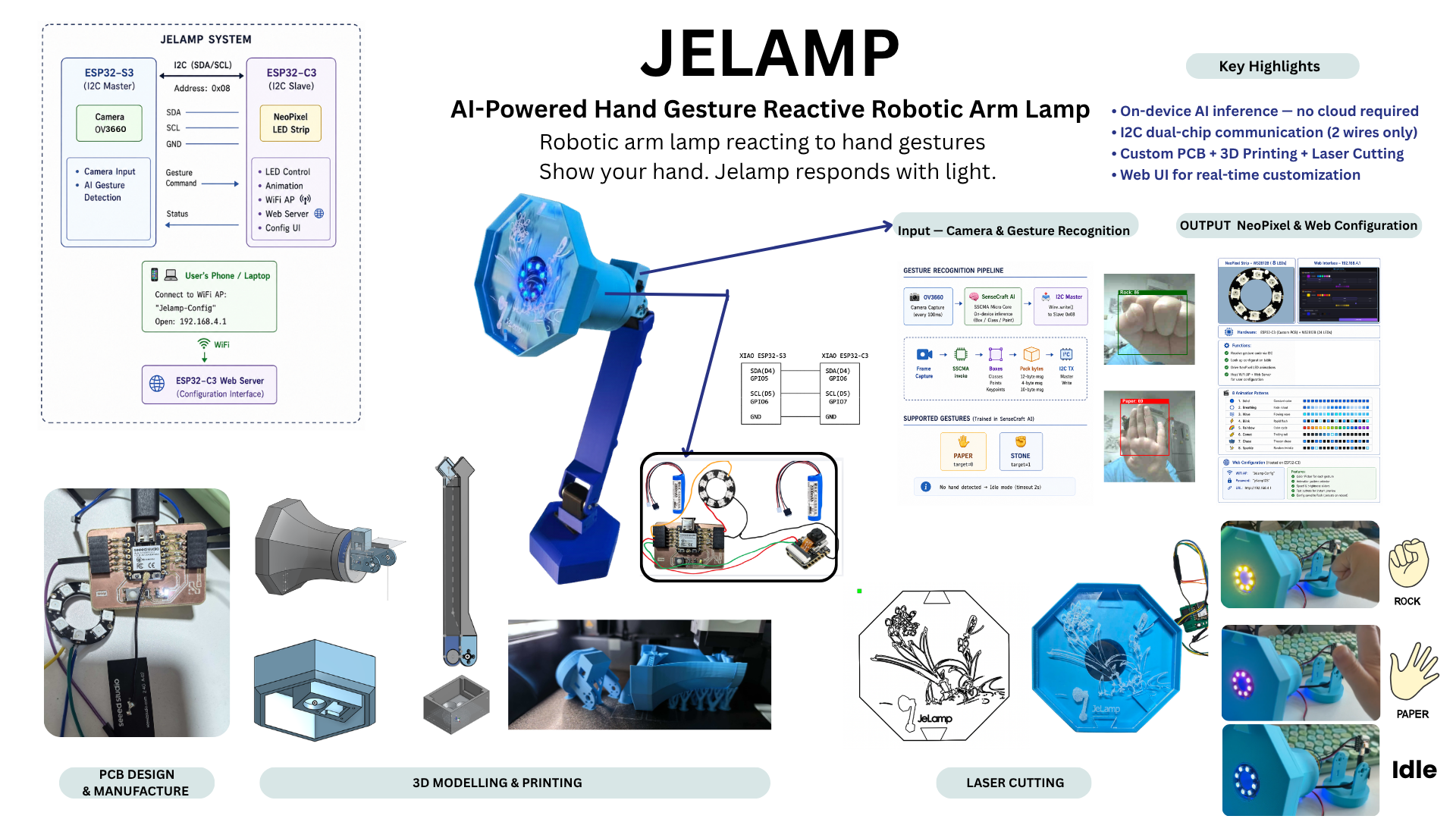
What's Working? What's Not?
Working
| Subsystem | Evidence |
|---|---|
| Gesture recognition | Edge Impulse model on XIAO ESP32-S3 Sense detects rock / paper / scissors with acceptable latency in normal desk lighting (Week 17) |
| Web UI control | Wi-Fi HTTP server drives NeoPixel patterns from a browser (Week 15) |
| PCB design workflow | Carrier board, NeoPixel driver, and Hello World test board all designed in KiCad and exported successfully |
| Mechanical concept | Base and arm segments print cleanly; STS3215 connector pockets fit with minimal post-processing |
| Documentation | Weekly pages, final project page, BOM, and draft presentation materials are published and linked |
Not working (yet)
| Issue | Impact | Planned fix |
|---|---|---|
| Full assembly pending | Cannot demo complete lamp with gesture → LED in enclosure | Finish printing remaining arm segments and assemble with STS3215 connectors locked at fixed pose |
| Carrier PCB not yet populated | Still using breadboard wiring for power and I2C | Solder and bench-test when JLCPCB boards arrive |
| I2C cable routing through arm | Wire may strain at head joint if slack is insufficient | Route through hollow printed channels; leave 15–20 mm slack at head |
| Power budget unverified under load | NeoPixels + camera may draw heavily on 5 V supply during bright patterns | Measure current draw with multimeter once assembled; add bulk capacitors if needed |
| Presentation media are drafts | Slide and video show concept renders, not final build photos | Re-record after assembly before the June 4 deadline |
What Questions Need to Be Resolved?
Updated from the open questions in Week 18:
| Question | Status | Resolution plan |
|---|---|---|
| Are STS3215 housings rigid enough as fixed joint connectors? | ✅ Resolved | Horns lock segments at design pose; arm is static — no servo power needed |
| Will 3.3V logic drive WS2812B reliably without a level shifter? | ✅ Likely yes | 330 Ω series resistor added; short wire run to lamp head — will confirm on carrier PCB |
| Can the gesture model run fast enough for real-time interaction? | ✅ Resolved | Tested in Week 16/17 — latency acceptable for rock–paper–scissors game |
| How to route I2C cables through the fixed arm? | ✅ Resolved | Hollow printed channels with slack at head joint — no rotating joints to bind |
| Will the JLCPCB carrier board meet power and connector needs? | 🟡 Pending test | Bench-test all headers, buck converter, and NeoPixel output after population |
| Is CC BY-NC the right license for future kit sales? | ✅ Resolved | NC prevents others from selling kits; I retain rights to sell through Chaihuo or grant commercial licenses |
Planned — What Will Happen When?
Schedule working backward from the final project due date of June 4, 2026 (Fab Academy 2026 final presentations):
| When | Milestone | Deliverable |
|---|---|---|
| Week 19 | IP, dissemination, business plan | This documentation page; CC BY-NC license applied site-wide |
| May 24–26 | Mechanical fabrication sprint | Print remaining arm segments, lamp head, base enclosure |
| May 27–28 | PCB arrival + population | Solder carrier board; verify power and NeoPixel output |
| May 29–31 | Full assembly + integration | Assemble fixed arm with STS3215 connectors; route I2C cables; connect camera; run end-to-end gesture demo |
| Jun 1–2 | Debug + polish | Verify arm stability; finalise LED patterns |
| Jun 3 | Presentation media | Update presentation.png with build photos; re-record presentation.mp4 |
| Jun 4 | Final project due | Working demo, final documentation, presentation slide & video — see Week 20 page |
| Post-graduation | Dissemination | Publish GitHub mirror, run first Chaihuo workshop pilot, list kit on Tindie |
What Have I Learned?
- IP is a design decision, not an afterthought. Choosing CC BY-NC forced me to articulate what JeLamp is for — a learning platform and community contribution, not a stealth commercial product. The license shapes how I disseminate files and how others can build on them.
- Dissemination needs a channel strategy. Publishing files alone is not enough; different audiences (evaluators, makers, workshop participants) need different formats — documentation pages, Git repos, short videos, and hands-on sessions.
- Business paths need actionable steps. Ranking possibilities by probability is useful only when each path has concrete next actions and dates. Kit sales are most feasible because I already have fab infrastructure at Chaihuo; consumer product requires steps I have not taken yet.
- Integration is the hardest phase. Individual subsystems (gesture ML, web UI, PCB design) each worked in isolation. The remaining risk is mechanical assembly, cable routing, and power budget — problems that only appear when everything is connected.
- Documentation is part of the invention. A well-documented open-source project has more lasting impact than a one-off prototype. This Fab Academy site is itself a dissemination channel.
The most realistic near-term income path is workshops and kit sales through Chaihuo, not mass production. Week 19 turned JeLamp from a build project into a plan for what happens after Fab Academy ends.