Pulse: A Living Lamp
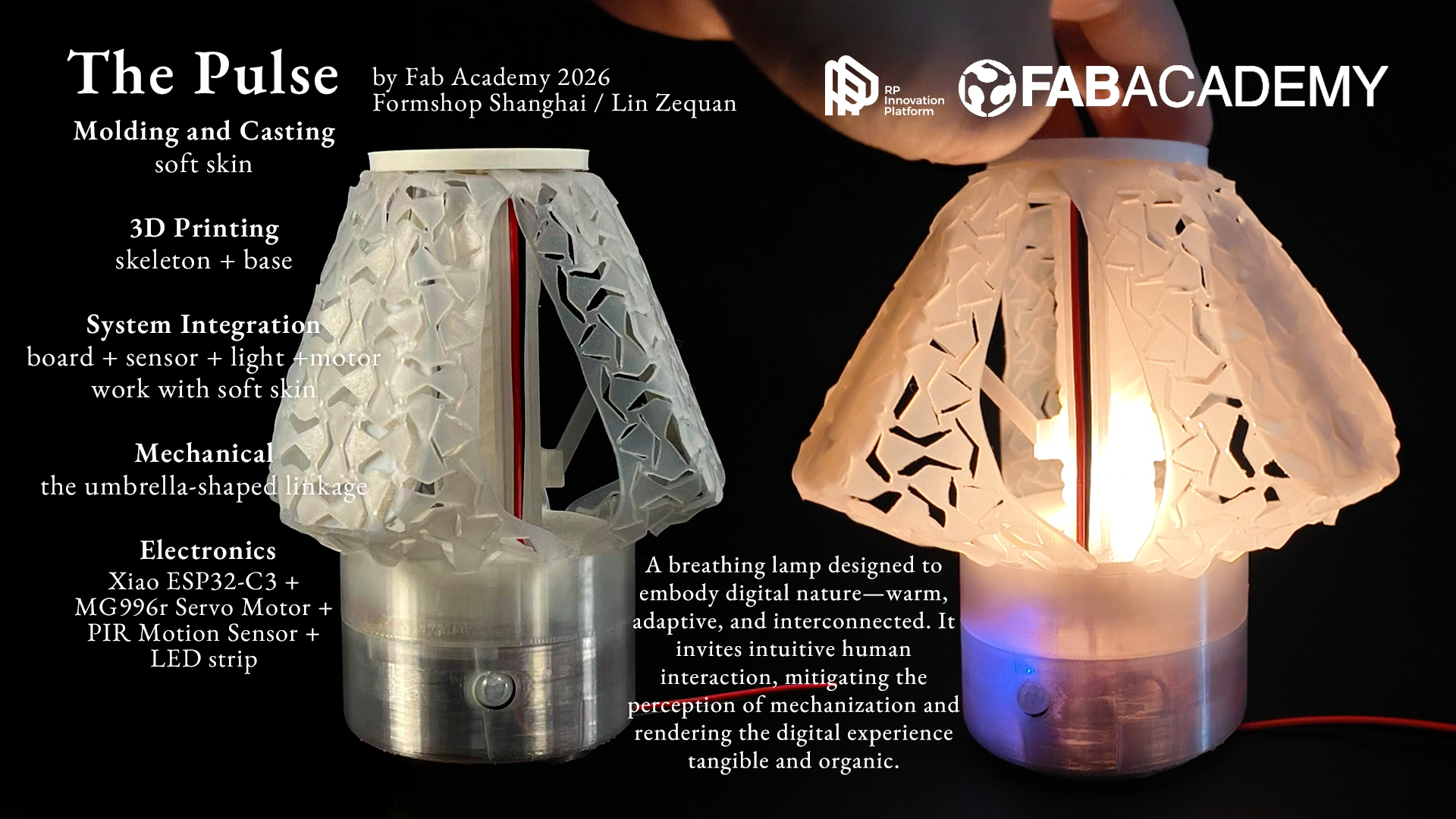
Pulse is an interactive, nature-inspired moving sculpture designed to bridge the gap between human emotion and modern technology. It is more than just a functional utility light; it is a gentle, ambient companion that transforms cold digital behavior into a rhythmic, living physical presence.
What does it do?
Interactive Sensing: Using a PIR motion sensor, the lamp detects when someone passes by, triggering its "awakening".
Physical Movement: A custom ESP32-C3 board drives a high-torque servo motor that pushes a slider-linkage mechanism similar to an umbrella structure causing the lamp to expand and contract vertically.
Breathing Light: As the structure moves, an internal LED array illuminates. The light is diffused through a hand-cast silicone skin with geometric textures that stretch and deform, mimicking the pulse of a living organism.
The Story Behind the Design
I have always wondered why we rely on technology yet often fear its complexity. I wanted to use design to make technology feel gentle and tangible. I chose the metaphor of a "Digital Embryo" a vessel of hope incubating in a complex world. The journey wasn't easy. I faced repeated failures with joint stability and silicone casting. However, through digital fabrication, I eventually solved these issues by printing joints all-in-one piece and iterating through many versions to reach this final "breathing" state.
How to Follow My Journey
To help you understand the full development of this project, I have organized my documentation into the following sections:
Final project Tracing
Midterm review
Final project presentations
Slide
Video
Stage
Idea Development: Explore the initial sketches to a "living lamp".
Bill of Material list: A comprehensive list for making the pulse lamp.
Structure & Production: A deep dive into the mechanical challenges, from telescopic screws to the final stable umbrella-like linkage.
Skin Casting: Documentation of my experiments with silicone and auxetic materials to create a flexible outer layer.
Electrics Design and Production: Details on the PCB design, power management for high-torque motors, and the debugging process for the ESP32-C3.
Programming and debug: Documenting the interaction logic and the intensive troubleshooting process to solve issues.
Assemble: How all the parts finally came together.