Final Project Presentation
Slide
Video
Stage
Idea Development: Explore the initial sketches to a "living lamp".
Bill of Material: A comprehensive list for making the pulse lamp.
Structure design and Production: A deep dive into the mechanical challenges, from telescopic screws to the final stable umbrella-like linkage.
Skin Casting: Documentation of my experiments with silicone and auxetic materials to create a flexible outer layer.
Electrics Design and Production: Details on the PCB design, power management for high-torque motors, and the debugging process for the ESP32-C3.
Programming and debug: Documenting the interaction logic and the intensive troubleshooting process to solve issues.
Assemble: How all the parts finally came together.
What does it do?
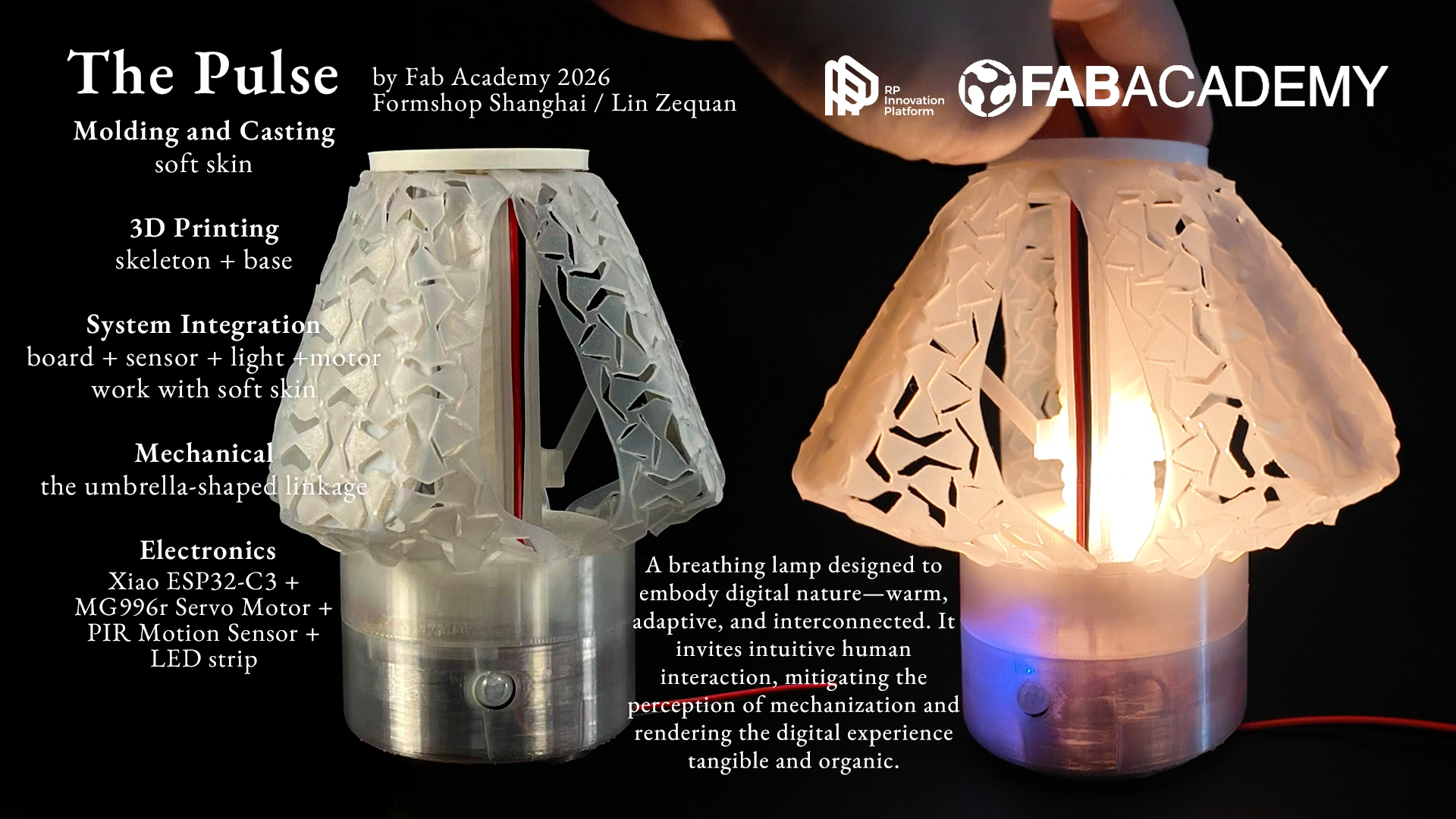
The Paule Lamp
It is an interactive, shape-changing lamp. When someone walks by, it senses the motion, expands vertically like an opening umbrella, and turns on its internal lights. As it opens, the soft outer skin stretches and deforms smoothly, beautifully diffusing the light and creating an organic, breath-like movement. Rather than just a regular utility light, it brings a living presence and comforting moving shadows into the home.
Who's done what beforehand?
Ivan Black's sculptures inspired my early exploration into rotating geometric forms, they lack electronics or lighting.
Totem de Luz by Kutarq Studio features an exposed pulley and counterweight system but relies entirely on manual adjustment instead of automated sensing.
For automated designs, Girasole by Yu-Chun Hsiao uses a screw mechanism to slowly move an LED panel along a timeline to simulate the sun, but this linear movement cannot respond to real-time human presence.
the Prinx lamp employs modular auxetic lattice structures for deformation, it remains a static material setup without an active motorized system.
What sources did you use?
Mechanical Structure: Referred to the opening and closing linkage mechanism of a standard umbrella.
Auxetic Materials: Referenced geometric studies on Auxetic materials with a Negative Poisson's Ratio, as well as the FAB14 Workshop's design approach for "Digital Mechanical Material" to develop the stretching outer skin.
Electronic Hardware: Core microcontroller setup was based on the official Seeed Studio XIAO ESP32-C3 datasheet and its pin initialization guidelines. Utilized a DFRobot PIR motion sensor as the interaction input. Utilized an MG996R high-torque metal gear servo motor for the mechanical drive.
Embedded Programming: Since the standard
What did you design?
Using Fusion 360, I created a custom 3D-printable structure featuring integrated linkage joints and a central slider rail. a main control PCB around the XIAO ESP32-C3, and with an N-MOSFET switch circuit. flat-surface casting mold to create the translucent silicone skin, embedded with precise auxetic geometric patterns that stretch smoothly under structural tension.
What materials and components were used?
A Seeed Studio XIAO ESP32-C3 microcontroller, a high-torque MG996R metal gear servo motor, short LED strip and a DFRobot PIR motion sensor.
An AO3400A SOT-23 N-MOSFET, An 1206-packaged LED, resistors
Translucent PLA filament used for FDM 3D printing the linkage bones and the lamp base.
AB soft silicone (0-5A) for casting the flexible auxetic skin.
FR1 PCB copper boards used to mill the custom mainboard.
Where did they come from?
Online shop (Taobao) and the fab stock
How much did they cost?
| Component | Qty | Source | Unit Cost | Total Cost |
|---|---|---|---|---|
| XIAO ESP32-C3 | 1 | Taobao | RMB39 | RMB39 |
| MG996R High Torque Servo Motor | 1 | Taobao | RMB17.64 | RMB17.64 |
| DFrobot PIR Motion Sensor | 1 | Taobao | RMB30 | RMB30 |
| MOSFET AO3400A SOT-23 | 1 | Taobao | RMB4.78 per pack(20) | RMB0.239 |
| LED strip | 1 | Taobao | RMB3.6 | RMB3.6 |
| 1206 LED | 1 | Fab inventory | RMB2.03 per pack(20) | RMB0.10 |
| 1206 Resistor | 3 | Fab inventory | RMB10 per pack(50) | RMB0.6 |
| 1206 Capacitor | 4 | Fab inventory | RMB5.1 per pack(10) | RMB2.04 |
| 2.54mmPinheader | 2 | Fab inventory | RMB2.38 per pack(20) | RMB0.24 |
| SS14 Diode | 1 | Fab inventory | RMB3 per pack(50) | RMB0.06 |
| Translucent PLA | 156.66g | Taobao | 60/1000g | RMB9.40 |
| FR-1 | 1 | Fab Stock | RMB160 | 160 |
| AB Sillicon | 60g(A30g/B30g) | Taobao | RMB23 A+B(500g) | RMB2.76 |
What parts and systems were made?
Mainboard System Kinetic Skeleton System Flexible Skin System
What tools and processes were used?
FDM 3D Printing (Bamboolab A1) PCB Design and CNC Milling (Roland MD-40) Mold Design and Casting (AB Sillicon with 3D Printed mold) Embedded Programming (Cursor, Arduino IDE)
What questions were answered?
First, on a conceptual level, it proved that combining a rigid parametric linkage with an auxetic silicone skin can turn cold electronics into a gentle, emotional companion with an organic breathing rhythm. Second, on a technical level, it answered how to eliminate mechanical backlash by using integrated 3D printing, how to stabilize high-current servo power on a custom compact PCB, and how to successfully cast complex auxetic patterns by shifting from a single cylindrical mold to flat, segmented casting.
What worked? What didn't?
It can react to people's movement, then stretch its skin to change its shape. However, I haven't tried it with many units connected. Also, the skin tends to fall off if it runs many times. If the skin falls off, the structure becomes loose and looks a bit wobbly. The next step is to optimize it so the skin can be properly secured.
How was it evaluated?
Nice experience from nothing to make it happen. It is not the end, it is just a beginning to learn more and do more.
What are the implications?
Through this project, I have changed the way I see objects and the world. I tried many different tools that I had never known before. It gave me many opportunities to work with.