





NODO

Final project evidence, integration checklist, downloadable files and pending presentation assets for Smart Lean Cell.
Week 20 is used to verify that the final project is ready for presentation and evaluation. The Smart Lean Cell integrates digital fabrication, electronics, programming, networking, packaging and user validation in a single educational system for children.
The Smart Lean Cell project was developed within the Fab Academy process supported by the ZOI node and the local infrastructure of Industrial FabLab UCuenca. The documentation also recognizes the academic context of the Career of Industrial Engineering and the Universidad de Cuenca.




| Institution / Node | Role in the Project |
|---|---|
| ZOI Node | Fab Academy support node connected to the learning and evaluation process. |
| Industrial FabLab UCuenca | Provided machines, fabrication infrastructure, technical support and the local project environment. |
| Career of Industrial Engineering - Universidad de Cuenca | Provided the academic frame for applying Lean Manufacturing, TPS, process improvement and STEM learning. |
| Universidad de Cuenca | Institutional context that supports the development of applied educational and technological projects in Cuenca, Ecuador. |
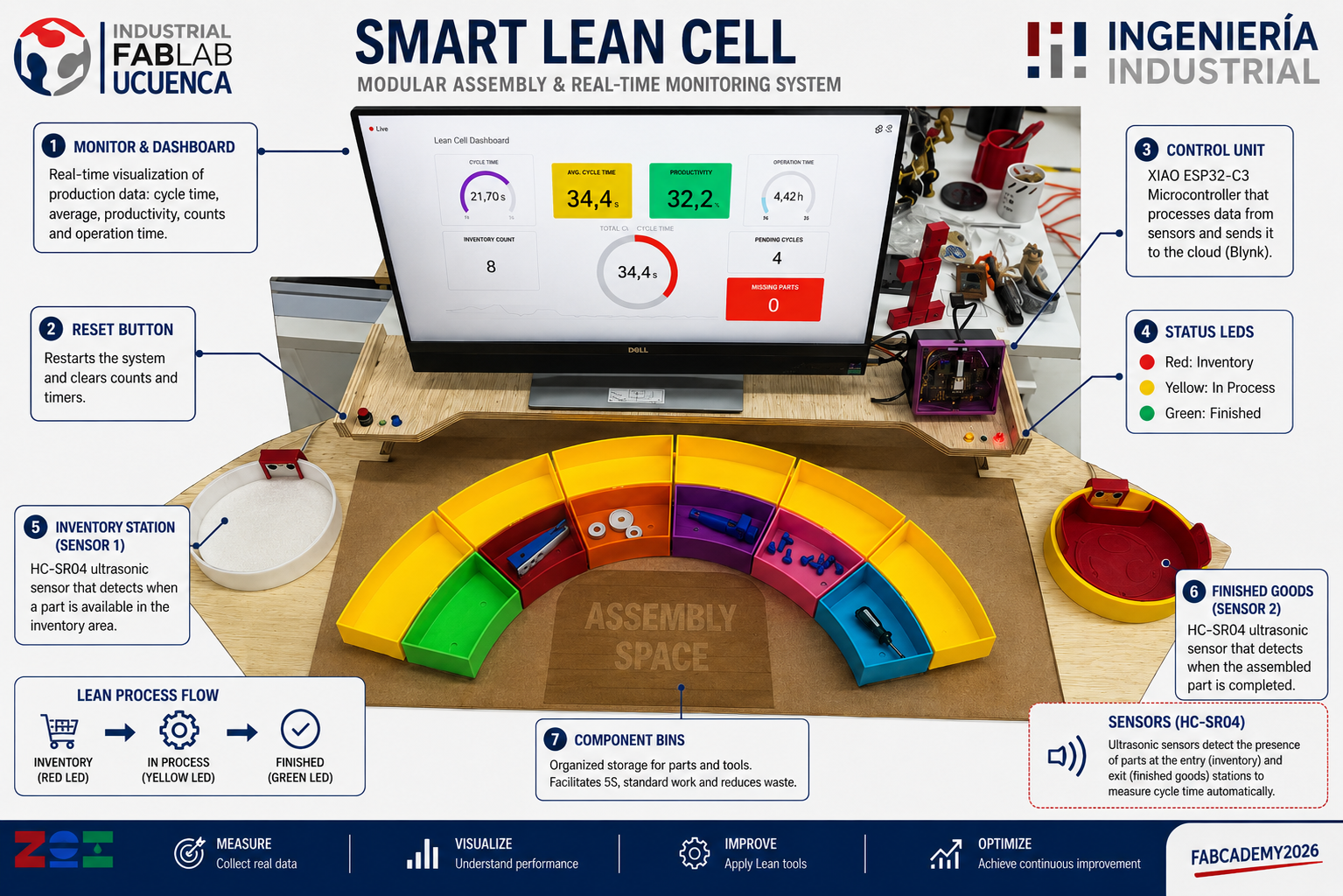
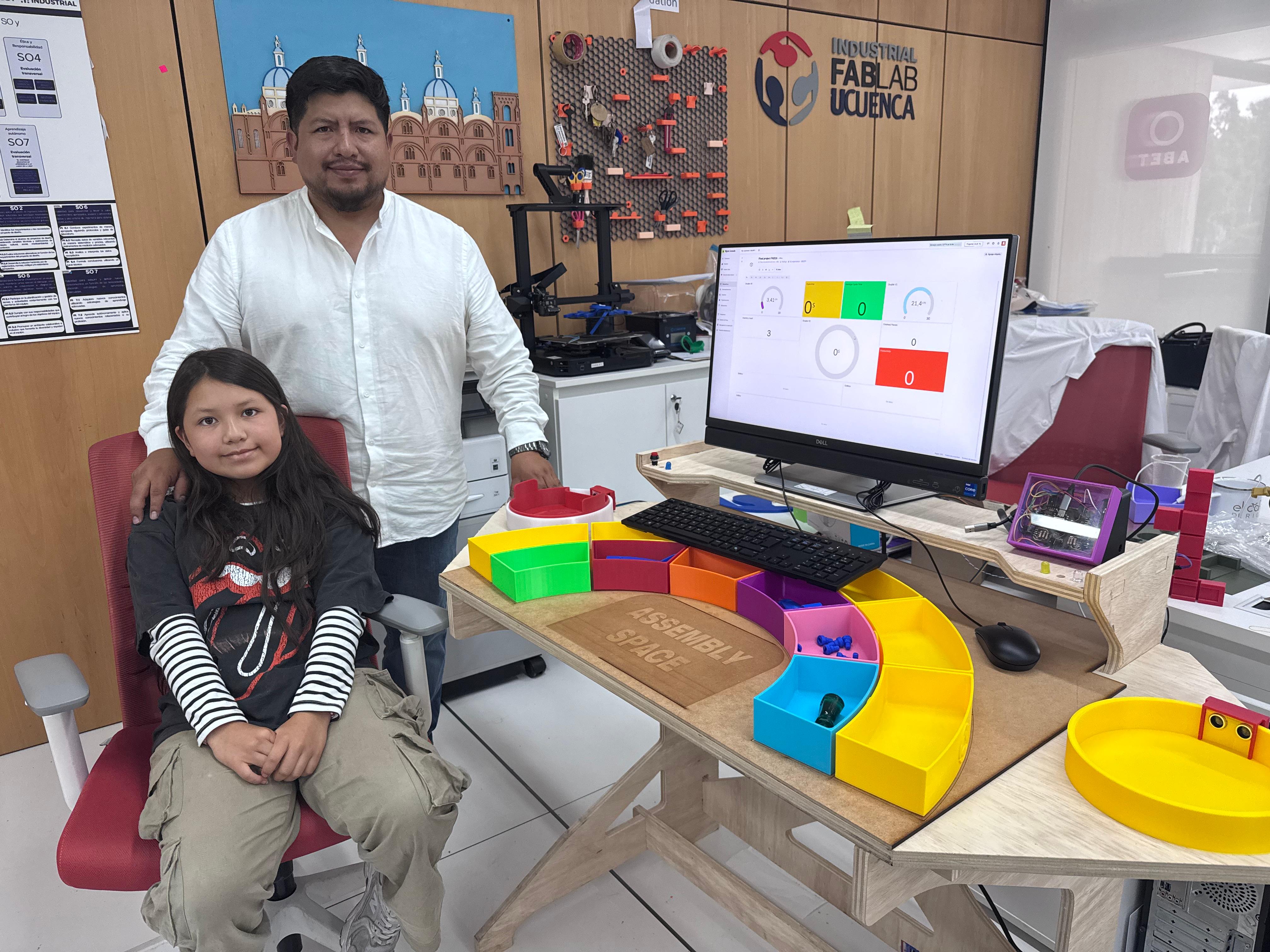
Smart Lean Cell is a gamified modular assembly station for STEM learning. It introduces children to TPS, Lean Manufacturing and process optimization through a physical cell with 3D printed trays, a CNC workstation, laser-cut organization tools, sensors, LEDs and a real-time Blynk dashboard.
| Fab Academy Outcome | Evidence in Smart Lean Cell | Status |
|---|---|---|
| Create an integrated design | Mechanical station, Lean tools, electronics, dashboard and gamification are integrated into one system. | Done |
| 2D and 3D modeling | Fusion 360, DXF files, 3D trays, PCB case, CNC module and laser-cut panel. | Done |
| Additive fabrication | 3D printed trays, inventory/finished goods stations and electronics case. | Done |
| Subtractive fabrication | CNC machined workstation and laser-cut organization panel. | Done |
| Electronics design and production | Custom PCB designed in KiCad and fabricated with fiber laser process. | Done |
| Microcontroller programming | XIAO ESP32-C3 code for HC-SR04 sensors, LEDs, cycle-time calculation and Blynk communication. | Done |
| Input and output | Inputs: HC-SR04 sensors. Outputs: red/yellow/blue or green LED status feedback and Blynk dashboard. | Done |
| System integration | Electronics, mechanical package, sensors, dashboard and learning strategy assembled in the final prototype. | Done |
The following checklist follows the Fab Academy final project requirement list. Instead of only linking to other pages, each item below explains how the requirement was completed in the Smart Lean Cell project and what evidence is available for evaluation. Some information is intentionally repeated here so that this page can be read as a standalone final compliance document.
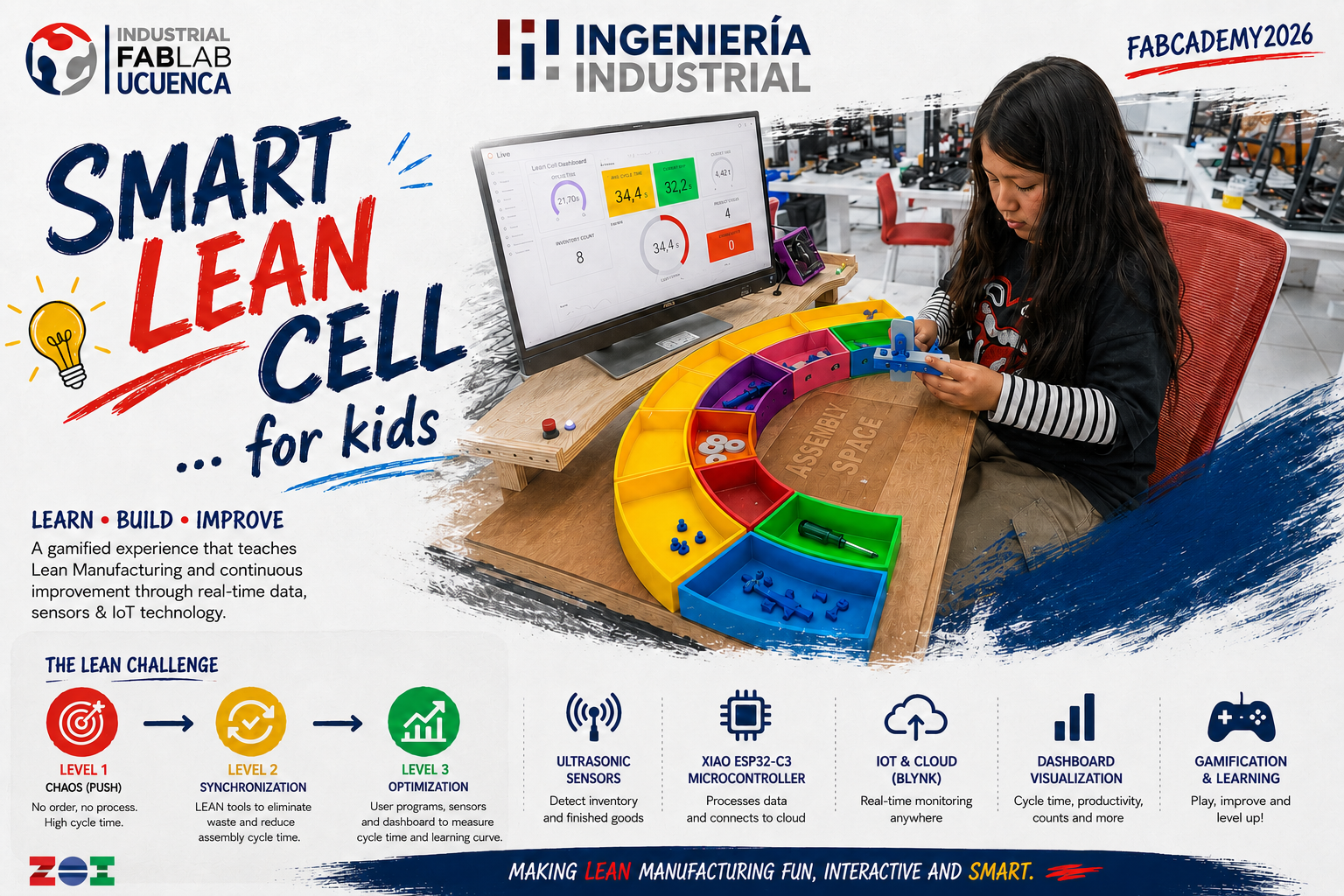
The final slide was prepared as a 1920 x 1080 px presentation image for the project Smart Lean Cell for Kids. It includes my name, the project name, the supporting Fab Lab context, the Industrial Engineering identity, a strong project image, and a brief description of what the system does: a gamified Lean Manufacturing learning experience for children using sensors, IoT, a real-time dashboard and modular physical assembly stations.
The slide communicates the project at a glance: children learn by assembling, measuring and improving. It also shows the main technical systems: HC-SR04 ultrasonic sensors, XIAO ESP32-C3 microcontroller, Blynk cloud dashboard, status LEDs, modular bins and gamification levels.
The final video was prepared to show the conception, construction and operation of the Smart Lean Cell. It presents the project as an integrated product rather than as isolated parts: the CNC workstation, the 3D printed trays, the electronic system, the sensors, the dashboard and the gamified activity are shown as one complete learning station.
The video demonstrates how a part moves through the learning flow. When the first sensor stops detecting a part, the cycle starts. When the second sensor detects the finished part, the cycle ends and the dashboard receives updated information through Blynk. This makes the final video evidence of both fabrication and functionality.
A separate Final Project page documents the complete Smart Lean Cell project. It explains the project objective, target audience, design decisions, fabrication processes, electronics, networking, dashboard logic, gamification strategy, integration and final reflection.
The project is focused on children as the main users. The goal is to introduce TPS, Lean Manufacturing, 5S, standard work, cycle time and continuous improvement through a playful STEM experience. The final page was structured so an evaluator can follow the complete development from concept to final prototype validation.
The following BOM summarizes the main physical, electronic and fabricated elements used in the Smart Lean Cell prototype. To calculate the project material cost, I used the actual amount consumed when it was known and a conservative market reference when the item was purchased or would need to be purchased externally. The prices are reference values because they change depending on supplier, country, stock, taxes and shipping. I added purchase/reference links so the component cost can be checked or updated later. The Ecuador column estimates local purchase or replacement costs, while the Amazon / other stores column keeps an external online reference and does not include possible import fees, shipping to Ecuador or local taxes.
| Item | Quantity / used amount | Source / origin | Smart LEAN Cell | Ecuador reference cost (USD) | Amazon / other stores reference cost (USD) |
|---|---|---|---|---|---|
| Plywood board, 15 mm | 1 sheet, 122 x 244 cm | Local wood supplier / Industrial FabLab UCuenca stock | Main structural body of the workstation, CNC-machined support module and physical assembly surface. | $51.99 | $70 |
| MDF board, 3 mm | 1 panel, 60 x 90 cm | Local material supplier / FabLab stock; reference: 3 mm MDF board | Laser-cut physical organization panel and low-cost learning surfaces for visual management. | $5.00 | $24.69 |
| PLA filament | Approximately 2 kg | Bambu Lab / FabLab stock; reference: PLA filament | 3D printed Kanban trays, modular bins, inventory station, finished-goods station and sensor supports. | $40.00 | $27.98 |
| Seeed Studio XIAO ESP32-C3 | 1 unit | Seeed Studio / electronics supplier; reference: XIAO ESP32-C3 | Main microcontroller for reading sensors, controlling LEDs and sending data to the Blynk dashboard through Wi-Fi. | $25.00 | $4.74 |
| Custom PCB material | 1 board, 10 x 10 cm | FabLab stock; reference: copper-clad PCB board | Custom controller board for XIAO ESP32-C3, pin expansion, sensor wiring and voltage-divider integration. | $2.50 | $9.99 |
| HC-SR04 ultrasonic sensors | 2 units | Electronics supplier / lab stock; reference: HC-SR04 sensors | Sensor 1 detects inventory availability; Sensor 2 detects finished parts and closes the cycle-time measurement. | $10.00 | $9.99 |
| 220 ohm resistors | 6 units | Electronics stock; reference: resistor kit | Voltage divider and signal conditioning to adapt the HC-SR04 echo signal to the ESP32-C3 logic level. | $0.30 | $7.00 |
| LEDs | 3 units: red, yellow and green/blue status indicators | Electronics stock; reference: LED assortment | Visual feedback for inventory, in-process status and finished-piece detection during the learning activity. | $1.00 | $6.99 |
| Jumper wires and pin headers | 1 connection set | Electronics stock; reference: jumper wires and headers | Modular wiring between the PCB, sensors, LEDs, reset button and physical stations. | $5.00 | $14.99 |
| USB-C cable | 1 unit | Lab stock; reference: USB-C data cable | Programming, serial monitoring and power supply for the XIAO ESP32-C3 controller. | $5.00 | $8.09 |
| Push buttons | 1 set used | Electronics stock / panel mounting; reference: push buttons | User interaction and reset control for restarting counts, timers and dashboard values during demonstrations. | $4.00 | $9.00 |
| Sensor holders and small printed fixtures | Several small printed parts | 3D printed at FabLab; reference: PLA fixture material | Mechanical support for the ultrasonic sensors and small accessories used in the inventory and finished stations. | $1.00 | $2.00 |
| Blynk cloud dashboard | 1 simple license / monthly plan | Blynk web platform; reference: Blynk Starter pricing | Real-time visualization of cycle time, average time, productivity, inventory count and finished parts. | $29.00 | $29.00 |
| All-in-one PC for control and dashboard | 1 unit | Market reference; example: HP all-in-one desktop on Amazon | Local control, dashboard visualization, programming support and final demonstration monitor. | $650.00 | $489.99 |
| Acrylic sheet for PCB case cover | 1 piece, 15 x 15 cm | Local acrylic supplier / FabLab stock; reference: clear acrylic sheet | Transparent cover for the PCB case, allowing the electronic system to be visible and protected. | $2.00 | $8.00 |
| Total estimated cost in Ecuador | Reference total using Ecuador market or local supplier prices. | $831.79 | |||
| Total estimated cost using Amazon / other stores references | Reference total using Amazon, Seeed Studio, Blynk and other external store links, without local import/tax variation. | $704.44 | |||
The project was built by combining knowledge and outputs from several Fab Academy weeks. The relevant weeks were linked because the final prototype depends on multiple processes: project management, CAD, computer-controlled cutting, 3D printing, electronics design and production, input devices, output devices, networking, interface programming, mechanical fabrication, system integration, applications and implications, invention/IP and final requirements.
The final project does not use every assignment equally. The most directly connected weeks are the ones related to CNC machining, 3D printing, electronics, input/output devices, networking with Blynk, dashboard development and system integration. The final page includes an integration map so the evaluator can see exactly how the weekly work contributed to the final result.
System integration was implemented by connecting the physical workstation, the Lean learning tools, the electronic system and the dashboard into one working product. The mechanical structure holds the monitor, the inventory and finished-goods stations, the electronic case and the learning area. The 3D printed trays organize the parts before assembly, supporting 5S and preparation before production.
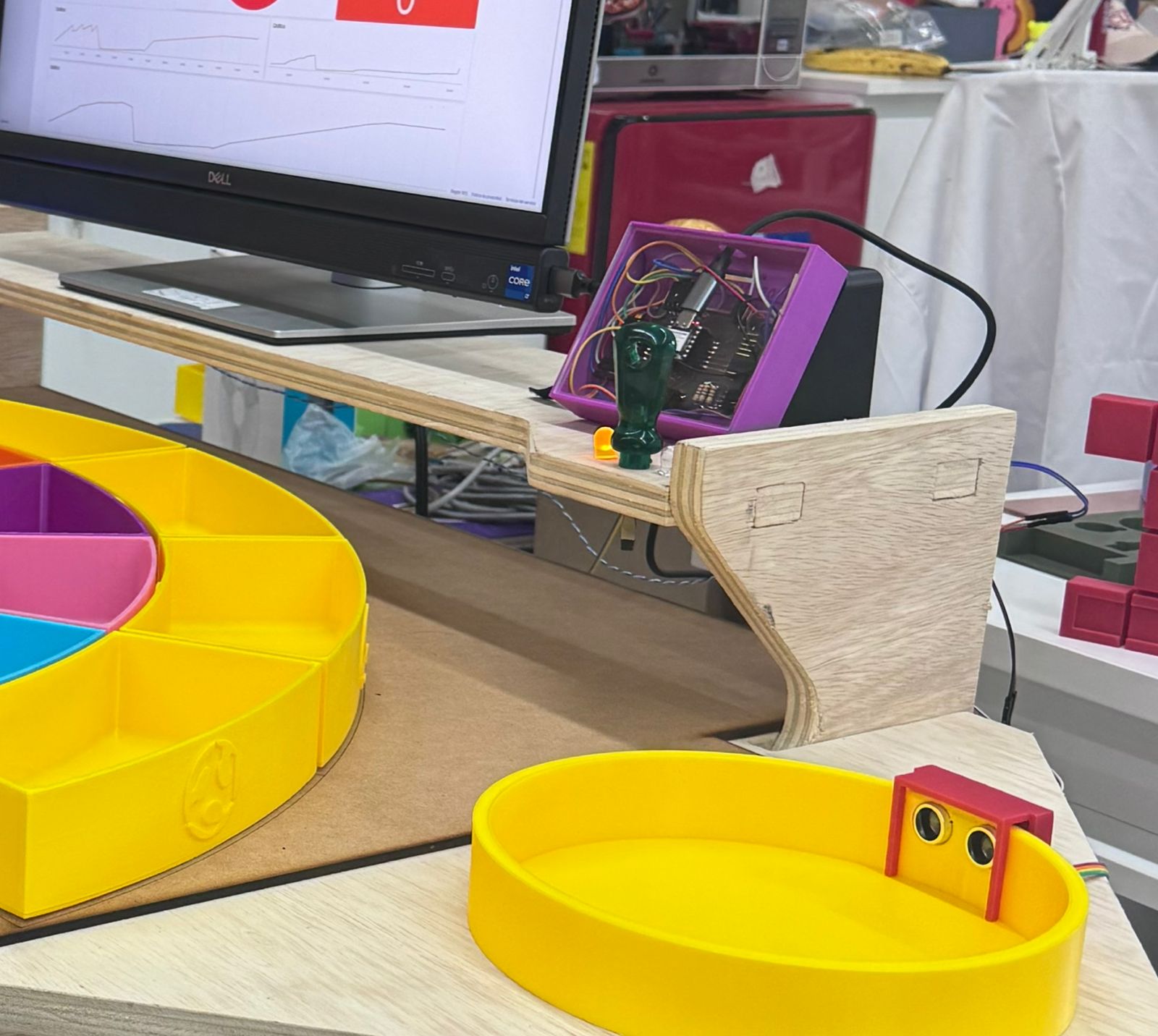
The electronic system uses an XIAO ESP32-C3, a custom PCB, HC-SR04 sensors, LEDs and wiring. Sensor 1 identifies inventory availability and cycle start when the part leaves the station. Sensor 2 detects the completed part and closes the cycle. The ESP32-C3 sends cycle time, average time, inventory count, finished pieces and productivity indicators to Blynk through Wi-Fi. This creates a closed loop between physical action and digital visualization.
The packaging was also part of the integration: the PCB is mounted inside a printed case, the cables are routed toward the sensors and LEDs, and the controls remain visible and reachable by the learner. This makes the prototype look and behave like a finished educational workstation.
The Fab Academy final presentation files were placed in the root of the website using the required names: presentation.png and presentation.mp4. This makes them easy to locate and avoids depending on external hosting. Both files are linked from this Week 20 page and from the Final Project navigation.
The project archive includes original design and fabrication files so the project can be reviewed, reproduced or modified. The files include 2D files for CNC and laser cutting, 3D design files for the printed parts and packaging, machine-ready files such as G-code and 3MF, KiCad files for the PCB, and Arduino IDE code for the dashboard, sensors, LEDs and cycle-time calculation.
More universal formats were included where possible to improve accessibility. For example, the CNC and laser files are provided as DXF, the 3D printed pieces are provided as 3MF/G-code/Fusion files, and the electronics design is available through KiCad project, schematic and PCB files.
The project uses a dual licensing approach. Documentation, images and design files are shared under CC BY-NC-SA, which allows others to study, adapt and share the work for non-commercial purposes while giving attribution and preserving the same license. The code is documented under the MIT License because it is more appropriate for firmware reuse and educational software examples.
This decision was made because Smart Lean Cell is intended as an educational STEM and Lean Manufacturing tool. The license encourages learning, adaptation and replication in academic contexts while keeping the project clearly attributed.
The final documentation acknowledges the support and contributions that made the project possible. The project thanks Fab Academy and Fab Foundation, Neil Gershenfeld and the CBA Center for Bits and Atoms at MIT, the ZOI node in Ecuador, Universidad de Cuenca, the Career of Industrial Engineering, Jenny Rojas, Industrial FabLab UCuenca and the local technical infrastructure that supported the fabrication process.
The project also acknowledges Sofia Guaman and Carlos Guaman, who helped validate the educational experience as users. Their participation was important because the target audience is children, and the gamified Lean Challenge needed to be tested not only as a technical prototype but also as an understandable learning activity.
| System | Evidence | Final Project Link |
|---|---|---|
| Mechanical system | CNC module, press-fit assembly and no glue, nails or screws. | Mechanical Systems |
| LEAN tools | Laser-cut panel, 3D printed trays and visual organization. | LEAN Tool Construction |
| Electronic system | XIAO ESP32-C3 custom PCB, voltage dividers, sensors and LEDs. | Electronic System |
| Networking & dashboard | Blynk datastreams, dashboard widgets, sensor data and cycle-time calculation. | Networking & Dashboard |
| Gamification | Three-level Lean Challenge for children: chaos, synchronization and optimization. | Gamification |
| Fab Academy integration | Relevant weekly assignments mapped to final project development. | Fab Academy Integration |
The evaluator checklist showed four items that needed to be made explicit: BOM, original design files, selected license and acknowledgement of work done by others. The table below consolidates those points and links each one to the corresponding evidence.
| Checklist Item | How It Was Completed | Direct Link / Evidence |
|---|---|---|
| Included the BOM | The Bill of Materials was expanded with material/component descriptions, reference purchase links, high-cost estimates and total prototype cost. | Week 18 - Bill of Materials |
| Included all original design files in the archive | Original fabrication files were added locally: CNC DXF, Kanban panel DXF, 3D tray files, G-code, KiCad project, schematic, PCB file, PCB case and Arduino IDE code. | Downloadable Project Files |
| Included the license chosen | The project uses a dual license strategy: CC BY-NC-SA for documentation/design files and MIT for code, documented in Week 19. | Week 19 - License and IP |
| Acknowledged work done by others | The final project reflection acknowledges Fab Academy, Fab Foundation, CBA MIT, ZOI, Universidad de Cuenca, Industrial FabLab UCuenca, the Industrial Engineering program, instructors, support staff and project validators. | Final Reflection and Acknowledgements |
This requirement was addressed by making the Smart Lean Cell operate as a single connected product. The project integrates mechanical design, digital fabrication, electronics, embedded programming, network communication, data visualization and a gamified educational activity. The purpose of the integration is not only technical: every subsystem supports the learning experience so children can understand Lean Manufacturing through action, feedback and improvement.
The application of system integration is visible in the complete workflow. A child starts with parts organized in the 3D printed trays, takes a component from the inventory area, assembles the product in the central work zone, and places the finished part in the output area. During this physical process, the ultrasonic sensors detect state changes, the XIAO ESP32-C3 processes the events, LEDs provide local feedback, and Blynk displays cycle time, inventory, finished parts and productivity. In this way, the physical learning activity and the digital monitoring system work together.
| Integration Layer | Technique Demonstrated | Application in the Project |
|---|---|---|
| Mechanical integration | CNC press-fit structure, modular workstation layout and physical mounting zones. | The workstation supports the monitor, trays, sensors, electronics case, inventory area, finished-goods area and assembly space in one stable product. |
| Fabrication integration | Combination of subtractive fabrication, additive fabrication and laser processes. | CNC machining creates the main station, 3D printing creates trays and housings, laser cutting creates Lean organization tools, and fiber laser fabrication creates the PCB. |
| Electronic integration | Custom PCB, XIAO ESP32-C3, voltage divider, headers, LEDs, sensors and wiring. | The board concentrates the electrical connections and makes the prototype easier to assemble, test and package inside the station. |
| Embedded software integration | Sensor reading, state logic, LED control, cycle-time calculation and data publishing. | The firmware converts physical events into process indicators: inventory status, work in process, finished part detection, cycle time and average cycle time. |
| Network integration | Wi-Fi communication between the XIAO ESP32-C3 and the Blynk cloud platform. | The dashboard receives real-time data from the physical prototype, allowing facilitators and learners to observe performance indicators during the activity. |
| User-interface integration | Color-coded trays, visible LEDs, dashboard widgets and game levels. | The child interacts with a clear physical interface while the facilitator can use dashboard data to explain Lean concepts and improvement opportunities. |
| Educational application | Gamification applied to Lean Manufacturing and STEM learning. | The system turns TPS, 5S, flow, inventory, cycle time and continuous improvement into a tangible learning challenge for children. |
Smart Lean Cell demonstrates system integration because the final project is not a collection of independent objects. The mechanical station, Lean tools, electronics, sensors, dashboard, packaging and gamified activity were designed to work together as one educational product. Each subsystem has a clear interface with the next one: physical parts move through the workstation, sensors detect process events, the ESP32-C3 processes the data, LEDs provide local feedback, and Blynk visualizes the performance indicators in real time.
| Integration Technique | Application in Smart Lean Cell | Evidence |
|---|---|---|
| Mechanical packaging | The PCB is installed in a 3D printed case and placed inside the station as a protected control module. | Week 16 - System Integration |
| Physical-to-digital interface | HC-SR04 sensors detect inventory and finished parts, converting physical movement into digital events. | Electronic System |
| Embedded control | The XIAO ESP32-C3 reads sensors, controls status LEDs, calculates cycle time and sends values to the cloud. | Networking & Dashboard |
| Cloud dashboard integration | Blynk receives Wi-Fi data and displays cycle time, average cycle time, inventory count, finished parts and productivity. | Blynk dashboard evidence |
| Human-centered learning interface | The color-coded trays, visual organization panel and three-level challenge translate Lean concepts into a child-friendly STEM activity. | Gamification evidence |
| Reproducible fabrication package | All core design files are downloadable so the project can be inspected, modified and fabricated again. | Downloadable Project Files section below. |
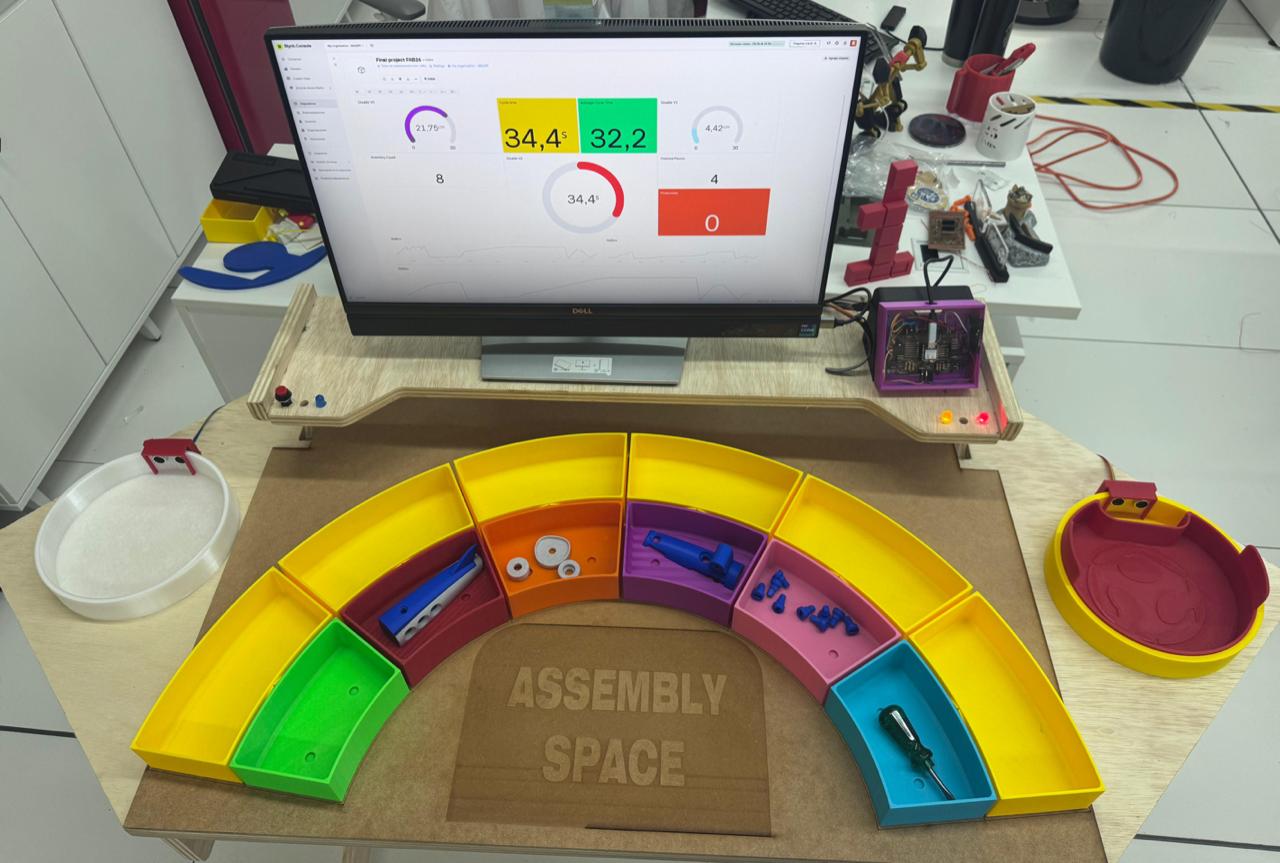
The presentation slide communicates the complete project in one image: project name, author, Fab Lab, system illustration, short description and the main integrated processes. The one-minute video shows the concept, fabrication, electronics, dashboard and operation of the Smart Lean Cell.
| Asset | Required Content | Status |
|---|---|---|
| presentation.png | 1920 x 1080 px slide with name, project name, Fab Lab name, project image and short description. | Completed |
| presentation.mp4 | Approximately one-minute 1080p video showing conception, construction and operation. | Completed |
Week 20 organizes the final evidence for Smart Lean Cell. The project demonstrates the integration of multiple Fab Academy skills into a complete educational prototype. The remaining final deliverables are the summary slide and one-minute video, which are now included in the website root as final presentation media.