


NODO
Ownership, licensing, dissemination strategy and sustainability model for Smart Lean Cell, a gamified Lean Manufacturing learning system for children.
Week 19 is focused on transforming the final project from a prototype into an invention that can be shared, protected, explained and potentially developed after Fab Academy. For my project, this means defining what is original in the Smart Lean Cell, how the documentation and files will be licensed, how the project can reach users, and what future income or sustainability paths could exist.
| Requirement | Status | Evidence in this page |
|---|---|---|
| Define the invention | Completed | Invention statement and originality analysis. |
| Define intellectual property approach | Completed | License strategy for documentation, design files and code. |
| Define dissemination plan | Completed | Audience, channels and communication roadmap. |
| Define possible income model | Completed | Workshops, kits, training and customization models. |
| Acknowledge work by others | Completed | Acknowledgement section and final project reflection. |
The following image summarizes the final project as a product: a modular assembly and real-time monitoring system that introduces children to Lean Manufacturing, sensors, IoT and continuous improvement.
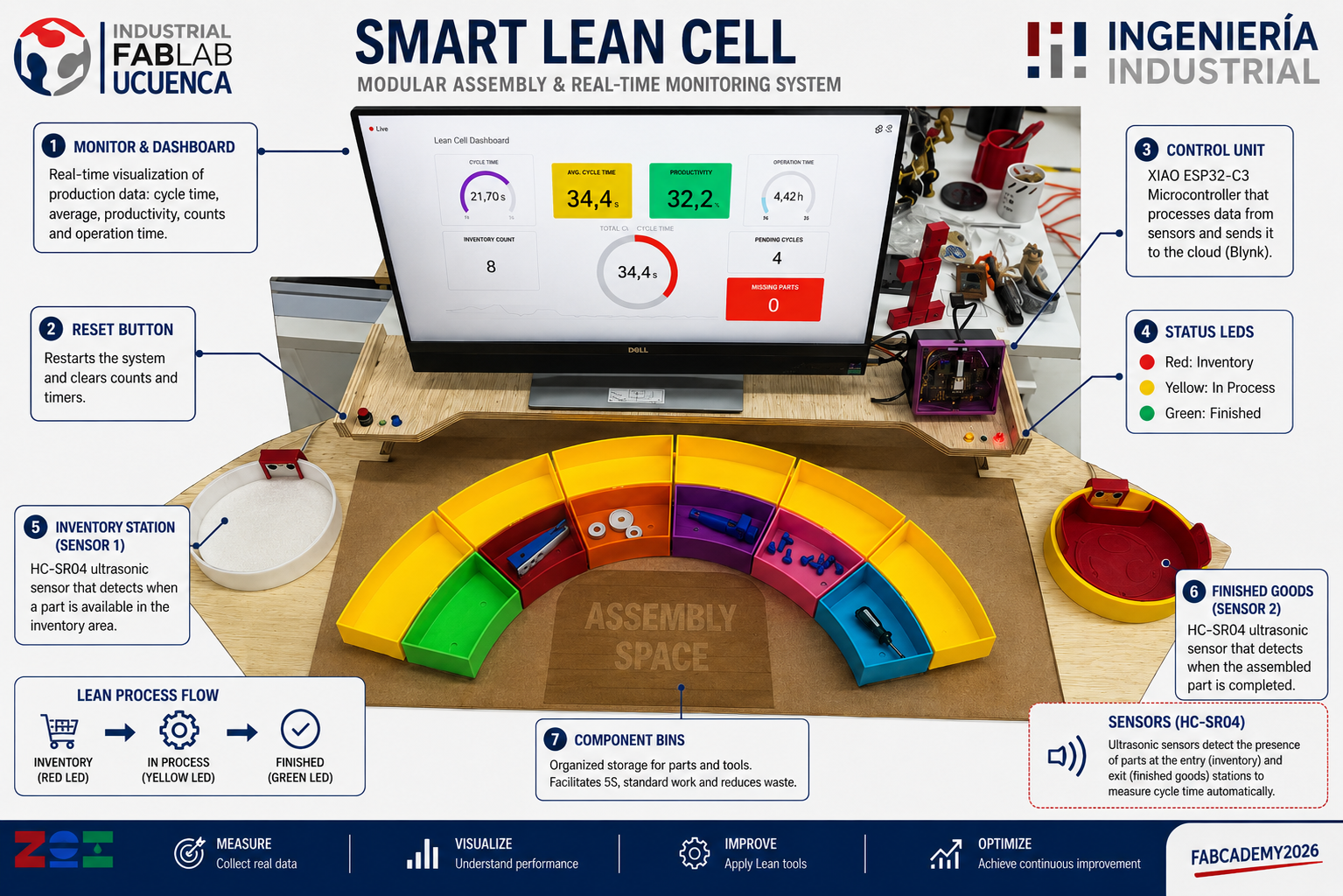
This is a reusable prompt to generate a similar explanatory project image. The prompt describes the composition, visual style and information hierarchy required for a final project flyer.
Design a clean technical infographic flyer for a Fab Academy final project called "SMART LEAN CELL". The image must show a modular assembly workstation for children, made from plywood, with colorful 3D printed bins arranged in a semicircle, an assembly space in the center, a monitor displaying a real-time dashboard, an electronics control unit with a XIAO ESP32-C3 microcontroller, HC-SR04 ultrasonic sensors for inventory and finished goods, status LEDs, a reset button and arrows showing the Lean process flow. Add callout boxes with numbers explaining: Monitor & Dashboard, Reset Button, Control Unit, Status LEDs, Inventory Station Sensor 1, Finished Goods Sensor 2, Component Bins. Use a white background, dark navy technical labels, thin connector lines, clean engineering infographic style, high resolution, professional educational STEM poster, Industrial FabLab UCuenca identity, Industrial Engineering identity, bottom band with icons for Measure, Visualize, Improve and Optimize. The project should look friendly, colorful and suitable for kids, while still communicating Lean Manufacturing, real-time monitoring, sensors and IoT.
The invention developed for the final project is Smart Lean Cell: a modular, digitally fabricated and data-enabled learning cell that introduces children to Lean Manufacturing through a playful assembly activity. The project combines physical organization, gamification, sensors, LEDs and a dashboard so that children can experience how order, standard work and measurement improve a process.
The invention is not only the workstation or the electronics. The main invention is the integration of a child-safe Lean dojo with Fab Lab fabrication processes. The system converts an industrial engineering topic into a STEM experience: children learn by placing parts, assembling objects, seeing process states and observing data.
CNC structure, laser-cut panel and 3D printed trays organize the activity.
Custom PCB, sensors and LEDs detect and communicate process states.
Blynk dashboard visualizes cycle time, inventory, productivity and status.
Lean training cells, classroom assembly games and STEM kits already exist. The originality of Smart Lean Cell is in combining those ideas into a compact, fabricated, connected and child-oriented system. It is a learning product that uses the same logic as industrial improvement, but presents it through color, motion, feedback and play.
| Original Element | Explanation | Evidence |
|---|---|---|
| Child-oriented Lean learning | Lean and TPS concepts are translated into game levels and visual cues. | Gamification section |
| Digital fabrication of the learning cell | The structure, trays, panel and case are made with Fab Lab processes. | LEAN tools |
| Custom electronics for education | The PCB exposes microcontroller pins and connects sensors and LEDs for the activity. | Electronic system |
| Real-time learning dashboard | Children and facilitators can see process data, not only the physical assembly. | Networking & Dashboard |
| Integrated Fab Academy product | The project integrates CAD, CNC, 3D printing, electronics, programming, networking and packaging. | Fab Academy Integration |
My intention is to share Smart Lean Cell as an educational project while preserving attribution. The project was made in an academic and Fab Lab context, so openness is valuable: other students, educators and Fab Labs should be able to learn from it, adapt it and improve it. At the same time, the documentation should clearly identify the authorship of the original concept and final project work.
| Asset | License / Strategy | Reason |
|---|---|---|
| Documentation and images | Creative Commons Attribution-NonCommercial-ShareAlike 4.0 | Allows educational reuse with attribution and prevents direct commercial use without permission. |
| 2D and 3D design files | Creative Commons Attribution-NonCommercial-ShareAlike 4.0 | Supports replication and remixing in Fab Labs, schools and academic contexts. |
| Arduino IDE code | MIT License | A permissive software license makes it easier to reuse, test and improve the code. |
| Project name and educational method | Attribution requested | Any derivative work should mention Smart Lean Cell and Rodrigo Guaman as the original Fab Academy project source. |
| Commercial use | Requires permission or separate agreement | Commercial training kits, paid implementations or institutional products should be discussed with the author. |
The Smart Lean Cell was developed as my individual Fab Academy final project, but it was possible thanks to the academic, technical and human support around the project. The documentation, design decisions and final integration are my work, while the infrastructure, feedback, validation and educational context were supported by the Fab Academy network and Industrial FabLab UCuenca.
| Contributor / Institution | Contribution |
|---|---|
| Fab Academy and Fab Foundation | Global learning framework, evaluation structure and documentation culture. |
| Center for Bits and Atoms, MIT | Origin of the digital fabrication learning model and Fab Academy methodology. |
| Neil Gershenfeld | Lectures and conceptual framework for making almost anything. |
| ZOI Node Ecuador | Regional node support for Fab Academy development. |
| Industrial FabLab UCuenca and Jenny Rojas | Infrastructure, equipment access, support and local project environment. |
| Universidad de Cuenca and Industrial Engineering program | Academic vision and institutional context for the project. |
| Sofia Guaman and Carlos Guaman | User validation, patience and support during the construction and testing of the project. |
The dissemination strategy is focused on education. The project should first be shared through the Fab Academy website, final presentation media and local Fab Lab demonstrations. Later, it can be used in STEM outreach, Industrial Engineering activities, Lean workshops and school visits.
| Audience | Message | Channel | Expected Result |
|---|---|---|---|
| Children | Learn, build and improve while playing. | Hands-on demonstration and gamified challenge. | Early exposure to STEM, Lean and process thinking. |
| Teachers | A physical tool to explain organization, time and improvement. | Workshops, classroom demos and guides. | Adoption as a teaching resource. |
| Fab Labs | A replicable educational manufacturing cell. | Documentation and downloadable files. | Replication and local adaptations. |
| Industrial Engineering students | A compact demonstrator of TPS, 5S, flow and cycle time. | University labs and lectures. | Connection between theory and practice. |
| Companies | A simple introductory Lean training experience. | Demonstrations and customized workshops. | Potential training service or kit customization. |
The goal is not to close the project, but to make it sustainable. The documentation can remain open for learning, while value can be generated through workshops, local fabrication, customization and educational content. This model respects the Fab Academy spirit while allowing future development.
| Model | Description | Possible Customer | Type of Income |
|---|---|---|---|
| Educational workshop | Short STEM/Lean activity using the Smart Lean Cell. | Schools, museums, universities. | Workshop fee. |
| Fabricated kit | Locally produced workstation, trays, sensors and electronics package. | Fab Labs and classrooms. | Kit production and assembly. |
| Customized Lean cell | Adapt the activity to another product, age group or training objective. | Companies and universities. | Design and consulting service. |
| Training module | Use the system as a Lean introduction for non-specialists. | Small companies and training centers. | Training service. |
| Digital materials | Facilitator guide, worksheets, dashboard templates and activity cards. | Teachers and instructors. | Educational content package. |
The current prototype demonstrates the idea and validates the first version. The next step is not only to make it more polished, but also to make it easier to replicate, transport and use with different groups of children.
| Stage | Objective | Status |
|---|---|---|
| Prototype documentation | Document the full Fab Academy final project with files and media. | Completed |
| Final presentation media | Prepare slide and one-minute video. | Completed |
| Educational guide | Create facilitator instructions and child-friendly learning cards. | Future work |
| Portable version | Reduce cable exposure and improve transportability. | Future work |
| Replicable kit | Package files, BOM and assembly guide for other Fab Labs. | Future work |
| Workshop validation | Run a structured session with more children and collect feedback. | Future work |
Since the target users are children, the project must be treated as an educational activity with supervision. The electronics should remain enclosed, cables should be organized, and small pieces should be handled with care. The project should not be presented as an industrial machine, but as a safe learning demonstrator.
| Risk | Mitigation |
|---|---|
| Small parts can be lost or misused. | Use adult supervision, labeled trays and controlled activity kits. |
| Cables can distract users or be pulled. | Improve cable routing and keep electronics inside a protective case. |
| Dashboard indicators may be too technical. | Use facilitator explanation and future child-friendly dashboard views. |
| Commercial reuse without attribution. | Use CC BY-NC-SA documentation and clear author attribution. |
The invention is supported by public documentation, final presentation media and downloadable design files. This allows the project to be evaluated, reproduced and improved.
Open Final Project Page Open Final Slide Open Final Video Download Arduino IDE Code Download PCB File Download 3D TraysSmart Lean Cell is an invention with educational value, not only a fabricated prototype. Its intellectual property strategy keeps the project open for learning while protecting authorship. Its dissemination plan focuses on children, STEM, Fab Labs and Industrial Engineering education. Its income model can grow through workshops, fabricated kits and customized training cells, always preserving the original purpose: helping children learn how to measure, visualize, improve and optimize through play.