Week 19
Week 19: Invention, intellectual property, and income
I wrapped Fab Academy by documenting invention, IP, income, and how I plan to release NeuroAR as an open project with the FAB license and future spirals.
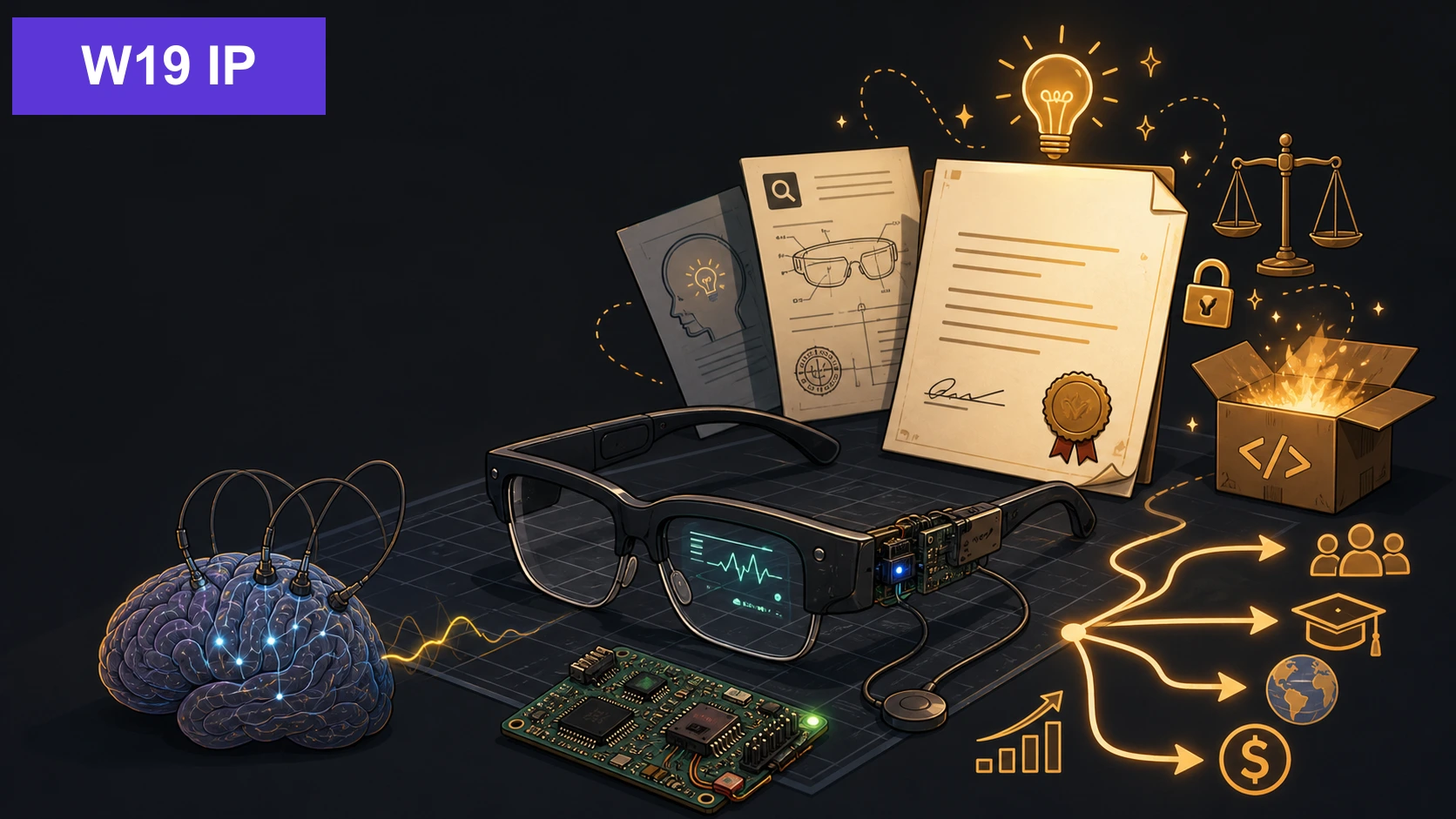
FINAL WEEK OF FAB ACADEMY... I can’t believe it tbh. I have learnt so much, and I am so grateful to everyone in the community who made this experience legendary.
This week was more of 2 weeks since it was also preparations for final projects, so I focused on some final touches for the project, remaking my website, and working on the additional spirals of the project.
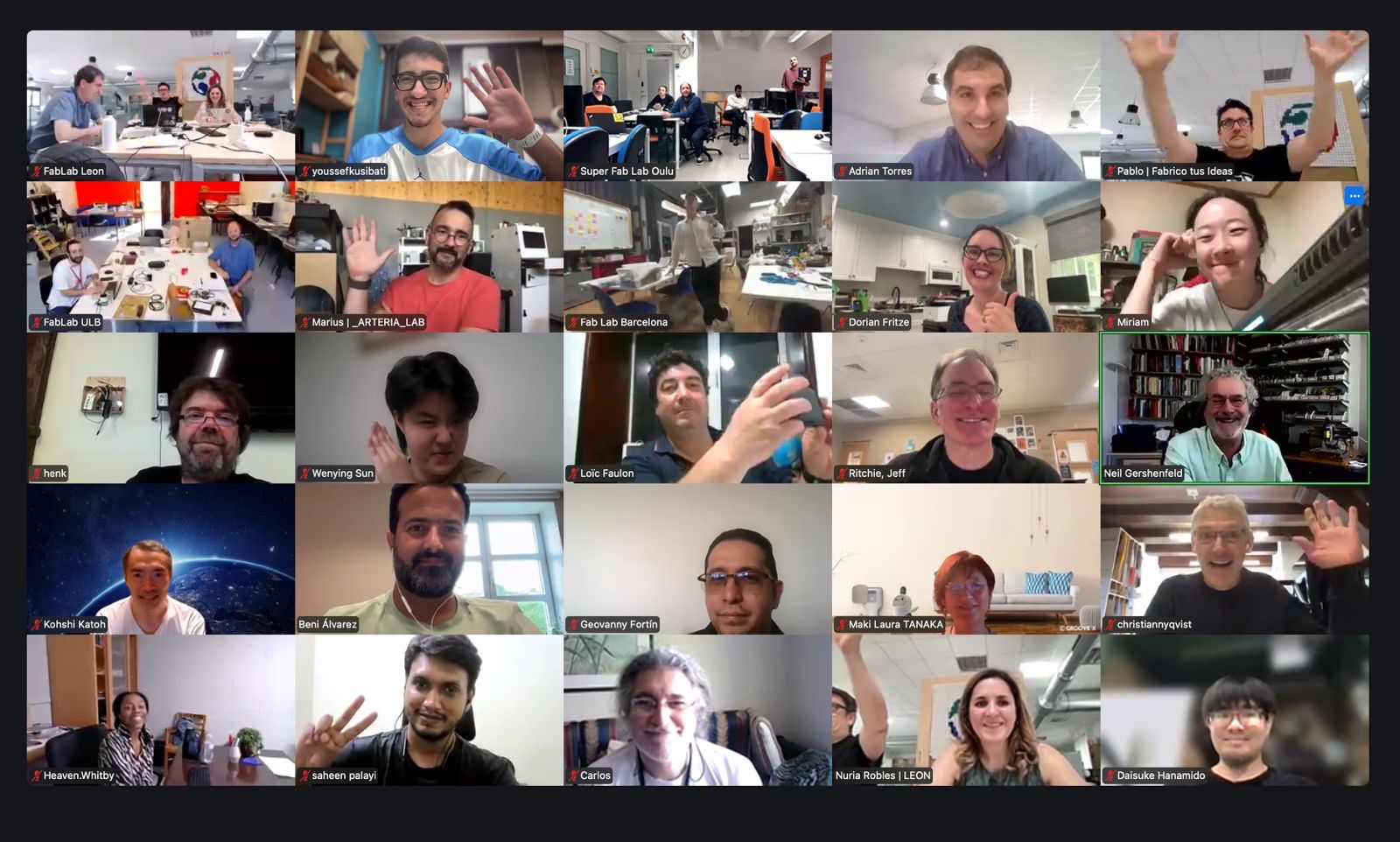
This week’s checklist is also more of the assignment itself, so you can jump directly to Answering this week’s questions.
Learnings from Global Session
This was the last regular global session, which felt a little strange to sit through tbh. It split into two halves: a wrap-up on what the final project and presentation need to be, then the real topic of invention, intellectual property, and income.
Weekly assignments are due June 3rd (completing this on the June 2nd!!!), my final presentation is on June 8th, and feedback (pass, provisional, or pushed to a future cycle) comes July 1.
The slide and the roughly one-minute video have to be ready and tested early, since on the day of the presentation, if they do not work, it is basically goodbye for your presentation.
The site itself has to answer a clear set of questions: what the project does, what existed before it, what sources I used (people, past years, AI), what I designed, where the parts came from and what they cost, what I made and with which processes, what worked, what failed, and how I judge whether it succeeded.
The assignment is basically finish the project, plus one small but real thing: make a plan for how you disseminate it. Open or closed source, free, for-profit, or non-profit, whatever you actually want to do to get it out there.
Invention as a System
The framing I liked is that invention is something you can manage. You do the work to set up the conditions for it instead of waiting around for some magic event.
It started from Vannevar Bush's post-WWII report, the document that basically created the idea of a government funding research at all (the NSF grew out of it). The critique that came later is that it assumed a clean pipeline, basic research then applied research then applications, when really it runs both ways.
The application often exposes the basic research question (coincidently and as Neil casually mentions a colleague of his proposed that).
Ready, fire, aim (check out Neil’s TEDTalk on it) is a sharper version of that. Ready is doing enough homework to be in the right area, fire is experimenting without overthinking it, and aim is looking hard at what you actually did. Ready-aim-fire leaves no room for surprise, which is the whole point of exploring.
The examples were kind of wild. Anti-shoplifting tags became the basis for some of the first quantum computers (I want to read that paper; I think this has to do with it), reading those out led to extremely sensitive molecular detection, and a spinoff of that became ThingMagic, the reference platform for RFID.
The cello had the same shape. A sensor built for one of Yo-Yo Ma's cellos turned into electric-field tomography, which turned into the sensor that stops airbags from killing infants in rear-facing car seats.
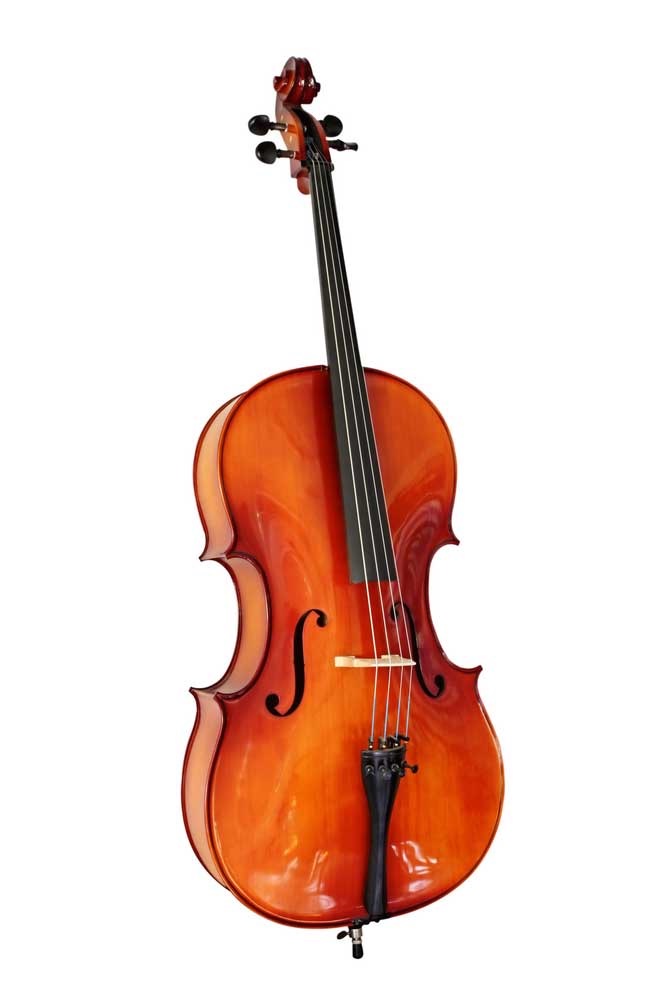
This is a cello for reference….
None of that connects without traffic between people, tools, and problems. A cello art project, a car-seat company with an urgent problem, and the right electronics all had to physically cross paths.
That's the case for an ecosystem, where people across the community get to be inspired and contribute to each others work by SHARING each others work with the world.
Patents
The patent section turned out to be mostly a long list of cautions, lol. I knew some of this stuff before tbh.
The first move is always a patent search to see what's already out there. The USPTO search is more powerful, Google Patents is easier to get oriented with. There are two main types, utility (how something works) and design (how it looks), and utility is usually stronger.
Disclosure is the concept to handle carefully. You can protect an idea just by keeping it secret, but the moment it goes public a clock starts: in the US you have a year to file, while in most other countries public disclosure kills your ability to file at all. So you don't disclose until you've protected it, unless you're doing it on purpose.
Before a full filing, you usually file a provisional. It's basically a cheap, fast timestamp, a paper trail that says you had this idea on this date, and you get a year to convert it into a full filing.
A common pattern is firing off something like 10 provisionals for every one that becomes a real filing, so it works as a filter.
A full filing goes public and has to teach the invention, meaning someone skilled in the field could rebuild it from what you wrote. It has a specification (the whole description) and claims, and the claims are the only part that's actually protected. Writing them is its own craft, shaped like a tree from a broad claim down to narrow ones, which is where patent lawyers come in.
You can patent four kinds of things: a composition (what it's made of), a method, an apparatus, or a manufacture (the thing you produced).
Examination checks whether it's novel, non-obvious, and useful, plus a fourth worth adding, whether it's actually protectable.
It's supposed to check that the thing isn't impossible too, but the office has granted patents for free energy from a vacuum and faster-than-light communication.
Patent offices are national, there's no world patent, and while the PCT (patent cooperation treaty) saves you from re-examining everywhere, you still nationalize and pay country by country.
Everywhere has moved to first-to-file, so timing beats proving you invented it first, and once you have the patent you still pay maintenance and have to actively defend it or you can lose it.
The costs were the reality check: roughly $100 for a provisional, $1,000 for a basic full filing, $10,000 to take it all the way to issued, and $100,000 once international filing and maintenance show up.
THERE IS NO PATENT POLICE. A patent doesn't stop anyone from copying you, it just buys you the right to take them to court on your own dime, so it only earns its keep if you can actually spot infringement and there's a barrier to copying.
A robot big enough to build a jumbo jet, only a few people can do that, easy to police. Almost anything you can make in a fab lab, anyone with a fab lab can make, with no barrier and no way to even know, so it's basically not protectable.
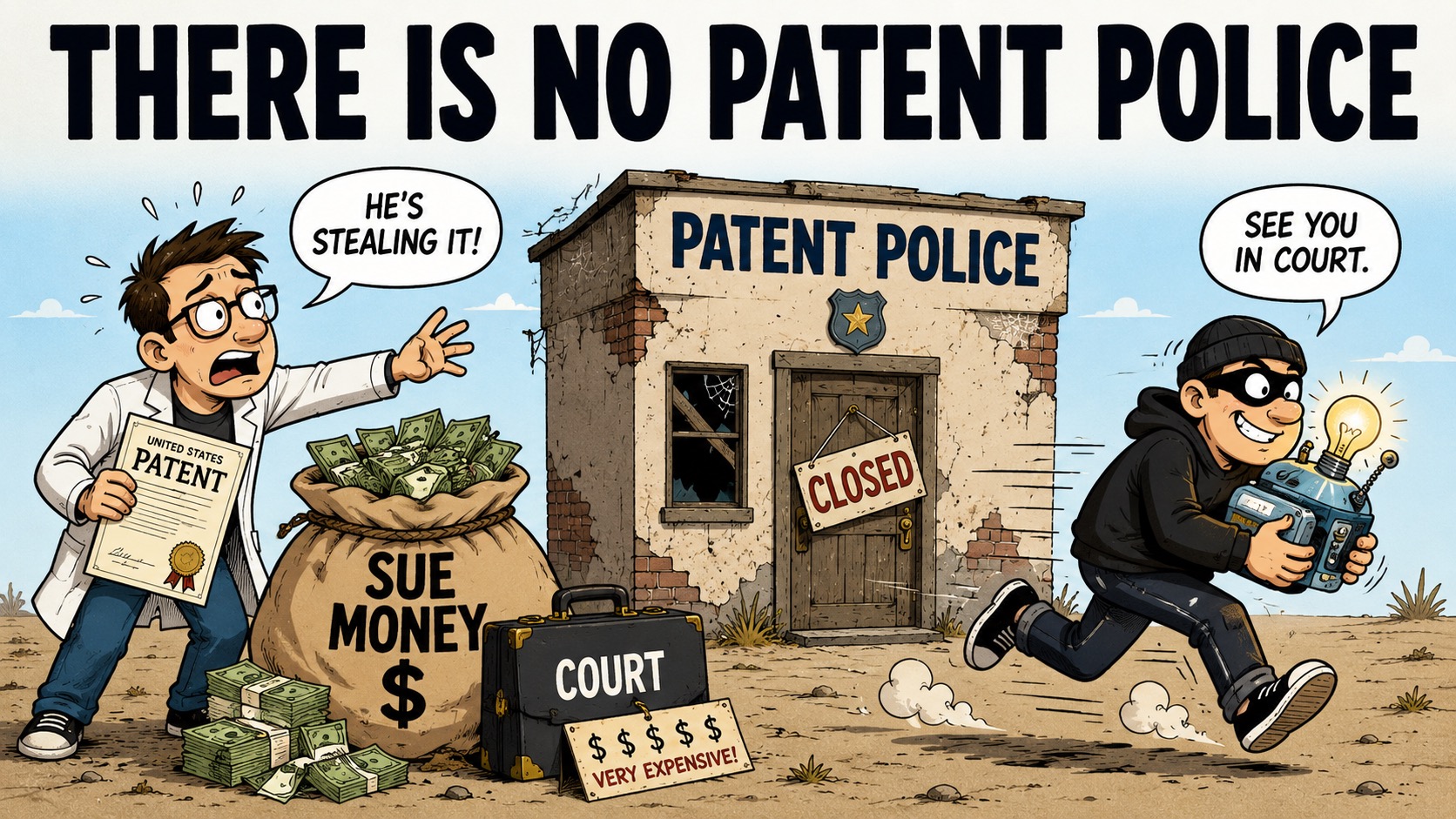
On top of that there's a whole world of trolls, NPEs, and submarine patents, entities that file or sit on patents purely to sue people once they start making money. The airbag sensor grew into a $100M business and someone crawled out to sue over physics that didn't even make sense, and it still cost a pile of time and money to swat away.
The one honest exception is that investors and marketing like patents, so sometimes that alone is reason enough to get one (it could raise you some good capital).
Copyright, Licenses, and Trademarks
Copyrights are underrated.
A copyright covers an original work of authorship, and "work" is broad: stories, sure, but also CAD, circuit designs, code, and PCB layouts and masks. A lot of how Intel protects its chips is copyright on the masks.
The best part is it's secured the second you create the thing, a notice makes it stronger, registering it makes it stronger still, and it runs your lifetime plus 70 years, with sub-rights to reproduce, modify, distribute, perform, and display the work.
The Phoenix BIOS story made the boundary click. IBM had the original PC BIOS code, so Phoenix did a cleanroom rewrite: engineers who could see what it did but never the original code, rebuilding it from scratch. Same behavior, totally new code, clean enough to copyright, and that's how the commodity PC business got going.
Copyright protects the specific expression, not the idea, with two limits: fair use (showing a picture of Harry Potter in a class needs no license, i think this was the example Neil said in session) and prior use (you can't copyright something already in common use).
Once you have the copyright you pick a license, and the first split is open source versus free, which aren't the same thing.
Red Hat is open source Linux with the code right there, and it's still one of the only genuinely profitable parts of IBM, because the business is the support and services around it. Open source doesn't mean giving your work away.
The menu is Creative Commons, GPL, LGPL, BSD, MIT, Apache, and the FAB license, and a comparison tool someone dropped in the chat during the session shows them all.
The full licenses run pages long, which is the whole point of the FAB license: a 3-sentence version that took 6 months with MIT's lawyers to write. It establishes copyright, names the project, and waives warranty and liability, and you get all of it just by pasting it in.
(c) holder date

This work may be reproduced, modified, distributed, performed, and displayed for any purpose, but must acknowledge "project name". Copyright is retained and must be preserved. The work is provided as is; no warranty is provided, and users accept all liability.
The catch is that changing a license later is messy, so pick it from your dissemination plan rather than habit and stick with it.
Worth knowing too: somewhere like GitLab won't enforce copyright for you but will honor takedown requests, while a platform like YouTube enforces it instantly.
There's deliberately no trademark on Fab Lab, because a trademark has to be defended, you'd have to stamp a symbol on every use and chase down everyone who misuses it. Nobody wanted to be the Fab Lab police, so the name gets protected by giving it meaning instead.
Same theme across all of these: a right you don't defend is a right you can lose.
Income and Business Models
Income isn't only about getting rich. It's also about whether the thing is sustainable, whether it scales, and what impact it can have.
You can't push on strings, you have to pull. It's hard to invent something and then convince people they want it, and much easier when there's an existing pain point and your invention pulls the person who already has the problem.
Two ideas ride along with that: a moat (something that makes you hard to copy, like expertise or scale) and the MVP (ship the smallest useful version, then build around it in spirals).
And of course, there is a lot of ways to commercialize the thing you built. The examples each showed a different model: Formlabs sells the printer but had to grow into a 1,000-person company to do it, Prusa sells kits alongside the finished printer, ARM makes nothing and licenses its designs (mostly through copyright, not patents), Google gives search away and sells the searching, Apple built a platform for other people, and Amazon built infrastructure and sells access to it.
Gillette sells cheap razors and charges for the blades, and Rolls-Royce stopped selling jet engines and now sells thrust, where you fly and they own and maintain the engine (still kind of wild, didn’t know that tbh). I wonder if AI will end up being pay as you accomplish type of model.
The fab lab version of that is services: running a lab, consumables, customization, education, entertainment, impact, research.
The deeper idea is selling the act of making something rather than the object, the same way Google sells the act of searching, because something getting made in a lab changes a community and changes educational outcomes.
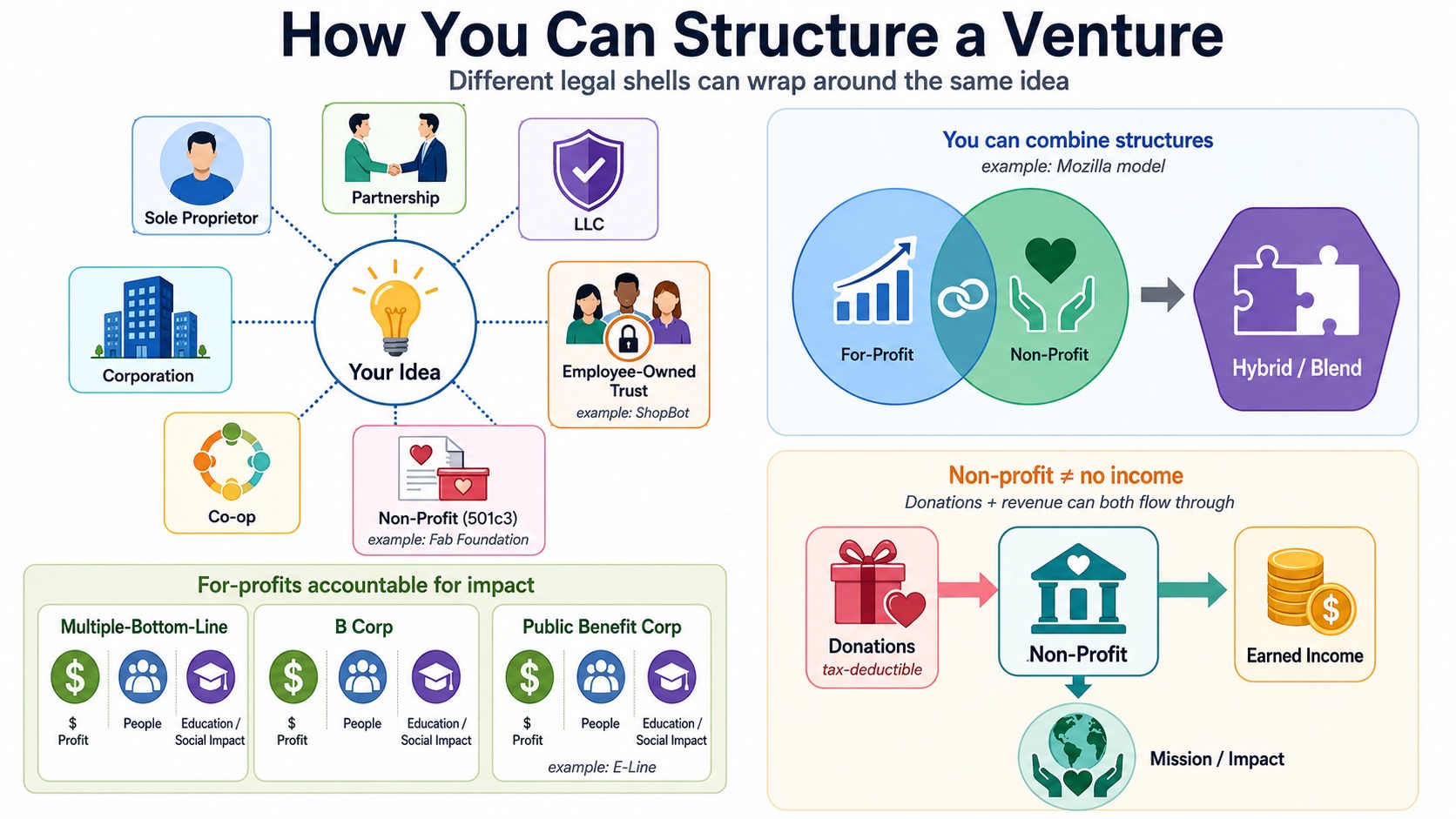
Then, there's the structure you wrap around it. You can go sole proprietor, partnership, LLC, corporation, an employee-owned trust like ShopBot, a co-op, or a non-profit (a 501c3 in the US, which the Fab Foundation is), and you can blend them, the way Mozilla runs a for-profit and a non-profit together.
Multiple-bottom-line companies, B Corps, and public benefit corps are for-profits that are legally accountable for social and educational impact, not just money (a studio like E-Line is one, and it actually has to measure and report that impact). Non-profit doesn't mean no income either: huge amounts can flow through one, with tax-deductible donations on top.
Funding usually happens in rounds, like spiral development :P. VCs are the standard path, but a bad one is a bad relationship that takes equity and pushes you toward an exit you don't want, while a good one helps you build teams and partners (that’s why tiers exist, oneday will get funded by a16z/YC/sequoia/etc.. inshallah).
The goal of VCs is to invest in startups that would bring back rate like 10x or more, so not all projects are a fit for them.
Beyond VC there are angels, friends and family, incubators, and crowdfunding (Recon raised a few million on Kickstarter and bootstrapped from there).
Loans plus purchase commitments is another model to gauge interest directly from your customer: if someone commits to buy 1,000 units at a spec, you take that commitment to a bank, get a loan to build them, and demand turns into financing without giving away the company.
Early business plans almost always break on contact with reality (ThingMagic set out to make interactive environments and ended up making RFID readers, because that's what people wanted).
Almost any structure works at 10 people, but around 40 you hit your first theft or harassment, and somewhere between 40 and 100 you suddenly need HR, security, and a real management team.
Founders usually don't have the skills to run the thing as it grows, which is why Google needed Eric Schmidt.
Answering this week’s questions
I answered some of the questions for this week’s assignment in Week 18.
Created a dissemination plan for your final project?
NeuroAR is going out as an open project. Everything I made gets published on my Fab Academy page and mirrored on a clean GitHub repo so someone can rebuild it from scratch: the Fusion CAD for the frame and optics, the KiCad files for the ADS1292 board, the firmware, the web dashboard, and the documentation.
The people I have in mind are makers and students poking at DIY EEG and AR, the same ones whose projects I leaned on when I started (OpenBCI, the Hackster custom-PCB EEG, the open smart-glasses work).
I was never designing in a vacuum, so putting mine back out is the way to give back to that pool.
For the license I'm going with the FAB license, the same one Neil walked through from MODS that he sat down with the MIT lawyers to sort out.
It fits a project that came out of this program better than pulling MIT or Creative Commons off the shelf, and it keeps everything I release consistent with the ecosystem it grew out of.
That license expects the full text to travel with the work, so I'll put it at the top of the firmware and alongside the CAD, board, and documentation.
To maximize reach for the project, I will be creating content across my social media about my journey in Fab Academy learning all the skills that led me to this final project and sharing product-launch-like video too.
Additionally, my documentation will be linked as a guide for people to follow to understand and learn how I built it.
Outlined future possibilities and described how to make them probabilities?
The possibility I'm focusing on for now is building on top of glasses people already wear instead of asking them to fabricate my hardware. The EEG and SNN processing layer sits on something like the Meta Ray-Bans through their SDK, so the useful part works on a device that's already on someone's face.
The reason I'm chasing this one first is that it sidesteps the problems my own frame still has. I don't need to fix the noise, the comfort, or the in-frame battery before anyone can use it, since the glasses already handle the wearable side and I bring the brain-state layer on top.
To turn it from a possibility into something real, the steps are concrete. Get access to the Ray-Ban SDK, redesign my different modules to latch on the Meta-Rayban glasses.
The heavier hardware spirals are still on the list: more electrodes, a fab-house ADS1299 board, and shrinking everything into the frame. They're slower and wait on ordering parts, so they sit behind the Meta route rather than ahead of it.
Beyond that, I want to utilize this project to get in contact with researchers and companies in the areas this project sits at to potentially work alongside them, learn from them, and build cool stuff in the next phase of my life, perhaps through internships, lab work, or potentially finding a co-founder to grow off of what I built or pivot to another project within the same area of human-computer interaction.
What tasks have been completed, and what tasks remain?
Most of the build is done. The frame is designed from my own lenses, the optics path (OLED, lens, prism, mirror-acrylic combiner) is aligned and readable, the ADS1292 board is milled and working, the firmware runs on the XIAO, the web dashboard and recording pipeline are up, and the whole thing snaps together with the cables hidden by the cover.
The presentation slide and the one-minute video are being finished too.
What's left for this final week is documentation. I need to finalize the BOM, package all the design files (CAD, board, and code) for the open release, and clean up the GitHub repo so someone can actually rebuild it.
The bigger tasks that remain are the spirals, led by the Meta Ray-Ban integration I'm focusing on next, then a larger EEG dataset for the SNN, and the heavier hardware work like a fab-house ADS1299 board and shrinking everything into the frame. Those run past the Fab Academy deadline.
What's working? what's not?
This is the same as where the project stands now, so instead of repeating it I'm linking straight to where I broke it down in full: What worked? What didn't?.
What questions need to be resolved?
With the FAB license settled, the open questions are mostly forward-looking.
The first is whether the Meta Ray-Ban route is actually open to me: how much SDK access I can get, and how cleanly my brain-state output ports onto their hardware. That's the direction I'm betting on, so it's the one I most need an answer to.
The second is how much data the SNN needs before it's dependable rather than promising. I can't yet tell whether that's a few more recording sessions or a much bigger collection effort.
The last is potentially how to make the glasses more useful/functional. I added different functionalities using the new dashboard, which I wrote about in the final project development log, like Gmail notifications, time, weather, and a small Pong game.
Planned what will happen when?
The near-term plan follows the Fab Academy deadlines from this week's session: weekly assignments wrapped up by June 3, the final presentation on June 8th, and complete local evaluation by 24th of June and implement global feedback by July 1.
Between now and the presentation it's documentation, the repo, and finishing the video/presentation.
After that, the spirals run on their own timeline. The one I'm focusing on first is the Meta Ray-Ban integration, which waits on getting SDK access, though the brain-state output it needs is already there.
The dataset collection and SNN work I can keep doing with the current hardware, and the heavier hardware spirals are a bit more complex and would require some major redesigns.
What have you learned?
Oh man, this is a huge question, it is a lot. Everything on this website is mostly things I learnt for the first time.
I came into Fab Academy basically clueless about electronics and shaky on parametric CAD, and I can now design a board, mill it, write the firmware, and package the whole thing into something wearable.
I was able to challenge myself on learning new stuff even in areas I thought I had some background knowledge in like software development, embedded programming is a different beast.
Learning how to deal with bio-potentials on a hardware level (I am still learning a lot) shows how complex and intricate our brain and body is.
CAD design is a mindset by itself. It feel unintuitive at the start, but once you get it and get into the flow you learning rate becomes exponentially faster.
In electronics, the design has been quite fun but routing is so annoying. I learnt a lot about navigating a data-sheet and bringing different components together and learning how to connect them with each other.
When packaging a system, some annoying things could break unexpectedly and need a small change somewhere to get fixed, and you get lost on how to effectively fix it while losing tons of 3D print filament xD.
AI is an incredible tool and I am so glad I am getting lots of hands-on exposure with it learning those new topics and experiences where it fails in that objective and rectifying it so it serve me best.
Finally, the Fab Community has some incredible people with incredible talent and work who I learn from in every interaction. I am so excited to meet everyone in Boston and graduate (shoutout to Yuichi and Henk, who unfortunately won't be in Boston but we'll meet one day) xD.