Overview
This week is about what happens to Maya's Mirror beyond Fab Academy: how I share it, the licence I release it under, and where it could go next. The build itself is documented on the final project page →; this page is the plan for its life after the deadline.
Maya's Mirror is a personal, research-driven art piece, not a product — so its “income” is measured less in units sold and more in where it can be shown, what it opens up, and how it feeds the work that comes after it.
Dissemination Plan
The plan to share the work runs on four tracks:
Open documentation
The full build — CAD, PCB, firmware, WebGL source, and the fabrication files — stays public on my Fab Academy site under an open licence, so the process is reproducible and the methods are reusable by others.
Exhibitions & festivals
The piece is built to be experienced in a room, so exhibition is the primary channel. The first showing is the IAAC exhibition on 2 July 2026 in Barcelona. Beyond that, I'd look to show it at new-media and interactive-art exhibitions; the core dossier (presentation video, hero image, documentation, CV, and a reusable artist statement) is being prepared so it's ready when the right open calls come up.
Logistics — moving (and not moving) the work
I return to India at the end of June, and the full-scale piece — a ~520 × 720 mm carved frame with a monitor and mini PC inside — is too large to travel with. So the original stays in Barcelona, where it can keep being shown locally (starting with IAAC), while I disseminate it remotely through the documentation, video, and dossier.
Writing & portfolio
The story behind the piece — Maya, dementia, and the dissolution and rediscovery of self — travels through my portfolio and writing, including a post connecting it to the remote-time / remote-space themes from CHI 2026.
Talks & teaching
The project doubles as a teaching case on process and method in interaction design, the way it already featured in a guest lecture at DTU.
Intellectual Property & Licensing
Maya's Mirror is really three kinds of work, so it wants more than one licence. This is the plan to decide on — I'm not a lawyer, so treat it as my reasoning, not legal advice:
- The artwork & experience (the botanical frame, the generative simulation, the piece as a whole) — CC BY-NC-SA 4.0. Others can learn from and build on it with attribution, but not sell it, and must share alike — which fits a memorial artwork.
- The code & electronics (firmware, the XIAO carrier PCB, the WebGL / MediaPipe source) — a permissive MIT licence, so the technical methods are freely reusable in other projects.
- Maya's letter & handwriting — kept as personal family heritage, shown as part of the piece but not licensed for reuse. It's hers.
The split keeps the engineering open and reusable while protecting the personal, non-commercial heart of the work.
Income & Sustainability
As an art-research piece, its value isn't a unit price. The realistic paths I'm considering:
- Exhibition & residencies — show fees, festival honoraria, and residency support, where the work earns its keep by being experienced.
- Commissions & editions — the method (a generative portrait that dissolves and is remade) could be commissioned or editioned for other families' stories — without ever reusing Maya's own letter.
- Grants & talks — funding tied to its research questions, plus paid talks and teaching around the process.
- Research capital — its biggest return is as a portfolio and research artifact, feeding a graduate research direction rather than a sales sheet.
Future Opportunities & Development
Where the piece goes after this version:
- A smaller, tabletop version — an open direction the files leave room for, for anyone who wants to make it small. Instead of a monitor and mini PC, you'd drop your own phone or iPad inside to act as the screen and camera, and fabricate the body either fully 3D-printed or milled from a small block of wood on the desktop mill. I haven't built this — it's a possibility, and one that would make the piece editionable.
- The intended interaction — moving the trigger from the current spacebar/HID signal to the planned proximity-and-gesture cycle via the PIR.
- A non-visual dimension — given my work on smell as a design material, extending the piece with scent as another route to memory, beyond the visual.
- A participatory version — generalising the generative-portrait method so other people's handwriting and stories can drive it, turning a personal memorial into a shared one.
- Research directions — the questions it raises about memory, identity, and interfaces map onto the kind of work done in the Fluid Interfaces and Critical Matter groups I'm aiming toward.
Completing & Tracking the Final Project
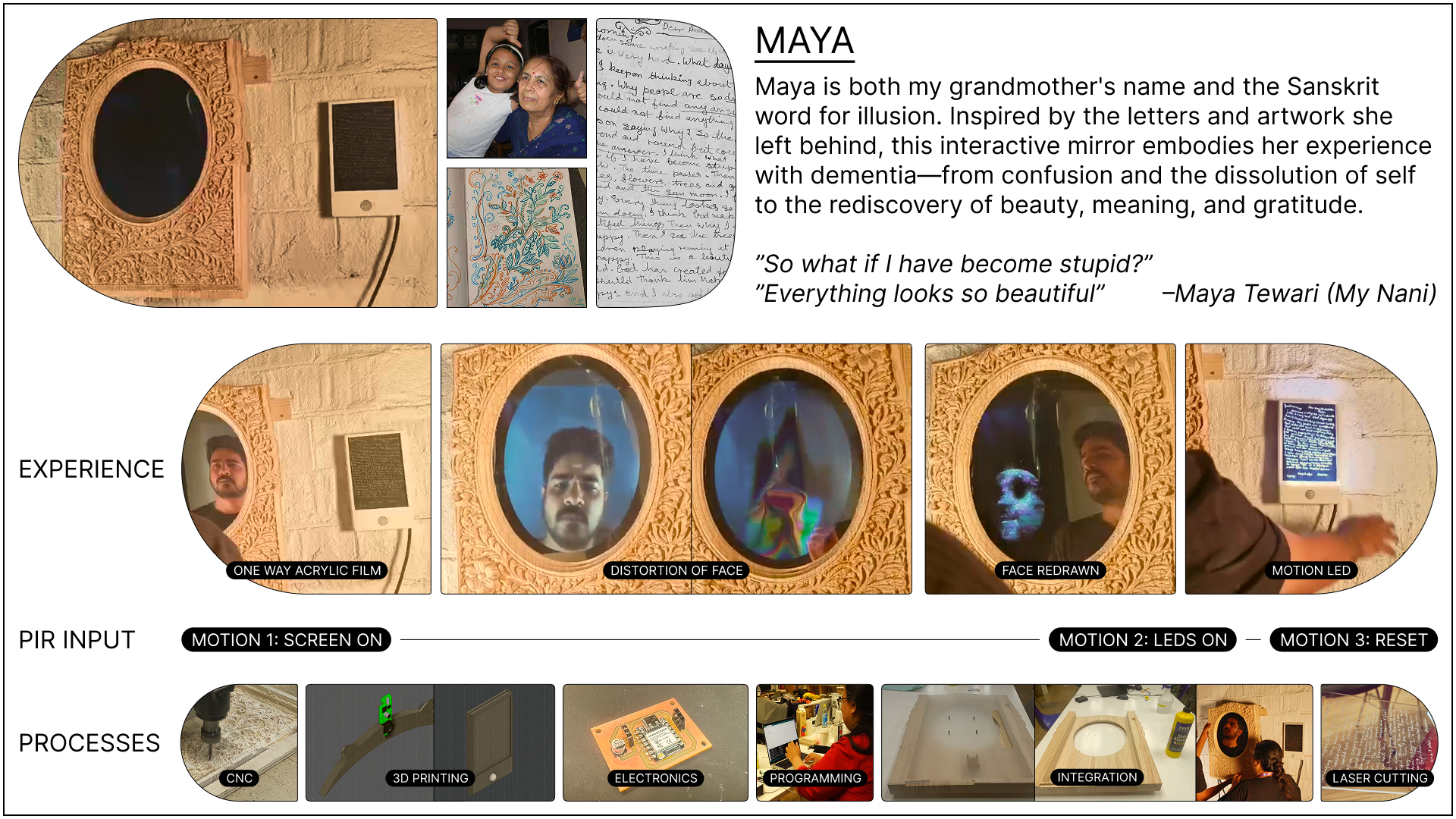
Alongside the dissemination plan, this week tracks the final project to completion. The physical installation is built and working — carved pine frame, one-way mirror, the face-tracking botanical simulation, the laser-marked letter with its NeoPixel light, and the integrated mini PC. What remains is closing documentation gaps and finishing the presentation. Progress is tracked in detail on the final project page →.
The Essence — Summary
Maya's Mirror turns a granddaughter's grief into an object that feels alive: look into it, and your reflection dissolves and is remade in the flowers and vines her grandmother once painted — confusion, loss, and the rediscovery of beauty, held in one mirror.
Summary video — presentation.mp4.