The process
This week answers four linked questions about the final project — the shoulder-clip posture corrector: what's actually inventive here, how the open work gets out into the world (dissemination), who owns and can build on it (intellectual property), and how the commercial version sustains itself (income / business). I treat all four as design choices — the same way I treated the PCB track width or the BLE / ESP-NOW radio split — there are trade-offs, and I want them explicit.
Use of AI:this srea was new on me and i needed alot of gidance and information, but I also needed to finishh theis as fast as possible and get back to finlizing the technicalities with the final project. I use Claude AI and I used.
My prompt to Claude: let me now share my ideas and though t in this regards. The product is this stage can be used as open source for purposed of eductaion objectives . as a product, this is the not my final commercial deisgn and that shoulder be owned by me . the tarrget user of this users are those who need help in fixing their posture includeing anyone who has along hours office work or building or need to be mindful. for my the commercial version of this clip can be sold at a point of 100 USD for complete case and clips. specially that when if I want to go commercial, i can get the main parts in bulk price. i will also provide the app in multikple languages. - im expecting my first clipts will be the fablab community and .. lets follwo the bsuiness model canvce blocks (Verbatim prompt — kept as sent.)
01: Two-track model: open for education, reserved for commerce
The single most important decision on this page is that the project lives on two tracks at the same time:
Open-source track this academy build
What's on this site, on my Fab Academy repo, and in the FA archive.The schematics, the firmware, the App Inventor blocks, the FreeCAD parametric clip case, and the MDF carry-case DXF are released openly for educational use. Other students, makers, and instructors can fork it, learn from it, and adapt it. This is the artefact of my Fab Academy thesis — and it deserves to live in the open the way every academy project before it did.
Commercial-product track reserved — © Hamidah Rahimi 2026
A separate, productised version I'm developing outside the academy.The productised version (refined SMD PCB, injection-moulded clip housing, multi-language native app, wireless-charging carry case, branding, support) is owned by me and developed separately from the academy artefacts. The open work is not a "free version" of the commercial product — it's the educational ancestor that taught me how to build it.
This hybrid is the same open-core / commercial-premium pattern that Arduino, Adafruit, and Pimoroni use. Nothing in Fab Academy's open-documentation ethos prevents a student from later building a commercial spin-off using new IP — the academy work is what made the spin-off thinkable in the first place.
02: Dissemination plan (open track)
For the open track, the default position is open hardware and open source: the schematic, PCB layout, firmware, and app blocks are public on my Fab Academy repo and on this site. The reasons:
- The project depends entirely on prior open work — KiCad, MicroPython, MIT App Inventor, ESP-NOW examples, the FA archive, and dozens of community tutorials. Closing the result would be inconsistent with how it was built.
- Posture biofeedback is well-explored commercially (Upright, Lumo Lift). My niche — dual-shoulder symmetry inspired by yoga and horse-riding posture — is small enough that the educational value is in adaptation, not in protecting the schematics.
- An open release lets future Fab Academy cohorts pick this up — academy projects are most useful as training material when others can fork and modify them.
How the open track ships: the GitLab repo (link from W01), the final-project page as the official write-up, the process page for the build narrative, and a short demo video from W16 showing the working system. Stretch channels: an OHWR submission of the hardware design files, a short write-up for the FabLab Network blog, and posting the App Inventor .aia to MIT's gallery.
03: Invention and prior art
What's actually inventive here, and what isn't? I split the project component-by-component against the standard "useful + novel + non-obvious" lens:
| Component | Inventive? | Prior art / why |
|---|---|---|
| ESP32-C3 + MPU6050 sensor stack | No | Commodity building blocks — used in hundreds of FA archive projects and thousands of maker tutorials. Standard MicroPython driver. |
| BLE-gateway + ESP-NOW relay (left clip = bridge to right clip) | Implementation novelty — not patentable | ESP-NOW is Espressif's own protocol; the gateway pattern is documented in Espressif application notes. My contribution is choosing it over two parallel BLE sessions for this specific dual-shoulder use case — a design decision, not a discovery. |
| Dual-shoulder symmetry framing for posture correction | Conceptual contribution | The product idea — correcting posture by tracking shoulder symmetry rather than a single spine point — is the project's distinctive angle. Builds on prior commercial work (Upright Go = single sensor, Lumo Lift = single clavicle sensor) and on Fab Academy archive work (Nadine Uwineza = flex sensors for spine; Praveen Kumar = generic ESP32 + MPU6050 integration). The framing is novel, but it's not patentable subject matter — it's a design choice grounded in my yoga and horse-riding background. |
| Pause-and-place magnet pocket in 3D-printed enclosure | No | Well-known assembly technique in the maker community — documented in Bambu and Prusa community guides. |
| The integration story end-to-end | Editorial contribution | The W01 → W17 documentation chain — how a vest concept simplified through 17 weeks of spirals into a working two-clip BLE+ESP-NOW posture corrector — is the project's main reusable contribution. Openly licensed as CC BY-SA so the next cohort can use it as curriculum. |
Prior-art / freedom-to-operate notes: a quick search on Google Patents for "posture correcting wearable vibration motor" returns a wide commercial field — mostly full-back or single-spine devices, none specifically targeting dual-shoulder symmetry. The implementation reuses very common open building blocks, so I'm not pursuing patent protection. This is a maker-level scan, not a rigorous freedom-to-operate analysis — a proper one would be needed before launching the commercial product.
04: Intellectual property and licence stack
The work splits into three open categories and one reserved category, each needing its own licence:
| Asset | Track | Licence | Why |
|---|---|---|---|
| Documentation, photos, schematics, drawings on this website | Open | CC BY-SA 4.0 | Anyone can share, remix, and build on the writing — with attribution and share-alike, so derivatives stay open. |
| Firmware (MicroPython on the ESP32-C3) + MIT App Inventor blocks | Open | MIT | Permissive — low barrier to entry for other students and makers. No copyleft burden downstream. |
| Hardware design files (KiCad schematic, PCB, Gerbers, 3D-printable STL, MDF DXF) | Open | CERN-OHL-P v2 (Permissive) | Designed specifically for open hardware — disambiguates how hardware-design files (vs. code or text) are licensed; recognised by the open-hardware community. |
| Commercial product (productised PCB, injection-moulded housing, multi-language native app, wireless-charging case, branding) | Reserved | All Rights Reserved © Hamidah Rahimi 2026 |
Developed as a separate IP track from the academy artefacts. The open licences above explicitly do not extend to the commercial product. Trademarks for any future product name are reserved. |
Operational checklist — what makes the licence choice real:
- Add a
LICENSEfile at the repo root pointing to CC BY-SA 4.0 (catch-all default). - Add a
LICENSE-MITfile in thefirmware/directory. - Add a
LICENSE-CERN-OHL-Pfile in thehardware/directory. - Add an SPDX licence header (
// SPDX-License-Identifier: MIT) to every source file. - Add an
ATTRIBUTIONS.mdlisting every reused open source — KiCad, MicroPython, the MIT App Inventor BLE extension, ESP-NOW example code, and any tutorial whose code I borrowed. - Add a footer line on every page of this site: "Open work © 2026 Hamidah Rahimi — CC BY-SA 4.0. Commercial product reserved."
05: Commercial product roadmap
The commercial track turns the academy artefact into a productised wearable.
- Target customers: people who need to correct their posture — anyone with long office hours, on-site construction or building work, drivers, students, yoga and mindfulness practitioners.
- Value proposition: dual-shoulder symmetry feedback, plug-and-play, multi-language. Different from Upright (single sensor, spine) and Lumo (single clavicle clip) because the symmetry signal is something only two coupled sensors can produce.
- Price point: $100 USD for the complete kit — 2 clips + carry case + multi-language app additionanl subscribtions model for advanced app features.
- Cost path to $100: the academy W17 BOM comes to ≈ $160 at one-off / Amazon retail. Going commercial, the key parts (ESP32-C3, MPU6050, vibration motor, LiPo, TP4056) become 60–80 % cheaper at order quantities ≥ 100 from LCSC / Alibaba; switching from FDM print to injection-moulded clip housing (per-unit) is cheaper at scale; replacing the laser-cut MDF carry case with a moulded shell collapses two manufacturing steps into one. The combined effect brings the unit cost below $40 — making $100 retail viable with comfortable margin.
- Productisation steps over the academy version:
- SMD-package MPU6050 directly on the PCB (fixes the drop-test failure documented in W15).
- Injection-moulded clip housing replacing FDM PLA.
- Multi-language app (English + Arabic minimum; more by demand).
- Wireless-charging carry case (the W17 §05 Spiral Development feature).
- Native Android / iOS app replacing the App Inventor build.
- First customers: the FabLab community — both as early buyers (they already understand the value of a thoughtfully-designed wearable) and as multipliers (instructors who can recommend it to their students).
- Channels: direct sales at first; later — B2B for compeies employees- yoga studios, physiotherapy clinics, makerspaces; an open-kit listing alongside the commercial product (the two coexist — the open kit is for builders, the commercial product is for end users).
06: Business Model Canvas
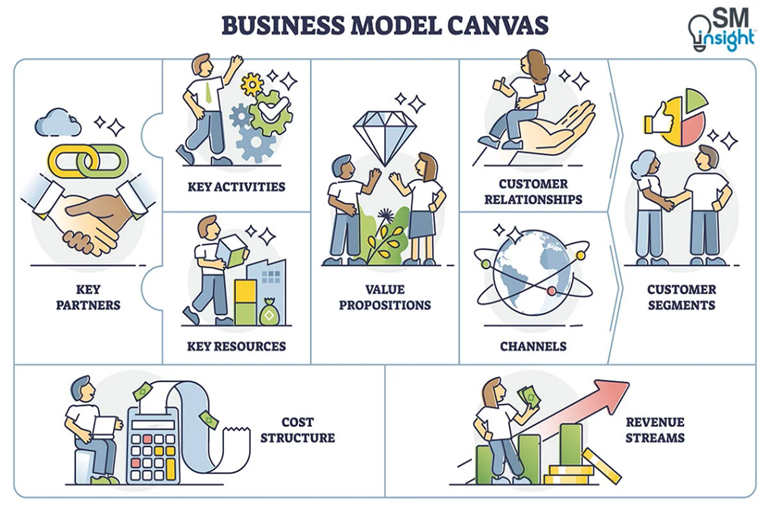
The commercial-track business model in one place — using the classic Strategyzer Business Model Canvas (Osterwalder, 2010). Nine blocks arranged so the operating side (Key Partners → Key Activities → Key Resources) sits on the left, the customer-facing side (Customer Relationships → Channels → Customer Segments) sits on the right, the Value Proposition bridges them in the middle, and Cost Structure + Revenue Streams sum the choices made above. This video explains the relation between the different blocks
Key Partners 🤝
- FabLab Network & FA cohorts (multipliers + early customers)
- LCSC / Alibaba bulk-component suppliers
- Injection-moulding contract manufacturer
- Yoga studios & physiotherapy clinics (B2B reseller channel)
- Open-hardware listing partners (OHWR / Tindie / Adafruit)
- Translators & localisation reviewers (multi-language app)
Key Activities ⚙️
- PCB design (KiCad) → SMD assembly
- Parametric clip housing → injection mould tooling
- Multi-language app development
- Firmware: BLE-gateway / ESP-NOW-relay logic
- QC: pre-ship calibration, drop & shake tests (W15)
- D2C fulfilment + post-sale support
- Open-track documentation upkeep
Key Resources 🧰
- The W01 → W17 documentation (curriculum)
- Domain knowledge — yoga + body mechanics + Upright-device experience
- Open-track IP (CC BY-SA + MIT + CERN-OHL-P) as marketing & proof-of-concept
- Reserved commercial IP (next-gen PCB, mould, brand, app)
- FabLab community relationships
Value Proposition 🎁
- Real-time dual-shoulder symmetry feedback — not just spine alignment
- Plug-and-play out of the box (no assembly required)
- Multi-language app (English + Arabic minimum)
- Wireless-charging carry case (next spiral)
- Built on documented open foundations — transparent, not a black box
- Brand promise: "posture correction that respects you — gentle, configurable, transparent"
Customer Relationships 💚
- Direct B2C with hands-on support (small batches, founder-led)
- B2B onboarding for yoga studios / physio clinics
- FabLab community channels (Discord / forums)
- In-app calibration walkthrough as the first relationship touchpoint
- Privacy promise: posture data stays on-device unless the user opts in
Channels 🚚
- Direct: project website + small e-commerce
- FabLab / makerspace recommendations (word of mouth)
- Yoga & physio reseller network (B2B)
- Open-kit listings on Tindie / Adafruit (open track)
- Conference + workshop demos (FA Network, maker faires)
Customer Segments 👥
- Long-hours office workers
- On-site building / construction workers
- Drivers (taxi, ride-hail, long-haul)
- Yoga & mindfulness practitioners
- Physiotherapy clients (gait / posture rehab)
- Students & makers (open kit)
Job-to-be-done: "help me notice and correct my own slumped posture, gently and configurably, without disrupting whatever I'm actually doing."
Cost Structure 🧾
- Per-unit BOM at bulk: ≈ $30–40 / kit (variable)
- Injection-mould tooling (one-time): high fixed cost — amortised over volume
- Native app development (one-time + per-language fixed cost)
- Inventory + shipping (variable; small batches early)
- Customer support (variable with units sold)
- Open-track docs & community (sunk cost — already done as the Fab Academy thesis)
- Cost shape: mostly fixed at launch, increasingly variable as we scale
Revenue Streams 💰
- Direct-to-consumer kit sales at $100 USD (target margin ≈ 60 %)
- B2B instructor / studio kits — volume discount (3 / 5 / 10 packs)
- Workshop & instructor-training packages (recurring)
- Open kit at cost + small margin (coexists with the commercial product)
- Future: premium analytics subscription (recurring SaaS)
- Revenue mix at year 1: heavy D2C; year 3+: shifts toward B2B + recurring
07: Presentation deliverables
The week's deliverables are a slide and a short video.
- Summary slide — single image: hero shot of the two clips + app on a phone, project name, one-line problem, one-line solution, the two-track model (Open: CC BY-SA / MIT / CERN-OHL-P • Commercial: All Rights Reserved at $100), and contact.
- Video — ≤ 1 minute. Calibration → wear → slouch → vibration alert → reset, with the app screen mirrored in a corner. Compressed with the FFmpeg workflow from Week 02.
- Pitch script — 30-second elevator-pitch version of the project for the live presentation, in plain English. WIP