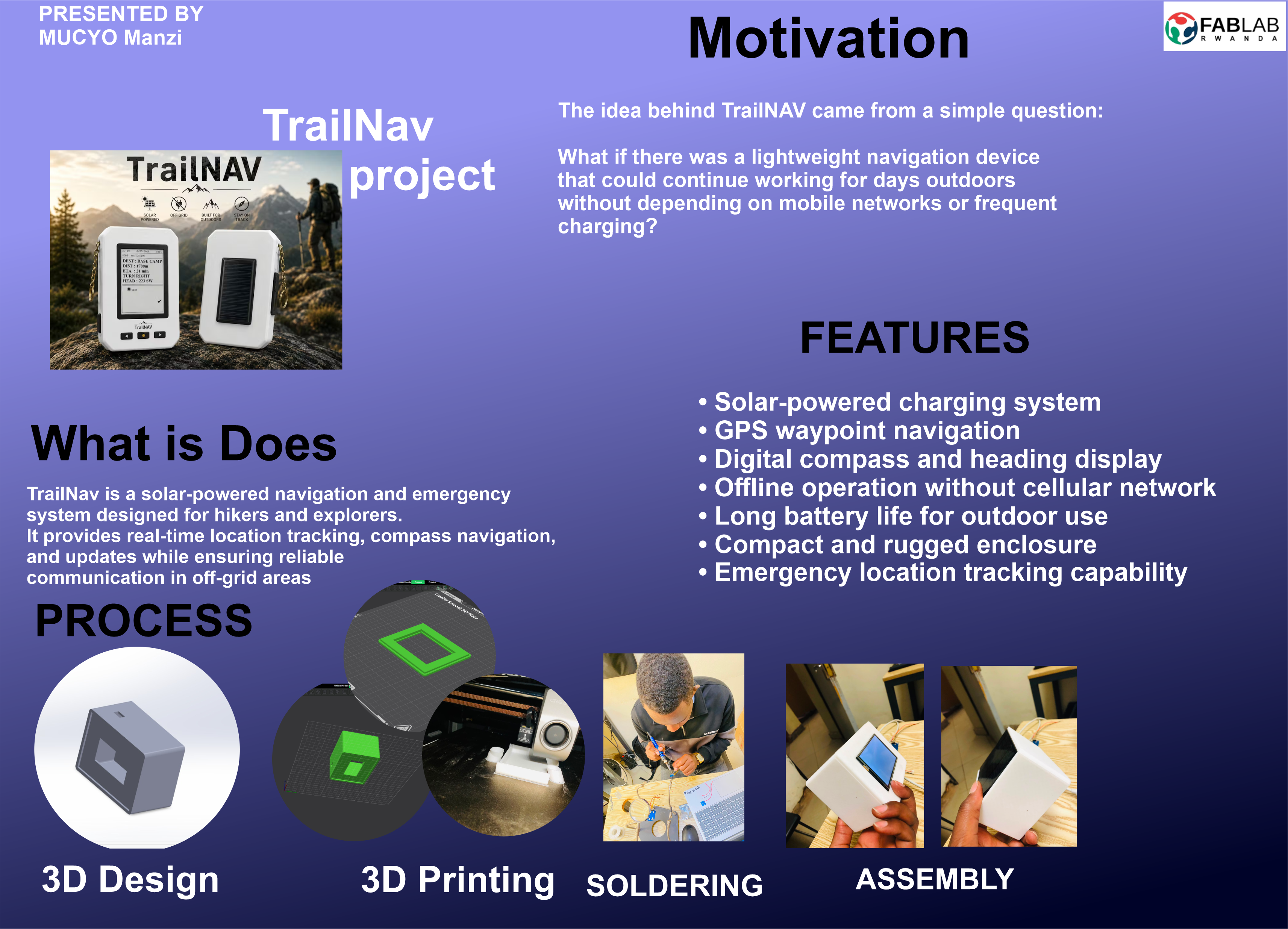
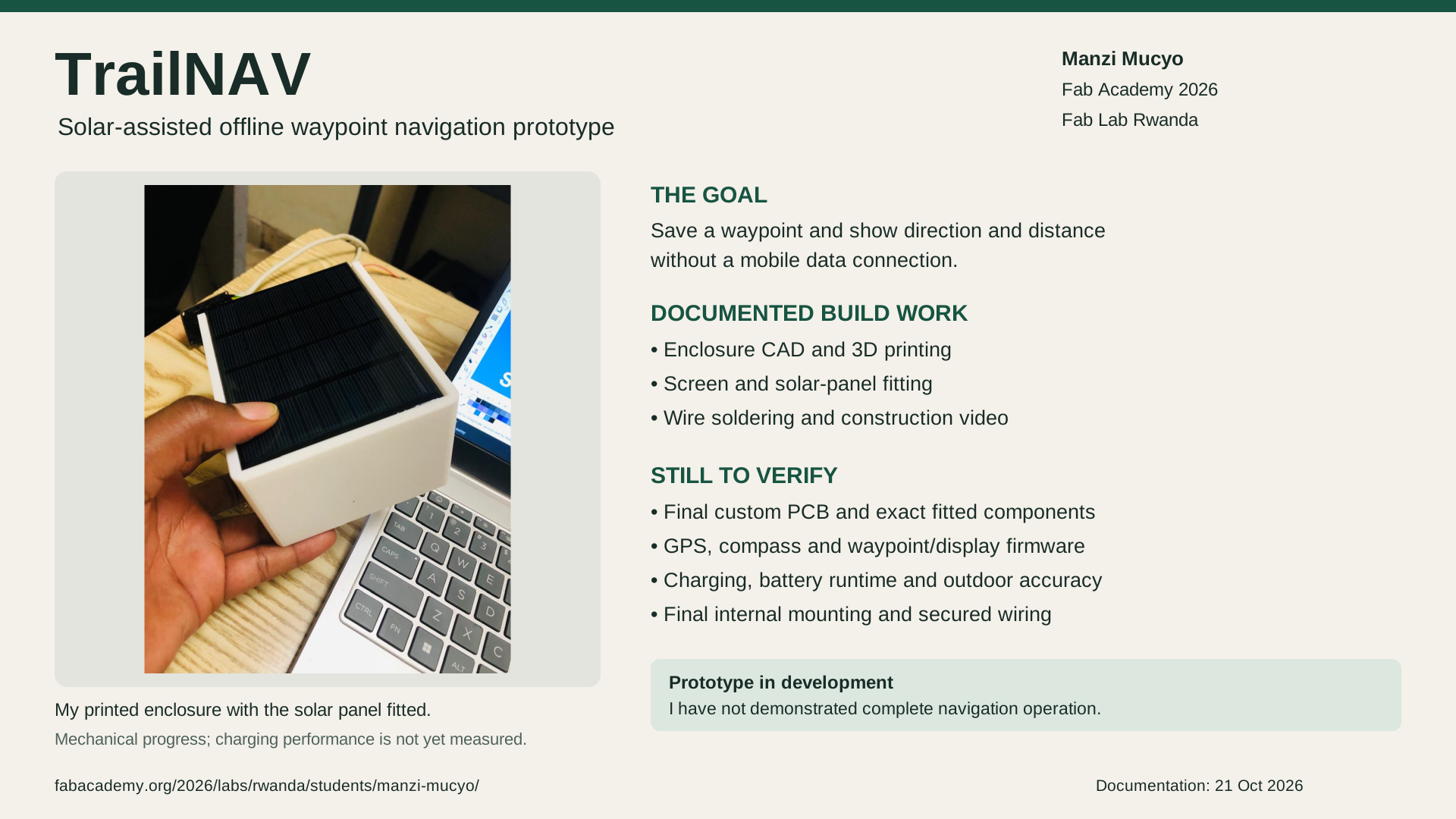
I want to build a solar-assisted navigation device for hikers that can acquire a location, save waypoints and show direction without a mobile data connection. The enclosure has been designed and printed, and screen/solar-panel fitting is photographed. The complete navigation, power and custom-electronics work is not yet demonstrated in this archive.
My earlier notes mentioned dedicated GPS devices and offline map applications, but did not cite the specific designs or sources used. I still need those references and a comparison of their functions with my smaller waypoint-navigation goal. I will distinguish sourced ideas, example code and my own changes.
This is my provisional planning BOM, copied from the recorded prices rather than new supplier quotes. It is not yet the verified as-built parts list. The differences between unit and line prices need an explanation; I have not assumed they are taxes.
| Planned item | Qty | Recorded unit price (RWF) | Recorded line price (RWF) | Verification needed |
|---|---|---|---|---|
| Planned XIAO ESP32-C6 | 1 | 20,000 | 23,600 | The earlier supplier link named ESP32-C3. Actual final controller and cost need verification; the presentation shows an ESP32 development module. |
| Planned u-blox NEO-M8N GPS | 1 | 19,682 | 19,682 | The earlier supplier link named NEO-6M. Module label and receipt still needed. |
| Planned QMC5883 compass | 1 | 4,500 | 5,310 | Earlier reference: Faranux GY-271/QMC5883L module; purchase and fitted part not verified. |
| Planned 2.7-inch E-Ink display | 1 | 27,080 | 27,080 | The earlier link named a 3.5-inch TFT, and my screen-test source targets a TFT. I must identify the screen actually fitted. |
| Planned 3.7 V battery | 1 | 9,000 | 10,620 | The earlier reference was a 500 mAh LiPo. Actual capacity and receipt need confirmation. This does not include an MPPT controller. |
| Planned 12 V solar panel | 1 | 8,900 | 10,502 | The earlier 12 V/100 mA description and 1.5 W link differ. I need the panel label and measured output. |
| Charger/regulator, PCB, connectors and enclosure material | To confirm | Not recorded | Not recorded | These items still need their own BOM entries and costs. |
The six recorded line prices sum to 96,794 RWF. That subtotal excludes the unpriced items and is not a final project cost. I need receipts and exact component identities before treating it as a verified budget.
I need to establish whether the selected parts can provide reliable waypoint guidance and whether solar input usefully supports the measured load. The following checks define the evidence I plan to collect; I have not filled the result column with expected values.
| Function | Planned check | Current result |
|---|---|---|
| GPS location | Record a satellite fix outdoors with time, coordinates, fix quality and comparison against a known reference. | No result or error measurement archived. |
| Waypoints | Save a waypoint, restart the device, retrieve it and show the distance/heading changing while moving. | Navigation firmware and demonstration still needed. |
| Compass | Record calibration and compare headings at known directions. | No calibration log archived. |
| Offline operation | Demonstrate the complete workflow without a network connection. | No complete navigation demonstration archived. |
| Power and solar | Identify the charging circuit; log battery voltage/current and charging behavior under recorded conditions. | Charging circuit and measurements need verification. |
| Runtime | Run a timed battery test at a recorded load and display update rate. | No runtime measurement archived. |
| Packaging | Show internal mounts, secured wiring, connectors and closed enclosure operation. | Enclosure fit is photographed; internal integration remains. |
The enclosure CAD screenshots, printing process, screen/solar-panel fit and soldering photographs show physical progress. My earlier claims about GPS accuracy, inter-module communication and solar charging were not supported by logs or a complete navigation program. I am keeping those functions unverified until the corresponding evidence is available.
| Order | Planned work | Evidence needed to move on |
|---|---|---|
| 1 — inventory | Confirm controller, GPS, screen, battery and charging circuit; reconcile the BOM. | Part labels, receipts and power/interface requirements. |
| 2 — electronics | Identify/design and fabricate the final PCB; recover editable sources. | Schematic, PCB, fabrication record and board test. |
| 3 — firmware | Read GPS/compass, implement waypoint storage and drive the actual display. | Uploaded source versions and observed outputs. |
| 4 — integration | Mount the electronics and battery; route and secure the wires. | CAD, internal photos and an assembled-device test. |
| 5 — validation | Run the navigation, charging and runtime tests. | Measured results against the test plan. |
| 6 — presentation | Update the slide/video with actual functionality and review the archive with my instructor. | Final source files, working demonstration and review feedback. |
This is my proposed order of work, not a record of completed sessions. I still need to agree calendar dates and lab access with my instructor; I have not backdated a schedule to the original course weeks.
I have prepared presentation files in 1920 × 1080 format. They describe the prototype and its remaining work; reformatting does not demonstrate that navigation is complete.
Summary slide · Construction video · Editable slide source (SVG)
I still need to verify the links in the final presentation schedule and replace the construction-only coverage with a complete working-device demonstration.