17. Applications & Implications

This week I finished defining my final project and started working on it. I realized it is a complex system, so I will follow a spiral development approach , I will build the minimum viable product first, then adding more as time allows.

Below is the complete plan: what it does, who inspired it, what I will design, materials and costs, fabrication processes, open questions, and how it will be evaluated.

Task:

Plan a final project masterpiece that integrates the range of units covered throughout Fab Academy.


What Will It Do?

Modular Active Air Quality Monitor (IoT)

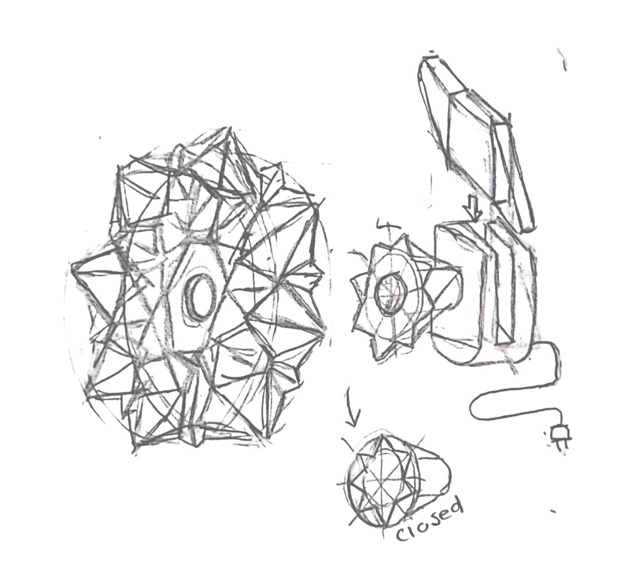
An environmental monitoring system that measures indoor air quality, compares it with outdoor data, and generates both a physical and a visual response. The design is split into two attachable modules connected via pogo pins, which allows the main sensor to be portable without interrupting the system's operation.

TOP MODULE — SENSOR & TRANSMISSION

The portable "brain" of the project. Runs independently on a LiPo battery.

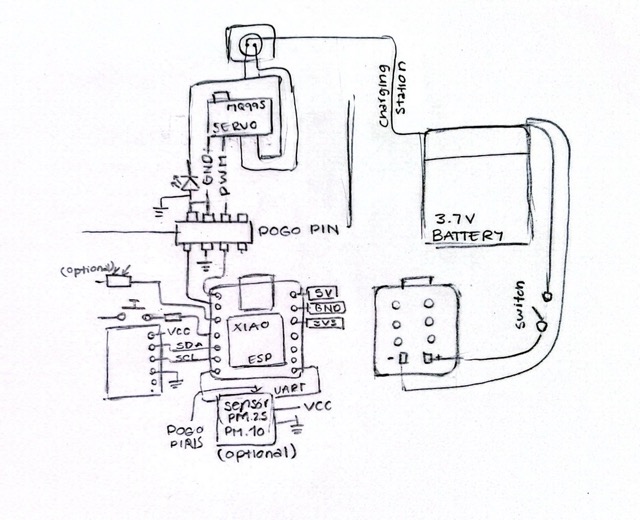
  • Uses a XIAO ESP32-C6 to read temperature and humidity from an AHT21 sensor.
  • Feeds data into an ENS160 sensor for precise, compensated gas readings.
  • Constantly transmits environmental measurements via Wi-Fi using the MQTT protocol.
BASE MODULE — ACTUATION & CHARGING

A wall-powered station that charges the top module and powers the high-current components.

  • Controls a servo motor attached to a kinetic origami structure that physically expands when air is good and contracts as a warning when quality worsens.
  • Features an RGB LED and a NeoPixel lamp that react to the air quality status.

Who Has Done What Beforehand?

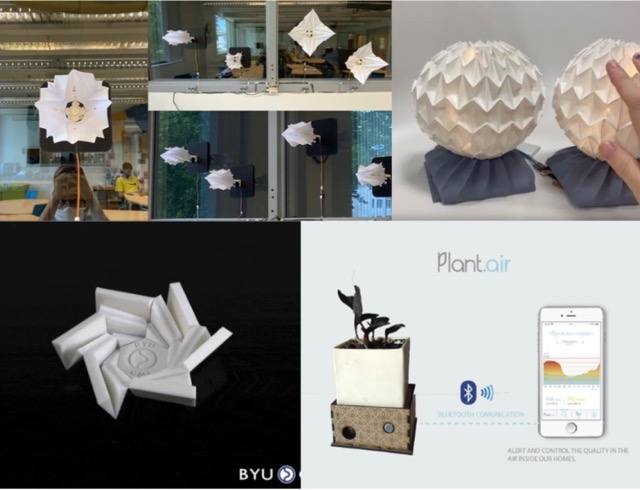
My project merges concepts from kinetic art, modular electronics, and environmental monitoring. I drew inspiration from these projects:

REFERENCE PROJECTS

  • Origami Interactive Kinetic Art— vietbui20 (Instructables) Explores how origami structures can be actuated using parallel processing to create moving art.
  • Folding Origami Flasher Hexagon — BYU CMR (Printables) A mechanical reference for utilizing living hinges and folding mechanisms in 3D-printable or cut materials.
  • Orilum: Touch Sensitive Light Talker — Leticia (MIT CBA) An excellent reference for integrating soft materials, light, and capacitive sensing into a physical computing project.
  • Planter with CO₂ Sensor— Fab Lab FCT (2017) A Fab Academy past project that successfully integrated a CO₂ sensor into a functional household object to measure indoor environments.

What Will I Design?

I will design a two-part modular system across three layers:

3D / 2D ENCLOSURES & MECHANISMS

I will design the structural housing for both the base and the portable sensor module, ensuring they mate perfectly using pogo pins. I will also design the kinetic origami pattern that the servo will actuate.

ELECTRONICS

I will design and manufacture two custom PCBs. The first PCB will house the XIAO ESP32-C6, the LiPo battery circuit, and the I2C sensors (ENS160 + AHT21). The second PCB will be located in the base to handle power distribution, servo motor connections, and LED/NeoPixel indicators — including pull-down safety resistors.

WEB INTERFACE

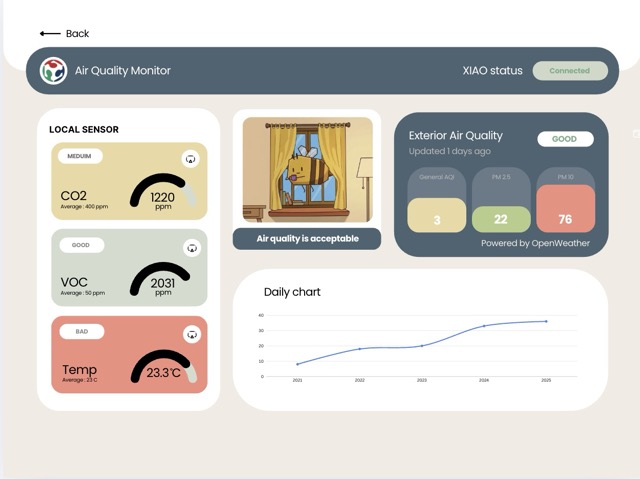
I will design a web interface hosted on Git using HTML, CSS, and JavaScript. This dashboard will use MQTT over WebSockets to graph real-time sensor data, and use fetch() to pull outdoor air quality data from a government API for comparison.


Materials, Components & Costs

Prices are estimates and will be updated as purchases are made.

Category Item Details Qty Unit Price (USD) Source
Microcontroller XIAO ESP32-C6 Seeed Studio 1 $7.18 Unit Electronics
Air Quality Sensor ENS160 + AHT21 Module CO₂ + Temp/Hum 1 $11.49 Unit Electronics
Motor Servo MG995 1 $5.74 Fab Lab Inventory
Connectors Pogo Pins (Spring-loaded) 4 $16.03 Amazon MX
Power LiPo Battery 3.7 V 2000 mAh 1 $13.73 Amazon MX
Lighting NeoPixel Ring / RGB LEDs WS2812 1 $8.10 Amazon MX
Material PLA Filament 1 $20.00 InovaMarket
Switch Rocker Switch (SPST) 1-pole, 2-position 1 $1.15 Steren
Button Push Button (round metal) NO / NC 1 $5.69 Steren
Components SMD Resistors, Pin Headers, Copper Board Assorted 1 $5.00 Fab Lab Inventory

Estimated Total: $94.11 USD


What Parts & Systems Will Be Made?

STRUCTURAL SYSTEM

  • 3D-printed modular enclosures (top module)
  • 3D-printed kinetic origami mechanism
  • Wood-routed base

ELECTRONIC SYSTEM

  • Manufacturing, milling, and soldering of the main sensor PCB
  • Power and actuation base PCB

SOFTWARE & LOGIC SYSTEM

  • C++ firmware for the XIAO ESP32-C6
  • I2C sensor reading, threshold logic (eCO2 & TVOC)
  • PWM servo control + MQTT data transmission

WEB SYSTEM

  • Front-end interface to visualize local WebSocket data alongside external API data

What Processes Will Be Used?

To demonstrate individual mastery of Fab Academy skills, this project integrates:

FAB ACADEMY SKILLS INTEGRATED

  • 01 2D & 3D Design: CAD modeling for the modular enclosures and vector design for the origami fold patterns.
  • 02 Additive & Subtractive Fabrication: 3D printing the housings and the origami material, and cutting the outer base with the router.
  • 03 Electronics Design & Production: Milling the custom PCBs on a precision router and soldering the SMD components.
  • 04 Embedded Microcontroller Interfacing: Programming the XIAO ESP32-C6 to handle I2C communication, PWM actuation, and MQTT Wi-Fi transmission.
  • 05 System Integration & Packaging: Combining the mechanical origami structure, the modular electronics via pogo pins, and the software logic into a cohesive, independently operable product.

What Questions Need to Be Answered?

Pogo Pin Reliability

Will the pogo pin connection be stable enough to reliably charge the LiPo battery and maintain signal integrity when the module is docked?

Material Durability

Can the origami structure withstand repeated physical expansion and contraction over time without the material wearing out or tearing?

Safety Response Speed

Will the pull-down resistor safety mechanism respond fast enough to prevent the servo and lights from acting erratically the exact moment the top module is detached?


How Will It Be Evaluated?

The project will be evaluated using a spiral development approach, establishing a Minimum Viable Product (MVP) to ensure core Fab Academy requirements are met first, with more complex integrations as secondary goals.

MVP — CORE SUCCESS

  • Sensing & Logic: The XIAO ESP32-C6 successfully reads eCO2 and TVOC data from the sensors and applies the programmed threshold logic.
  • Basic Feedback: The base module provides clear visual feedback (e.g., LED or NeoPixel turning red) when air quality drops below acceptable limits.
  • System Integration: The 3D-printed enclosures successfully house the custom PCBs. If pogo-pin modularity proves unstable, a fixed wired connection will be considered a successful fallback.
  • Basic Interface: A web interface successfully displays local sensor data received via Wi-Fi/MQTT.

SECONDARY GOALS — SPIRAL 2 (IDEAL OPERATION)

  • Kinetic Actuation: The servo motor successfully actuates the origami structure: contracting and expanding based on air quality data without the paper tearing or the motor stalling.
  • True Portability: The top module successfully and safely runs on the LiPo battery when detached, and the pogo pins reliably recharge it when docked.
  • Data Contextualization: The web dashboard successfully fetches outdoor air quality data from the external government API to compare alongside the local MQTT data.