Week 17: Applications and Implications, Project Development
Introduction
This week is dedicated to discussing and resolving questions related to our final projects, with the goal of gaining a clearer understanding of the development process and the steps required to successfully complete our projects. It provides an opportunity to review progress, identify potential challenges, and receive feedback that can help guide future work and improve the overall project outcome.
Questions
What will it do?
1. The project consists of a device that measures reaction time using capacitive sensors, Neopixels, and an interface that communicates via MQTT with the central ESP32. The ESP32 reads the values it receives from each step response sensor and sends them to an MQTT broker, which communicates directly with the interface. The interface allows users to choose from 10 combinations and create their own routines, as well as save and view the reaction time of each performed routine to monitor performance.
Who has done that beforehand?
2. For my project, I drew inspiration from FAB23 participant Petra Rutanen, who developed a reaction-time training system. In particular, I adapted the idea of using Neopixel LEDs to provide clear visual cues and immediate feedback to the user. I also reviewed commercial reaction-training products such as BlazePod and StrikeTec, which use illuminated targets to improve reaction speed, coordination, and athletic performance. I also took a look at Boxmaster's products to get inspiration for the shape of my pads. These references helped shape the design and functionality of my boxing training device while adapting the concept to my own requirements and fabrication methods.
What sources will you use?
‣ ESP32 WROOM 32 by Esspresif.
‣ AMS1117 by Digikey.
‣ Step Response tx/rx by Robert Hart.
‣ Week 8 by Emilio Cruz - Fab Academy 2024.
‣ Adrian Torres Step Response documentation. Adrianino.
‣ NeoPixel documentation by Adafruit
‣ Fab Academy 2026 classes.
What will you design?
‣ Main PCB integrating the ESP32-WROOM-32, power supply circuitry, Neopixel output connections, and sensor interface outputs.
‣ ESP32 and Neopixel 3D printed Cases.
‣ Step response sensors and board.
‣ Crimp the wires.
‣ The impact pads and their enclosure.
‣ The central structure responsible for integrating and organizing all project subsystems.
⦿What materials and components will be used?
⦿Where will they come from?
⦿How much will they cost?
PCB
| Material | Description | Quantity | Unit price | Source |
|---|---|---|---|---|
| ESP32 WROOM-32 SMD Dual Core 32Bits 4 MB | It is a 32-bit dual-core microcontroller with Wi-Fi and Bluetooth capabilities; it is an SMD surface-mount device with 32 pins. | 1 | $6.46 | UNIT ELECTRONICS |
| AMS1117 3.3v regulator | It is a low-dropout linear voltage regulator. | 1 | - | IBERO |
| 1 USB Typpe A | It serves as a standard “host” connection to transfer data and power. | 1 | $0.69. | - |
| 10μF smd Capacitors | It is an electronic component that temporarily stores electrical energy in an electric field. | 3 | - | IBERO |
| 100nF smd Capacitors | It is an electronic component that temporarily stores electrical energy in an electric field. | 4 | $1.21 | - |
| 10k Ω resistor | It a passive electrical component that restricts or limits the flow of electrical current in a circuit. | 1 | - | IBERO |
| 2k Ω resistor | It a passive electrical component that restricts or limits the flow of electrical current in a circuit. | 1 | - | IBERO |
| 4.7k Ω resistor | It a passive electrical component that restricts or limits the flow of electrical current in a circuit. | 3 | - | IBERO |
| 0 Ω resistor | It is essentially a wire link packaged to look like a standard resistor. | 1 | - | - |
| 1M Ω resistor | It a passive electrical component that restricts or limits the flow of electrical current in a circuit. | 6 | - | IBERO |
| Blue LED | LED stands for Light-Emitting Diode. It is a highly efficient electronic component made of semiconductor materials that converts electricity directly into light. | 1 | - | IBERO |
| Pinheaders | A pin header is a common electrical connector consisting of one or more rows of metal pins mounted on a plastic base. They are primarily used as bridges on printed circuit boards (PCBs) to route power, data, and signals, or to connect components to external wiring and other boards. | 39 | - | - |
| Ft232rl 3.3v 5v | It is a highly popular USB-to-UART bridge integrated circuit (IC) manufactured by FTDI (Future Technology Devices International). | 1 | $4.55 | Mercado Libre |
| Soku Charger Usb 5v 3a 15w | It is a usb charger. | 1 | $10.21 | Mercado Libre |
| Usb to Usb cable 1.7 meters | It is a usb to usb cable. | 1 | $4.55 | Mercado Libre |
Cases
| Material | Description | Quantity | Unit price | Source |
|---|---|---|---|---|
| PLA | A biodegradable thermoplastic derived from renewable resources like corn starch. It's the standard for desktop printing due to its minimal thermal expansion. | 1 | $20 | Inova Market. |
Integration
| Material | Description | Quantity | Unit price | Source |
|---|---|---|---|---|
| 3mm-thick MDF board | MDF (Medium-Density Fiberboard) is an engineered wood product made by breaking down hardwood and softwood residuals into fine fibers, combining them with wax and resin, and pressing them into flat, dense sheets under high heat and pressure. | 2 | $9.51 | HOME DEPOT |
| Canvas fabric snippet | is a highly durable, heavy-duty plain-weave fabric traditionally made from cotton or linen. | 2 | $2.88 | - |
| Foam | These are foams of different densities used for the pads. | 3 | $11.82 | - |
What parts and systems will be made?
‣ Main PCB integrating the ESP32-WROOM-32, power supply circuitry, Neopixel output connections, and sensor interface outputs.
‣ Main PCB programming via UART.
‣ Code for sensor data acquisition and MQTT-based communication.
‣ User interface for selecting training combinations and visualizing performance results.
‣ Step response sensors and board.
What process will be used?
‣ Electronic Design using KiCad.
‣ Electronic Production using the Roland SRM-20.
‣ 3D modeling using a CAD software.
‣ 3D printing for enclosure fabrication.
‣ Embedded programming using Arduino IDE and Visual Studio Code.
‣ Laser cutting.
‣ Embroidery using Inkscape and the Brother NS1850L.
What questions need to be answered?
‣ The sensors will last for many rounds without breaking?
‣ Will it stay securely attached to the wall?
‣ Won't the pads lose their volume over time?
‣ Will everything stay in place when we hit it?
How will it be evaluated?
‣ The sensors must detect impacts correctly.
‣ The device must accurately transmit data via MQTT.
‣ The interface must receive data correctly and send combo sequences correctly. It must be able to save the history correctly and display the graph without errors.
‣ The pads and structure must be able to withstand impacts.
Slice and video
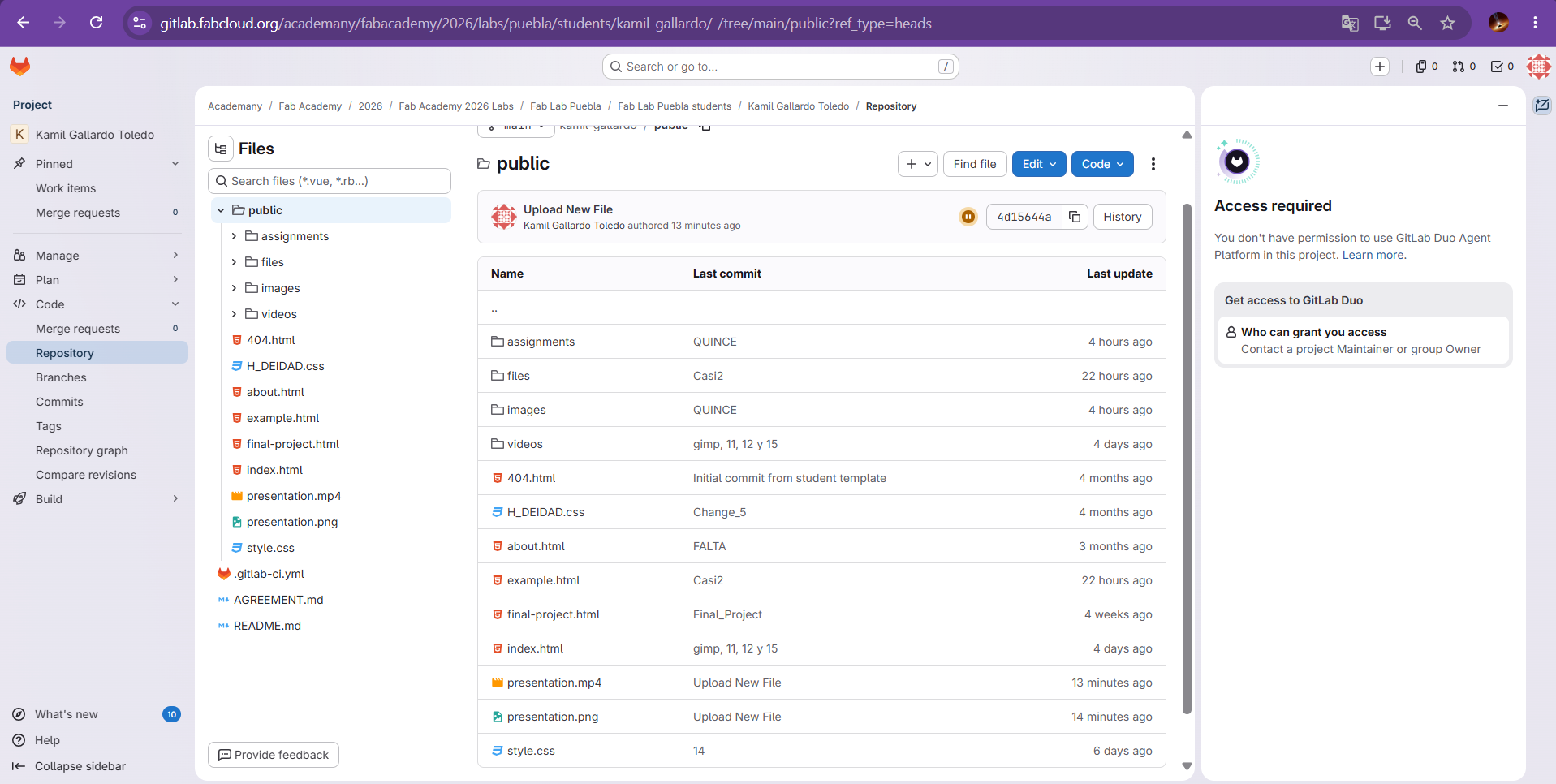
For this part, we just have to upload the slice (presentation.png, 1920X1080) and the video (presentation.mp4, 1080, around 1 minute, < 25 MB).
Learning outcomes
This week's learning is broken down into the questions; however, this week I clarified all the processes involved in my project, from the materials to how each part of it works. I am interested in resolving the questions I have about my own project so that I can deliver a better result.