Week 18. Invention, Intellectual Property and Income
1. Dissemination Plan
For the SpiderBot, the main goal is to share it as an open-source project focused on education and mobile platform robotics.
Creative Commons is a website and global organization that allows you to register and protect any project you create (whether it's a mechanical design, software, 3D model, or music), enabling you to grant copyright licenses easily and for free.
It primarily serves to tell the world exactly what permissions you want to grant for your work without needing to hire a lawyer. Instead of prohibiting everything with the classic "All rights reserved," it allows you to use a "Some rights reserved" approach. With this, you can authorize other people and students in the community to clone, modify, or share your project openly for educational purposes, while legally making it clear that you are the original author and prohibiting companies or third parties from using your files to sell or profit from them without your authorization.
- Chosen License: I have decided to use the Creative Commons Attribution-NonCommercial-ShareAlike 4.0 International (CC BY-NC-SA 4.0) license. This allows other students and makers to replicate, modify, and improve the hexapod's design, provided they give proper credit, do not use it for commercial purposes, and share their versions under the same license.
- Dissemination Channels:
- Code Repository: Publishing all the control firmware (ESP32 code) on GitHub with a clear installation guide.
- 3D Models: Uploading the STL and STEP files of the chassis and legs to platforms like Printables or Thingiverse.
- Fab Academy Documentation: Maintaining this page as the definitive step-by-step guide for electronic assembly and servo calibration.
1.1 How to generate your license?
To generate your license you need to do the following:
Go to the Creative Commons "Choose a License for Your Work" page.
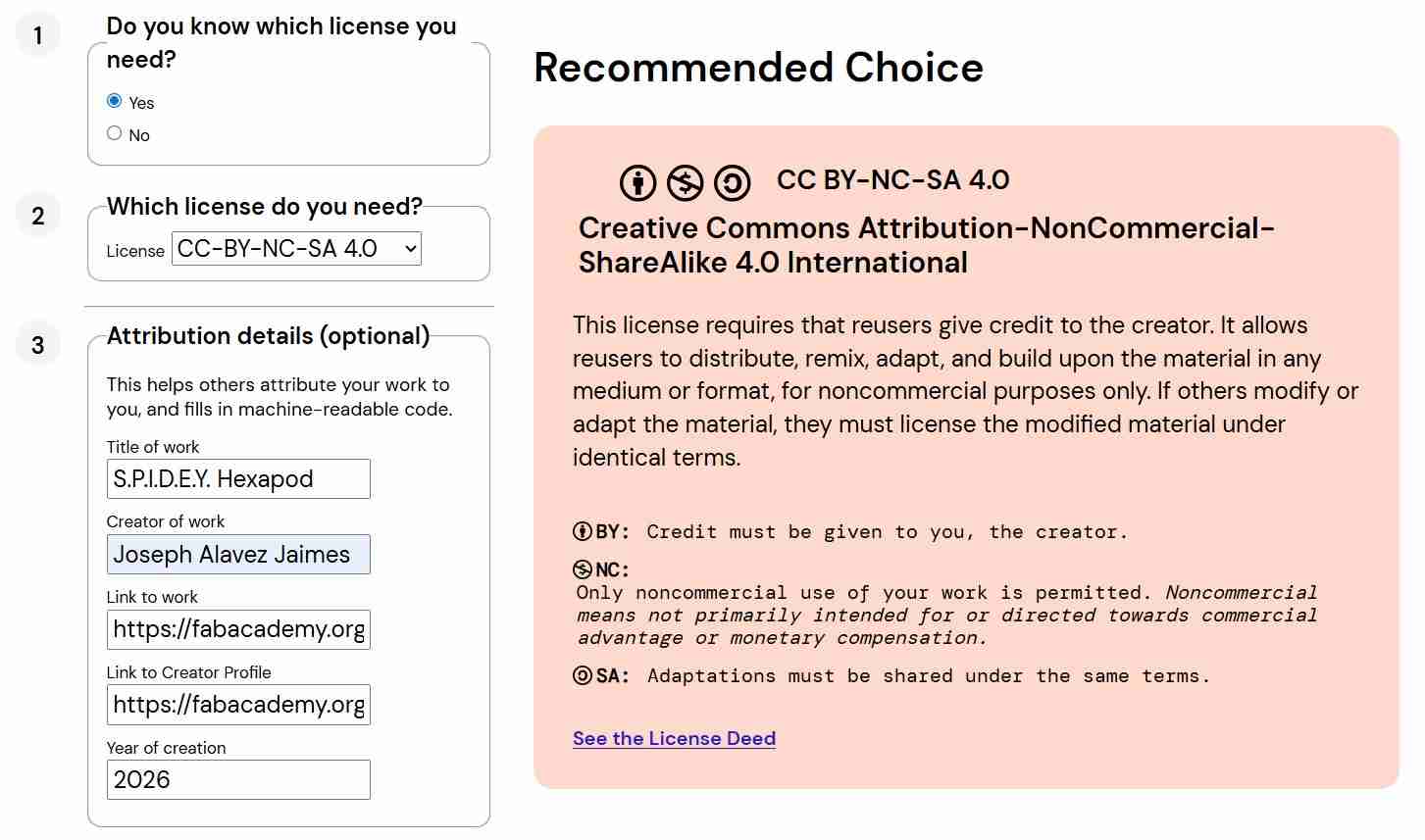
Once there you should fill the information asked in the order that is asked, the only thing that could be different is the point 2 but in my case I will select the CC BY NC SA 4.0 option. When all is filled it should look like this.
Once filled in, scroll down to the Website section, then to HTML, and select full tool name.
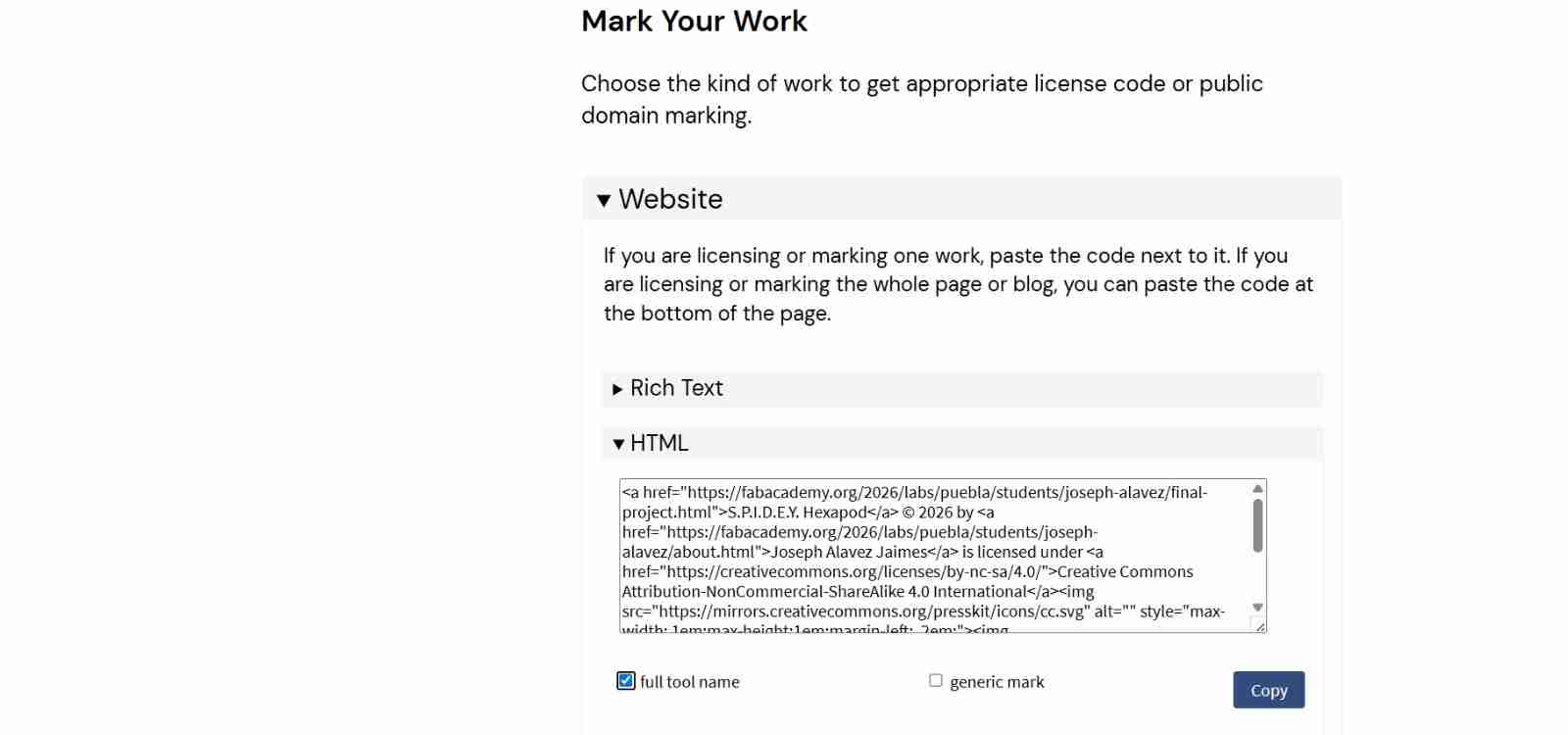
After that you can copy and paste your copyright information. You should paste it at the end of your page, replacing one of the last lines. It should say something like <p>Copyright #### <Your_name> - Creative Commons Attribution Non Commercial <p>, then your page should look like this.

2. Future Possibilities and Probabilities
- Future possibilities: Fully integrating the SpiderBot into a ROS 2 (Robot Operating System) environment for advanced mapping and autonomous navigation tasks, adding depth sensors or a distance sensor array like the VL53LXX-V2.
- Making them probabilities: During the current hardware design, I planned ahead by using a dual ESP32 control architecture. This means one chip can be dedicated exclusively to gait generation and inverse kinematics, while the second ESP32 is completely free to handle serial or I2C communication with a central computer (like a Raspberry Pi) in charge of processing ROS 2 navigation data.
3. What tasks have been completed, and what tasks remain?
| Completed Tasks | Remaining Tasks |
|---|---|
| Mechanical design and 3D printing of the chassis and all 6 legs. | Fine calibration and offset adjustment of the 18 MG90s servos. |
| Design and routing of the custom PCB for dual control and power distribution. | Redisgn the body to implement the aesthetic part. |
| Power system architecture using Buck converters for voltage regulation. | Final wire management and routing inside the central chassis. |
| Successful basic I2C communication tests. | Continuous walking tests on real friction surfaces. |
4. What's working? What's not?
- What's working: The power distribution system is responding excellently. The custom PCB stably regulates the voltage from the 2200 mAh and 35C LiPo battery through the Buck converters without overheating at rest. Communication between microcontrollers and the I2C servo drivers responds correctly to basic position commands.
- What's NOT working: The main challenge currently is the voltage drop when several of the 18 MG90s servos try to move simultaneously under mechanical load. Also, the internal space of the chassis is quite compact, making it difficult to cleanly route the leg wires without generating resistance to the base servos movement.
5. What questions need to be resolved?
- Will the MG90s servo gears withstand the continuous torque of the robot when lifting three legs simultaneously in a tripod gait, or will they experience excessive wear?
- Is it necessary to add extra decoupling capacitors to the power lines of the furthest servos to mitigate electrical noise generated by current spikes?
- Will Pin 10 or the pins assigned for interrupt control present any firmware conflict when activating parallel tasks on both cores of the ESP32?
6. Planned schedule (What will happen when?)
To ensure the project is delivered on time, I divided the remaining days as follows (from June 1st to june 7th):
- Day 1 - 2 (Assembly & Hardware): Finish internal wire management, secure the LiPo battery in its bay, and mechanically close the main chassis.
- Day 3 (Calibration): Program the alignment routine to set the 18 servos exactly at 90 degrees (neutral position) and save those offsets in the ESP32's non-volatile memory (EEPROM/Flash).
- Day 4 - 5 (Gait Software): Deploy the inverse kinematics algorithm and test the walking sequences (tripod gait and ripple gait) by controlling the phase transitions of the legs.
- Day 6 (Closing & Multimedia): Record the final demonstration video, capture photos of the SpiderBot in action, and polish the final documentation on the website.
- Day 7 (Documentation): Complete and add all the remaining information for the final project.
7. What have you learned?
This final project has been a masterclass in mechatronic systems integration. I have learned to:
- Design PCBs capable of withstanding high current demands (calculating track thickness to avoid failures due to amperage spikes from multiple simultaneous motors).
- Implement distributed and multi-core control systems on microcontrollers to separate low-level tasks (PWM signal generation for servos) from high-level logic.
- Solve packaging and mechanical tolerance problems, understanding that everything fits perfectly on paper, but in reality, the play of 3D printed materials and the space required for wiring demand a highly iterative design.