Project Type
Open-source wearable for biometric monitoring and anxiety awareness.
Fab Academy 2026
Evaluating the dissemination strategy, future development opportunities and commercialization possibilities of my final project.
Open-source wearable for biometric monitoring and anxiety awareness.
Seeed XIAO ESP32-C6, MAX30102, Led and vibration motor.
Provide real-time alerts when heart rate variations associated with anxiety are detected.
The dissemination strategy for this project will primarily follow an open-source hardware approach. The objective is to share the PCB design files, source code, 3D models and documentation so that anybody can learn from the project, replicate it and improve it.
The project documentation will be available through my Fab Academy website, allowing others to understand the complete development process.
In addition, I am interested in exploring a commercial alternative in the future by offering fully assembled wearable devices for users who want a ready-to-use solution without requiring fabrication or programming knowledge.
By combining open-source documentation with a possible commercial version, the project can contribute to the maker community while exploring real-world applications in different contexts.
This project could evolve beyond a simple heart rate monitoring wearable. Future versions could integrate additional biometric sensors such as skin temperature, galvanic skin response (GSR) or motion sensors to improve the accuracy of anxiety detection.
Another possibility is the development of a mobile application capable of receiving biometric information through Bluetooth Low Energy (BLE), allowing users to visualize stress levels, monitor trends over time and customize alerts.
The system could also incorporate Machine Learning algorithms capable of identifying individual anxiety patterns and generating more accurate notifications.
In the long term, the wearable could become a personal wellness tool focused on stress management and emotional awareness.
Which biometric signals could improve detection accuracy?
How long can the wearable operate using only its rechargeable battery?
How can false alerts be minimized during daily use?
The first step was visiting the Creative Commons License Chooser to determine which license would be the most appropriate for my project.
Creative Commons provides a tool that guides users through a series of questions and recommends a license based on how they want others to use, modify and distribute their work.
The license chooser can be found here:
Creative Commons License ChooserSince I was not completely sure which license would best fit my project, I completed the questionnaire provided by the platform.
After answering the questions, the system generated a recommended license that matched the level of sharing and protection I wanted for my work.
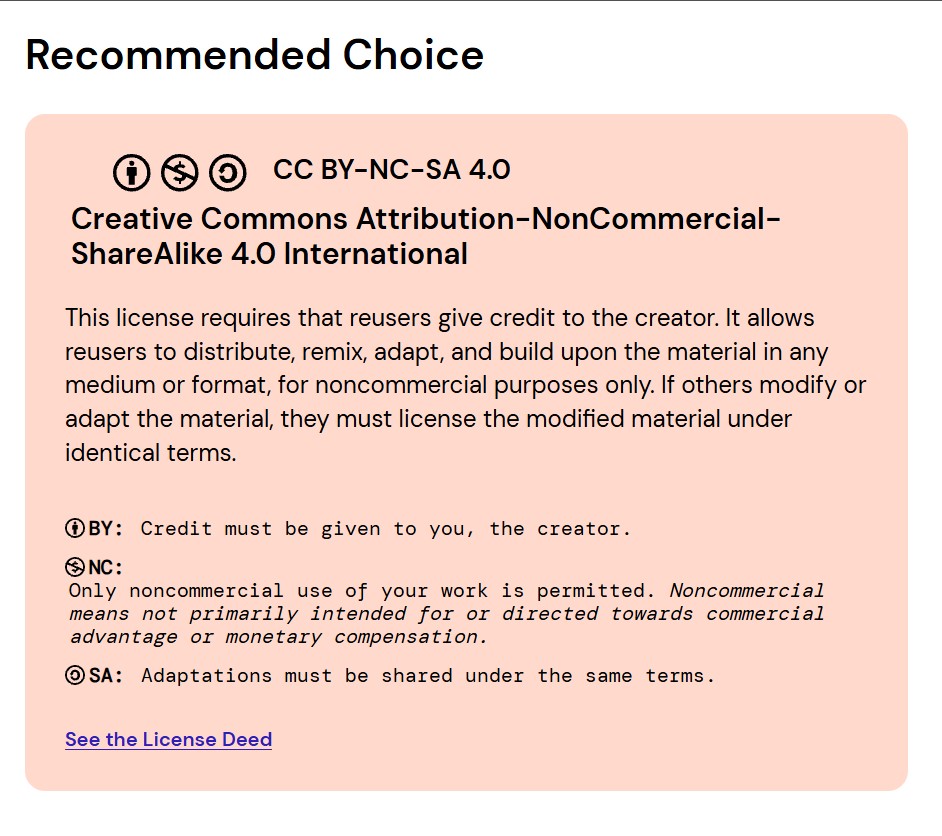
Finally, Creative Commons provides a section called "Mark your work". This section generates the HTML code, plain text and attribution information required to properly display the license on a website.
I copied the generated HTML code and integrated it into my Fab Academy documentation page so that visitors can clearly understand the permissions and restrictions associated with this project.